
Dilemma 




Dilemma is a diachronic Greek lemmatizer spanning Ancient Greek (Classical, Homeric, Hellenistic), Medieval/Byzantine Greek (both vernacular and literary), and Modern Greek (Demotic and Katharevousa).
It is part of the Open Greek project and the NLP companion to the Open Greek Corpus, whose corrected open-licensed texts feed its corpus frequencies and form-attestation data.
A four-layer pipeline, not a single model
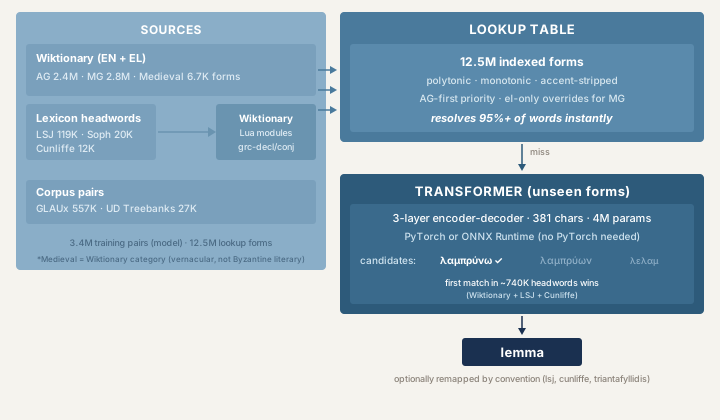
Dilemma stacks complementary techniques and falls back through them in priority order, so the expensive layer only runs on the words the cheap layers can't reach. This is the single most important thing to know about the design.
| # | Layer | Resolves | Speed |
|---|---|---|---|
| 1 | 14.5M-form SQLite lookup | known forms (Wiktionary + LSJ + Sophocles + GLAUx + treebanks) | O(1) hash, microseconds |
| 2 | Rule-based fallback | augment / reduplication stripping, elision, crasis, enclitic particles, compound decomposition | O(1) per rule |
| 3 | Dialect normalization | Ionic, Doric, Aeolic, Koine -> Attic, so the (Attic-heavy) lookup can match | O(k) candidates |
| 4 | Character-level transformer | unseen forms the other three layers miss | beam search, O(b·n²) |
The lookup carries the bulk; layers 2-3 catch systematic things a lookup table can't enumerate exhaustively; layer 4 (a 4M-parameter encoder-decoder trained from scratch on 3.5M supervised pairs) only sees the ~5% the cheap layers can't resolve. That is why Dilemma is both faster than pipelines that route every word through a model and more accurate than ones that lean only on a lookup table.
See Pipeline overview for the full layer list with every sub-rule (particle stripping, BK-tree spell correction, etc.).
Three distinctive choices within the pipeline
A 14.5M-form lookup driven by Wiktionary's own Lua modules. The
biggest contributor to layer 1's coverage is running
Module:grc-decl and
Module:grc-conj
-- the modules Wiktionary editors invoke via templates when writing
inflection tables -- via
wikitextprocessor
over the LSJ headword set (32K nouns + 22K verbs + 14K adjectives) and
the Sophocles Byzantine/Patristic lexicon (13.5K nouns + 4.6K verbs).
The current expansion plus the pinned, known-good historical expansion layer
generate millions of additional Ancient Greek entries, bringing the current
AG input to 10.64M mappings and the combined lookup to 14.47M forms across
all languages. This mechanism closes the
classical and Byzantine vocabulary gap that every other tool has. See
LSJ/Sophocles expansion.
A character-level encoder-decoder for layer 4, not a fine-tuned
subword LM. The SIGMORPHON
architecture (4M params, ~50 MB ONNX) trained from scratch on 3.5M
(form, lemma) pairs from Wiktionary inflection tables (including the
LSJ verb-paradigm Lua expansion) plus the GLAUx morphologically-tagged
corpus. (The other treebanks and the LSJ/Sophocles noun expansion feed
the lookup table, not the model.) Existing Greek
tools either fine-tune giant subword models (stanza, spaCy, ~300M+
params) or use hand-coded rule engines (Morpheus, CLTK) that don't
generalize. Training from scratch takes ~35 min on a 4090; the small
specialized model matches ByT5-small (300M params, 20-hour fine-tune)
because Greek lemmatization is pattern-rich enough that 4M parameters
of Greek-specific capacity beat 300M of general capacity. See
Transformer model.
Convention remapping baked into the API. The same word has
different citation forms in different dictionaries -- LSJ writes εἶπον
as λέγω, Cunliffe writes γίνεται as γίγνομαι, Triantafyllidis
writes σπήλαια as σπήλαιο. Other tools lock you into whatever
convention their training treebank used. Dilemma(convention=...)
remaps the output to LSJ, Cunliffe, Triantafyllidis, or Wiktionary at
runtime from the same model weights:
Dilemma(convention="lsj")               # LSJ headwords
Dilemma(convention="cunliffe")          # Cunliffe Homeric Lexicon
Dilemma(convention="triantafyllidis")   # Triantafyllidis MG dictionary
Dilemma()                               # default: Wiktionary headwords
This is the difference between scoring 65% on a benchmark because of citation mismatch and 95% on the underlying linguistic task. See Conventions.
Worth flagging
- No other lemmatizer covers Ancient, Byzantine, and Modern Greek in one system. Morpheus is classical AG only; stanza is AG or MG but not both. Dilemma resolves Katharevousa, vernacular medieval, and regional MG varieties (Cypriot, Cretan) alongside Homer and Herodotus.
- Dialect normalization is systematic, not a wordlist. No other Greek lemmatizer handles Ionic/Doric/Aeolic/Koine variation this way.
- Elision recovery does consonant de-assimilation.
καθ’becomesκατάby reversing the aspiration rule, with corpus frequency as the tiebreaker between candidates. - Fully supervised, end to end. Every training pair is labelled (Wiktionary tables, Lua expansions, gold treebanks) and the lookup is a dictionary of correct answers -- nothing relies on unsupervised pattern discovery from raw text. Failure modes are predictable and fixes reproducible: edit the Wiktionary entry, rerun the pipeline, the fix flows through.
SQLite + ONNX backends: The lookup loads from a pre-built SQLite database (~0.3s startup) instead of parsing 600 MB of JSON (~11s), falling back to JSON if the DB isn't present. ONNX Runtime (~50 MB) and PyTorch (~2 GB) produce identical inference results -- use whichever you already have. The lookup handles 95%+ of words and needs neither.
For unseen forms, ONNX decoding batches active beams from different words in
groups of at most 128. Each word retains its own beam ranking and stopping
condition. Encoder batches are also capped at 128 words to bound memory on
large input lists. This reduces repeated decoder calls without changing model weights
or search width. tests/test_batched_decoder.py compares the ranked results with
the previous serial search, including a real-model check under --run-slow.
An instance also retains up to 65,536 context-independent model guesses so
lemma selection and candidate scoring do not decode the same form again.
Different beam widths use separate cache entries.
Table of Contents
- Quick Start
- Evaluation
- How It Works
- API Reference
- POS tagger and dependency parser
- Greek Coverage
- Development
- Data
- Architecture
- Projects using Dilemma
- Credits
- License
Quick Start
Installation
pip install "dilemma-nlp[onnx] @ git+https://github.com/open-greek/dilemma.git"
python -m dilemma download
The first line installs the package plus ONNX Runtime (~50 MB, for unseen-form
inference). If you already have PyTorch installed, use dilemma-nlp[torch]
instead, or just plain dilemma-nlp to skip the model backend and rely on the
lookup table alone. The second line downloads the lookup tables, ONNX
model files, and tagger weights from HuggingFace into ~/.cache/dilemma/
(~4.3 GB: lemma and model data ~2.8 GB + tagger weights ~1.5 GB; add
--no-tagger for the ~2.8 GB lemma-only download). The two opt-in
form-attestation DBs add ~1.36 GB more.
Dilemma uses $DILEMMA_DATA_DIR if set; otherwise it picks whichever of
~/.cache/dilemma/data/ (the download), <repo-root>/data/ (a clone), or a
bundled copy holds the most recently built or downloaded lookup.db, so a
fresh local rebuild is never shadowed by a stale download cache. Set
DILEMMA_DATA_DIR to force a specific copy.
To work from a git checkout (for development or to rebuild the data):
git clone https://github.com/open-greek/dilemma.git && cd dilemma
pip install -e ".[onnx]"
python -m dilemma download          # or use the build pipeline below
To build the data from scratch instead of downloading:
python build_data.py --download        # downloads Wiktionary dumps, builds lookup tables
python build_lookup_db.py              # builds SQLite DB for instant startup (optional)
python fix_selfmaps.py                 # fixes inflected forms that self-map (optional)
Basic Usage
from dilemma import Dilemma

d = Dilemma()                                  # all periods (default, AG-priority)
d.lemmatize("ἀνθρώπους")                      # "ἄνθρωπος"
d.lemmatize("ἔγραψα")                         # "γράφω"
d.lemmatize_batch(["λέγουσι", "θεούς"])       # ["λέγω", "θεός"]

# Elision expansion (AG elided forms resolved via Wiktionary lookup)
d.lemmatize("ἀλλ̓")                            # "ἀλλά"
d.lemmatize("ἔφατ̓")                           # "φημί"
d.lemmatize("δ̓")                              # "δέ"
d.lemmatize("κατ̓")                            # "κατά"

# Single period
d_mg = Dilemma(lang="el")                     # MG only
d_mg.lemmatize("τραγουδάει")                  # "τραγουδάω"
d_mg.lemmatize("έγραψε")                      # "γράφω"
d_grc = Dilemma(lang="grc")                   # AG only

# Specific model scale
d = Dilemma(scale="test")                     # use test-scale model

# Treebank evaluation mode: resolve articles and personal/interrogative pronouns
d_eval = Dilemma(resolve_articles=True)
d_eval.lemmatize("τῆς")                       # "ὁ" (not "τῆς")
d_eval.lemmatize("μοι")                       # "ἐγώ" (not "μοι")
d_eval.lemmatize("αὐτοῦ")                     # "αὐτός"
d_eval.lemmatize("τι")                        # "τις" (indefinite)
d_eval.lemmatize("τί")                        # "τίς" (interrogative)

# Byzantine text with orthographic normalization
d_byz = Dilemma(normalize=True, period="byzantine")
d_byz.lemmatize("εκκλησια")                   # "ἐκκλησία" (restores accents and breathing)
By default, articles and pronoun clitics self-map (e.g. τῆς returns
τῆς). This is better for alignment pipelines where you want
surface-form matching. Set resolve_articles=True to resolve them
to canonical lemmas (ὁ, ἐγώ, σύ, αὐτός, τις, τίς), matching
treebank conventions (AGDT, DiGreC). This mode uses accent placement to
distinguish indefinite τις from interrogative τίς; a final grave is
normalized to acute. Default lookup can retain independent adverb and
particle readings of forms such as αὐτοῦ and τί.
The opt-in mode also recognizes monotonic projections of polytonic articles,
such as τών from τῶν, without removing accents from unrelated words.
The triantafyllidis convention auto-enables
article resolution (articles to ο, skipping AG pronoun resolution
for forms like σε/με that are MG prepositions).
Conventions
Different dictionaries cite the same Greek word differently. LSJ uses
λέγω for the εἶπον family; Cunliffe uses γίγνομαι rather than
γίνομαι; Triantafyllidis uses είμαι rather than εἰμί. A tool
that outputs εἰμί against a gold standard expecting είμαι looks
wrong, even though both answers are correct for their respective
conventions.
The convention parameter remaps Dilemma's output to whichever
standard you're targeting. The same model can serve an LSJ workflow, a
Cunliffe workflow, and a Triantafyllidis workflow without retraining.
| Convention | Target | Example mappings |
|---|---|---|
None (default) |
Wiktionary headwords | εἶπον→εἶπον, θεούς→θεός, σπήλαια→σπήλαιον |
lsj |
LSJ dictionary | εἶπον→λέγω, αἰνῶς→αἰνός, σπηλαίου→σπήλαιον |
cunliffe |
Cunliffe Homeric Lexicon | γίνεται→γίγνομαι, θέλει→ἐθέλω, νοῦν→νόος |
triantafyllidis |
Triantafyllidis MG dictionary | ὁ→ο, εἰμί→είμαι, σπήλαιον→σπήλαιο, εἷς→ένας |
The mapping is built automatically from data/lemma_equivalences.json
cross-referenced against the convention's headword list, with explicit
overrides in data/convention_{name}.json. The Triantafyllidis inventory uses
only the source dictionary's bare citation headwords and unions them with the
existing Modern Greek Wiktionary inventory for words outside the dictionary;
definitions, examples, pronunciation, grammar, etymology, and source-page
content are neither read nor shipped. Lemma equivalences also
group valid alternative lemmatizations (comparative/positive adjective
forms, active/deponent pairs, spelling variants) so that benchmarks
score them as correct rather than penalizing convention disagreements.
Note: data/lemma_equivalences.json covers Ancient Greek equivalences.
For Modern Greek, the lookup merge in build_data.py prefers EL
(Greek) Wiktionary lemma forms over EN (English) Wiktionary, since
EL uses the modern contracted forms that reflect actual usage
(τρώω, λέω) while EN tends toward fuller morphological stems
(τρώγω, λέγω). For the remaining cases where the two sources
use genuinely different lemmas, downstream consumers like
Lemma use a separate MG
equivalences file generated by cross-referencing
mg_lookup_scored.json against Wiktionary headwords, with corpus
frequency as a tiebreaker for the canonical form.
Cross-source form references preserve cycles in every Greek language dataset.
A noun and verb can each have an inflection spelled like the other's headword:
ἔργον (work) and ἔργω (enclose) retain separate lemmas and paradigms instead
of collapsing according to the order of the source entries.
Ancient training pairs retain each source morphological reading. Their table
owners and same-part-of-speech references resolve to independently defined
heads before the flat lookup: ἀλέομαι (shun) keeps its own table, while the
same spelling in the conjugation of ἀλέω (grind) still belongs to ἀλέω.
An explicit reference belonging only to another part of speech cannot consume
an independently defined head: the noun reading of κρίνω points to κρίνον
(lily), while the verb κρίνω (judge) keeps its own conjugation. References
already applied within one source receive the same check. This also preserves
the verb δύω (plunge) beside the Epic numeral variant of δύο (two).
Dialect, contracted-form and voice-only descriptions alone do not establish a
separate lexical head, including when the source labels the entry as a verb.
Their inflection tables resolve to the supported parent without treating the
variant description as an independent definition. A separate lexical meaning
in the same entry still supports its headword.
Nominal case descriptions also recognize slash-separated cases, gender and
contraction labels. Verb-form descriptions with explicit grammatical qualifiers
likewise remain grammatical evidence, not independent lexical definitions.
Explicit spelling references, sacred abbreviations, and
unexpanded inflection templates do not supply independent definitions. A form
header still permits a genuine lexical meaning, such as a lexicalized plural.
Reference targets can follow a colon or an explicit word label.
The entire description must be a reference or a recognized grammatical note;
an appended definition remains evidence of an independent meaning.
English form senses may nest a translation beneath their grammatical
description. Such translations do not define another head: ἦλθον retains
its aorist readings under ἔρχομαι. Greek present-tense head descriptions
followed by their own lexical meanings remain independent.
Alternative-spelling references from the original word to a supported head
of the same part of speech still canonicalize normally. When a source assigns
the alternative to a different numbered etymology from an independently
defined homograph, only that alternative entry follows the reference. For
example, the binding and needing senses of δέω retain their own tables;
the separate alternative spelling of δήω still points to δήω.
A spelling-reference chain also follows explicit references before a competing
inflection-table mapping, provided it reaches one positively defined head of
the same part of speech. Thus the pitch spelling πίτα follows πίττα to
πίσσα, while the independent pie reading keeps πίτα. Ambiguous or
unsupported chains retain the previous fallback.
Scalar lookup also follows an exact form page's unambiguous, same-part-of-speech
reference chain when an intermediate word belongs to an unrelated lexical
head. Thus παρόντος reaches the verb πάρειμι through its participle παρών,
while the separate noun παρών and its genitive παρῶνος retain their own
reading. Independent source words and their normalized keys are protected;
conflicting references and cycles retain the previous lookup. Name references
count as conflicting evidence without redirecting names, so the name forms
Ἀθηναίην, Ἀθηναίης, and Ἀθηναίῃ retain their Athena reading.
This priority applies to the explicit target recorded in a source reading,
including structured spelling and inflection references;
scalar part-of-speech mappings keep their existing choice between homographs.
An Ancient comparative or superlative description alone does not establish
an independent adjective head, even when it includes a translation after a
colon. A separately supplied lexical meaning still establishes that head.
Synthesized first-aorist active infinitives and present or future neuter
participles retain their accent position while taking a circumflex on a
known long penult before a short final syllable (τμῆξαι, παιδεῦον).
Unmarked vowel length is not guessed, and finite optatives keep their
distinct accent. A diphthong consumes only two vowels; a following vowel
starts another syllable when determining the accent's permitted position.
An inflected reading
does not replace an independently defined homograph: δίω keeps its own
conjugation as well as its separate reading in the conjugation of δείδω.
data/grc_reading_heads.json records the exact source definitions, parts of
speech, and source hashes for surviving Ancient training heads that differ
from their flat lookup target or are absent from the flat map. The training-data
integrity check requires this evidence; an unrelated definition under another part of speech cannot
authorize an exception.
In the Modern Greek dumps a capitalized page (a name, an abbreviation, a
heading in sentence case) reaches its lowercase keys only where no
lowercase page or table claims them: the female name Ερωτώ does not take
ερωτώ from the verb, nor the abbreviation ΔΕΣ take δες from βλέπω.
And a form-of reference of one Wiktionary that would point a lemma back at
a word the other files under it is not followed: EN files ρωτώ as a form
of ρωτάω while EL's ρωτώ table lists ρωτάω, and the cycle made the
chain-breaking delete both conjugations. The same priority applies across
the two dictionaries: a weak lowercase key derived from a name in one
source does not override the other's verb form (λεν, τρων, μιλάνε).
A form page's head line and its verb inflection table resolve through the
word that page names. They do not inherit a noun homograph's lemma:
ερωτήσεις remains a form of ερωτώ on verb rows, and the participle
forms of αντιπαθών belong to αντιπαθώ.
The same POS-specific references are followed through spelling pages, so
ἀντιπαθών also reaches the verb. A row tagged as a verb is omitted when
its target is attested only as another part of speech; this removes
misclassified noun and adjective forms without losing their genuine
nominal rows. Existing noun, adjective and ethnonym paradigms remain.
Only a sense with an explicit form_of reference can supply verb evidence
from its gloss; descriptive mentions of a verb do not redirect passive
heads or create new verb lemmas. When the gloss names that same reference,
it can correct an incorrect head-page POS (δηώ). A broken reference does
not remove a separately attested verb head or proper-name head form.
A participle's top-level reference can resolve its verb only when that
target reaches an independent lexical verb entry in either dictionary,
including through an explicit spelling-reference chain. All explicit verb
targets from both dictionaries are retained separately from inflection-table
claims. A successful sense-level reference chain from the participle's own
entries takes priority over top-level pointers. A finite-form homograph's
references do not replace that parent, and a sense labeled as a synonym is
not a spelling alias. Other alias nodes use their explicit verb references;
table evidence is used only when neither supplies a finite endpoint.
Conflicting successful targets remain unresolved. Participles tagged on an
entry or one of its senses remain intermediate forms, and an explicit-reference
cycle must have one unambiguous exit to a finite verb. A standalone participle
that would otherwise remain a verb lemma also enters this check, even without
a top-level pointer. Its actual references are followed before an unsupported
verb reading is omitted. This check runs after both sources have been read,
so entry order does not affect it. A resolved participle keeps that finite
verb through POS-specific cleanup instead of inheriting a flat homograph's
lemma; independent noun and adjective readings remain. Its own recorded
table also keeps that supported verb when a spelling-alias pointer names
an unresolved participle (καθούμενος to κάθομαι, despite καθήμενος).
Without a supported own-head path, the unresolved alias still blocks the
verb reading.
Nominal labels in top-level references cannot supply verb endpoints through
unrelated inflection tables. An unresolved participle also cannot remove an
independently defined finite verb through a reverse table or lookup alias.
The build also writes data/el_participles.json for explicitly recorded
participles whose finite parent remains unresolved. This is morphology for
dictionary export, separate from the verb training pairs: it preserves the
source headword and its own nominal inflection cells without inventing a
finite verb or relabeling it as an adjective. A headword without a table
retains only its own spelling, with no inferred case or descendants.
The version-1 JSON envelope has language: "el" and a cells array. Each
row records form, lemma, original pos: "verb", kind (headword or
inflection), grammatical tags including participle, the unmodified
source_form and source_lemma, and sorted source editions in sources.
Inflection rows require an explicit case and number and exclude finite
person or mood cells. Different source spellings and cells remain separate;
only identical readings merge their source editions.
An independently defined noun's own table also retains its source lemma
in the training pairs, even when the flat lookup chooses an inflectional
homograph. The masculine noun σκιάς and the feminine genitive σκιάς
of σκιά therefore keep separate paradigms. Form-of and alternative-spelling
entries still follow their explicit references; no ownership marker enters
the output JSON, and flat lookup arbitration is unchanged.
A Modern noun form page with an explicit case and number does not supply a
full table when that table assigns incompatible cells to the page's own
headword. Its exact form reference remains: noun κρατών stays the genitive
plural of κράτος, while the independently defined adjective κρατών owns
κρατούν and κρατούσα. Spelling-variant pages, tables that reproduce the
stated cell, and entries with a separate lexical meaning retain their tables.
data/el_noun_heads.json documents the independent noun heads for which that
flat choice differs, with exact source headwords, noun senses, tags, and
SHA-256 hashes of the source editions. The version-1 envelope has
language: "el", source_sha256, and heads; each head retains all distinct
qualifying source entries in evidence. Integrity checks permit a non-self-mapped
noun lemma only when this companion contains valid independent evidence for
that exact head. Inflection, alternative-spelling, and misspelling entries
cannot authorize an exception. Both the command-line data check and pytest
validate the built pairs against the lookup and this companion.
Independently defined Modern adjectives retain their own source tables through
the same flat homographs. Adjective κρατών therefore owns κρατούν,
κρατούσα, and κρατούσες, while noun κρατών remains the genitive plural
of κράτος. A new typed adjective field preserves the previously published
non-adjective fields and their scalar fallbacks; an adjective correction does
not expose unrelated internal noun or adverb table mappings.
data/el_adjective_heads.json records exact adjective definitions,
declared head types, source forms, and source-edition hashes for non-flat owners.
Certification also requires an explicit adjective head template, forms in at
least two genders, or an explicitly indeclinable header. A raw adjective POS
label alone cannot certify a duplicated noun or adverb entry. Definitions with
insufficient morphology retain their previous processing. Grammatical form
descriptions, spelling references, and empty headers cannot authorize an
exception. The extractor publishes the supported ADJ target in
mg_pos_lookup.json whenever it differs from the scalar fallback, including
forms with only one typed reading. The scalar lookup remains unchanged.
The companion is generated by the normal Modern build, included in the base
data download and CI registry, and required by the built-pair integrity check.
The corresponding finite-verb exceptions are recorded separately in
data/el_verb_heads.json. Generate it after extraction with
python build/build_el_verb_heads.py --kaikki PATH_TO_DUMPS (or pass
--data PATH_TO_OUTPUT). The builder selects only non-self-mapped verb
lemmas from the final pairs, reads the same source editions, and requires
an independently defined finite verb for every selected head. Participle,
form-only, and nominal entries cannot supply that evidence. A header or
no-gloss relation alone also cannot make a terminal finite verb: its explicit
source references must reach a positively defined finite parent. Missing support
fails the build. These companions validate morphology ownership; they do
not change the runtime lookup or its POS table.
Modern reference rows retain their own sense's grammatical and usage tags,
rather than reducing every reference to form-of or alt-of. Distinct source
cells remain separate. Independently defined determiner and pronoun heads also
retain their own POS-specific morphology when the flat homograph is a verb:
πάση keeps its dative tags and determiner owner πας, while the verb πας
still resolves to πηγαίνω. The extraction-generated
data/el_closed_class_heads.json records exact same-POS source definitions and
input hashes for non-flat heads. Built-data integrity checks require this
positive evidence and an exact matching DET or PRON self-target in
mg_pos_lookup.json; form-only, spelling-reference, and no-gloss entries cannot
authorize an exception. The scalar lookup remains unchanged.
Own determiner and pronoun sense references follow same-POS chains to a
positively defined head before competing table claims: εσένα and εσένανε
resolve to εσύ, without treating weak form σε as a lexical head.
Different accented references keep their own roots; a normalized key with
multiple supported roots retains its previous mapping.
lookup.db takes these changes up when build_lookup_db.py next rebuilds
it. A pronoun table that spans
several grammatical persons is the shared personal-pronoun grid, whose forms
are no forms of the page it stands on, and is skipped whatever its
template's name: in the 2026-09 dumps EN's τα page carries it under a
generic template and EL's εγώ and εσείς under a renamed one, which
made εγώ, εσύ, αυτός and μου forms of τα.
A Modern Greek page that only gives another spelling of a word (the Greek
Wiktionary's γιός, "πολυτονική γραφή του γιος", or μιλῶ, whose link to
μιλώ kaikki does not carry; the English Wiktionary's "polytonic spelling
of" pages) is read as that word's alternative form, not as a lemma: as a
lemma it took the word's monotonic and accentless keys, made γιος a form
of γιός in a cycle that deleted its paradigm, and filed the forms of
μιλώ and αγχωτικός under μιλῶ and ἀγχωτικός. Such a page is one
every sense of which names the page's own word without the marks monotonic
writing drops, and for a monosyllable (one run of vowels, γιος, γεια)
without its accent, by an alt_of or form_of reference or by that gloss
(γιος for γιός, μουστακάτος for μουστακᾶτος): 76 pages of the Greek
dump, 50 of them known only by the gloss, and 47 of the English one
(build_data.spelling_target). A page that names a word of other letters
(ἐτρώθη, a form of τιτρώσκω), a form_of reference of a sense tagged
with a case (σοφίᾳ, "dative singular of σοφία"), and a page with a sense
of its own are read as before, and so are the Ancient and Medieval Greek
dumps, where a page whose monotonic spelling is another word's is an
inflected form of it (the dative φωνῇ of φωνή). In each Modern Greek
dump's own pass two pages that name each other as forms (αγχωτικός and
αγχώδης, each "συνώνυμο του" the other, which kaikki reads as alt_of),
or a page naming a word whose key already maps back to it, both stay
lemmas, where following the reference made a cycle that the chain-breaking
deleted with both paradigms. The merged lookup checks all proposed
references before applying any of them. Reciprocal synonyms such as
νησοπυριτικός and ορθοπυριτικός therefore keep both paradigms regardless
of their order in the dumps. The weak pronouns μόνος shows on its
headword line (μόνος μου, μας, σας) are not read as its forms, which
had made σας a form of μόνος.
An abbreviation is no form of the word it abbreviates, and in the Modern
Greek dumps its reference does not move the key of a lowercase word with a
sense of its own (build_data.Abbreviations). The English Wiktionary gives
δις and δ as abbreviations of δεσποινίς; once δεσποινίς kept its
paradigm, following them made the adverb δις ("twice", and the "billion"
of δισ., 20,825 monotonic tokens) and the letter δ its forms. They stay
themselves, and so do α, β, ν and κ, which the same pages of
letters had made forms of άντε, βόρειος, νότος and κυρία. The other
abbreviations the page of one abbreviation lists as alternatives are forms
of the word it abbreviates, not of the page's headword: δ's δις is a
form of δεσποινίς, where filed under δ, the letter, it was a noun of
lemma δ. A key no lowercase word claims still follows its abbreviation:
κα goes to κυρία, whose Greek Wiktionary page is an abbreviation too,
μαρ to Μάρτιος beside the surname Μαρ, and the contraction στο
("σε + το"), which the English Wiktionary also tags as an abbreviation, to
σε.
Modern Greek pair deduplication retains the part of speech and complete
grammatical tags of each table cell. Identical rows are removed, but the
genitive, accusative and vocative singular rows of καθηγητή remain
separate even though their monotonic spelling is identical. The exporter
can then distinguish καθηγητῆ from καθηγητή. The JSON fields remain
form, lemma, pos and tags; internal reference metadata is not
written to the data files.
For individual form-to-lemma corrections where the lookup table returns
the wrong lemma due to ambiguity (e.g., proper nouns beating common
verbs), build_lookup_db.py has a _LOOKUP_OVERRIDES dict that
hard-corrects specific entries in the database.
Other tools (stanza, spaCy, CLTK) have fixed output conventions matching their training treebanks and cannot be remapped.
# LSJ lemma convention: remap output to LSJ dictionary headwords
d_lsj = Dilemma(convention="lsj")
d_lsj.lemmatize("αἰνῶς")                     # "αἰνός" (adverb -> adjective)
d_lsj.lemmatize("εἶπον")                      # "λέγω" (aorist -> present stem)

# Cunliffe convention: remap to Cunliffe Homeric Lexicon headwords
d_cun = Dilemma(convention="cunliffe")
d_cun.lemmatize("γίνεται")                    # "γίγνομαι" (Homeric form)
d_cun.lemmatize("θέλει")                      # "ἐθέλω" (Homeric form)
d_cun.lemmatize("νοῦν")                       # "νόος" (uncontracted Homeric form)

# Triantafyllidis convention: remap to Modern Greek monotonic forms
d_mg = Dilemma(convention="triantafyllidis")
d_mg.lemmatize("σπήλαια")                     # "σπήλαιο" (not σπήλαιον)
d_mg.lemmatize("Είναι")                       # "είμαι" (not εἰμί)
d_mg.lemmatize("εργαλεία")                    # "εργαλείο" (not ἐργαλεῖον)
d_mg.lemmatize("τα")                          # "ο" (not ὁ)
Citation-Form Hygiene
Ancient Greek grave accents are positional in running text, not dictionary citation accents. By default, Dilemma rejects grave-accented citation lemmas unless replacing the grave with an acute produces an independently attested Ancient/Byzantine headword. It also rejects citation candidates with overline abbreviation marks, stranded combining marks, final elision/keraia marks, or structurally impossible accent placement (a tonal mark on a non-vowel or two tonal marks on one vowel). Multiple accents across a phrase or enclitic-bearing form are not rejected merely for being multiple. These are treated as bad lemma evidence, not spelling variants to normalize blindly.
For downstream dictionary/headword audits, use citation_policy="strict_ag".
That policy keeps the default artifact checks and additionally requires AG
outputs to be backed by the independent headword inventory:
d = Dilemma(lang="grc", citation_policy="strict_ag")

d.citation_status("οὐρανοστεγὴς", lang="grc")
# {"normalized": "οὐρανοστεγής", "ok": True, "reason": "grave_to_trusted_headword", ...}

d.citation_status("Παντὸς", lang="grc")
# {"normalized": None, "ok": False, "reason": "untrusted_grave", ...}

d.citation_status("α̅", lang="grc")
# {"normalized": None, "ok": False, "reason": "overline", ...}
strict_ag can reduce coverage because an unverified candidate becomes
None rather than a guessed headword. It is intended for audit pipelines and
dictionary lookup surfaces where no lemma is safer than a false citation form.
python scripts/audit_citation_hygiene.py audits the built database. Each
lookup rebuild also writes data/citation_hygiene_rejections.tsv, whose
entries retain the source input, table, form, lemma, and rejection reason for
every citation value removed by the build-time gate.
One rejection cannot be made per pair. A corpus tokenizer that splits a
printed word at its elision mark and gives the second half the whole word's
lemma leaves an ending that looks exactly like an elided word - νοντ᾽ under
βαρύνω, which is the end of βαρύνοντ᾽. What gives it away is the rest of the
lemma's paradigm, so build_lookup_db.py runs one whole-table pass
(dilemma/elision_tails.py) over the merged and per-language tables once
every source has contributed. A form is rejected only when all four hold: it
ends in an elision mark, it is the ending of a longer form of the same lemma,
no corpus in form_profile.db wrote it, and it is cut from that longer form
by two or more characters. The last two conditions are what keep real words:
an unaugmented form such as γράψατ᾽ is its augmented sibling minus one
character, and an unreduplicated form such as δοῦσ᾽ is its reduplicated
sibling minus two but is written by the corpus. Rejections go into the same
citation_hygiene_rejections.tsv, carrying the form each tail was cut from as
the evidence, so the build is reversible from the report.
That pass needs data/form_profile.db, which is an opt-in download
(python -m dilemma download --with-attestation) and is not a step of the
rebuild order above. Rebuild without it and the filter does nothing: the
word-tails are written to lookup.db as though they were words, and the same
code over the same corpora produces a different artifact depending on what is
on disk. The build prints a banner when that happens, and the per-table
"Dropped N corpus word-tails" line is absent.
The audit reports lookup-source-aware grc and el sections because both
languages share the database's deduplicated lemma table. Ancient Greek strict
headword validation is applied only to AG-sourced lemmas; valid Modern Greek
multiword names are not misclassified as untrusted AG headwords. The broad
multi-accent diagnostic is also split into single-token and
multiword/punctuated classes, but neither class is rejected without an
independent structural or headword-backed reason.
In the benchmark table, the first two Dilemma rows use the Wiktionary
convention. The convention="triantafyllidis" row auto-enables article
resolution (articles to ο, the αυτός demonstrative to αυτός) and outputs
monotonic MG lemma forms. This is the recommended setting for Modern
Greek text.
Evaluation
Multi-period benchmarks
The tables below retain the earlier full comparison across tools and
conventions. The 1.3.7 artifact recheck with bench_fast.py scores
99.7% on Classical Greek and 95.0% on Katharevousa with all/
wiktionary, and 96.0% on Demotic with el/triantafyllidis.
Equiv-adjusted accuracy across four periods of Greek. All tools
evaluated with the same normalization (case-folded, accent-stripped)
and lemma equivalence groups (see data/benchmarks/bench_all.py).
Test sets:
- AG Classical: Sextus Empiricus, Pyrrhoniae Hypotyposes 1.1-1.8 (357 tokens, First1KGreek, CC BY-SA 4.0). Not in any UD treebank or Gorman.
- Byzantine: Swaelens et al. (2024) DBBE gold standard (8,342 tokens of unedited Byzantine epigrams, CC BY 4.0). Not in the training data of any tool in the table below.
- Katharevousa: Konstantinos Sathas, Neoelliniki Filologia (1868), biography of Bessarion (318 tokens, el.wikisource.org, public domain). No Katharevousa treebank exists.
- Demotic MG: Greek Wikipedia articles "Σπήλαιο Πετραλώνων" and "Ελαιόλαδο" (400 tokens, CC BY-SA 4.0). Not in any MG treebank. A separate dev set (251 tokens from "Μέλισσα" and "Σαμοθράκη") is also included at
data/benchmarks/demotic_dev.txt.
| Tool | AG Classical | Byzantine (literary) | Katharevousa | Demotic MG |
|---|---|---|---|---|
spaCy el |
-- | 31.7% | 44.6% | 79.9% |
stanza el |
-- | 37.4% | 48.4% | 87.0% |
| Swaelens et al. (2024) | -- | 65.8% | -- | -- |
| CLTK | 81.2% | 66.6% | 74.8% | -- |
| Morpheus (oracle) | -- | 71.1% | -- | -- |
stanza grc |
92.2% | 71.3% | 85.2% | -- |
| Swaelens et al. (2025) | -- | ~74-75% | -- | -- |
| Dilemma (best convention per period) | 99.7% | 89.2%‡ | 94.7% | 94.8%† |
†For Demotic MG, lang="el" with triantafyllidis (94.8%) matches lang="all" with triantafyllidis. For MG-only workloads, lang="el" with triantafyllidis is recommended since it avoids AG lemmas (e.g. σπήλαιον) being returned for MG words that have an AG lookalike. ‡Byzantine is 89.2% from the static lookup alone (no POS); with per-token POS (the shipped grc tagger, or gold POS) it reaches 91.8%, since much of the residual is genuine syncretism (θεῶ = dat. θεός vs θεάομαι) that only context resolves.
Cells marked -- indicate the tool doesn't support that period or
wasn't tested. Morpheus "oracle" picks the best candidate from all its
analyses, representing the ceiling for rule-based morphology. (The TLG
lemmatizer is compared separately below,
since it reports a different metric and no per-era breakdown.)
Dilemma detail by convention:
| Lang | Convention | POS | AG Classical | Byzantine (literary) | Katharevousa | Demotic MG |
|---|---|---|---|---|---|---|
all |
wiktionary (default) |
-- | 99.7% | 89.2% | 94.7% | 79.5%* |
all |
wiktionary (default) |
gold | -- | 91.8% | -- | -- |
all |
triantafyllidis |
-- | 87.7% | 79.3% | 89.6% | 94.8%† |
grc |
wiktionary (default) |
-- | 99.7% | 88.7% | 94.7% | 79.5%* |
grc |
triantafyllidis |
-- | 91.0% | 83.3% | 91.8% | 89.2% |
el |
wiktionary (default) |
-- | 95.2% | 84.5% | 91.5% | 90.0% |
el |
triantafyllidis |
-- | 87.7% | 79.3% | 89.6% | 94.8% |
*Demotic MG scores with wiktionary convention are convention mismatches, not real accuracy gaps: AG citation forms like σπήλαιον don't match the MG gold standard σπήλαιο. Using convention="triantafyllidis" fixes this. The AG and Byzantine benchmarks run with resolve_articles=True (the correct setting for gold that lemmatizes articles, e.g. τὸν -> ὁ); the article paradigm is otherwise excluded from the lookup so MG function words don't leak to AG forms.
lang="all" searches both AG and MG lookup tables for every token.
Other tools in the comparison table are locked to a single language.
The wiktionary convention outputs polytonic AG citation forms. The
triantafyllidis convention outputs monotonic MG lemma forms and is
the recommended setting for Modern Greek text (see
Conventions).
POS column: -- means Dilemma disambiguates on its own (default).
gold means gold-standard POS tags from the dataset are fed in. Only
DBBE provides gold POS; the +2.6pp gain there (89.2% -> 91.8%) is
genuine syncretism that only context can resolve (θεῶ = dat. θεός vs
θεάομαι), which the shipped grc tagger recovers without gold tags.
The eval scripts (eval/eval_dbbe.py, eval/eval_digrec.py,
eval/eval_hnc.py, eval/bench_dbbe.py, eval/eval_iliad_elision.py,
eval/eval_gorman_gold.py, eval/eval_ptnk.py) provide per-POS
breakdowns and error categorization. eval_ptnk.py measures Koine/LXX
gold agreement against the manually lemmatized UD_Ancient_Greek-PTNK
Septuagint treebank (96.8% with PTNK's lemma conventions neutralized
locally; its text, though not its annotation, overlaps dilemma's
corpora).
Elided forms (AGDT Iliad)
Homeric Greek elides constantly, and elided forms are exactly where a
frequency-ranked fallback picks the wrong homograph (elided ὅτ' is
ὅτε, never the more frequent ὅτι, which does not elide in Homer).
Measured over every elision-marked token in the AGDT Iliad treebank
(10,312 tokens, eval/eval_iliad_elision.py, point ILIAD_TREEBANK
at your AGDT tlg0012.tlg001 file):
| agreement with AGDT gold | |
|---|---|
| raw | 99.0% |
| counting elided ὅτ'/ὅθ' -> ὅτε as correct | 99.3% |
The adjustment is applied because AGDT itself labels its 35 elided ὅτ'/ὅθ' tokens as ὅτι, which Homeric phonology rules out. The result is independent of which apostrophe codepoint the text uses (U+2019, U+1FBD, U+02BC, ASCII, or combining U+0313). The residual is genuinely contextual: a handful of locative ὅθ' (= ὅθι) and τόθ' (= τόθι) readings, and AGDT tokenization quirks (οὐ + δ' with gold οὐδέ on the δ' token).
Held-out gold: the Gorman treebanks
The Gorman treebanks
(Vanessa Gorman, CC BY-SA 4.0; 554K hand-annotated tokens across 18
classical prose authors) are deliberately never ingested into any
Dilemma artifact - not the lookup, not the POS tables. They serve as
the project's held-out gold standard, so agreement with their lemma
annotation is a genuinely independent accuracy measure
(eval/eval_gorman_gold.py, equiv-adjusted, same scoring as the
multi-period benchmarks). The holdout runs deep: GLAUx sentences whose
manual trees were sourced from Gorman are skipped at build time too
(build/nc_filter.py), and holding all of it out costs nothing
measurable - every other benchmark is unchanged. The benchmark is
diachronically broad: oratory, history, philosophy, and the only
held-out Ionic gold.
| Author (tokens) | Gold agreement |
|---|---|
| all 18 authors (554,440) | 94.0% |
| Herodotus, Ionic (29,327) | 92.2% |
| Thucydides (28,923) | 93.6% |
| Xenophon, Cyropaedia (36,116) | 92.4% |
| Polybius (95,531) | 94.6% |
| Diodorus (23,159) | 96.2% |
The residual is dominated by lemmatization-convention differences (κεῖνος vs ἐκεῖνος, plural ethnonym lemmas, voice conventions), the same class the equivalence table cannot fully absorb.
Dilemma vs the TLG lemmatizer
The Thesaurus Linguae Graecae (TLG) runs the only other diachronic Greek lemmatizer of comparable scope. It is proprietary, bound to the subscription TLG corpus and search engine, and cannot be run on external text. The only figure it publishes is a recognition rate (the share of wordforms its lexicon + paradigm analyzer can identify): 98.4%, including Byzantine and early-modern forms (Pantelia 2022). It does not report lemma-disambiguation accuracy.
To compare on equal footing, Dilemma's recognition rate is measured the same way: the share of wordforms it resolves via lookup + deterministic rules, with the neural model excluded (TLG has none, and the model maps almost any string to a nearest headword). Measured over the full held-out First1KGreek corpus (24.4M word tokens, ancient + patristic, not a Dilemma lookup source):
| TLG lemmatizer | Dilemma | |
|---|---|---|
| Recognition rate (wordforms analyzed) | 98.4%¹ | 98.8%² |
| Lemma accuracy (correct lemma chosen) | not published | 94.6%³ |
| Era coverage | ancient → Byzantine (to ~1669) | ancient → Byzantine → Modern (incl. Demotic) |
| Open source | No | Yes |
| Runs on arbitrary text | No (TLG corpus only) | Yes |
¹ Recognition over the TLG's own subscription corpus (Pantelia, Thesaurus Linguae Graecae: A Bibliographic Guide to the Canon of Greek Authors and Works, UC Press, 2022). ² Dilemma lexicon + rules only (no neural model, to match TLG), token-level over 24.4M held-out First1KGreek tokens (Dilemma normalizes lunate sigma ϲ→σ/ς internally, since these editions use it throughout). The remaining 1.2% unrecognized is almost entirely editorial sigla, Greek numerals, and abbreviations (γρ, ΙΙ, κζ), not vocabulary gaps. Enabling the neural model lifts the full pipeline to ~99.7%. ³ Unweighted mean of the four per-period accuracy scores above (token-weighted, 90.0% - the DBBE epigrams dominate the token count) - a metric TLG does not publish.
The two systems are on par on recognition. Beyond that, Dilemma additionally reports lemma accuracy, extends into Standard Modern Greek (Demotic), is open source, and runs as a library on arbitrary text rather than only inside a subscription corpus.
Rare vocabulary coverage
Following SIGMORPHON shared task
methodology for out-of-vocabulary evaluation, we take every distinct
non-capitalized word of a text, stratify by corpus frequency, and check
whether the output lemma is a valid LSJ/Wiktionary headword
(bench_rare.py). This tests the hard tail that matters for real
texts.
| Text | Period | Morpheus | Stanza | Dilemma |
|---|---|---|---|---|
| Xenophon, Cyropaedia | Attic | 99.5% | 84% | 99.6% |
| Kresadlo, Astronautilia 13 | Epic | 74% | 74% | 84% |
| Herodotus, Histories | Ionic | 99.5% | 88% | 99.3% |
Herodotus is measured over the full Histories text (Perseus canonical-greekLit TEI, tlg0016.tlg001, CC BY-SA; 24,862 distinct non-capitalized forms). The figure holds across the frequency range: 99.6% for high-frequency forms down to 99.0% for forms attested 1-9 times, and 64/64 corpus-unseen forms. The Cyropaedia and Astronautilia rows and the Morpheus/Stanza columns are pinned to their original 2026-03 measurement. For gold-match accuracy against hand-annotated treebanks (including Cyropaedia at 92.4% and Herodotus at 92.2%, both genuinely held out), see the Gorman held-out gold benchmark.
DiGreC treebank
On the DiGreC treebank (Homer
through 15th century Byzantine Greek), Dilemma reaches 93.3%
equiv-adjusted (89.3% strict) over 87,672 tokens. The gap accounts for
convention differences between annotation schemes (e.g.
εἶπον/λέγω, ἐγώ/ἡμεῖς). DiGreC's Herodotus, New Testament,
Septuagint, and Sphrantzes sections derive from the PROIEL treebank
(CC BY-NC-SA), which this project avoids entirely, evaluation
included, so those sections are excluded
(eval/eval_digrec.py --exclude-author ...).
HNC Modern Greek
eval_hnc.py evaluates against the
HNC Golden Corpus (88K tokens
of gold-standard Modern Greek from CLARIN:EL).
How It Works
Pipeline overview
| Layer | Speed | Coverage | Source |
|---|---|---|---|
| Lookup table | hash lookup O(1) |
14.5M known forms | Wiktionary + LSJ + Sophocles + GLAUx + treebanks |
| Normalizer | k candidates O(k) |
Byzantine orthographic variants | Rule-based candidate generation |
| Elision expansion | v=7 vowels O(v) |
AG elided forms | Vowel expansion against lookup |
| Crasis table | hash lookup O(1) |
~40 common crasis forms | Hand-curated |
| Particle suffix stripping | suffix check O(1) |
AG enclitic forms (-per, -ge, -de, deictic -i) | Strip suffix, re-lookup base form |
| Verb morphology stripping | prefix check O(1) |
Unseen augmented/reduplicated verb forms | Strip augment/reduplication, re-lookup |
| Dialect normalization | k candidates O(k) |
Ionic, Doric, Aeolic, Koine dialect forms | Map dialect forms to Attic equivalents |
| Compound decomposition | n=word length O(n) |
Byzantine compound words | Split at linking vowel, look up base |
| Spelling correction | BK-tree O(d·m) |
ED0-2 suggestions for unknown words | Accent-stripped edit distance |
| Transformer | beam search O(b·n²) |
generalizes to unseen forms | Trained on Wiktionary pairs |
Lookup table
The lookup table combines forms from multiple sources:
| Source | Forms | Notes |
|---|---|---|
| Wiktionary (EN + EL, all periods) | 5.2M | Baseline from kaikki.org dumps |
| LSJ + Sophocles expansion | 6.4M net AG additions | Current Wiktionary-Lua expansion plus the marked surface forms from the revision-pinned historical expansion delta; 32K LSJ nouns, 22K verbs, 14K adjectives, and 13.5K Sophocles nouns + 4.6K verbs |
| GLAUx (Keersmaekers, 2021) | 557K | 17M-token corpus, 8th c. BC - 4th c. AD, 98.8% lemma accuracy |
| Diorisis (Vatri & McGillivray, 2018) | 76K new | 10M-token corpus, Homer - 5th c. AD, 91.4% lemma accuracy. Low-priority pairs (only added when no conflict with existing sources). Contributes to the merged 94.0M-token corpus_freq.json alongside GLAUx, PTA, and the Open Greek Corpus open-text rollup. |
| HNC Golden Corpus (CLARIN:EL) | 1K new | 88K-token gold-standard MG corpus, 11K unique form-lemma pairs. Low priority (only added when not in Wiktionary). Also used for MG evaluation. |
| Perseus / AGDT (CC BY-SA 3.0 US) | 81K | The 33 Greek AGDT works: Sophocles, Aeschylus, Homer, Hesiod, Herodotus, Thucydides, Plutarch, Polybius, Athenaeus. Sourced from the original, not the NonCommercial UD release. |
| DGE (Diccionario Griego-Espanol) | 52K | Headword filter coverage for spell-check |
| LGPN (Lexicon of Greek Personal Names) | 44K | Proper noun headword coverage |
| Perseus Digital Library (L&S, Pape, Bailly, etc.) | 176K | Headword filter from multiple classical lexica |
| VLG (Vocabolario della Lingua Greca, Montanari) | 133K | Headword filter coverage; 12K new beyond LSJ/DGE/Perseus |
| Words in Progress (Aristarchus supplementary lexicon, Montanari & Perrone) | 4K | Curated new/rare AG headwords with morphology; ~1,135 new |
| Closed-class fixes | ~500 | Articles, pronouns, prepositions mapped to canonical lemmas |
Wiktionary Lua expansion. Most of the non-Wiktionary forms above
come from running Wiktionary's own
grc-decl and
grc-conj Lua modules
over LSJ and Sophocles headwords, via
wikitextprocessor.
These are the same modules Wiktionary editors invoke through
{{grc-decl}} / {{grc-conj}} templates when they paste in a headword
plus its grammatical metadata; the modules emit the full noun, verb, or
adjective paradigm. Wiktionary itself only renders those paradigms for
headwords an editor has manually written up. Running the modules over
the 32K nouns + 22K verbs + 14K adjectives in LSJ and the 13.5K nouns +
4.6K verbs in Sophocles produces millions of inflected forms for
classical and Byzantine vocabulary that no editor has touched, which
is what lifts the lookup table from 5.3M Wiktionary-only forms to 14.5M
total and is why rare-vocabulary coverage on classical and Patristic
texts is competitive with rule-based morphological analyzers. Cunliffe's
Homeric Lexicon (~12K headwords) isn't expanded this way because its
headwords are a subset of LSJ and already covered by the LSJ expansion
plus the GLAUx Homeric corpus (557K pairs). See
LSJ/Sophocles expansion for the build step.
Verb expansion rejects source entries explicitly identified as prefixes, imperative forms of another verb, or defective verbs whose entry explicitly limits the available persons. Those restrictions preserve source-attested forms without inventing an unrestricted paradigm. It checks the original headword spelling before quantity marks are removed, so the prefix ἡμῐ cannot receive a verb paradigm merely because its letters end in -μι. Ordinary verb entries that describe their conjugation remain eligible.
Synthesized uncontracted active imperatives receive recessive accent from
the complete form, rather than inheriting the citation or future stem's
accent. For example, ἀκούω and ἀκούσω give ἄκουε and ἄκουσον.
The independently documented futures of ἁνδάνω and ἐνίπτω do not
supply an aorist stem: their source aorists use different stems. Their
observed aorist cells and future participles remain available; irregular
aorist parts are not reinterpreted through regular sigmatic participle templates.
Explicit vowel lengths in independent Wiktionary verb citations and first-person
indicatives are retained in grc_lexical_heads.json. Synthesis uses matching
principal-part spellings to recover these lengths without copying their accent.
Conflicting lengths remain separate source readings and supply no inferred
length. Nominal headers and contradictory grammatical tags cannot supply
verb quantities. A declared verb-form page needs a separate lexical definition;
quantity notation is removed after accent placement.
The verb expansion is more than just the present system. For each
verb headword, an LSJ-entry parser (build/lsj_principal_parts.py)
walks the head paragraph and pulls out whatever principal parts LSJ
has labeled (fut., aor. 1 / 2, pf., pf. m./p., aor. p.,
impf., plpf.), feeding each into Module:grc-conj as a
positional argument. A principal part must carry a tonal accent. The parser
skips an unaccented token when an intact accented form immediately follows
in the same clause; it never supplies a missing accent to the source text.
About 712 LSJ-only verbs receive at least one
parsed principal part this way, lifting them from present-tense-only
expansion to full paradigm coverage and adding ~+55 unique forms per
eligible verb on average. The classifier itself
(build/expand_lsj.py::_classify_verb) routes athematic and
irregular verbs explicitly: -ννυμι / -νυμι / -ημι / -ωμι / -αμι /
-μι suffix dispatch for the regular cases, plus a hand-coded Attic
core paradigm for εἰμί, εἶμι, οἶδα, χρή, φημί and their preverbed
compounds (πάρειμι, σύνειμι, εἴσειμι, ...) joined via a backtracking
preverb splitter. Across the 28,745-candidate LSJ verb set the full
pipeline succeeds on 28,535 (99.27%); the residual failures are all
OCR-corrupt or non-Attic dialect entries with no canonical Attic
base.
The lookup table is built from Wiktionary kaikki dumps
(EN and EL editions for MG and AG, plus EL Medieval Greek), expanded with
inflected forms from LSJ (via Wiktionary Lua modules) and the Sophocles
lexicon of Roman and Byzantine Greek, then augmented with form-lemma pairs
from gold-standard treebanks (AGDT). Each form is indexed under
its original, monotonic, and accent-stripped variants, so θεοὶ (polytonic
with grave), θεοί (monotonic with acute), and θεοι (stripped) all
resolve to θεός. Input can be polytonic, monotonic, or unaccented. AG
forms take priority over MG, ensuring classical lemma forms (βιβλίον,
φύσις, θεῖος) are preferred over their MG equivalents (βιβλίο, φύση,
θείο). Medieval Wiktionary entries are merged into the MG table at
build time. When lang="el" is used, 150K MG-specific entries
override the AG-first defaults with MG lemma forms (ο instead of ὁ,
είμαι instead of εἰμί). For polytonic input (breathings/circumflex),
an additional AG-only lookup pass runs first.
When the transformer handles an unseen form, beam search generates
multiple candidates and picks the first that matches a known headword
from the citation-safe filter. In default mode that includes validated lookup
self-maps plus independent Ancient/Byzantine lexicon headwords; with
citation_policy="strict_ag" it uses only the independent headword inventory.
If nothing matches, the input is returned unchanged. (DGE, LGPN, and the
Perseus Digital Library lexica feed the build-time lemma-validation and
spell-check filters, not this runtime output filter.)
Wiktionary as upstream: Because Dilemma's lookup tables are built
directly from Wiktionary, any missing or incorrect lemmatization can
often be fixed by editing the Wiktionary entry itself. When the kaikki
dumps are next regenerated and build_data.py re-run, the fix flows
into Dilemma automatically. This means the coverage and accuracy of
Dilemma improve over time as Wiktionary's Greek coverage improves,
without any changes to Dilemma's code.
Rule-based fallback layer
The rule-based morphological analysis fills the gap between the lookup table and the transformer:
Particle stripping (-περ, -γε, -δε, -ι): These are appended particles
that create forms the lookup table may never have seen. ὅσπερ is not a
separate word in Wiktionary - it is ὅς + -περ. The lookup table would
need to store every word x every enclitic particle combination. Stripping
is simpler.
Augment/reduplication stripping: A rare verb's aorist (e.g.,
ἐμόρμυρσεν) might not appear in any corpus or Wiktionary table, but the
present stem μορμύρω is there. Stripping the augment and tense markers
recovers the connection. The transformer might learn this pattern, but an
explicit rule is more reliable for rare verbs it has never trained on.
Transformed readings also consult grammatical evidence. An augment or
reduplication cannot use a noun homograph as a verb stem, and compound
reconstruction retains the supported reading of its base. Orthographic
normalization preserves ordinary unambiguous matches while withholding a
reading contradicted by the source form's grammar.
Elision/crasis: δ' needs to expand to δέ, κἀγώ needs to
decompose to καὶ ἐγώ. These are mechanical text artifacts, not
morphology - the transformer would waste capacity learning them.
In short: the rules handle systematic, predictable transformations that the lookup table cannot enumerate exhaustively and the transformer might not generalize to for rare forms. They are the cheap, reliable middle layer between brute-force lookup and expensive ML inference.
Dialect normalization
For Ancient Greek dialect texts (Herodotus, Pindar, Sappho, etc.), the normalizer maps dialect-specific forms to their Attic equivalents so the Attic-heavy lookup table can match them.
Ionic (highest coverage): η/ᾱ alternation after ε, ι, ρ (ἱστορίης → ἱστορίας), uncontracted vowels (ποιέειν → ποιεῖν, τιμέω → τιμῶ), κ/π interrogative interchange (κῶς → πῶς, ὅκου → ὅπου), σσ/ττ alternation (θάλασσα → θάλαττα), ρσ/ρρ alternation (θάρσος → θάρρος), and common word mappings (μοῦνος → μόνος, ξεῖνος → ξένος, κεῖνος → ἐκεῖνος).
Doric: ᾱ/η alternation (Ἀθάνα → Ἀθήνη), word mappings (ποτί → πρός, τύ → σύ), Doric futures (-σέω → -σω).
Aeolic: smooth breathing mapped back to Attic rough breathing (Aeolic systematically drops the rough breathing, a feature known as psilosis).
Koine: σσ/ττ alternation (overlaps with the Ionic rule above and with the period-specific normalization rules in the orthographic normalizer).
d = Dilemma(dialect="ionic")                              # Ionic texts
d = Dilemma(dialect="doric")                              # Doric texts
d = Dilemma(dialect="auto")                               # try all dialects
d = Dilemma(dialect="ionic", period="hellenistic")        # combined
Dialects can be combined with period profiles. Setting dialect
implicitly enables the normalizer (no need for normalize=True).
Orthographic normalizer
For texts with non-standard spelling, Dilemma includes an optional orthographic normalizer that generates candidate normalized forms before lookup. This handles:
- Itacism: η/ει/οι/υ all pronounced [i] and interchanged by scribes
- αι/ε merger: αι pronounced [e] and confused with ε
- ο/ω confusion: loss of vowel length distinction
- Missing iota subscripta: ᾳ/ῃ/ῳ written as α/η/ω
- Spirantization: β/υ interchange, φ/π, θ/τ, χ/κ confusion
- Geminate simplification: λλ→λ, νν→ν, etc.
Period-specific profiles (hellenistic, late_antique, byzantine) weight rules by historical probability.
d = Dilemma(normalize=True, period="byzantine")
Transformer model
The transformer is what catches everything the lookup and rule layers miss. It's a 4M-parameter character-level encoder-decoder, the standard SIGMORPHON inflection architecture pointed at lemmatization instead.
It's supervised, not self-supervised. Training data is 3.5M explicit
(form, lemma) pairs drawn from Wiktionary inflection tables (AG, MG,
and Medieval, including the LSJ verb-paradigm Lua expansion) plus the
GLAUx morphologically-tagged corpus. Every example has a known-correct
answer. (The LSJ/Sophocles noun expansion and the other treebanks --
Perseus, Diorisis, HNC -- feed the lookup table, not the model; the
Gorman treebanks are held-out gold and DiGreC is evaluation-only.)
The vocabulary is character-level, not subword. The encoder reads one Greek character at a time over a ~381-token vocabulary covering monotonic, polytonic, and extended Unicode ranges. A 10-character Greek word is 10 encoder steps, not the ~20 UTF-8 byte steps ByT5 would need, so the model can use a small hidden size without losing morphological resolution.
The model is trained from scratch, with no pretrained weights. End-to-end training on a single GPU takes ~35 minutes (RTX 4090) or ~95 minutes (RTX 2080 Ti). Fine-tuning ByT5-small on the same task takes ~20 hours and ships 300M parameters with the transformers stack attached.
The encoder is shared with three auxiliary classification heads (POS,
nominal morphology, verbal morphology), which improve representations
via multi-task learning and produce morphological tags as a free
byproduct. The same model handles AG, MG, and Medieval data, so AG
augment patterns (ἔλυσε → λύω) and MG stem transformations
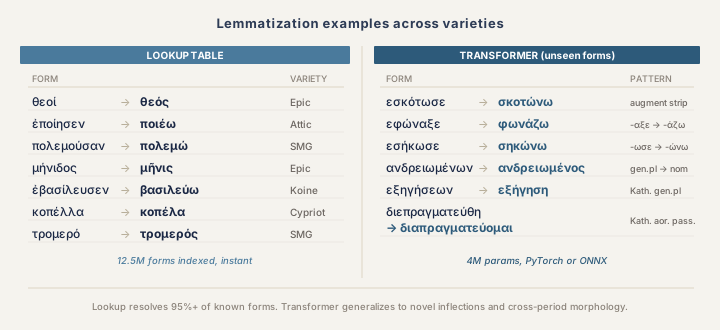
(σκότωσε → σκοτώνω) inform each other; Katharevousa hybrids like
εσκότωσε have both signals to draw from.
At inference time the decoder runs beam search and the first candidate that matches the citation-safe headword filter wins. If nothing matches, the input is returned unchanged rather than guessed at. Inference uses ONNX Runtime (~50 MB) by default, with PyTorch as an optional alternative; both backends produce identical outputs.
API Reference
Language and convention options
from dilemma import Dilemma

d = Dilemma()                                  # all periods (default)
d_mg = Dilemma(lang="el")                     # MG only
d_grc = Dilemma(lang="grc")                   # AG only

# LSJ lemma convention
d_lsj = Dilemma(convention="lsj")

# Cunliffe convention
d_cun = Dilemma(convention="cunliffe")

# Triantafyllidis convention (recommended for MG)
d_mg = Dilemma(convention="triantafyllidis")

# Strict AG citation validation for audit/dictionary surfaces
d_audit = Dilemma(lang="grc", citation_policy="strict_ag")
Verbose mode
For ambiguous forms, lemmatize_verbose returns all candidates with
metadata so downstream tools can disambiguate using context:
from dilemma import Dilemma

d = Dilemma()

# Proper noun vs common noun: Ἔρις (goddess) vs ἔρις (strife)
candidates = d.lemmatize_verbose("ἔριδι")
for c in candidates:
    print(f"{c.lemma:10s} lang={c.lang} proper={c.proper} via={c.via}")
# Ἔρις       lang=grc proper=True  via=exact

# Multiple candidates: common noun + proper-noun capitalization variant
candidates = d.lemmatize_verbose("πόλεμο")
# -> [LemmaCandidate(lemma="πόλεμος", lang="grc", via="exact"),
#     LemmaCandidate(lemma="Πόλεμος", lang="grc", via="exact+case_alt")]

# Elision with multiple valid expansions
candidates = d.lemmatize_verbose("δ̓")
# -> [LemmaCandidate(lemma="δέ", source="elision", via="elision:ε"),
#     LemmaCandidate(lemma="δή", source="elision", via="elision:η"), ...]
Article-agreement disambiguation: When multiple candidates exist, pass the preceding word to rank by gender/number agreement with a Greek article:
# Prefer candidates matching masculine article τόν
candidates = d.lemmatize_verbose("λόγου", prev_word="τοῦ")
# -> masculine λόγος ranked before proper Λόγος
This only re-ranks candidates, never excludes them. If the preceding word is not a recognized article form, it has no effect.
Each LemmaCandidate has:
lemma- the lemma stringlang-"el"(MG, including medieval),"grc"(AG),"med"(medieval provenance label in output)proper-Trueif lemma is a proper noun (capitalized headword)source-"lookup","elision","crasis","particle_strip","verb_morphology","compound","article","normalize","byzantine_norm","prefix_strip","model","identity","nonlexical"via- how it matched:"exact","lower","elision:ε","suffix_strip","augment_strip","θεο+φθόγγος","+case_alt", etc. For a non-lexical token, the non-lexical class label.score-1.0for lookup,0.5for model,0.0for identity fallbacktag-"X"for a non-lexical token,""otherwisecitation- citation-form validation note such as"trusted_headword","grave_to_trusted_headword","modern_greek", or"unchanged"is_lexical-Falsefor a non-lexical token (source == "nonlexical"),Trueotherwise
Non-lexical tokens
Real corpora - especially OCR'd lexica, scholia, and the Patrologia Graeca -
are full of tokens that are not words: γράφεται variant marks (γρ), Greek
numerals (κζ', ,αφ'), editorial references ([76], [49-59]), Latin or
citation abbreviations (fr., Herod.), lone punctuation/sigla, and
vowel-less consonant fragments. These have no lemma. Dilemma classifies them
structurally (pure stdlib, no model) so they can be told apart from a real
word that failed to lemmatize, and are never sent to the transformer fallback
(which would only manufacture a spurious lemma):
from dilemma import Dilemma, classify_nonlexical, is_lexical

classify_nonlexical("γρ")     # -> "variant-mark"
classify_nonlexical("κζ'")    # -> "numeral"
classify_nonlexical("[76]")   # -> "bracket-ref"
classify_nonlexical("fr.")    # -> "abbreviation"
classify_nonlexical("πλ")     # -> "consonant-cluster"
classify_nonlexical("λόγος")  # -> None  (a real word)
is_lexical("λόγος")           # -> True
is_lexical("γρ")              # -> False

d = Dilemma()
d.lemmatize("γρ")             # -> "γρ"  (returned unchanged, not sent to the model)
d.lemmatize_verbose("γρ")     # -> [LemmaCandidate(source="nonlexical", via="variant-mark", tag="X")]
A census-style consumer filters non-words out of a failure count with
d.is_lexical(token) (or the module-level is_lexical). The class labels are
dilemma.nonlexical.NONLEXICAL_CLASSES. The classifier is conservative: an
elided monosyllable (δ᾿), a word that merely resembles a numeral (τε), and
any accented real word stay lexical.
Batch processing
When processing a large corpus (thousands of words), call preload() to
enable query-level caching on the SQLite lookup tables. This avoids
repeated SQLite round trips for forms that appear multiple times:
d = Dilemma()
d.preload()  # enable query cache - ~40x faster for repeated lookups

for word in corpus:
    d.lemmatize_verbose(word)  # second lookup of same form is instant
preload() is safe to call multiple times (idempotent) and does not
change output - it only affects performance. It caches query results
on demand rather than loading the full 14.5M-entry table into memory.
POS-aware disambiguation
When a POS tagger (e.g. Dilemma's POS tagger module)
provides UPOS tags, lemmatize_pos uses POS to disambiguate between
multiple candidates from the regular lookup:
d = Dilemma()
d.lemmatize_pos("αὐτοῦ", "ADV")    # "αὐτοῦ" (adverb: here/there)
d.lemmatize_pos("αὐτοῦ", "PRON")   # "αὐτός" (pronoun: genitive)
d.lemmatize_pos("λευκόν", "NOUN")  # "λευκόν" (noun: white-of-egg)
d.lemmatize_pos("λευκόν", "ADJ")   # "λευκός" (adjective: white)
Curated POS entries can select among regular lookup candidates or override
a single candidate when the dictionaries and corpus evidence support a
different lemma for that part of speech.
An explicit verb tag also overrides a single competing reading represented
by lowercase and capitalized candidates, such as Λάμπε selecting λάμπω
instead of the independent name Λάμπος. Untagged name readings remain
available.
Batch POS calls apply the same overrides when all candidates are case or accent variants of the input. Agreement with a self-map still compares the available citation spellings. If no POS entry matches, case twins retain the scalar API's candidate order and capitalization rule; a single accent variant retains its scalar citation spelling. This fallback checks only structured readings, so unresolved words keep their batched model inference.
With convention="triantafyllidis" or lang="el", POS tags also fix MG
self-map issues for adjective and verb inflections. MG lookup tables
sometimes return self-maps for inflected forms (e.g. ανθρώπινα maps to
itself instead of ανθρώπινος). When POS is ADJ, the masculine nominative
citation form (-ος, -ής, -ύς) is preferred. When POS is VERB, the
infinitive/1sg form (-ω, -ώ, -μαι) is preferred. Adverbs and nouns keep
their MG self-maps unchanged.
The POS lookup tables (~1.82M AG-only entries, ~1.86M combined) are built from six sources in priority order: AGDT originals and licensed corpus votes, LSJ9 indeclinables (2.2K adverbs, prepositions, conjunctions, particles, interjections with unambiguous POS), GLAUx corpus (8.7K entries), MG Wiktionary, AG Wiktionary, LSJ9 grammar. For polytonic input (breathing marks, circumflex), the AG-only POS entries are checked first to avoid MG lemma overrides on Ancient Greek text, mirroring the main lookup's AG-first logic.
Rebuild the corpus POS table after a source refresh with
python build/build_treebank_pos_lookup.py --kaikki PATH_TO_KAIKKI.
Corpus lemma targets must occur in the merged grc_lexical_heads.json
inventory; membership in the generated flat lookup alone is insufficient.
The builder requires that inventory before writing outputs and records
rejected targets, source fingerprints and all tied owner votes in
data/treebank_pos_lookup.audit.json. Use --audit-output PATH to choose
another audit destination. A tied owner does not enter the scalar POS table,
and rejected source claims still protect against conflicting projections.
Explicit Ancient Greek POS calls also reject those documented unsupported
targets if an older POS table or the ordinary lookup offers them as a fallback.
This applies equally to scalar and batch calls; it does not change untyped
lemmatize() or Modern Greek behavior. The rejection audit must match the
exact grc_lexical_heads.json bytes. Missing or mismatched evidence raises a
data-mismatch error rather than trusting an unbound rejection list. Refresh
both files with python -m dilemma download --no-tagger (use --dir PATH
for a custom data directory), or rebuild the corpus POS table against the
current merged lexical-head inventory. Validation is cached for each model.
When a POS entry supplies a distinct supported citation spelling for an
inflection, it takes precedence over an accent-stripped lookup collision.
An exact independent lookup entry keeps its own spelling, such as οὖ
beside the differently accented adverb οὐ.
The audit also retains every source-supported capitalized name and ethnic
adjective owner before the runtime table's ambiguity filter. The dictionary
export combines those owners with exact cased corpus counts and lexical-head
evidence, preserving attested names hidden by a flat lowercase owner.
Capitalization checks recognize both Unicode uppercase and titlecase letters,
including Greek capitals with a written iota such as ᾍ in ᾍδης, without
changing their spelling or treating lowercase iota-subscript letters as capitals.
A corpus vote that agrees with the bare lookup can still be needed when a
lower-priority POS table, a projected spelling, or a capitalized scalar query
would select another lemma. A case variant already corrected by the effective
POS lookup does not authorize a redundant recovery.
These additional entries require at least two weighted corpus votes, a unique
highest-weight corpus owner, and an independent definition of the exact lemma
and part of speech in the English
or Greek Ancient Greek extracts. Tied corpus owners remain in the source
evidence and cannot authorize an additional scalar override.
Without --kaikki, this additional recovery is disabled. Lowercase and
monotonic aliases retain each unambiguous part of speech, and withhold a part
of speech with competing owners. Newly recovered entries also account for
conflicting corpus claims that did not qualify for recovery. Exact spellings
remain available. An exact entry overrides a projected reading only for its
own part of speech; an exact noun does not suppress a projected adjective
with independent adjective evidence. Adding another POS beside an
exact spelling requires independent lexical evidence for that POS, so inherited
corpus-tag errors do not introduce unsupported targets. Fresh Wiktionary definitions
qualify; --lsj9-headwords PATH also admits explicit LSJ noun/adjective grammar
when the file matches the fingerprint and head membership in the merged lexical
evidence. Without either source, the existing exact POS scope is retained.
Explicit DET tags retain the established article lemma (ὁ or ο) when
an auxiliary POS table instead returns a noncanonical form. This uses the
same article inventory and accent-sensitive normalization as the optional
article resolver and applies before candidate selection in both scalar and
batch calls; untagged words, pronouns, and other POS tags are unchanged.
Spelling correction
For unknown or misspelled words, suggest_spelling returns candidate
corrections from the lookup table ranked by edit distance:
d = Dilemma()
d.suggest_spelling("θεός")       # [("θεός", 0), ...]  (exact match)
d.suggest_spelling("θεος")       # [("θεος", 0), ("θεός", 0), ...]  (diacritic error = free)
d.suggest_spelling("θδός")       # [("θεός", 1), ...]  (letter-level ED1)
The approach works in two layers. First, diacritics are stripped from both the input and the dictionary, collapsing the 14.5M-entry lookup into 6.97M unique base forms. ED0/ED1/ED2 matches are found on these stripped forms, then expanded back to their original polytonic variants and ranked by true Levenshtein distance. This means accent and breathing errors (wrong accent, missing breathing mark) are corrected for free, while letter-level errors (θ/δ, ρ/ν) use standard edit distance. The spell index is built lazily on first call.
By default, suggestions include all forms in the lookup table (inflected forms and lemmata from all sources). Two filtering options reduce false positives when resolving to a specific dictionary:
# Only return known LSJ headwords (strictest - ~119K entries)
d.suggest_spelling("ἀγωνιστήριον", max_distance=1, headwords_only="lsj")

# Only return lemmata/citation forms (less strict - ~700K entries)
d.suggest_spelling("ἀγωνιστήριον", max_distance=1, lemmata_only=True)
You can also check headword membership directly:
d.is_headword("θεός")              # True  (LSJ headword)
d.is_headword("θεοί")              # False (inflected form, not a headword)
d.is_headword("θεός", "cunliffe")  # check against Cunliffe headwords
Paradigm generation
dilemma.paradigm resolves Ancient Greek inflection cells by source
precedence (jtauber > Morpheus > dilemma_corpus > template), with a
small template fallback for the simplest regular cases. Useful when
a build pipeline needs full inflection paradigms for every lemma but
the kaikki / corpus extracts only carry the cells that happened to
be attested.
from dilemma.paradigm import generate, generate_paradigm, ParadigmSlot

slot = ParadigmSlot.verb_finite(
    voice="active", tense="aorist", mood="indicative",
    person="1", number="sg",
)
generate("γράφω", slot)
# ParadigmForm(form="ἔγραψα", source="jtauber")

generate_paradigm("γράφω", "verb")
# {"active_aorist_indicative_1sg": ParadigmForm(...), ...}
Each form is wrapped in ParadigmForm(form, source) so callers can
decide whether to trust a cell. Corpus and paradigm-table sources are
safe to ship as-is; template fallbacks are best-effort. Inflection
keys match the canonical shapes:
| Shape | Example |
|---|---|
| Verb finite | active_aorist_indicative_1sg |
| Verb infinitive | active_aorist_infinitive |
| Verb participle | active_aorist_participle_nom_m_sg |
| Noun | genitive_pl |
| Adjective | nominative_m_sg |
The orchestrator reads paradigm JSONs from $DILEMMA_PARADIGM_DATA
(set this to a directory containing jtauber_ag_paradigms.json,
ag_verb_paradigms.json, ag_noun_paradigms.json,
dilemma_ag_verb_paradigms.json, and/or
dilemma_ag_noun_paradigms.json). Missing files yield empty per-source
dicts; the orchestrator falls through to whichever sources are
available and finally to the template fallback.
Templates handle thematic -ω verbs (present-system active only),
vowel-stem 1st / 2nd-declension nouns, and three-termination -ος /
-η / -ον adjectives. Anything that needs accent re-placement or stem
allomorphy (contract -άω / -έω / -όω, athematic μι-verbs, suppletive
verbs, 3rd-decl consonant stems) returns None so callers can leave
the cell empty rather than ship a bogus form. Pass allow_template=False
to skip the template path entirely and only return cells with explicit
source attribution.
A CLI entry point fills missing inflection cells across a build's
canonical hash, mapping {filepath: entry}:
python -m dilemma paradigm fill --in pending.json --out filled.json [--with-templates]
Each filled cell is recorded in a sidecar inflections_source.<dialect>.<key>
field on the entry so downstream consumers can render generator-filled
cells distinctly from corpus-attested ones.
Elision expansion
Ancient Greek texts frequently elide final vowels before a following
vowel, marking the elision with an apostrophe (U+0313 in polytonic
encoding, U+1FBD/U+02B9/U+02BC/U+1FBF/U+2019/ASCII '/U+0060 in other
encodings). All of these resolve identically: the lemma never depends on
which apostrophe codepoint the source text used.
Exact elided entries first: the lookup table stores corpus-derived
lemmas for elided forms under one canonical key (U+1FBD), and these win
before any expansion heuristic: ὅτ᾽ -> ὅτε (not the more frequent
homograph ὅτι, which never elides in Homer), μ᾽ -> ἐγώ, σ᾽ -> σύ,
κ᾽ -> ἄν, θ᾽ -> τε, ποτ᾽ -> ποτέ, αὖτ᾽ -> αὖτε. One
residual static-lookup limit: a few Homeric ὅθ᾽ tokens are the locative
ὅθι rather than temporal ὅτε, which only syntactic context can settle.
Verbose and POS-aware calls prioritize an exact entry over reconstructed expansions when its original lemma is supported by the merged lexical inventory for the requested language. This checks the original citation before convention remapping, including proper names. Unsupported exact targets retain their former ordering, and every alternative remains available. A matching POS reading can still select another candidate.
Forms without an exact entry fall through to the expander, which strips the elision mark and tries each Greek vowel against the lookup table:
| Elided | Expanded | Lemma |
|---|---|---|
ἀλλ̓ |
ἀλλά |
ἀλλά |
δ̓ |
δέ |
δέ |
τ̓ |
τε |
τε |
ἐπ̓ |
ἐπί |
ἐπί |
ἔφατ̓ |
ἔφατο |
φημί |
κατ̓ |
κατά |
κατά |
καθ᾿ |
κατά |
κατά |
ἀφ᾿ |
ἀπό |
ἀπό |
βάλλ̓ |
βάλλε |
βάλλω |
Consonant de-assimilation: Before rough breathing, Greek assimilates
voiceless stops to aspirates (τ->θ, π->φ, κ->χ). The elision expander
reverses this: καθ᾿ tries both καθ- and κατ-, ἀφ᾿ tries both
ἀφ- and ἀπ-, recovering prepositions like κατά and ἀπό.
Frequency ranking: When multiple expansions match the lookup table,
candidates are ranked by lemma-keyed corpus attestation (see
attestation() below), so common prepositions like κατά always beat
obscure verbs like κάθω. Function words are further prioritized when the
stem matches a known elision pattern, and proper nouns are deprioritized.
Polytonic input automatically restricts expansion to the AG lookup table, avoiding false matches from MG monotonic forms.
Corpus attestation
Dilemma.attestation(lemma) returns a per-lemma diachronic profile built from
the GLAUx and Diorisis corpora plus the OGA and Pedalion corpora consumed via the
Open Greek Corpus
standardized annotation export (34M deduped tokens, 304K lemmas): how often,
when, where, and in what genre a lemma is attested. It is keyed by the corpora's
own NFC polytonic lemma annotation and returns None for an unattested lemma.
d.attestation("ἀείδω")
# {
#   "total": 1942,                                          # deduped frequency
#   "source_counts": {"glaux": 1869, "diorisis": 1240},    # independent, NOT summed
#   "by_genre":   {"philosophy": 367, "poetry": 441, "history": 263, ...},
#   "by_century": {"-8": 49, "-7": 20, "-6": 40, ...},      # signed; -8 = 8th c. BC
#   "by_dialect": {"Aeolic": 2, "Attic": 249, "Attic/Koine": 662, ...},  # GLAUx only
#   "dominant_pos": "verb",
# }
The artifact is data/lemma_attestation.json, built by the standalone
build/build_lemma_attestation.py pass. The three sources annotate many of
the same texts, so the frequency (total and the by_* breakdowns) is
deduplicated at the work level by TLG id (each work counted once, with
priority GLAUx > Diorisis > OGA > Pedalion; GLAUx preferred for its dialect and
richer metadata) - a union, not a sum. OGA is all-automatic annotation (a form of
model output), so it is the lowest-priority source; its ~17M tokens cover
795 works - the Suda, the Iliad scholia, Eusebius, patristic homilies -
that no hand-checked treebank annotates, and works the Gorman treebanks
annotate are excluded from it entirely (Gorman is the held-out gold).
Pedalion (manual-gold AGDT trees, PROIEL already dropped by cog) adds ~39K
deduped tokens from works no other source covers (Sextus Empiricus, Menander,
papyri, poetic fragments); its Gorman-provenance rows are skipped and its
constructed example-sentence collections feed only lookup/POS, not attestation.
source_counts separately keeps each lemmatizer's full independent count
(overlapping, never summed): agreement is a confidence signal, and a lemma seen
only in a non-preferred source's reading of a shared work has total 0 but a
non-empty source_counts. It is distinct from the form-keyed, genre-only
corpus_freq.json: this one is lemma-keyed and adds the century and dialect
axes. Because the corpora are not
sense-disambiguated there is one profile per lemma string, so dominant_pos
disambiguates a noun-vs-verb homograph but not same-POS senses. The file's
_meta block documents the full schema, the signed-century scheme, and the
caveats.
Attested forms: the "attested only" gate and form attestation
The lemma profile above has a surface-FORM sibling: which exact inflected forms
actually occur in the corpus, with their own usage distribution and the passages
that attest them. Dilemma.form_attestation(form) returns it, or None if the
form is unattested:
rec = d.form_attestation("μῆνιν")
# {
#   "total_count": 349, "n_works": 128,
#   "source_counts": {"diorisis": 104, "first1k": 219, "glaux": 128, "pg": 28, "pta": 4},
#   "by_century": {-8: 14, -6: 5, -5: 12, ...},     # usage-by-year axis
#   "by_genre":   {"poetry": 40, "history": 34, "philosophy": 13, ...},
#   "by_century_genre": {-8: {"poetry": 14}, ...},  # joint, for a usage heatmap
#   "dominant_pos": "other",   # untagged raw-text sources (first1k/pta/pg) -> "other"
#   "citations": [                                 # example passages (work + locus)
#     {"author": "Homerus", "title": "Ilias", "source": "glaux",
#      "century": -8, "locus": "1.1", "locus_scheme": "line", "count": 1}, ...]
# }
Both directions of the lemmatizer/generator take an attested_only flag (off by
default, so nothing changes unless you ask for it):
# Input: only lemmatize forms that actually occur in the corpus (exact NFC,
# elision resolved); an unattested form returns None instead of a guess.
d.lemmatize("μῆνιν", attested_only=True)          # "μῆνις"
d.lemmatize("υπολογιστές", attested_only=True)    # None (modern, unattested)
d.lemmatize_batch(words, attested_only=True)      # None at unattested positions
# attach the citations to each candidate:
d.lemmatize_verbose("μῆνιν", with_attestation=True)

# Output: only generate paradigm cells whose form is attested (grave/case
# folded, since generated forms are citation-style), with optional citations.
from dilemma.paradigm import generate, generate_paradigm, ParadigmSlot
generate_paradigm("λύω", "verb", attested_only=True, with_attestation=True)
The data lives in two SQLite artifacts built by the standalone
build/build_form_attestation.py pass. It reads the lemmatized GLAUx + Diorisis
treebanks plus the raw-text First1KGreek, PTA, Patrologia Graeca and
byzantine-vernacular corpora (for late-antique, patristic and Byzantine
coverage), deduping each work once by source priority (so total_count is a
deduped union while citations keep every source's passages). The Patrologia
Graeca and byzantine-vernacular texts are read from the
Open Greek Corpus.
The Patrologia Graeca comes in three tiers of evidence, best first, and a Migne volume is counted once under the best tier that covers it:
- The CC-BY calfa-co text
as the corpus serves it, with whole-token OCR corrections applied and each
volume carved into its works. 22 volumes, loci
PG<volume>.<page>. - The corpus's Qwen3.6-27B re-OCR of the public-domain Migne scans, which
replaced a retired first-generation OCR pass that misread whole sorts
(
ϖasσ). 48 further volumes, locipg<volume>_<page>.<line>- Eusebius, Athanasius, Basil, both Gregories, Chrysostom, Cyril of Alexandria, Theodoret, John of Damascus. - The raw first-generation calfa-co dump, read from
<corpus>/sources/cgpg/PG*/PG*_text.txt. It is the only text for 11 volumes nothing else covers, and for the 22 carved volumes it is read as secondary evidence: it creditssource_countsand citations for the part of a volume the carve plan leaves out, without touching the deduplicated totals the better text decides.
The raw-text sources (especially the OCR'd Patrologia Graeca) are noisier than
the treebanks, so a form attested only there is lower-confidence;
source_counts tells you which corpora attest each form. Both artifacts are opt-in downloads, kept out of the base
dilemma download:
python -m dilemma download --with-attestation   # form_profile.db: gate + distribution
python -m dilemma download --with-citations      # + form_citations.db: example loci
--with-attestation is enough for the gate and the usage distribution that
powers the usage-by-year graph and heatmap; --with-citations adds the example
loci (and implies the profile). Without them, attested_only and
form_attestation raise a clear "download it" error.
Example loci require matching schema versions, content hashes and source hashes in the two
databases. If the citation file belongs to another build or lacks this
metadata, form_attestation still returns the usage profile, with an empty
citations list and a citations_note asking you to download both files
together. max_citations=0 reads only the profile.
Saying "I don't know": guess=False
By default the lemmatizer always answers: when nothing structured resolves a
word it falls back to the transformer, and when even that fails it returns the
input unchanged. For a dictionary-lookup caller a wrong lemma is worse than no
lemma (a guessed headword puts a false definition in front of the reader), and
an echoed input is indistinguishable from a successful identity lemmatization.
All five lemmatization entry points therefore take guess=False, which skips
the transformer and returns None (or an empty candidate list) instead of a
guess or an echo:
d.lemmatize("μάκαπ")                         # "μάκαπ" (echo - OCR junk, unresolvable)
d.lemmatize("μάκαπ", guess=False)            # None ("I don't know")
d.lemmatize_batch(words, guess=False)        # None at unresolvable positions
d.lemmatize_verbose("μάκαπ", guess=False)    # [] - no identity/model candidates
Non-Greek and NON-LEXICAL tokens (see classify_nonlexical) still pass through
unchanged: those are classifications, not lemma guesses. For a per-candidate
confidence signal, use lemmatize_verbose() - each candidate's score (1.0
lookup ... 0.5 model ... 0.0 identity echo) and source say how much to trust
it.
Repairing corrupt lemma annotations
Lemma annotations in treebanks and OCR-derived data break in learnable ways:
OCR letter confusions (μάκαπ for μάκαρ), digamma noise (ϝέκταρ for νέκταρ,
πρόσθεϝ for πρόσθεν), diaeresis/gemination variation (ἐυμελίης for ἐϋμμελίης),
and truncation (ἐπιτροχάδη for ἐπιτροχάδην). repair_lemma() validates a lemma
against the canonical AG headword inventory (LSJ + Cunliffe, shipped in
data/) and repairs a corrupt one - preferring evidence from the surface form
it was assigned to, which is usually correct even when the annotation is not:
d.repair_lemma("μάκαρ")                      # "μάκαρ"  (already canonical)
d.repair_lemma("μάκαπ")                      # "μάκαρ"  (edit-distance repair)
d.repair_lemma("ϝέκταρ")                     # "νέκταρ" (digamma normalization)
d.repair_lemma("Πειραί", form="Πειραΐδης")   # "Πειραΐδης" (form-guided)
d.repair_lemma("διαπέταμαι", form="διέπτατο") # "διαπέτομαι"
d.repair_lemma("ξζψχβγ")                     # None - never echoes junk back
The same digamma handling also works on surface forms in plain lemmatization:
lemmatize("πρόσθεϝ") -> πρόσθεν, lemmatize("ϝάναξ") -> ἄναξ (a variant
is accepted only if it itself resolves in the lookup, so this never invents a
lemma).
POS tagger and dependency parser
Dilemma also ships a diachronic Greek POS tagger and dependency parser
under dilemma.tagger, on a lightweight onnxruntime + tokenizers
inference backend. Ancient (grc) and Medieval/Byzantine (med) use a
fine-tuned GreBerta encoder
(Apache-2.0) that PRESERVES polytonic accents and breathings; Modern Greek
(el) uses a Greek-BERT
encoder with a Dozat-Manning biaffine dependency head:
pip install "dilemma-nlp[tagger-onnx]"   # torch-free runtime: onnxruntime + tokenizers
# or "dilemma-nlp[tagger]" for the full tagger (runtime + torch + transformers, for training)
python -m dilemma download               # also fetches the tagger weights
from dilemma import Tagger

tagger = Tagger(lang="grc")    # Ancient Greek (GreBerta, accent-preserving)
results = tagger.tag(["μῆνιν ἄειδε θεὰ Πηληϊάδεω Ἀχιλῆος"])
for tok in results[0]:
    print(tok)
# {'form': 'μῆνιν', 'upos': 'NOUN', 'lemma': 'μῆνις',
#  'feats': {'Case': 'Acc', 'Number': 'Sing', 'Gender': 'Fem'},
#  'head': None, 'deprel': None, 'raw_form': 'μῆνιν'}
Supports lang="el" (Modern Greek), lang="grc" (Ancient), and
lang="med" (Medieval/Byzantine). When lemmatize=True (the default),
the tagger preloads the lemmatizer internally and returns a lemma field on
every token (POS-aware, from the model's predicted UPOS).
Tokenization is whitespace-based with two refinements, so the output can
contain more tokens than text.split(): leading/trailing punctuation becomes
standalone PUNCT tokens (ἄειδε, -> ἄειδε + ,; elision and aphaeresis
apostrophes like δ’ stay attached), and Modern Greek multiword tokens
expand (στο -> σ + το).
The Modern Greek (el) model is trained ENTIRELY on openly licensed gold
treebanks - UD_Greek-GUD (Standard MG) plus the Cretan, Lesbian, and Messinian
dialect treebanks, all CC BY-SA 4.0 - NOT the NonCommercial UD_Greek-GDT. It
does UPOS + UD-feature tagging AND dependency parsing (so el tokens carry
head/deprel; Modern Greek multiword tokens like στο = σ + το are split
automatically). On the held-out GUD (Standard MG) test split:
| Modern Greek tagger | UPOS | feats | UAS | LAS |
|---|---|---|---|---|
Dilemma el (GUD + CC BY-SA dialects, ~38K tokens) |
97.9% | 99.4% | 89.5% | 86.1% |
| reference: a model trained on the NonCommercial UD_Greek-GDT (~62K tokens) | 97.5% | -- | 90.5% | 88.4% |
So declining the NonCommercial GDT costs only ~2 LAS (and gains UPOS) on ~40% less data, while keeping the model fully CC-licensed. The dialect treebanks are not optional padding: ablating them collapses parser LAS from 86.1% to 58.9%, because they nearly double the dependency-training signal.
The Ancient and Medieval (grc/med) model now carries a Dozat-Manning
biaffine dependency head too, trained on GLAUx with the CC BY-SA AGDT relation
set (the NonCommercial PROIEL and UD Perseus are excluded). So grc/med
tokens also carry head/deprel (AGDT relations such as PRED, SBJ, OBJ,
ATR, ADV, plus the _CO/_AP coordination and apposition variants). On the
held-out GLAUx test split:
| Ancient Greek tagger | UPOS | feats | UAS | LAS |
|---|---|---|---|---|
Dilemma grc (GLAUx + AGDT, ~19M training tokens) |
96.3% | 99.5% | 83.6% | 78.3% |
(dev-split numbers run higher - UPOS 97.9 / feats 99.7 / UAS 88.6 / LAS 84.3;
the test split is a harder held-out sample.) The grc model is Morpheus-free
(trained --no-prior), so nothing in the runtime path needs the Morpheus binary.
The tagger is ~25x faster than gr-nlp-toolkit on real-world Greek text
after gr-nlp-toolkit's PR #29
(which Dilemma's author contributed; pre-PR the gap was ~215x). On the
full Iliad (24 books, 146K tokens) it tags in 19.5 s. Trained
weights, treebank sources, and the lang="med" Medieval/Byzantine model
are documented in dilemma/tagger/__init__.py.
The ONNX taggers are reproducible from train_tagger.py (Greek-BERT/GreBerta
encoder + per-feature heads), export_tagger_onnx.py (3-input ONNX export),
and the data builders build/build_tagger_data.py (Ancient Greek from GLAUx)
and build/build_mg_tagger_data.py (Modern Greek from UD_Greek-GUD + the
CC BY-SA dialect treebanks), with
convert_treebank.py doing the AGDT postag→UD mapping. Both are Morpheus-free,
so the taggers reproduce from the public repo plus the corpora.
Device and throughput planning (CPU vs GPU)
Two engines sit behind the API and they scale very differently:
- The lemmatizer is the workload: a 14.5M-form SQLite lookup, the rule layers, and a small char-transformer beam search for the tail. It is CPU-bound and, in aggregate, memory-bandwidth-bound. A GPU does not speed it up.
- The tagger (GreBerta ONNX) is a batched encoder forward pass. GPU- acceleratable in principle, but it is a small fraction of the per-token cost and runs fast on CPU, so it is not where a full-corpus pass spends its time.
Verdict: a full-corpus annotation pass is CPU + memory-bandwidth bound, not
GPU-bound. Measured directly (open-greek-corpus-annotations/scripts/bench_devices.py)
over a fixed ~50k-token Ancient Greek sample on two boxes:
| Box | lemma, 1 worker | lemma saturation | tag (CPU, 1 proc) | coupled tag+lemma per shard on GPU |
|---|---|---|---|---|
| EPYC 7B12 (64c / 2.5-3.3 GHz, DDR4) | 54 tok/s | ~1,100 tok/s @ ~32 workers | 745 tok/s | 361 tok/s (12 shards, 90% GPU util) — worse |
| Threadripper PRO 7995WX (96c/192t, 5.39 GHz, DDR5 8-ch) | 110 tok/s | ~2,460 tok/s @ ~48-61 workers | 2,531 tok/s | not run (proven counterproductive) |
The lemmatizer scales with cores until it hits a memory-bandwidth wall, then flattens. On the 7B12, per-worker throughput fell 54 → 38 (16w) → 31 (32w) → 18 (61w), so aggregate peaked near ~1,100 tok/s around 32 workers and more workers bought almost nothing. The 7995WX starts at 2x the per-worker rate and, with DDR5 8-channel bandwidth, pushes the wall out: 110 (1w) → 995 (16w) → 1,728 (32w) → 2,327 (48w) → 2,460 (61w), with per-worker sliding 110 → 62 → 54 → 40 as the wall is approached. Aggregate peaked near ~2,460 tok/s at ~48-61 workers (2.2x the 7B12). Tag-on-CPU also scales with cores (745 tok/s on the 7B12 vs 2,531 on the 7995WX), so it never becomes the bottleneck.
The GPU is nearly irrelevant, and coupling the two engines on it is an anti-pattern. Running the pipeline as N sharded processes on a GPU box gives each shard its own GreBerta CUDA session, so scaling the CPU-lemma parallelism to the core count spawns dozens of CUDA sessions, exhausts VRAM (util collapses toward 0), and the run tops out below the CPU-only rate — it measured 361 tok/s (12 shards maxing a 24 GB card) versus 1,100 tok/s for the same box's CPU lemmatizer. Never run one GPU tagger session per worker.
Recommended shape: decoupled, pure-CPU scale-out. Run N CPU workers that each tokenize + tag + lemmatize (equivalently, many CPU lemmatize workers fed by a few batched CPU tagger processes), tagger on CPU, no per-shard GPU session at all. Set the worker count at the box's memory-bandwidth knee — the point where per-worker throughput has fallen off but aggregate is still near its max (~32 on the 7B12, ~48-64 on the 7995WX). Do not exceed it: past the knee you pay for cache/bandwidth contention with no throughput gain.
Picking hardware for a large pass: buy cores and memory bandwidth, not a GPU. A high-clock, many-DDR5-channel CPU (Threadripper PRO / EPYC Genoa) beats a GPU box for this job, and a low-end GPU (or none) is fine.
Device selection and verification. ONNX sessions pick their device
automatically (dilemma/_ort_providers.py): CUDA when onnxruntime-gpu is
installed, else CPU; override with DILEMMA_ORT_PROVIDERS (e.g.
CUDAExecutionProvider,CPUExecutionProvider to force GPU, or
CoreMLExecutionProvider,CPUExecutionProvider for Apple's Neural Engine). A
pure-CPU box (plain onnxruntime) correctly reports Tagger.on_gpu=False /
Tagger.providers=['CPUExecutionProvider'] and runs at full speed. Watch out
for the silent trap: onnxruntime falls back to CPU if onnxruntime-gpu is
missing or CUDA/cuDNN mismatches, so if you intend to use a GPU, assert
tagger.on_gpu up front (make_session() also warns) rather than discovering a
CPU fallback from a slow run.
Rule of thumb, and the one caveat. The saturation numbers above are an upper bound measured on ordinary running text, where the lookup resolves ~95% of tokens and the char model only fires on the tail. Real throughput tracks how often the expensive char-model beam search fires, which is a property of the text: lookup-heavy prose runs near the box's saturation rate, but dense rare-vocabulary material - OCR'd lexica (Suda, Hesychius), scholia, and Patrologia Graeca commentary, where a large share of tokens are unseen headwords/forms - drives the beam search far more and runs several times slower per token. Plan with the mix you actually have. Scaling still comes from cores: because the beam search is compute-bound (not bandwidth-bound like the lookup), a beam-heavy pass keeps scaling with workers past the lookup knee, so use ~1 worker per hardware thread for it. One more structural limit: a single work runs on one worker, so a run's wall-clock is floored by its largest work; split giant lexica/scholia across workers if that tail dominates. ETA ≈ (remaining word tokens) / (measured tok/s on that text) - e.g. the ~45M-token, beam-heavy lexica/scholia tail of the Open Greek Corpus measured ~1,150 tok/s aggregate at 96 pure-CPU workers on the 7995WX and scaled up with more workers (the run used ~160, since a beam-heavy pass keeps scaling past the lookup knee), well under the ~2,460 tok/s the same box hits on ordinary prose.
Greek Coverage
Language codes
| Code | Period | ISO standard |
|---|---|---|
el |
Modern Greek (including vernacular medieval, Katharevousa, regional) | ISO 639-1 |
grc |
Ancient Greek (Homer through Byzantine literary Greek) | ISO 639-2 |
Code and API calls use ISO 639 language codes: el for Modern Greek
and grc for Ancient Greek. In English text we often use the
shorthands MG (Modern Greek) and AG (Ancient Greek).
For Dilemma's purposes, MG (el) includes Katharevousa, even though
Katharevousa often benefits from AG lemmatization due to its archaizing
vocabulary and morphology. Medieval/Byzantine Greek has two components:
vernacular medieval Greek (ancestor of Modern Greek, merged into el)
and literary Byzantine Greek (classicizing, Atticist-influenced, resolved
via the AG lookup under grc).
For lemmatization, the two-way split works because Byzantine literary
Greek is classicizing (handled by grc), while vernacular medieval
Greek is the ancestor of Modern Greek (handled by el). The med
label still appears in LemmaCandidate.lang for forms from the
medieval Wiktionary dump, but these are merged into the el lookup
at build time.
Note: Dilemma's POS tagger and dependency parser
use lang="grc" for Byzantine text. Byzantine literary syntax
(polytonic, full case system, optative mood) is closer to Ancient
Greek, so the AG-trained tagger handles it well.
Modern Greek varieties
| Variety | Wiktionary-tagged headwords |
|---|---|
| Standard Modern Greek (SMG/Demotic) | 877K entries (core) |
| Katharevousa | 283+ tagged, hundreds more formal/place terms |
| Cretan | 273 |
| Cypriot | 199 |
| Heptanesian (Ionian) | 18 |
| Maniot | 3 |
| Medieval/Byzantine (vernacular) | 3K (merged into MG - vernacular medieval is the ancestor of MG; literary Byzantine is Atticist-influenced and resolves via the AG lookup, not this table) |
Ancient Greek varieties
| Variety | Wiktionary-tagged headwords |
|---|---|
| Epic/Homeric | 3,755 |
| Ionic | 1,638 |
| Attic | 1,279 |
| Koine | 1,209 |
| Byzantine (literary) | 496 |
| Doric | 456 |
| Aeolic | 163 |
| Laconian | 52 |
| Boeotian | 15 |
| Arcadocypriot | 11 |
The counts above are Wiktionary headwords explicitly labeled with a dialect tag. Each headword generates a full inflection paradigm (10-40 forms for verbs, 4-8 for nouns), so Wiktionary-derived form coverage is much larger than the headword count suggests.
However, Wiktionary tags are only a fraction of Dilemma's actual dialect coverage. Corpus-derived form-lemma pairs add substantially more: GLAUx contributes 76K Ionic pairs from Herodotus and the Hippocratic corpus, with Diorisis and AGDT adding more across Herodotus, Thucydides, Xenophon, Demosthenes, and others. The dialect normalization layer (Ionic, Doric, Aeolic, Koine) then maps remaining dialectal forms to their Attic equivalents for lookup, catching forms that no corpus or dictionary has catalogued.
Katharevousa forms are the primary non-SMG target for Modern Greek - they mix AG morphology (augments, 3rd declension genitives) with MG vocabulary. The strong Epic/Homeric coverage (3,755 tagged headwords plus extensive GLAUx corpus data) is directly relevant for literary texts based on Homer.
Medieval/Byzantine Greek
Medieval/Byzantine Greek has two distinct registers that Dilemma handles
differently. Vernacular medieval forms are merged into Modern Greek
(el) since they are the direct ancestor of MG. Literary Byzantine
forms are classicizing and resolve via the AG (grc) lookup.
EL Wiktionary's "Medieval Greek"
category (3,158 entries, 3,080 headwords) is roughly 71% vernacular
and 29% literary Byzantine, based on presence of polytonic diacritics:
- Vernacular (~71%): δέρνω, θυμώνω, χτενίζω, βρίσκω, γούνα, ναράντζι, βουρκόλακας, ξεχαρβαλώνω - early MG vocabulary
- Literary Byzantine (~29%): ἀποφθέγγομαι, αἰθεροπόρος, περικαλλής, κριθάλευρον - Atticist-influenced forms
- Medieval-specific: μαξιλάριν, ἀδελφάτον, κασσίδιον, ἴνδικτος, γαστάλδος - neither pure AG nor modern MG
Merging all into el works because the AG lookup runs first. The 29%
literary forms typically already exist in the AG table and resolve
there; only the vernacular and medieval-specific forms actually fall
through to the MG lookup. On the DBBE benchmark, only 2 of 8,342
tokens resolved via the medieval table, while 92.8% came from the AG
lookup.
Development
Full installation
git clone https://github.com/open-greek/dilemma.git && cd dilemma
pip install -e ".[onnx,lm,torch,dev]"  # build + train + test deps
python build_data.py --download
python build_lookup_db.py              # SQLite for instant startup
python fix_selfmaps.py                 # fixes inflected forms that self-map
python train.py                        # full scale (~45 min on RTX 2080)
python export_onnx.py                  # optional: PyTorch-free inference (also needs: pip install onnx)
Training
1. Build data
Downloads all 5 kaikki dumps and extracts every form-lemma pair from inflection tables. Non-Greek characters are filtered out.
pip install -e ".[lm]"                       # build-data deps (lxml, betacode, beta-code, pygtrie)
python build_data.py --download             # downloads + extracts (~1.5GB total)
2. Train
Trains the character-level transformer on the extracted pairs. Use
--scale to control the training size.
python train.py --scale test                # quick sanity check (20K pairs, ~15 sec)
python train.py --scale full                # all data (~45 min on RTX 2080, default)
python train.py                             # same as --scale full
Legacy --scale 1/2/3 flags are still accepted for compatibility.
Training scales
Every scale includes 100% of non-standard varieties (Medieval, Katharevousa, Cypriot, Cretan, Maniot, Heptanesian, archaic, dialectal). The remaining budget is split 50/50 between Ancient Greek and standard MG. Underrepresented tense categories are oversampled to compensate for their rarity in Wiktionary's paradigm tables, following Swaelens et al. (2025)'s finding that perfects are underrepresented in training data relative to Byzantine text. Aorist forms (3x, critical for stem-changing 2nd aorist), perfect (3x), future (3x), imperfect (2x), and pluperfect (5x, rarest at 0.15% of pool) are oversampled proportionally to their rarity and the degree of stem change from the present form.
| Scale | Training pairs | Varieties | AG | SMG | Time (RTX 2080) |
|---|---|---|---|---|---|
| test | 20K | 9K (100%) | 5.5K | 5.5K | ~15 sec |
| full | 3.5M (all) | 9K (100%) | 1.5M (100%) | 1.7M (100%) | ~95 min |
Models save to model/{lang}-test/ (test scale) or model/{lang}/
(full scale).
Eval accuracy is the model's score on held-out pairs without the lookup table. In practice, the lookup resolves most forms instantly and the model only handles truly novel words. When the model is used, beam search generates 4 candidates and the first one that matches a known headword in the lookup wins. If none match, the input is returned unchanged (safe fallback).
Multi-task learning
When training pairs include POS tags (from Wiktionary) and morphological features (from GLAUx), the model jointly predicts POS, nominal morphology (gender/number/case, 45 labels), and verbal morphology (tense/mood/voice, 69 labels) alongside the lemma via auxiliary classification heads on the encoder output. This follows Swaelens et al. (2025)'s finding that multi-task learning (joint POS + morphology + lemma) improved Byzantine Greek lemmatization by ~9 percentage points. Each auxiliary loss is weighted at 0.1x relative to the lemmatization loss. At full scale, the heads reach 90.4% POS, 81.5% nominal, and 91.2% verbal accuracy on the held-out set.
Training uses a linear warmup LR scheduler (500 steps warmup, then linear decay) and gradient clipping (max norm 1.0) for stable convergence.
LSJ/Sophocles expansion
To regenerate the expanded lookup table from LSJ and Sophocles sources:
pip install --force-reinstall --no-deps git+https://github.com/tatuylonen/wikitextprocessor.git
python build/expand_lsj.py --setup           # build Wiktionary Lua module database
python build/expand_lsj.py --expand          # expand LSJ nouns
python build/expand_lsj.py --expand-verbs    # expand LSJ verbs
python build/expand_sophocles.py --expand    # expand Sophocles nouns
python build/expand_sophocles.py --expand-verbs  # expand Sophocles verbs
python overlay_lsj.py                        # recover pinned historical expansion gaps
python build/expand_lbg.py                    # inflect Byzantine headwords (gated gap-fill)
This requires LSJ9 data from lsj9
(included in data/lsjgr_bridges.json and data/lsj9_frequency.json) and
the Sophocles TEI data (included in data/sophocles/).
The final overlay is intentional. A May 2026 base-data refresh replaced the
9,947,605-entry expanded AG table with a 2,354,300-entry Wiktionary base, and
the June re-expansion recovered only part of the prior paradigms. The overlay
derives only the expansion delta from the known-good, revision- and
SHA-256-pinned March artifact in data/ag_expansion_reference.json; it never
restores a historical base mapping and never overrides a current mapping.
It restores marked surface spellings only, not the generated accent-stripped
fallback keys that can shadow unrelated analyses sharing the same bare
skeleton. The generated data/ag_expansion_exclusions.json also removes
historical rows that conflict with the pinned 1.3.1 resolved lookup or with
Dilemma's nonlexical classifier. Its generator is
build/build_ag_expansion_exclusions.py.
Running it without --reference downloads and verifies that exact artifact.
After withholding approximate irregular-compound paradigms, the overlay
separately preserves actual source cells and their original, monotonic, and
unaccented lookup aliases within the historically represented families. This
requires a clean merged Wiktionary, corpus, or reviewed textual cell and a
positively defined Ancient lexical owner; a historical letter pattern alone
never generates a spelling. Existing independent readings and hard spelling
rejections take precedence. Unresolved source or marked-cell ownership ties,
and unsupported aorist, perfect, or pluperfect annotations under εἰμί/εἶμι
compound owners do not license new aliases without direct ownership evidence.
An automatic shorter compound owner is also withheld when only a longer,
independently defined compound accounts for the actual source cell's preverb;
that comparison never infers a replacement owner. Replacing an unsupported
existing target owner requires direct evidence. Missing citation accents may
be supplied from a unique positive head. Structurally impossible citation
accents (on a consonant, duplicated within a syllable, or an invalid second
accent) can use that same unique-head path while preserving breathing,
subscript, and case. Actual source spellings remain unchanged in the audit.
A valid existing accent is preserved because it can distinguish a different
lexeme or contracted form, including a productive enclitic accent. A solely capitalized
automatic cell also needs matching lowercase or direct evidence before gaining
aliases, and cannot erase a possible existing name. Final
elision is normalized to Greek koronis while the original source spelling is
retained in the audit. --source-alias-audit FILE records all readings,
restorations, canonicalization, ambiguity skips, and portable input/source
hashes. The merged source pairs, reviewed exact-form specification, and
grc_lexical_heads.json are required inputs for this step.
With --kaikki DIR, the overlay also checks historical-only elisions against
both fresh Ancient Greek dumps in en-el/ and el/, and binds noun input
validation to that same directory. It can replace an
unsupported historical owner only when all positively defined current source
readings agree on one PRON or DET owner, and every reading fits an explicit
case/number cell in that owner's independently defined entry of the same POS.
The complete cell must be the marked stem plus one literal vowel. Source
quantity notation and initial capitalization are normalized; accents,
breathings, and other letters are preserved. Competing owners or POS readings,
incompatible cells, a positive historical marker variant, and a matching
complete unelided word all withhold the change. Existing predecessor mappings
and later changes remain protected. When rebuilding from a reversed alias
audit, an exact historical cell with its unchanged historical owner is checked
again against current evidence, so a still-supported repair is reproducible.
Independent marker variants remain protected. This check creates no bare lookup aliases.
The historical overlay counts remain unchanged. Proven replacements run after
the normal alias recovery, only while the former historical owner still
matches, and join the reversible canonicalized audit. The audit retains all
source claims, own-entry cells, definitions, and withheld decisions. It pins
both fresh dumps and the imported definition classifier and repair helper.
Omitting --kaikki disables this additional check; providing it requires both
dumps and rejects missing, malformed, or changed input files.
The Ancient export retains independently cited proper-name forms even when
the flat lookup assigns their spelling to a common-word lemma. The finite
source_forms specifications in data/hunspell_grc_postclassical_review.json
record the spelling, owner, citation, and source. They preserve forms such as
Πῶλε and Ὀνησίμῳ without exempting unrelated capitalized common nouns from
the case filter.
An already reviewed compatibility spelling also survives the case filter when it has positive exact-case corpus evidence or no lowercase spelling survives. This retains inherited capitalized spellings and work titles without inventing a proper-name lemma. The audit distinguishes those two reasons and records the retained spelling, its count, and the existing ownership decision. Unattested lowercase name aliases and redundant sentence capitals remain filtered; explicit spelling, quotation, and bare-fragment rejections still take priority. Restored capitals with unresolved ownership must also pass the structural and corpus respelling checks; exact-case counts alone do not waive those checks.
Exact reviewed forms also retain Archimedes' Doric ἀποχρὴ under ἀπόχρη,
with its contextual acute twin. This textual exception does not remove accents
from other valid citation heads when recovering aliases.
The Diorisis pair extractor preserves terminal Beta Code elision as Greek koronis, with medial σ before the mark. An elided source token therefore cannot silently become a complete word; unelided homographs remain separate readings. After compatibility forms are restored, the exporter checks bare fragments again, including capitalized spellings. A terminal-consonant fragment with a matching case-preserving elided lookup reading is excluded unless a separate unelided owner or an independently edited headword establishes a complete word. Closed apocope and consonant-final word lists remain available. The export audit records these rejections; raw corpus counts do not override the check because transcriptions can lose apostrophes.
Exact reviewed corpus fragments are also excluded after compatibility and
from source-alias recovery. The review for ἐνεί records the split complete
words ἐνείραντα and ἐνείκασθαι and the remaining OCR loci; it preserves
the independent headword ἔνει. The authored spelling review is reversible
and leaves the original source readings unchanged.
The exact ἐπεῖ review distinguishes erroneous transcription from genuine
ἔπει, ἐπεί/ἐπεὶ, and ἐκεῖ. The printed Herodotus witness has ἐπεὶ;
the reviewed corpus contexts do not establish a circumflex verb form.
The decision does not choose one replacement for unrelated damaged passages.
The optional data/ag_source_alias_audit.json and
data/ag_source_alias_manifest.json preserve source readings and reversible
alias changes, and pin the matching lookup, predecessor, source revision,
and input hashes. scripts/build_source_alias_manifest.py verifies those
pins and reverses each change before writing the manifest. Use
--pre-alias-lookup for the first manifest, or --pre-alias-manifest to
verify it against the recorded predecessor hash. When the audit includes
historical closed-class elision checks, also pass the same --kaikki DIR to
verify both external dump pins. The manifest verifies the imported classifier
and helper against the source revision and retains strict byte reversal.
These files are provenance artifacts and are not required at runtime.
Expansion sources sometimes encode restored letters with Leiden square
brackets or spelling alternatives with parentheses. These delimiters are
metadata, not Greek spelling. The build resolves only the structurally safe
terminal movable-nu notation ((ν or (ν)) into both real spellings; all
other bracketed forms or lemmas are rejected rather than guessed. The final
overlay also cleans an already-expanded target, and build_lookup_db.py plus
the Hunspell exporter repeat the rejection as defense in depth.
The GLAUx pair builder applies the same rejection before its shared tagged
artifact is written. export_morphology.py repeats the check while deriving
both movable-nu and elision tables, so grc_morph.json remains clean even
when it is built from an older local pair file.
--expand-verbs does three things:
- Classifies the headword via
_classify_verb(suffix dispatch for thematic and athematic types, explicit table for εἰμί / εἶμι / οἶδα / χρή / φημί and their preverbed compounds) and runsModule:grc-conjon the present-system paradigm. - Parses the LSJ entry head paragraph with
build/lsj_principal_parts.pyto extract whatever principal parts LSJ has labelled (fut.,aor.,pf.,pf. m./p.,aor. p.,impf.,plpf.). - Re-invokes
Module:grc-conjfor each extracted tense, merging the results into the verb's paradigm. Verbs without parsable principal parts fall back to present-only behaviour, so the path is strictly additive.
About 712 LSJ-only verbs receive at least one parsed principal part through path 2; full-pipeline success on the 28,745 LSJ-only verb candidates is 99.27%.
A separate post-processing pass in build/build_grc_verb_paradigms.py
takes the same parsed principal parts and procedurally synthesizes the
missing finite-mood cells (subjunctive / optative / imperative / aorist
infinitive) for thematic -ω verbs via build/synth_verb_moods.py, plus
the full case×gender×number declension of every participle slot via
build/synth_verb_participles.py, plus the past-indicative 1sg cells
(active / middle imperfect; active / middle / passive aorist) for any
verb where kaikki dropped the tense tag and the unaugmented Homeric
variants got correctly filtered out into the epic dialect slice. Stem-
templating only fills cells that aren't already attested by Wiktionary
or GLAUx; real corpus cells are never overwritten.
Corpus-only lemmas need an independent headword in data/grc_lexical_heads.json
before this pass infers a citation or synthesizes forms. Without that evidence,
the observed cells and dialects are retained, but no conjugation is extrapolated.
Build the lexical-head inventory before building canonical verb paradigms.
Coverage: on the 27K-verb output the synthesis adds ~278K finite-mood cells, ~775K participle cells, ~15K aor-2 cells, ~430K contract cells (active + middle present participle), and ~36K past-indicative 1sg cells. Comparing against jtauber/greek-inflexion's hand-curated paradigms on the 3.6K shared lemmas, dilemma's per-mood coverage is currently:
| mood | dilemma / jtauber | notes |
|---|---|---|
| indicative | 0.83 | mostly corpus / Wiktionary cells |
| subjunctive | 1.17 | full thematic + contract synth |
| optative | 0.95 | full thematic + contract synth |
| imperative | 1.03 | full thematic + contract synth |
| infinitive | 1.49 | over-broad sigmatic synthesis |
| participle | 0.95 | thematic + aor-2 + ε/α-contract |
| overall | 0.97 | well past the 95% full-flip mark |
Synthesis covers thematic -ω verbs (regular and aor-2 / strong-aorist), α-/ε-/ο-contract verbs (present system), and the mixed-α aor-2 class (πίπτω → ἔπεσα, λέγω → εἶπα, εὑρίσκω → εὗρα) that uses α-style endings on the active and middle indicative but regular ο-thematic endings elsewhere. The participle ending tables encode jtauber's macron / breve quantity-mark conventions on feminine forms (-ουσᾰ / -ουσᾰν / -ούσᾱς present-active, -σᾱσα / -σᾱ́σᾱς aorist-active, -μενᾱς middle-passive, -υίᾱς perfect-active) so synthesised cells match jtauber verbatim.
Known limitations: athematic μι-verbs are handled in the upstream LSJ expansion (path 2) rather than the synth module; perfect contract participles aren't synthesised because they'd need separate perfect- stem extraction; ο-contract middle participles are skipped because jtauber's pattern is too inconsistent cell-by-cell; and a small set of verbs with idiosyncratic accent (e.g. ὁρᾷς) are deferred to corpus.
Non-Attic form filtering
GLAUx provides AGDT 9-position morph tags but no dialect axis: a Homeric unaugmented imperfect / aorist gets the same active-imperfect or aorist tag as its Attic counterpart, and a sandhi crasis form like κἄβλεψας gets the same active-aorist-2sg tag as a regular ἔβλεψας would. The build pass recovers dialect / sandhi status from the surface form itself before populating the canonical Attic slice:
- Crasis forms (consonant-initial words with a breathing mark on a non-initial vowel: κἄβλεψας, τοὔνομα, χἠμεῖς) are dropped entirely as textual artifacts. ~650 forms are removed across the 27K-verb output.
- Homeric iterative imperfects (-εσκον / -ασκον / -οσκον infix forms
on verbs whose lemma doesn't natively end in -σκω) are routed to
the
epicdialect slice. ~370 forms. - Athematic root-aorist passives (ἐλύμην / ἔλυντο / λύτο series, with
middle-voice personal endings on a slot tagged passive aorist) go
to
epic. ~130 forms. - Unaugmented past-indicatives (aorist / imperfect / pluperfect cells
whose form lacks the augment that Attic mandates) go to
epic. ~27K forms.
Detection is conservative: lemmas starting with ε- whose forms also start with ε- are skipped to avoid clobbering compound-prefix verbs where the augment is internal (ἐκμολεῖν → ἐξέμολεν), and lemmas with long-vowel initials (η-, ω-) are skipped because their temporal augment is morphologically invisible.
GLAUx does record a dialect per work, which build/build_glaux_pairs.py
now carries onto the pairs: a form attested only in works marked Ionic,
Epic, Doric or Aeolic is tagged with that dialect, so it fills that
dialect's slice instead of competing for the Attic one. Works marked
Attic, Attic/Koine or Koine share the default slice.
Each pair also carries its token count (count) and, when its tokens were
tagged more than one way, every analysis with its own count (analyses,
[pos, tags, count], commonest first); pos and tags stay the first
token's analysis.
Choosing the form that fills a cell
Source tags are interpreted deterministically. A single ambiguous grammatical axis contributes each explicit reading, and a form tagged for several dialects contributes to each slice. Tags with several ambiguous axes cannot establish which values belong together; they stay in the raw data but do not populate canonical cells. Filtering a collapsed cell does not discard another valid reading of the same form.
An unbreathed citation form can acquire a breathing from a unique surviving present first-person source cell when all other letters and marks agree. Existing breathings, accents, subscripts, and ambiguous candidates are preserved. This corrects the canonical citation without changing the original source rows.
For a verb whose own citation is explicitly marked defective, procedural synthesis is limited to the tense and voice families present in retained source cells, including dialect slices. An automatically inserted citation cell does not authorize a present paradigm, and a defective tag on a different referenced head is not inherited. Supplied cells remain unchanged.
Several sources can offer a form for the same cell, and the sources disagree. The pass ranks the candidates and, before ranking, discards two kinds of evidence that are wrong rather than merely weaker:
- A Wiktionary table row that reaches kaikki with its person and number
collapsed onto the first cell. A real cell holds one form and at most
a few spellings of it, so four or more distinct letter sequences in
one cell of the same dialect means the row lost its person-number axis.
Independently tagged Attic, Epic, Doric, and Koine variants are counted
separately; rejecting one dialect's damaged cell preserves the others.
The detector counts
letters without diacritics; polytonic and simplified copies of contracted
and uncontracted forms do not multiply that count. All surviving source
variants remain available for choosing the canonical spelling. For example, τιμάω's entire
present active indicative arrives tagged first-person singular, and
τιμάς— far commoner as the accusative plural of the noun τιμή — then wins the cell on corpus frequency. - In a subjunctive cell, a form whose ending belongs to the
corresponding indicative. The subjunctive lengthens the thematic
vowel, so
-εις,-ομενand-ονταιrule a form out where-ῃς,-ωμενand-ωνταιare required. Endings the two moods genuinely share, such as the alpha contracts'-ᾶτεand the middle-ῃ, are left alone.
What survives is ranked by how many sources assign it to the cell,
then (in a past indicative cell) whether it carries the augment, then
whether Wiktionary lists it for this verb, then its corpus count in
form_profile.db.
Finally, Wiktionary's conjugation tables decide the accent of any cell
that a corpus token or the synthesizer spelled the same letters
differently. That pass reads which cell Wiktionary puts each spelling
in, so an accent that is the only thing telling two cells apart
survives — λύσαι is λύω's aorist optative third-person singular and
λῦσαι its aorist middle imperative — while a spelling both cells
share is still corrected, as βαίνον is to βαῖνον. When grammatical
tags exist, the replacement must fit the current cell, including an
explicit tense. A missing tense imposes no extra restriction. An infinitive
cannot reaccent a generated optative merely because the optative's
own source row was filtered out. Untagged spellings cannot change a cell's
accent, because they provide no grammatical evidence for that cell. Accent
evidence also stays within the default paradigm's dialect: an Epic
κυλίσαι does not replace Attic κυλῖσαι. A paradigm drawn entirely
from another dialect uses that dialect's evidence. A unique matching
cell takes precedence over the corpus's preferred accent.
If a damaged table row survives in only some cells or dialects, only
those retained readings can supply accent evidence.
Synthesized first-aorist middle imperatives in the second-person singular
use recessive accent, with final -αι counted as short: κέλευσαι and
ὄζησαι, compared with the active infinitives κελεῦσαι and ὀζῆσαι.
Long penults written with η or ω, a diphthong, or explicit source quantity
take a circumflex in two-syllable forms (κρῶξαι). The existing source-cell
correction still supplies vowel quantity that an unmarked α, ι, or υ
cannot establish. A diaeresis keeps adjacent vowels in separate syllables
when placing the recessive accent (ἄϊξαι).
Second-aorist mood synthesis requires a matching second-aorist principal
part. An -α ending or a difference from the present stem is insufficient:
sigmatic variants (ἔπαιξα) and liquid first aorists (ἔμεινα) must not
generate second-aorist optatives or infinitives. Mixed-alpha synthesis is
limited to established lemma/form pairs; other source forms remain in
their attested cells. If the selected principal part does not fit the
active second-aorist template, both mood and participle synthesis try the
separately labeled second aorist. A middle-only principal part cannot
displace an available active form.
Passive aorist endings from a source table with an empty stem cannot
supply a complete verb cell. For example, τύπτω's incomplete Ionic
passive table lists ῆν and εῖτε; those readings are withheld while
the complete active Ionic and passive Attic/Epic forms remain. This
checks the specific grammatical cell and keeps independent homographs
such as ἵημι's active aorist εἷτε and εἰμί's imperfect ἦν.
The shared check also runs during Ancient source-table extraction, before
creating lookup, POS, or training records. Raw filtering requires explicit,
unambiguous grammatical axes. Gender-only participle headings are filtered
only when the entry's matching grc-conj template explicitly lacks both
passive stems and no complete competing template uses that dialect.
Other missing or conflicting labels remain auditable source data. A
separately identified active or middle reading survives when the same
row's passive reading is invalid.
For grc-conj aor-1, an augmented indicative stem without its nonpast
stem can also produce bare active or middle endings. Extraction withholds
only matching nonpast endings when every competing template for that
voice and dialect proves the missing stem. Indicative-only declarations,
complete competing templates, augmented indicative forms, uncertain labels,
and independently supplied voice readings remain. This prevents incomplete
οἰδάνω, δύπτω, and παρακελεύομαι tables from claiming forms such as ῶ
and αίμην; it does not ban those spellings in other entries.
Periphrastic forms contribute the main verb, not the separate auxiliary
εἰμί. The filter also recognizes the source's monotonic είμεν, είτε,
and είεν copies when they explicitly carry perfect-optative tags.
The distinct aorist forms of ἵημι and imperative forms of ἵστημι remain.
Each marked auxiliary also needs its corresponding mood, preserving the
aorist middle indicative ἔστω of ἵστημι beside the imperative of εἰμί.
Conflicting mood labels, or conflicting tense labels on a monotonic copy,
remain available for later disambiguation.
Ancient Wiktionary extraction applies the same check before creating training
pairs and lookup entries, so a compound tense cannot teach the isolated
auxiliary as a form of the main verb. Original source dumps remain unchanged.
Ancient nominal headers can abbreviate a genitive ending, such as -ῆς
beside αὐλή. An omitted hyphen does not make that ending a complete
inflection. Unqualified header endings are withheld from training, lookup,
and POS data; complete case forms, marked alternatives, and independent
parts of speech remain available.
Export to ONNX
Generates ONNX model files so inference works without PyTorch.
python export_onnx.py # exports encoder.onnx + decoder_step.onnx
Shipping rebuilt data artifacts
build_lookup_db.py fills reviewed missing Modern Greek present-active cells
for εμπίπτω, απορρέω, and συνιστώ, plus the masculine noun paradigm of
αιτών. The rules in dilemma/el_paradigm_gaps.py require an existing
self-mapped Modern head and never overwrite an existing Modern reading or
infer another tense. The noun readings αιτούντος and αιτούντες belong to
αιτών; they are not relabeled as finite verbs.
For a bounded refresh of an existing release, run
python scripts/complete_el_paradigms.py --base PATH_TO_BASE --manifest PATH_TO_BASE_MANIFEST.
The base directory must contain lookup.db, spell_index.db, and
mg_lookup.json whose hashes match that release's manifest. The command uses
the same rules as the full builder, preserves existing combined and Ancient
rows, and writes data/changes/el_paradigm_completion.json with input/output
hashes, source references, generator hashes, and every added row. Reversing the
exact refresh with --undo PATH_TO_AUDIT restores the original logical rows;
it refuses files changed by subsequent work. A full rebuild remains the
standard path when other lexical inputs change.
The artifacts CI tests against (including lookup.db, spell_index.db,
lemma_attestation.json, form_profile.db, and the ONNX/PyTorch files in
model/combined-s3/) live on HuggingFace, not in git, so the two
have to be kept in step by hand. data/hf_manifest.json pins their
sha256 and scripts/hf_data.py does the bookkeeping:
python scripts/hf_data.py push      # upload whatever changed, refresh the manifest
git add data/hf_manifest.json       # commit it with the code change
./scripts/install_git_hooks.sh      # once per clone: pre-push sync check
CI waits for the Hub to serve the manifest's bytes before downloading
(hf_data.py wait) and re-checks them afterwards (hf_data.py verify).
That way a git push that beats a slow upload just makes the test job
wait rather than run new tests against the previous artifacts, and an
upload that never happened fails with a message saying so. The pre-push
hook catches both cases before they reach CI; git push --no-verify
skips it.
Release
Releases are cut with scripts/release.py. It requires a clean, synchronized
main, updates VERSION, pyproject.toml, and CHANGELOG.md in lockstep,
commits and pushes main, and waits for the Tests workflow on that exact SHA.
Only after CI succeeds does it create and push the numeric annotated tag. The
tag workflow verifies that successful main run, then publishes the GitHub
Release and PyPI artifacts without running the full suite a second time.
python3 scripts/release.py 1.3.1 --dry-run
python3 scripts/release.py 1.3.1
Before bumping, regenerate and HF-upload any data outputs the new version is meant to ship (see the section above), so the release tag points at a SHA whose data files match what's on HuggingFace.
Testing
Tests run automatically on GitHub-hosted runners for pushes and pull requests
to main. CI downloads data
files from HuggingFace (lookup.db, spell_index.db,
lemma_attestation.json, and the matching form_profile.db and
form_citations.db pair for the Hunspell export,
plus source tables including the elision-preserving diorisis_pairs.json)
and the complete combined-s3 model, all pinned by sha256 in data/hf_manifest.json.
ONNX Runtime and PyTorch are installed, and model/data integrity and real-model
batched-decoding checks run before the full suite so missing or incompatible
model files fail early. The Ancient
export and coverage audit also run first, using the pinned merged corpus
frequency table. The exporter creates its output directory before writing
audit files, including on a clean checkout. The job has a 75-minute limit to
cover both the full dictionary export and the test suite
(see Shipping rebuilt data artifacts).
python -m pytest tests/ -v                  # run all tests via pytest (recommended)
python scripts/check_benchmark_regressions.py  # deterministic accuracy gate
python bench_fast.py                      # compact comparison across three periods
python tests/test_integrity.py              # data integrity + model inference checks
python tests/test_dilemma.py                # lookup table + end-to-end lemmatization tests
python tests/test_dilemma.py --lookup-only  # skip model tests
The compact benchmark counts missing predictions as errors and continues scoring the remaining forms.
The suite covers the runtime, source builders, exports, and their regression fixtures.
tests/test_comprehensive.py is one of the largest single files (~170 tests)
and covers core lemmatization, particle suffix stripping, verb
morphology stripping, article-agreement disambiguation, crasis
resolution, elision handling, orthographic normalization, dialect
normalization (Ionic, Doric, Aeolic, Koine), convention switching,
language filtering, spelling suggestions, batch operations, and
edge cases. The remaining files cover
paradigm builders, athematic verb expansion, LSJ principal-parts
extraction, the morph_diff annotator, and end-to-end integrity
checks.
tests/test_integrity.py runs 7 structural checks: ONNX/vocab dimension
match, DB table presence, model load, inference, and ONNX/PyTorch
parity. tests/test_dilemma.py validates lookup correctness and known
form-lemma pairs across Greek varieties.
Frequency-ranked inflection lists
rank_forms.py produces per-lemma ranked form lists, sorted by corpus
frequency. This is useful for downstream consumers (e.g.
Lemma) that need to know which
inflections of a word are most common.
python rank_forms.py --lang el     # Modern Greek (default)
python rank_forms.py --lang grc    # Ancient Greek
python rank_forms.py --lang mgr    # Medieval/Byzantine Greek
python rank_forms.py --lang all    # All three
For each language, the script produces:
{prefix}_ranked_forms.json- lemma to list of forms sorted by frequency{prefix}_form_freq.json- form to raw frequency count
Frequency sources (used for primary ranking):
- MG: FrequencyWords/OpenSubtitles (1.49M forms)
- AG: merged
corpus_freq.json(94.0M tokens, 1.99M unique forms) from GLAUx + Diorisis + PatristicTextArchive + the Open Greek Corpus open-text rollup (First1KGreek, corrected Patrologia Graeca, Perseus canonical-greekLit, byzantium.gr) - Medieval: AG corpus frequencies as proxy
Additional corpora available in --verbose per-form breakdowns:
- Patrologia Graeca (
freq_pg): 3.14M tokens of Byzantine/Patristic Greek from PG corpus (Church Fathers, PG071-PG158) - Byzantine vernacular (
freq_byz_vern): 191K tokens from the Byzantine Vernacular Corpus (Digenes Akritas, Chronicle of Moreas, Erotokritos, etc.)
By default, rank_forms.py downloads pre-built files from the
open-greek/dilemma-data
HuggingFace dataset. Use --rebuild to regenerate locally from the
lookup and frequency source files:
python rank_forms.py --lang el --rebuild            # regenerate MG locally
python rank_forms.py --lang all --verbose --rebuild  # all languages with per-corpus breakdown
python rank_forms.py --lang el --polytonic --rebuild  # MG with polytonic variant ranking
The --polytonic flag generates mg_polytonic_ranked.json, which maps
each monotonic MG form to its attested polytonic variants ranked by
corpus frequency. This is built from mg_polytonic_freq.json (see
build/build_polytonic_freq.py), which extracts polytonic word
frequencies from the glossAPI/Wikisource Greek texts
dataset (~38M tokens, 5,394 texts). Forms appearing fewer than 3 times
are filtered out.
The --verbose flag adds a {prefix}_ranked_forms_verbose.json file
with per-corpus frequency breakdowns for each form. Each entry includes
frequencies from all available corpora (OpenSubtitles, GLAUx, Diorisis,
Patrologia Graeca, Byzantine vernacular), letting consumers re-rank for
mixed-period use cases (e.g., a Modern Greek dictionary for a book about
ancient topics could boost forms with high freq_glaux).
Hunspell spell-check export
export_hunspell.py produces compact Hunspell .dic + .aff pairs from
lookup.db, aimed at mobile consumers (primarily the
Tonos iOS polytonic keyboard)
where the full 1.07 GB lookup.db and 560 MB spell_index.db do not
fit inside the ~48 MB memory ceiling of a keyboard extension. Affix
compression uses a zero-strip SFX rule only when its dictionary base is itself
a real member of the paradigm. A mechanical common prefix such as λόγ or
ἀνθρώπ is inlined instead, because both Hunspell and Tonos accept every
.dic base as a word. Every flagged base therefore has an identity rule.
Editorial brackets and parentheses are excluded before affix compression, so
the generated .aff remains loadable by consumers that compile affixes as
regular expressions, including spylls.
Default output is the grc variant (Ancient + Medieval polytonic),
which is what Tonos ships. An optional el variant (Modern Greek
monotonic) is retained for other downstream consumers via
--variant el. Output layout under build/hunspell/:
| Variant | Script name | Lang tag | Contents |
|---|---|---|---|
grc_polytonic.{dic,aff,version} |
grc |
grc |
Ancient + Medieval polytonic forms. Rows owned by src='grc' are eligible, as are language-shared rows for a lemma that also has grc evidence; this preserves AG headwords such as λέγω, πατήρ, and γῆ without admitting unrelated Modern lemmas. New forms require exact evidence from the complete accent-preserving form_profile.db, including hapaxes, or membership in a pinned citation, textbook-paradigm, grammar, or productive second-accent class; arbitrary unattested generator output is not admitted. A productive second accent needs a proparoxytone or properispomenon host (θάλασσάν, δῶρόν, but not λύκοί). A new spelling that differs only in accent, breathing, diaeresis, or iota subscript from a well-formed spelling with at least 1,000 corpus tokens (ἑγώ beside ἐγώ, ταΐς beside ταῖς) must also be attested in the GLAUx or Diorisis treebanks: at least 25 tokens when it has under 1% of the common spelling's count, at least 5 when it has under 5%. A spelling both treebanks annotate independently, more than once each and at a rate of at least one treebank token per thousand of the dominant spelling, is confirmed instead of counted, which keeps the dual πρώτω, Doric γλώσσᾳ and the contract πειρᾷς. This keeps genuine dialect spellings such as Doric τᾷ and τῶ. Outside the reviewed April surface (see the release audit below), a vowel- or rho-initial form without a breathing is rejected, and so are a grave accent before the final syllable (καὶτοὺς, ὓστερον) or on an elided word (γὰρ᾽), and a second accent anywhere but on the ultima of a proparoxytone or properispomenon, or before a fused enclitic (Αἴγυπτόνδε). Valid elisions normalize their final textual apostrophe to U+1FBD koronis. Same-lemma bare elision fallbacks are excluded unless an independent DGE/Cunliffe headword proves the collision, while the reviewed historical fallback set catches malformed self-headwords and preserves genuine ἄν. The closed Homeric apocope set preserves κὰτ/κάτ through κὰγ/κάγ and ἂμ/ἄμ. A closed grammatical list preserves legitimate unaccented words: enclitics including the τις, φημί, and εἰμί forms, dialect proclitics (ἁ, αἰ), and crasis with a proclitic (κἀν, χὠ), including the legitimate indefinite-pronoun forms του and τῳ. The same list carries the article's graves (τὸ, τὼ), which lookup.db leaves to resolve_articles, the relative pronoun's (ὃ, ἣ, οἳ, αἳ), and the crasis of καί written with an iota subscript that GLAUx or Diorisis has at least 4 times (κᾂν, κᾀπὶ, κᾀπειδὰν, κᾄπειτ᾽, the unaccented κᾀκ and κᾀξ), for which lookup.db has no row. A spelling GLAUx or Diorisis has at least 5 times outside the language model's held-out sentences comes in even when no lemma source proposes it, under itself, or when only the Modern Greek lexicon does, under that lexicon's lemma (σπανίως, κτήσεις, χαίρετε); the counts are case-sensitive, a contextual grave counts with its acute, and the held-out sentences' own occurrences are left out (data/hunspell_grc_lm_dev_spellings.json.gz, written from build/lm/dev_sentences_{glaux,diorisis}.txt by scripts/build_hunspell_dev_spellings_fixture.py), so those sentences stay a fair test of the dictionary. An elided spelling, an inner capital, an iota adscript, a vowel-length mark, a breathing after a consonant (δὔ, a converted elision mark), a second accent, or the grave of an explicitly rejected spelling (τοὺ) keeps a treebank spelling out, a capitalized one comes in only when its lowercase is not a word, and the respelling rule above applies to them as to every new form; --treebank-spelling-min-count 0 turns both rules off. Crasis inside a word may carry its breathing past the first syllable (ἐγᾦμαι, καλοκἀγαθία, ταὧν), crasis with ὦ keeps the interjection's circumflex wherever it lands (ὦνθρωπε, ὦλεθρε), and reviewed lists keep complete words that end in a consonant (ἔκ, παρέκ, ὑπέκ, χερουβίμ). A fused enclitic's host keeps its own accent window: the -τις of ὅστις (οὗτινος), -περ (οἷονπερ), and the -δε of the epic and Ionic datives of ὅδε (τῇσιδε); any other -δε takes the second accent (πόλεμόνδε). In a Latin name ου between two vowels is the consonant v, not a syllable (Ὀκτάουιος), and the Ionic enclitics τεο, τεῳ and τεων are written without an accent. Every retained contextual grave receives its citation/before-pause acute twin unless the twin fails a structural rule. |
el_GR_monotonic.{dic,aff,version} |
el |
el_GR |
Modern Greek monotonic forms, including MG-relevant vocabulary drawn from the AG side of lookup.db (articles, common verbs, proper names). Not shipped in Tonos. |
A third list, grc_mg_polytonic.{dic,aff,version}, holds polytonic Modern
Greek spellings, attested ones and generated ones for the frequent forms of
verbs, nouns, adjectives and the other inflected words, for a keyboard to
merge into grc. It comes from
export_mg_polytonic.py; see
below.
Each dictionary entry carries a morphological field fr:<bucket> where
the bucket is one of C (common), M (medium), R (rare), or X
(unseen in corpus). This lets consumers rank spelling candidates
without shipping the full frequency table.
The bucket is chosen from three signals, in priority order:
- Canonical seed.
data/canonical_ag_forms.jsonpins ~194 iconic polytonic surface forms toC(Iliad/Odyssey/Herodotus incipits, Olympians, Homeric heroes). These are low-token-count forms whose cultural weight exceeds their corpus frequency -ἄειδεappears only 71 times in corpus but is the opening word of the Iliad. The grc export also pins the citation forms of the 2,000 most frequent LSJ9 headwords and the 971 reviewed forms of the language-model head, so unaccentedλυωranksλύωfirst. Textbook paradigm cells and closed-list forms are exempt from the evidence filters but keep their corpus bucket. - Canonical lemmas. ~168 famous lemmas (
ἀείδω,μῆνις,Πλάτων, etc.) promote any polytonic-marked form of theirs toC. This catches canonical inflections beyond what the seed enumerates. - Lemma aggregate. For polytonic forms, the lemma's total corpus
count promotes the form:
>= 20K -> C,>= 5K -> M. Highly- inflected lemmas (ἀείδωhas 1289 surface forms) would otherwise dilute frequency across the paradigm so no single form crosses the per-form threshold. - Per-form count fallback.
count >= 1000 -> C,>= 100 -> M,>= 1 -> R, elseX.
Only polytonic-marked forms receive the canonical promotions, so
monotonic leaks like άειδε (acute-only, no breathing) stay at R
and downstream rankers can pick the polytonic variant when the two
otherwise tie.
python export_hunspell.py                 # grc polytonic (default)
python export_hunspell.py --variant both  # grc + el
python export_hunspell.py --variant el    # el monotonic only
python export_hunspell.py --sanity 10000  # 10K-lemma sanity pass (no April surface)
The release audit loads the expanded .dic/.aff pair with spylls and
checks both the corpus head and the complete artifact. The LM fixture lists
the 1,000 most frequent Greek-bearing words of the language model (ranked
with a contextual grave read as the acute) in each of the 1,215 spellings the
model writes them with, καί and καὶ apart (16,546,390 LM tokens). Each
spelling is looked up as written: a keyboard writes a grave only where the
dictionary has the grave spelling, so an acute twin does not stand in for it.
All must be accepted except 30 reviewed Modern spellings (among them the
graves τὴ and στὴν, which the polytonic Modern Greek list carries),
fragments, numerals, bare stems and corpus misspellings (ὃτι, ἢδη),
which must remain rejected. The fixture checks all 1,185 remaining spellings,
including their contextual grave variants. The whole-artifact gates additionally
check the 1,363,275 spellings in the reviewed baseline (the export of commit
2e633cc, as the keyboard compiled it), with documented exclusions for
unsupported case variants, bare elision fragments, reviewed respellings, and
explicit source errors. The current export has 1,371,104 expanded
spellings. The gates also require all 1,996 valid citation spellings
among the top 2,000 LSJ9 lemmas, and all 2,154 pinned cells of the textbook
paradigms for λύω, παιδεύω, τίθημι,
δίδωμι, ἵστημι, τιμάω, ποιέω, and δηλόω. They also reject
punctuation, internal breathings, impossible accent placement, synthetic
flagged bases, bare elision stems, and new weak respellings of common
spellings, and require an acute twin for every contextual grave whose acute
spelling passes the structural rules.
The baseline is the dictionary Tonos ships now, not the April 0.4.1 export it started from: it moves forward with each swap-in, and what it encodes is that an export must not lose what the keyboard already accepts. Because the gate strips its structural classes before pinning, a baseline taken from a recent export grandfathers far less than one taken from April: 18 truncated stems rather than 8,971, and no missing-breathing forms rather than 166,226. The reviewed surface is exempt from Dilemma's structural rules, and whatever still fails them stays until it is reviewed in Tonos, because dropping it would count as a loss in the gate. The acute twin of a reviewed grave inherits its review.
data/hunspell_grc_spelling_review.json records spellings a review
rejected, which the exporter drops with their grave or acute twins whatever
protects them, and which the audit no longer requires. Two reviewers
labelled each candidate independently, from its attestation by source and
up to three corpus sentences, and a form is listed only where both rejected
it. It covers two groups: respellings of common words that OCR'd text
admitted (191 of them, such as στρατηγού for στρατηγοῦ and βοής for
βοῆς), since the respelling guard's thresholds were calibrated on
labelled forms and are not to be tightened by guess; and reviewed-baseline
entries that fail the structural rules and are not words anyone types
(89: editorial underdots, synizesis ties, spurious extra accents such
as δόκιμάζω). Two breathing variants both reviewers rejected, αὗθις
and ἄπαντα, stay, because GLAUx attests them in held-out text. The
exporter also accepts the polytonic Modern Greek particles θὰ and γιὰ,
which no lemma source proposes.
The reviewed source specifications also preserve παῖσι as the old Attic
dative plural explicitly recorded under παῖς in LSJ. Its dictionary evidence
is kept separate from mistaken accents in later corpus transcriptions.
A finite reviewed source-form list can preserve a rare spelling beside its
more common form. For example, ὤοντο remains beside ᾤοντο only while
its exact spelling is present in both cited Diorisis passages and the
merged lexical inventory supports οἴομαι. The audit distinguishes the
reviewed grammatical interpretation from the corpus's unknown lemma.
The export requires matching logical content hashes and source hashes in
form_profile.db and form_citations.db before joining their form IDs;
rebuild both with build/build_form_attestation.py when either changes.
A content-hashed fixture measures rejection counts over the New Testament
(Perseus), the Septuagint (First1KGreek), Iliad 1, Herodotus 1, and a
Katharevousa sample. These are regression corpora, not held-out text:
form_profile.db contains the same works, so the exact-attestation rule
admits almost all of their forms. Candidate token and type rejection counts,
measured with spylls, may not exceed those of the April .dic/.aff read
the same way. data/hunspell_grc_shipped_compat.json.gz records the reviewed
baseline surface; data/hunspell_grc_textbook.json.gz pins the textbook
paradigms, taken from data/ag_verb_paradigms.json (built by
build/build_grc_verb_paradigms.py; the fixture records its SHA-256);
tests/fixtures/hunspell_heldout.json.gz records only exact form counts and
source hashes, not source prose. The compatibility fixture is built from files
that ship with Tonos, not with Dilemma: its compiled dictionary and language
model, and its candidate gate with the gate's review lists, each recorded by
SHA-256. Rebuild the fixtures only when deliberately changing the baseline or
source revisions:
python scripts/build_hunspell_compatibility_fixture.py \
  --baseline /path/to/shipped/grc_polytonic \
  --lm /path/to/shipped/grc_ngram.bin \
  --gate /path/to/candidate_gate.py
python scripts/build_hunspell_textbook_fixture.py
python scripts/build_hunspell_heldout_fixture.py \
  --baseline /path/to/shipped/grc_polytonic \
  --ogc-root /path/to/open-greek-corpus
The corpus-head fixture is built from the full train_lm.py run behind the
current language model (--source json: vocab.json, unigrams.json and
stats.json, 30,933,396 training tokens), not a train_lm.py --sanity
output.
JSON fixture regeneration reads stats.json and fails unless
"sanity": false; the binary route reads the exact vocabulary and unigram
counts embedded by export_lm.py. The exporter itself uses
data/form_profile.db (python -m dilemma download --with-attestation) for
sparse exact-form evidence; data/hunspell_grc_form_freq.json.gz is retained
only as an auditable LM artifact and is not an admission boundary.
Sparse inflections can use an exact dictionary POS reading when a flat lookup
self-map hides their defined headword. data/grc_contracted_verb_aliases.json
records explicit contracted-verb references separately from independent definitions,
so an attested form under καταμετρῶ can retain the defined καταμετρέω owner.
The exporter requires one supported target and preserves tied references
without choosing between them; it does not infer a verb from its ending.
Contracted references retain the source spelling's accent; only contextual
grave and acute variants share a key.
An accent-tolerant lookup alias cannot borrow a contracted citation's evidence
when the spelling itself differs from that citation only in its marks.
Build this artifact with python build/build_grc_contracted_aliases.py --kaikki DIR
after generating the lexical inventory from those same source extracts.
The export excludes the monotonic lookup aliases of the genitives and datives
of λιγυστικόν and περσικόν; their circumflex spellings and the acute dual
περσικώ remain available.
# Audit a fresh Hunspell export against the committed full-run fixture.
python scripts/audit_hunspell_frequency.py --source fixture

# Regenerate after a full train_lm.py run; refuses sanity outputs.
python scripts/audit_hunspell_frequency.py --source json --write-fixture

# Or regenerate from a format-v2 binary and its provenance sidecar.
python scripts/audit_hunspell_frequency.py --source binary \
  --lm-binary build/lm/grc_ngram.bin \
  --lm-version build/lm/grc_ngram.version \
  --write-fixture \
  --attestation-out data/hunspell_grc_form_freq.json.gz

# Produce the full LM-weighted review against a previously shipped artifact.
python scripts/audit_hunspell_frequency.py --source binary \
  --lm-binary build/lm/grc_ngram.bin \
  --lm-version build/lm/grc_ngram.version \
  --baseline-dictionary /path/to/shipped/grc_polytonic \
  --comparison-report build/hunspell/baseline_comparison.json
Output layout, with one sidecar .version file per variant so the
consumer can detect updates:
build/hunspell/
  el_GR_monotonic.dic
  el_GR_monotonic.aff
  el_GR_monotonic.version   # semver + dilemma commit hash + entry count
  grc_polytonic.dic
  grc_polytonic.aff
  grc_polytonic.version
  grc_mg_polytonic.dic      # from export_mg_polytonic.py
  grc_mg_polytonic.aff
  grc_mg_polytonic.version
  eval_results.txt          # from eval_hunspell.py
eval_hunspell.py is the quality gate. It samples mid-frequency real
Greek words (ranks 100..10K in the corpus), generates synthetic typos
at edit distance 1 and 2, and measures top-1/top-5 correction accuracy
against the compact artifact. Add --compare-full to also benchmark
Dilemma's own suggest_spelling() on the full lookup.db.
python eval_hunspell.py                    # default 500 targets per variant
python eval_hunspell.py --n 100            # quick sanity eval
python eval_hunspell.py --variant el       # only MG
python eval_hunspell.py --compare-full     # compare vs full Dilemma (slower)
Requires pip install spylls for the Python-side Hunspell consumer.
To regenerate both artifacts and the eval report end-to-end:
python export_hunspell.py
python eval_hunspell.py --n 200
Polytonic Modern Greek word list (grc_mg_polytonic.dic)
The grc dictionary is built from Ancient and Medieval Greek sources, so it
has almost no Modern Greek vocabulary, and on purpose it rejects the
unaccented του and the Modern spellings among the language model's
commonest words (κι, της, μας, τώρα). A keyboard that ships only grc
turns polytonic Modern Greek (Modern Greek written with breathings and
accents, as in print before 1982, in church texts and by some writers
today) into Ancient Greek neighbors: τώρα becomes τἄρα, ἀκόμη
becomes ἀκμὴ, σπίτι becomes σπίτιν. export_mg_polytonic.py writes a
separate list that such a keyboard can merge into grc, and leaves
grc_polytonic.dic as it is:
python export_mg_polytonic.py     # build/hunspell/grc_mg_polytonic.{dic,aff,version}
python export_mg_polytonic.py --holdout-author-fold 0/5 --out-dir DIR   # evaluation list
The .dic is a plain list, one spelling per line with the grc fr: field
and no affix flags; the .aff only makes the pair loadable on its own. No
entry is a spelling grc_polytonic.dic accepts, as written or, for a
capitalized spelling, through its lowercase entry, so the whole list is
Modern-only. The .version sidecar records the sha256 of the grc dictionary
the list was selected against, and the exporter must be rerun after every
grc rebuild. An evaluation variant needs --out-dir and is refused in
build/hunspell, where it would replace the shipping list. The source is the
polytonic Modern Greek slice of Wikisource that the next-word language model
also reads (extract_polytonic_mg.py), and only the language model's
training sentences, so its dev sentences stay held out; a training sentence
that repeats a dev sentence word for word, case aside, as Wikisource's
duplicate copies of a text do, is left out too. A spelling is listed when:
- it comes from a polytonic source. A document is dropped when more than 1%
of its lowercase words, with 95% confidence (the Wilson lower bound), and
at least three, read as monotonic: a vowel-initial word without a
breathing, or a monosyllable polytonic writing always accents (
και,να,δεν,στο, ...), counted on the training sentences. The bound keeps a short polytonic poem with three OCR slips; it drops 39 of 2,213 documents, 10.5% of the slice's words. Inside the rest, a sentence with any such word is skipped, which also drops the monotonic license note Wikisource adds to its pages. Elision and aphaeresis marks are read as the texts write them: the apostrophes, the koronis, and the spacing psili and dasia (νά ῾βρω), which in front of a vowel is that vowel's breathing (῾ΗisἩ); - it has at least 3 tokens from at least 2 authors, in its own case: the
lowercase spelling counts its lowercase tokens, a capitalized one (a name)
its capitals inside a sentence, and a capital that opens a sentence, line,
quotation or stretch of dialogue, or follows an ellipsis or a closing
bracket (
[Γελῶσα] Χάχ), goes with the case in which more authors write the word inside a sentence, the word's grave and acute spellings together. A capital carrying the iota (ᾍδη) is a capital, though Unicode makes it a titlecase letter. So a word and a name are both listed when each qualifies (διάολος), and neither passes on the other's authors (λάζος, one author's "blade", beside the nameΛάζος); a capitalized spelling whose lowercase is listed adds nothing a Hunspell reader does not accept, and is left out. Measured with each dev word's author held out (below), one-author spellings would add 3,200 entries that cover 0.8% more of the dev words when their authors are read and 0.2% more when they are not; a floor of 2 tokens would add 9,100 entries, of which 60% have a monotonic spelling Dilemma's lexicon knows, against 68% at 3 or 4 tokens; - it is well-formed polytonic Modern Greek: the grc structural rules and
explicit rejects, in either case, except that the weak possessive pronouns
του,της,μας,σας,τους,τωνandκιare correct unaccented, syllables are counted with synizesis (τέλειωσε,πλάγιασε,γάϊδαροςkeep their accent within three), a lowercase word may end in a consonant when it is not an attested word that lost its last vowel (ἄχ,κονιάκ, but notτόμ), and an elided word may end in the glide ι (κι᾽,γι᾽). An unaccented elided spelling must stand for an attested word accented on the vowel it lost (γι᾽,γιατ᾽,ἐδ᾽), soμητ᾽,φερ᾽andμεσ᾽are out: a paroxytone keeps its accent (μήτ᾽,μέσ᾽). The weak accusativesτο,τα,τον,τηνstay out: a bare-typedτοis almost always the articleτὸ; - it is not a misspelling of another spelling in the slice. A spelling whose
breathing alone differs from another is one when the other is five times
as common, or at least as common and accepted by grc, however rare both
are (
ἔτοιμοςbesideἕτοιμος,εἷνεbesideεἶνε); a reviewed list keeps the real homographs (ὅντας,ἄρματα,οὗλα). Any other mark-only respelling with under 5% of the count of a spelling of the same letters that has at least 100 tokens is one too (εἴχεbesideεἶχε), unless its monotonic spelling differs and Dilemma's lexicon knows it, which keeps different words (χρονιάbesideχρόνια,ἔμεναbesideἐμένα); such a word must still not be that rare beside the commonest spelling with its own monotonic letters and accent (ὄποιοςgoes besideὅποιος). An elided spelling counts as another word only through an attested word it stands for (κάθ᾽, forκάθε, besideκαθ᾽); - a recorded review did not reject it:
data/hunspell_grc_spelling_review.jsonanddata/hunspell_mg_spelling_review.json, which lists the accent-type and iota-subscript misspellings no rule catches (ἤταν,ἐδῷ,ξῦλον,χειμώναbeside the slice's five times commonerχειμῶνα), two words run together (τουκαὶ, andεἰδ᾽, written forεἰ δ᾽) andτουναντίονwithout its koronis.
Each oxytone also gets its contextual twin (στὴν beside grc's στήν).
fr: is the higher of two buckets: the grc bucket edges on the spelling's
token count in the slice, the two twins counted together, and the bucket of
its monotonic form's count in monotonic Modern Greek text
(data/mg_freq.txt, OpenSubtitles, 263M tokens) at the rates per token of
grc's edges on its 27M-token corpus: C from 37 per million (9,724
tokens), M from 3.7 (973). A traditional subjunctive in -ῃ or -ῃς counts
with its monotonic spelling in -ει or -εις, and an elided spelling has no
monotonic count. The counts are of lowercased text, so they count a name
with the word of the same letters: a lowercase spelling whose monotonic
form the slice writes more often capitalized inside a sentence, with 95%
confidence (the Wilson lower bound of the capitalized share above one
half), gets no bucket from them (κίνα, beside Κίνα), nor a capitalized
one the slice does not write so. A handful of capitals is no such
evidence: the slice's 4 Τσάντα beside 2 τσάντα say nothing of the
noun's 18,966 monotonic tokens. A name the slice does not write still
lends its tokens to a generated form (the imperative κίνα is M, and
μάσα); Wiktionary's list of names is no guard, since it lists rare ones
too (Σταμάτα, beside the imperative σταμάτα). A generated form ranks no
higher than an attested spelling of its letters, whatever their counts:
the imperative μίλα, C by its own, is M like the attested μιλᾶ. A
spelling with the second accent an enclitic gives it (ὁδήγησέ) is the
same word as the plain one and sets no such ceiling. The slice is 1.7M
tokens of older prose, so its counts alone put 234 spellings above R;
monotonic text raises 3,109 more from R (βρήκαμε, ἀγόρια,
καλοκαῖρι, λέμε) and 120 from M to C, and gives the generated forms
below their only bucket. A spelling in -ῃ or -ῃς takes only its share of
its -ει form's count (below). The .version records where the buckets come
from (bucket_source). A keyboard may take a C or M word for a sign
that a text is Modern Greek, or write letters that only such a word has as
that word, so these get fr:R whatever their count:
- one the GLAUx and Diorisis treebanks attest 20 times (
του, the Ancient enclitic genitive ofτις), or the contextual twin of a grc spelling they attest that often. A treebank count is the larger of the two treebanks' counts: they annotate largely the same works, so their sum counts most tokens twice (τὴ: 15 and 11, 9 of them the same lines of Aristophanes), and taking each work from one of them would lose a word the other spells differently (οὔτε: GLAUx 0, Diorisis 13,323); - one the patristic texts (PTA) or First1KGreek write, with its twin, 20
times and at a rate at least a thirtieth of its rate in the Modern Greek
slice (
μοναχὸς, beside the patristic and Byzantineμοναχός). Below that rate a Modern spelling in those OCR'd editions is a misprint or a quotation (στήν,δὰ), soστὴνandστὸνstay signs of Modern Greek; - one whose letters grc has under no spelling while the treebanks write
them 20 times: the interjection
τάκ, whose letters are those of the crasisτἀκ, would otherwise turn a passage of Ancient Greek that writesτἀκinto Modern Greek.
The Patrologia's OCR is not read, nor the Byzantine vernacular corpus, which
is early Modern Greek itself. The counts come from Dilemma's form
attestation (data/form_profile.db, python -m dilemma download --with-attestation); without it the exporter warns and caps nothing. In the
current list this caps του, των, μοναχὸς, μίας, κό, πὲ and
τάκ, with their twins. The .version records
the sha256 of every file that decides the list: the grc dictionary,
lookup.db, form_profile.db, and for the generated forms and the
monotonic buckets the verb paradigms (data/mg_pairs.json) and the
monotonic counts (data/mg_freq.txt).
The list also names the grc spellings polytonic Modern Greek writes another
way, with lines of the form form<TAB>mg:avoid, so that a keyboard writing
Modern Greek can leave them out of its candidates: the Katharevousa dative
ἐκείνῃ beside ἐκείνη, misspellings such as εἷναι beside εἶναι or
μὰς beside μᾶς, and the weak forms με, which the slice writes μὲ 25
times as often, σε, που beside ποὺ and ποῦ, and πως. A lowercase
spelling is marked when it is a respelling of its word, the spellings of the
same letters with the same monotonic spelling (accents as the acute,
breathings and iota subscript dropped):
- its share of the word's lowercase tokens is under a tenth with 95%
confidence (the Wilson upper bound, which needs at least 53 tokens of the
word), and the word's commonest spelling takes at least a tenth, is a word
grc or the list accepts and is written by at least as many authors. Another
word of the same letters does not count:
ὁπού, 26% of the demotic relative's spellings, is not marked thoughὅπουfills its letters; - a spelling of the word that the slice writes more often and grc or the
list accepts differs from it only in marks, and where they differ in the
breathing, the accent type or a dropped iota subscript, the GLAUx and
Diorisis treebanks do not write the rarer one 20 times and a twentieth as
often as the other, each with its contextual twin and both treebanks
counted. An added subscript, with the accent it brings, is a respelling
outright: polytonic Modern Greek writes the Katharevousa dative
ψυχῇasψυχή, while the treebanks, where the dative is a word, cannot say so (taking the datives to the treebanks too unmarks 45 lines and costs 15 words on the folds below). The test keeps the Katharevousa reflexiveαὑτοῦbesideαὐτοῦ,ὄνbesideὅν,ἤν("if") besideἦνand the relativeἥbeside the dativeᾗ. The breathing misspellings the slice writes (εἷναι,ἃν,ἄμα,ὦν) are at 3.3% of their word or below, but a misspelling whose spelling is also an Ancient word goes unmarked (ὀποῦ, the genitive ofὀπός"sap", beside the relativeὁποῦ;σάςbesideσᾶς), and the rarest reflexives (αὑτά,αὑτήν,αὑτοῖς, 4.0 to 4.6%) stay marked, as does the subjunctiveᾖ, which adds a subscript toἤ.
So a spelling that is another word is never marked: ὅ of ὅ,τι, the
numerals ἕν, εἷς and ἕξ, πάρα, ὥς, πασᾶν and the crasis
ταὐτά differ from their commoner neighbors in the monotonic spelling. The
weak forms με, σε, που and πως are reviewed exceptions: unaccented,
they are words of their own (clitics and Ancient enclitics), but polytonic
Modern Greek writes them accented in most of their uses. So is τῶ, the
τῶν of Εφταλιώτης and Μαβίλης without its final ν, which has the
monotonic spelling of the dative τῷ and is never marked. Nor is a word
with the second acute an enclitic gives it (γυναῖκά beside γυναῖκα), a
spelling the list or its contextual twin carries, or one of the unaccented
closed list. Elided and aphaeresized spellings are not judged, and only
grc's spellings get a line, with the contextual grave of an avoided acute.
A Hunspell reader that does not know the field accepts the marked
spellings, as grc does.
The list has 16,774 attested words (759 in C and 2,408 in M),
49,344 generated spellings (below), 189
mg:avoid lines and 6,651 mg:shared lines. The attested words include 969 capitalized, 152
elided and 197 aphaeresized spellings (᾽ναι,
᾽ς), the six weak
pronouns, κι and κι᾽, στὴν, στὸν, στὴ, στοὺς, τὴ, γι᾽, and
the Modern vocabulary (τώρα, ἀκόμη, σπίτι, ὄχι, μπορεῖ). θὰ,
νὰ, γιὰ, στὸ, στὰ, δὲν, ἀπ᾽, μου and σου are in grc already.
An adversarial review of the earlier 17,789-entry list judged 500 random
entries and every entry whose breathing, accent-type or iota-subscript twin
is five times commoner, and confirmed 82 errors, about 1 in 200; the rules
and the review file above remove all of them but ποιητῆ, which a second
look found correct (the genitive, beside the accusative ποιητή). Of a new
random sample of 200 entries none is an Ancient-only or OCR-damaged
spelling; the rarest are older spellings and dialect words (θᾶμμα,
κἀμμία, ὁλοκαιρὶς, μίλαε, crasis such as σὅλους). A later review found
no error in 300 random entries (every C, 100 M, 179 R) and two in 50
each of the capitalized, elided and aphaeresized ones: εἰδ᾽ (now in the
review file) and Χὰχ, an interjection that only sentence-initial capitals
had made a name; a scan of every capitalized entry added Χάχ, Ἀετὲ, and
᾽Σ beside ᾽ς. The rules above now leave all of them out.
The slice is mostly older prose, so it rarely attests the second person and
the spoken forms of common verbs, or the words of everyday life: it has
ἔρθει and ἔρθουν but not ἔρθεις, no μιλήσεις, πιεῖς or
καταλάβεις, and no τηλέφωνο, κινητό, αὐτοκίνητο or ἐνημέρωση. A
keyboard with the attested list alone turns these into Ancient neighbors
(μιμήσεις, πιεῖν, the datives αὐτοκινήτῳ and κέντρῳ), and with the
verbs generated but not the nouns, into verb forms of the same letters
(τηλεφωνῶ, ἐνημερώσῃ). mg_polytonic_paradigms.py writes polytonic
spellings for the inflected forms of every part of speech in Wiktionary's
monotonic paradigms (data/mg_pairs.json, written by build_data.py):
verbs, nouns, adjectives, names, adverbs, pronouns, numerals and the rest,
but not romanizations, abbreviations or symbols. It does so for every form
that monotonic text has at least 50 times (data/mg_freq.txt,
OpenSubtitles). A cell Wiktionary tags rare, archaic, dialectal, obsolete or
dated is generated like any other (ὑπακούουν, συντριβεῖ,
ἀπεχθάνεσαι), unless another part of speech has its letters, whose count
it would borrow (πιάνου, the piano's); Katharevousa cells and datives are
not generated. These Wiktionary rows are left out:
- forms filed under an abbreviation in capitals (
ΔΕΣforδες), whereas a page title in a heading's capitals is read in lowercase (Ερωτώ, withρώτησα); - the pieces of tables Wiktionary could not split into stem and ending
(
σαλπάρω'sούμε,όμαστε,όσουν). Such a piece starts with another letter than its word, even after an augment, and is the very ending of the same cell in at least 5% of the words of its part of speech; a suppletive form (φάγατε,είπα,ήρθα) also starts otherwise but ends no other verbs' forms; - spellings that are polytonic already (
ἔχομεν,ζᾶ); - a noun's or adjective's row with no case or number where another row of
its part of speech places the form (
αρκτικών, filed only as a form under the sentence-case pageΑρκτική, beside its cell underαρκτικός); - a name's form with the letters of another word (the surnames
Δώση,Γράψη), which is that word at the start of a sentence, and the names Wiktionary does not decline in any form (Τέσα,Τζέιμς,Γουίλιαμς), foreign names in transliteration, which Greek writes in many ways.
A form several words share gets one spelling, from the word that is a verb
rather than another word's page, then the one whose letters it shares the
longest beginning with (πουλᾶμε is πουλάω's, not πωλώ's), reading the
attested spellings of all of them (ἑπόμενες, beside the attested
ἑπόμενη of επόμενος). When independently inflected nouns supply
different explicit case-and-number cells, their whole-paradigm monotonic
counts select the primary owner. Thus common feminine σκιά retains its
own nominative, and σκατά the neuter plural of σκατό. Adjective or
adverb readings of an inflected form do not invalidate its independent
noun head. Nouns supplying the same cells retain the closest lexical
stem, so a diminutive or synonym in another word's table does not acquire
that word's declension. Finite verbs, names, and mixed headword analyses
keep their existing selection rule. An independently defined adjective or
adverb sharing the form does not reset an already selected noun owner:
the noun cells still determine the primary and rare alternative readings.
This refinement leaves a preferred adjective, finite verb, or name in its
existing selection path.
A different explicit cell of another independently inflected noun remains
at R with zero pooled count: χημεῖα, plural of χημείο, remains beside
χημεία, and masculine genitive σκατᾶ beside neuter plural σκατά.
These alternatives do not borrow the common homonym's frequency or
provide evidence for raising another spelling's rating. A monotonic
spelling has the letters, the
accented vowel and any diaeresis of the polytonic one. The rest is decided
as follows:
- the breathing of an initial vowel or
ρ: the verb's attested polytonic forms with the same first two letters (ἔρθω,ἔρθει->ἔρθεις); without them, the grc words with the longest prefix of the word, up to 7 letters, that at least 5 of them share, when 90% of those agree (ἀναρωτιέμαιfromἀνα-,εὑρέθηκαfromεὑρε-,ἑστιάζωfromἑστια-). A prefix that many words share but do not agree on decides for the default, since its words are already further from the word than those of the longer one:εστι-is split byἐστί, andεσ-below it, smooth almost throughout, would makeἐστιάζω. The default is the smooth breathing, the rough one onυandρ. An augment before a consonant is smooth (ἦβρε, notἧβρεafterἥβη). On a diphthong the breathing goes on the second vowel; - the type of the accent, by the Ancient rule that polytonic Modern Greek
keeps, with syllables counted the Ancient way (
ἤ-πι-ε): an accented antepenult takes the acute; an accented penult the circumflex when its vowel is long and the last syllable short (δῶσε,ποῦμε,ἦρθα,εἶσαι), else the acute; an accented last syllable the circumflex when its vowel is long (μπορεῖς,δοθεῖ,πιῶ,ἐπιζῶν), else the acute (πές). Only the aorist passive participle in -είς takes the acute on its long last syllable (γραφείς, beside the dependentγραφεῖς).η,ωand the diphthongs are long,εandοshort, and a finalαιorοιcounts short. Forα,ιandυthe verb's attested forms decide, where the type of their accent shows the length, if they have at least 3 tokens, the list's own floor: one token ofγελᾶστεis a misspelling. Before a consonant of a perfective stem only forms with that consonant too count, since the longαof a contraction (γελᾶτε,κοιτᾶς) says nothing of the stem's (γελάστε,κοιτάξτε,κοιτάχτε); and a perfective form's acute (σκάσε) says nothing of an imperfective contraction (σκᾶς,σκᾶνε). Without such forms, the contracted endings are long: of the-άωverbs and of those filed under a polytonic-ῶ(μιλᾶμε,μιλᾶτε,μιλᾶς,μιλᾶνε), of the passive-άμαιand-ώμαι(θυμᾶμαι,αὐταπατᾶσαι) and of any imperative plural in-ᾶτε(ἐλᾶτε); any other vowel is short (κάνε,σκάσε). The-αof an imperative counts long (ζήτα,φεύγα). Monotonic writing leaves a monosyllable unaccented (πιω,πεις), so its accent goes on its last vowel (πιῶ,πιεῖς). The gerund keeps the acute, which the slice writes 283 times to the circumflex's 241 in the paradigms' gerunds (μιλώντας,ζητῶντας); - for a noun, adjective, pronoun or name, the same rule, with the length of
a last syllable that its vowel does not show taken as Ancient Greek has
it. A final
-ιis long (the neuters from-ιονkeep their acute:συκώτι,γιαούρτι). A feminine singular-αis long (χώρα,καρδιά) except afterσσ,ττ,ζor a diphthong andρ(γλῶσσα,μοῖρα) and in the-ειαof an adjective in-ύς(ταχεῖα), and a feminine genitive-αςis long; a neuter plural, a masculine or any other-αis short (σχολεῖα,μῆνας,παιδιά), and a noun in-μαis neuter when its tags do not say (νῆμα). An accented last syllable takes the acute (ψυχή,καλοί,κινητό), and the circumflex, when it is long, only in the genitive (ψυχῆς,καλοῦ,καρδιᾶς,καρδιῶν,δικιᾶς), in a word of one syllable, in an adverb (ἀκριβῶς), and in the endings Ancient Greek contracted: the nouns in-άς,-ούςand-ούin every case (μπαμπᾶς,μπαμπᾶ,παπποῦς,ἀλεποῦ), the plural-εῖςof a noun or adjective (γονεῖς,ἀληθεῖς,ταχεῖς, but not an aorist passive participle filed under itself,γραφείς), and every ending of an adjective in-ήςwith a neuter in-έςbut the nominative singular (ἀληθῆ,ἀληθοῦς). An adverb's-άis short (ξανά). A form Wiktionary files with no cell, in-ούor-ών, is a genitive (ἐθνικοῦ,πνευματικῶν). The length of anα,ιorυbefore the last syllable comes from the word's attested forms with the same letters through the next one, as for a verb, and is short without them. A name keeps its capital (Λονδίνο,Ἰούνιο); - the iota subscript: the verb's attested forms with at least 3 tokens
carry it over to the same vowel before the same letter (
σῴσειbesideσῴσῃ, butἀγαπάειbesideἀγαπᾷ), and the contracted-ᾶςand-ᾶtake it as most of the slice's tokens of such forms do (69% and 83%:ἀγαπᾷς), except in a monosyllable (πᾶς).
The texts write the subjunctive of the second and third person singular
both as the indicative (νὰ πάρεις, νὰ πάρει) and the traditional way
(νὰ πάρῃς, νὰ πάρῃ), so both are generated, for the dependent forms, for
the present forms that serve as their imperfective subjunctive, and for any
form in -ει or -εις that Wiktionary tags only as a form of its verb
(ξαναδῇ, ὁδηγῇς). Monotonic writing spells the subjunctive -ει(ς) and
writes it -η(ς) only by mistake, a few times in a hundred; where it has
the traditional spelling's letters and accent 50 times and a tenth as often
as the form, they are another word's, and the twin is left out (the noun
υπολογιστή, 12,664 tokens, beside the subjunctive ὑπολογιστῇ).
A generated spelling is listed only where neither grc nor the attested list
has a lowercase spelling of its monotonic form (a diaeresis aside:
χάιδεψε is the attested χάϊδεψε; a name such as Δροῦσε covers no
δροῦσε), so it fills a gap. A Katharevousa dative of a noun, adjective or
pronoun neither covers nor competes with the plain spelling Modern Greek
writes (κέντρῳ beside κέντρο), while a verb's subscript is its
contraction's (σταματᾷ) and competes like any other spelling. Other
spellings of its letters, in the attested list, in grc or generated before
it, compete with it for the same typed letters by the cell each spells, a
cell being a word's form (_stops): two cells of the same letters are
two forms, and both go in for the context to tell apart, whatever their
counts (the imperative περπάτα and the present περπατᾷ, the noun
τηλέφωνα and the imperative τηλεφώνα; ξεκινᾷ beside the attested
ξεκίνα). Two spellings of the same cell are one form spelled two ways,
and the generated one gives way to the attested one (ἀνέβουμε to
ἀνεβοῦμε), to one generated before it, which monotonic text has at
least as often (πεθάναν, 61 tokens, to πέθαναν, 8,404), and to a grc
spelling whose monotonic form monotonic text has at least as often as its
own (φάκελους, 59, to φακέλους, 2,712; χειροῦργος, from the
misaccented χειρούργος, 1,286, to χειρουργός, 1,643). A noun's or
adjective's cell is its case and number, the same under the noun and the
adjective of one word (ὑπάλληλους gives way to ὑπαλλήλους), and another
word of the same letters is another form (the adjective ἔνοχη beside the
noun ἐνοχή). A spelling whose monotonic form is in no paradigm (an
Ancient word, a word Wiktionary lacks) stops a generated one only where
monotonic text writes it twice as often (RIVAL_RATIO), so καταλαβεῖς, of
καταλαβεύς "clamp", leaves καταλάβεις, and a subjunctive twin, whose
letters monotonic text writes only by mistake, gives way to any spelling of
its letters it writes twice as often (ἐνημερώσῃ to the noun ἐνημέρωση,
3,970). The generated spellings come with the one whose own letters and
accent monotonic text writes most first. A generated spelling must
pass the list's orthography rules and recorded reviews, and each oxytone
gets its contextual twin; a loanword may end in a consonant (μπάσκετ,
μοτέλ, ἀλκοόλ), unless it is a word of grc or the list that lost its
last vowel. Normally, a capitalized form (a name, a month) is listed where no
spelling of its monotonic form is, capitalized or in lowercase (a spelling
in -ῃ too: γράψῃ keeps out the surname Γράψη), a dative in -ᾳ or
-ῳ aside (grc's Ῥωσίᾳ and ῥωσίᾳ leave Ῥωσία), where it would not
give way as its lowercase spelling does (Ἅγιους, of the page Άγιος, to
grc's ἁγίους), and then only with a
mark monotonic writing drops (Ἰούνιο, Ὑόρκης, Ῥωσία), where
monotonic text has it often enough for M (Λονδίνο, 14,283 tokens;
Τζένη, 2,315), or where it has two of its declined forms, as it has a
Greek word's (Δανία, 676, and Δανίας, 214), so that a keyboard takes it
for a word rather than respell it (Λονδίνῳ, a dative of the attested
list) or leave it bare. A rarer name in one form (Τζίμα, 85), mostly a
foreign one, is right as typed, and in the list it would only draw names
typed near it to itself (τζιμ, typed without an accent, corrected to
Τζίμα). A generated name is R, since its lowercased count is shared
with the words of its letters. An uncounted lowercase Ancient spelling
(fr:X) alone does not cover a counted capital noun or name with an
independently defined Modern head and two distinct, explicitly identified
case-and-number forms. Literal capital coverage and counted lowercase
coverage (C, M, or R) retain their guards. An Ancient spelling a review found to have
the letters of the word Modern Greek means by them is left out of the
list, is no evidence for a generated spelling and covers none, and is
marked mg:avoid where grc has it (MG_LETTERS_OF_ANOTHER_WORD): εὑρῶ,
the subjunctive of εὑρίσκω (5 tokens in the slice), beside the currency
εὐρώ (4,311 monotonic tokens). It is written form<TAB>fr:B mg:generated, with
the bucket B of its monotonic form's count (above), so a reader can tell
it from the attested spellings; a Hunspell reader that does not know the
field accepts it like any entry. The .version counts the attested and
generated entries and their buckets, and records the sha256 of the
paradigms and the frequencies (verb_paradigms_sha256,
form_frequencies_sha256). Without those files the exporter says so and
generates nothing, and --no-generated-verbs leaves the generated forms
out. In the current export, 80,678 candidate analyses are covered by grc or
the attested list, 2,219 remain beside a spelling of the same letters,
and 1,234 give way to one. The 49,344 generated entries cover verbs,
nouns, adjectives, names, standalone participles, and other source cells,
including subjunctive twins, contextual twins, and plain nominal twins.
Of the generated entries, 274 are in C and 4,950 in M.
The list leaves out what grc accepts, so the commonest Modern Greek words
that keep their Ancient spelling (θέση, πόδια, κοίτα, ἀγορά) had no
Modern Greek rating: a keyboard ranking the readings of Modern Greek text
by the list's buckets saw only grc's, and preferred θέσῃ, rated from the
monotonic θέσει. The list now rates them with lines of their own, θέση fr:C mg:shared (shared_lines): a grc spelling the slice attests takes
the bucket an attested entry would, and a generated spelling grc has as
written the bucket of its monotonic form's count, unless the slice writes
that form otherwise (ἐμᾶς, not the generated ἐμάς). The current list
has 6,651 shared rows (1,422 C, 5,105 M, 124 R). Low-frequency alternatives
remain at R. These rows rate spellings already in the Ancient dictionary;
they are no sign that a text is Modern Greek and are not additional
entries: a reader that merges the two lists keeps grc's entry and reads
the field to use the rating.
A spelling in -ῃ or -ῃς (θέσῃ, ἔρθῃς), a traditional subjunctive,
is rated by its own use (subscript_count). Monotonic text writes it
-ει or -εις, as it writes the indicative, the perfect and the dative of
those letters (θα θέσει, έχει θέσει, εν θέσει), so the spelling takes
only the part of that form's count which the slice writes with the
subscript, (n + 1) / (n + m + 2) of it by the rule of succession, where n
counts the slice's tokens of the spelling and m those of its -ει
spellings: θέσῃ, 19 tokens beside 19 of θέσει, takes half of θέσει's
2,110 and is M, below θέση's C; σταματήσῃ, 21 beside 8, takes 73% of
25,119 and is C; a generated twin the slice has in neither spelling takes
half. The whole -ει count rated θέσῃ before. The slice's count alone,
or the monotonic count of the spelling's own letters, which monotonic text
writes only by mistake, rates almost every such spelling R: measured as
below, that broke 12 dev words on the author folds in the Automatic
register, against 1 now, and lost the traditional subjunctive in mixed text
(πρὶν σταματήσῃ, νὰ ἀποφασίσῃ left bare).
eval/eval_mg_paradigms.py measures reconstruction of held-out source
spellings. It holds out, in turn,
every form the slice attests at least 3 times with one spelling taking more
than half its tokens (a capitalized form's capitalized tokens inside a
sentence), generates it with that form and its subjunctive spelling left out
of its word's evidence, and compares the two, contextual grave and acute
counted as one and a capital as its small letter. The 81 forms the generator
declines (an unaccented word of several syllables, a clitic of one) are left
out:
| Verb class or part of speech | Spelling | Of them, forms with 50 monotonic tokens (those generated) | Subjunctive spelling |
|---|---|---|---|
verbs in -ω (γράφω) |
99.0% of 5,027 | 99.2% of 3,416 | 91.1% of 1,058 |
-άω (μιλάω) |
95.5% of 1,034 | 95.8% of 781 | 93.6% of 157 |
-ώ, -είς (μπορώ) |
98.1% of 565 | 99.5% of 378 | 86.7% of 181 |
-μαι (έρχομαι) |
96.4% of 716 | 97.3% of 444 | 87.3% of 118 |
| other verbs | 92.4% of 118 | 98.5% of 66 | 87.5% of 32 |
| all verbs | 98.1% of 7,460 | 98.5% of 5,085 | 90.5% of 1,546 |
| nouns | 96.5% of 11,871 | 96.7% of 7,444 | |
| adjectives | 97.9% of 5,967 | 97.8% of 3,603 | |
| adverbs | 93.5% of 864 | 92.9% of 396 | |
| pronouns | 90.1% of 152 | 90.4% of 114 | |
| names | 89.8% of 1,195 | 83.7% of 338 | |
| standalone participles | 89.1% of 119 | 81.8% of 44 | |
| all other parts of speech | 96.1% of 20,385 | 96.2% of 12,106 |
By cell, the past is right 99.9% of the time, the imperfect 99.3%, the
present 98.9%, the imperative 99.0%, participles 96.2% and dependent forms
96.7%. Examples of competing spellings include the Katharevousa
participle γραφεὶς
beside the dependent γραφεῖς, ζητῶντας beside ζητώντας, μιλᾶς
beside μιλᾷς, the nouns γραφή, λάμψη and δύση beside the
subjunctives γραφῇ, λάμψῃ and δύσῃ, the relative ὃν beside the
participle ὄν, and subjunctives that some texts write without the
subscript (κρύβης). Among the nouns and adjectives they are the same
letters in another cell (the genitive μαθητῆ beside the accusative
μαθητή, the adjective καστανά beside the genitive καστανᾶ), Ancient
datives the slice prefers (ἀφοβίᾳ, προτεραίᾳ), and words whose long vowels polytonic Modern Greek writes
both ways (σαπούνι and σαποῦνι, κολώνα and κολῶνα, βοριάς and
βασιλιᾶς). The names are compared with the slice's capitalized
spellings, which are often another word at the start of a line.
The forms the list generates are the ones the slice does not attest, so a
hand-checked sample of them gives a second number:
eval/mg_generated_sample.tsv holds 356 generated verb spellings,
stratified by verb class and cell, and 379 generated noun and adjective
spellings, stratified by part of speech, case and number and fr: bucket,
each checked for its breathing, accent type and subscript.
Of the historical sample, 723 spellings remain generated verbatim,
all with a prior correct judgment. One other sample, μαρή, is supplied by grc; the
Modern list supplies its contextual grave μαρὴ. The other 11 samples are
no longer generated. eval/eval_mg_paradigms.py reports the sample's
membership and prior judgments on the current list.
The language model's dev split is per sentence, so a dev sentence's document
and author also supply training sentences. eval/eval_mg_polytonic.py
measures how many of the 34,315 words in its clean dev sentences the
dictionary accepts, with the list built four ways, each with its generated
forms read from its own sources:
| Dictionary | Accepted, attested words only | Accepted, with generated forms | Out-of-dictionary words removed |
|---|---|---|---|
| grc alone | 81.6% | ||
| grc + list from the training split | 92.2% | 93.3% | 63% |
| grc + list without the documents holding a dev sentence | 88.8% | 91.3% | 53% |
| grc + list without each dev word's author (5 author folds) | 91.0% | 92.5% | 59% |
| grc + list without another author fold (control) | 91.9% | 93.0% | 62% |
The authors' own texts account for about 0.5 points of the 11.7 the list
adds. The generated forms add 1.0 to 2.5 points, the most where the list
has the fewest attested words. --write-lists DIR writes the author-fold
lists, each with the mg:avoid lines and fr:R caps read from its own
authors and the verb forms generated from their spellings, for a keyboard
harness. The keyboard measurements below retain the earlier list and engine
snapshots described in each comparison. One such measurement was made with a
keyboard (not part of Dilemma) that has a Modern Greek register, offers the
list's words only in Modern Greek text and reads the mg:avoid marks there.
The dev sentences were typed as bare letters, with each author's fold held
out from the list and its marks. Of the 2,415 sentences, 149 (2,493 words)
are monotonic in the gold text itself, so they are left out; on the other
36,129 words the keyboard made these errors:
| Register | Without mg:avoid |
With mg:avoid |
Fixed | Broken |
|---|---|---|---|---|
| Modern | 5,248 | 4,965 | 332 | 49 |
| Automatic | 7,210 | 7,088 | 136 | 14 |
With the monotonic sentences counted as well, the 38,622 words give 6,210
and 5,943 in the Modern register, 8,250 and 8,137 in the Automatic one. Two
earlier mark rules gave the same within a word: a share of all the letters'
tokens with the lexicon's different-word check (207 lines on the same list)
4,966 and 7,089, and the same share with the respelling test (211 lines)
4,965 and 7,088. The weak forms carry
nearly all of the gain: 126 με, 30 σε, 49 που and 4 πως fixed,
against 5 με, 6 σε, 2 που and 4 πως that were correct enclitics
(ἄφησέ με, οὕτω πως), 3 πῶς written πὼς, and 13 of the older
relative ποῦ written ποὺ. On 474,220 words of held-out Ancient Greek
sentences, the keyboard's Ancient and Automatic registers gave the same
words with the list as without it.
A later build of the same keyboard measured the generated verb forms and
the monotonic buckets against the attested words alone, as the earlier
lists had them. On the author folds above (all 38,622 words), its errors
went from 6,661 to 6,457 in the Modern register (209 words fixed, 5 broken)
and from 8,014 to 7,396 in the Automatic one (634 fixed, 16 broken); the
C and M buckets let it read more text as Modern Greek there, and write
letters only a frequent list word has as that word. The Ancient register
gave the same words. Typed as bare letters after θα and να, the active
dependent forms of all six persons and the present second and third person
singular of the 400 verbs with the most monotonic tokens (3,562 cases, each
form at least 50 tokens) came out as the intended word 53.8% of the time
before and 99.1% after, in the Modern and Automatic registers alike. Of
1,440 imperatives typed alone (360 forms of the same verbs, opening a
sentence or after Ἄκου,, before ! or .), the Modern register wrote
31.3% as intended before and 96.0% after, the Automatic one 13.8% and
44.0%, none lost. On the held-out Ancient Greek sentences and passages the
Ancient register gave the same words, byte for byte. In the Automatic
register the held-out sentences gained 612 words and lost 14, all but 9
gained in the Modern Greek ones (8 Byzantine vernacular, 1 GLAUx), and the
passages gained 287 and lost 17, in Modern Greek, Katharevousa and
Byzantine vernacular but for 5 gained in patristic, capitalized and New
Testament ones; a scholion apparatus that writes the Modern-looking νότο
was read as Modern Greek once, so the question Τίνες after it came out
Τινές.
The next version of that keyboard measured the list with the generated
forms of every part of speech, against the list with generated verb forms
only and against the keyboard's current list, all with each author's fold
held out. On the author folds its errors went from 6,458 (verb forms only)
and 6,663 (current list) to 6,249 in the Modern register (245 fixed and 36
broken against the first), and from 7,406 and 8,024 to 7,240 in the
Automatic one (197 fixed, 31 broken). Most of the broken words are
traditional subjunctives after νὰ and θὰ (νὰ προτιμήσῃ, νὰ ἐξετάσῃ), now written as the noun of the same letters (προτίμηση), and
Katharevousa genitives (δυσαρεσκείας, αἰθούσας). The verb forms typed
after θα and να came out as intended as often as before (99.1%); of the
1,440 imperatives typed alone, 6 were lost in the Modern register (95.5%)
and 4 in the Automatic one (43.8%), where τηλεφώνα gives way to the noun
τηλέφωνα, 24 times as common, and κούνα ranks no higher than the
attested κουνᾶ. Of 550 everyday Modern Greek sentences typed in both
registers, 127 came out better than with the verb forms only and none
worse. The 5,000 commonest monotonic words, typed alone as bare letters in
both registers, came out right 8,580 times of 10,000, against 7,625 with
the verb forms only and 5,691 with the keyboard's current release and its
list. Held-out Ancient Greek sentences and passages, and 1,280 further
passages of Ancient, Koine, patristic, Byzantine and Katharevousa text, came
out the same in the Ancient register, but for one Modern Greek sentence
among the held-out ones in which ῥόζ, a loanword the list
now has, made the keyboard respell the typed ροζ as ῥοῦ. In the
Automatic register the held-out sentences gained 129 words and lost 28 and
the passages gained 173 and lost 25, the losses again mostly subjunctives
after νὰ.
Against that list, with the same keyboard build, the list as it is now
fixed 8 words on the author folds in the Modern register and broke 1 (6,184
errors to 6,177), and fixed 3 and broke 1 in the Automatic one (7,190 to
7,188); the broken word, γιοὺς written γιὸς in the two folds whose
authors attest it, was generated before from a stray row of the pairs,
which lack the paradigm of γιος. The 10,000 commonest monotonic words,
typed alone in both registers, came out right 103 more times and 8 fewer:
the forms of ρωτάω, φακέλους, συναδέλφους, χειρουργός and
κινέζικο gained, and ἐξάλλου, ὁποῖες, ἐνοχές and ἀξίες lost,
beside which the rarer word of the same letters now goes in (ἔξαλλου,
ὅποιες, ἔνοχες, ἄξιες, rated R against C and M) and is the
keyboard's choice for a word alone at the start of a sentence. Of the 550
and 778 everyday sentences typed in both registers, 35 came out better and
1 worse; after θα and να 2 more verb forms came out as intended
(99.2%), none fewer; of the imperatives typed alone 6 more and 4 fewer did
in the Modern register, where τρεχάτε is now written as the present
τρέχατε beside it (157 monotonic tokens against 129). In the Automatic
register the held-out sentences gained 2 words and lost 2, the passages
gained 11 and lost 1, and the further passages gained 7 and lost 4, three
of them subjunctives that their own use now rates R, just below M
(ἀπομακρυνθῇ, παρουσιάσῃ, ἐπικοινωνήσῃς), and ἐν τῇ Ῥωσίᾳ, now
beside the generated Ῥωσία. The Ancient register gave the same words,
byte for byte, on every set.
Boundary rewrites (grc_morph.json)
export_morphology.py writes build/hunspell/grc_morph.json, the table a
keyboard uses to respell a word once the next word turns out to start with a
vowel. nu lists the forms that take movable nu (Smyth 134): third-person
singulars in -ε, in -σι, and in -στι (ἐστί, its compounds, crasis and
prodelided spellings, but not the Doric ἐντί); third-person plurals in -σι,
the subjunctive's included (ὦσι, epic ἐθέλῃσι); every dative plural in
-σι, -ξι or -ψι, the article's and numerals' as much as a noun's or a
participle's; and adverbs in -σι, and adverbs of place in -θε (Smyth 134 D),
that the texts write with a nu in at least a tenth of their tokens
(παντάπασιν, Ἀθήνησιν, πέρυσιν, πρόσθεν, ὄπισθεν, but not the
deictic οὑτωσί or εἴθε). Where a spelling has another reading that cannot take nu,
GLAUx's token counts decide: φέρε is an imperative 956 times and an
unaugmented imperfect 45, so it is left out, while μέλλε, an imperative 14
times and an imperfect 7, stays, because the imperfect is spelled μέλλεν 17
more times before a vowel. A capitalized spelling is weighed with its
lowercase word; a lowercase one only with its lowercase spellings, so a name's
vocative (Κέλσε) does not decide the verb (κέλσε). Diorisis lists every
candidate analysis on each token, so it shows that a spelling can take nu but
does not vote, and the export refuses a GLAUx pairs file without counts.
An unaugmented imperfect or thematic aorist is spelled like the imperative
(κατένεγκε, ἐντύγχανε), and the taggers do not tell them apart, so such a
spelling is left out unless the texts write it with its nu somewhere: GLAUx
writes the nu on 99.6% of these past forms before a vowel, so one never written
with it stood there only as the imperative. The augment is read after the
verb's preverbs, from an accent it holds on the penult (συνεξεῦρε, Smyth
426), and for a stem that cannot show it (ἐνεγκ-) from the augmented spelling
filed under the same verb or its simple verb. A liquid verb's first aorist
(σήμηνε) has its imperative in -ον and stays. The aorist optative in -ειε
takes the nu like any third-person singular in -ε (δόξειεν); the pluperfect
in -ει is left out, since GLAUx writes it with the nu 11 times in 4,317.
el maps a full form to its elided form, ending in U+1FBD. An
elision is written only in the spelling the rules give: the short final vowel
goes, an oxytone throws its accent back onto the new last vowel as an acute
unless it is a preposition, conjunction or enclitic, and every other mark
stays. It is written only when the tagged corpora or the lookup table attest
exactly that spelling among the elided forms of a lemma that claims the full
form, and the value takes the key's case. No entry is made for a final vowel
that cannot elide: a long one, marked or not (η, ω, a circumflex, an iota
subscript or adscript, the Attic accusative in -έᾱ of nouns in -εύς, the
deictic -ί), the words Attic never elides (ὅτι, περί, πρό, ἄχρι,
μέχρι; Smyth 72), a monosyllable not ending in ε, and the dative -ι and -σι,
which elide only in epic. The tagged corpora say which spellings are datives;
for a form they do not analyze (the lookup table's paradigm expansions, such
as δμητῆρι), the forms of its lemma decide: a genitive in -ος beside it, the
uncontracted -εϊ of an s-stem, or a third-declension stem that yields the -σι.
A present participle's dative plural is also the verb's third person plural
(κεύθουσι, τιμῶσι), so those keep their elision.
el_modern holds the Modern Greek elisions in the same {full: elided}
shape, read from the polytonic Modern Greek slice as the word list reads it:
39 pairs such as γιὰ -> γι᾽, στὸ -> στ᾽, τώρα -> τώρ᾽,
ὅλα -> ὅλ᾽, ποὺ -> π᾽, εἶναι -> εἶν᾽, νὰ -> ν᾽, and κι ->
κι᾽, which the slice writes for κι about half the times it precedes a
vowel. An elided spelling qualifies with 10 tokens from 2 authors, and its
full form is the commonest attested word that spells its letters and marks
plus one vowel or vowel digraph (unaccented when the elided spelling keeps
an accent, accented when it has lost it, as an oxytone's does) and is at
least as common; an unaccented preposition's aspirated spelling (ἀφ᾽,
καθ᾽) is left to the plain one. Only the pairs el lacks or spells
otherwise are listed: 51 Modern Greek pairs agree with el (διὰ, ἀπὸ,
μέσα, σὲ), and one differs (μιά is μί᾽ in el by the Ancient rule,
μι᾽ here). A keyboard writing Modern Greek reads el with el_modern
laid over it, and one writing Ancient Greek reads el alone. The pairs are
kept out of el because a keyboard that elides automatically rewrites the
word before every vowel, and Ancient Greek never elides the article τὸ or
ὅτι.
Modern Greek elides optionally, and most of these elisions are the minority
spelling, so el_modern_share gives each el_modern key its rate: of the
times the slice writes a word the elided spelling stands for right before a
vowel-initial word, the share it writes it elided (στ᾽ counts στὸ and
στὰ together). A word the elided spelling stands for only through a long
ending does not count: the article's τοῦ and the dative τῷ are not
τ᾽. Only γιὰ (0.65) and στὸ (0.58) pass
half, and κι is just under it (0.49); νὰ is at 0.29, τὸ at 0.20,
τώρα at 0.06 and ὅτι at 0.01. With automatic elision off, a keyboard
reads the table only to decide whether an apostrophe after a word is an
elision mark. A reader that knows only nu and el ignores both keys;
--no-modern-greek leaves them out, as the slice's parquet is needed to
build them.
tests/test_export_morphology.py checks the built table against these rules.
Polytonic next-word prediction LM
train_lm.py + export_lm.py produce a compact next-word prediction
language model, build/lm/grc_ngram.bin, aimed at the Tonos iOS
keyboard extension for a QuickType-style suggestion strip over
polytonic Greek.
This is a classical stupid-backoff trigram over GLAUx + Diorisis (~29.6M polytonic tokens, 1.48M sentences after a deterministic 2% dev split). Classical n-gram is a deliberate choice: inference is a couple of binary searches on mmap'd bytes (no ML runtime, no matmul), trivially under 1 ms per keystroke, and the artifact can be used directly from a keyboard extension without adding a Core ML dependency. A small neural LM would improve perplexity but cannot beat this on the cost side that keyboards are constrained by: cold-start memory and per-keystroke CPU.
Build
python train_lm.py --sanity         # few files per corpus, <1 min
python train_lm.py                  # full GLAUx + Diorisis, ~5 min
python train_lm.py --no-diorisis    # GLAUx-only baseline
python export_lm.py                 # writes grc_ngram.bin + .version, ~30 s
python eval_lm.py                   # writes eval_results.txt, ~90 s
export_lm.py reads the grc Hunspell dictionary
(build/hunspell/grc_polytonic.dic, from export_hunspell.py --variant grc) to choose which out-of-vocabulary counts it carries (see below),
so export the dictionary first, or pass --oov-min-count 0 to leave
that table out. Re-export the LM after every rebuild of the grc
dictionary: the table follows the dictionary it was chosen against,
whose sha256 grc_ngram.version records. export_hunspell.py prints a
note when the dictionary it wrote differs from that one, and
python export_lm.py --check-dictionary # exit 1 when the LM needs re-exporting
checks the pair without exporting anything.
Corpus loaders live in train_lm.py (GLAUx, inline) and
extract_diorisis_lm.py (Diorisis, beta-code to NFC). To add
another Ancient Greek corpus, write a loader that yields
(sentence_id, [<s>, ...NFC tokens..., </s>]) and append one
entry to build_corpus_sources in train_lm.py; the counting,
vocab, split, and eval stages do not need any changes.
The Diorisis pairs, frequency, language-model, and form-attestation readers
share build/diorisis_source.py for quotation context. A terminal Beta Code
apostrophe is removed as a duplicated closing quote only when the following
punctuation repeats it and the same document independently contains the
resulting form under every annotated lemma, part of speech, and morphology
reading. Genuine elision, including ) notation, remains intact; unresolved
quote/elision readings are preserved. The pairs builder writes the original
and normalized forms, witness locations, source hashes, and generator
revision to data/changes/diorisis_token_normalizations.json by default;
--token-audit PATH chooses another audit destination. Each recorded change
can be reversed with restore_source_beta.
The same-cell rule also resolves a final apostrophe before plain sentence
punctuation when the next sentence begins with a consonant. A vowel-initial
continuation preserves possible elision. This distinguishes complete
ἐπάιον followed by punctuation from the genuine elision ὤιετ᾽ εἶναι.
When normalization brings source cells together, the pair extractor retains their distinct part-of-speech and morphology readings. POS disambiguation counts each form/lemma/POS edge once per corpus, so additional morphology readings do not multiply that source's vote.
Preserving an unresolved corpus reading does not establish a new dictionary spelling. The Ancient export uses that audit to require an exact independent lexical head, a cited source-form review, or a closed grammatical exception before admitting an elision implicated in quotation punctuation. Corpus counts and generated lookup rows do not provide that exception. Spellings in the curated compatibility fixture remain eligible; explicit spelling rejections still take precedence. The export audit records the withheld forms and the hashes of its quotation and lexical evidence. Cited exact forms preserve genuine elision and printed prodelision spellings even when the same spelling also occurs with quotation punctuation in a corpus.
The GLAUx loader reads through the license filter in
build/nc_filter.py, the same one the pair, frequency, attestation
and tagger builders use: the 7 NonCommercial and 25 PROIEL-derived
works are dropped whole, and the 40 Gorman-derived works contribute
only their automatic sentences, since their manual sentences are the
project's held-out gold. That removes 841,551 of the 17.0M tokens
GLAUx contributes, so the counts above, measured before the filter
reached this loader, fall by that much on the next rebuild. The
filter reads GLAUx's metadata.txt, which the loader expects next
to the --glaux directory; --glaux-metadata points it elsewhere,
and a run stops rather than proceed without it.
The GLAUx pair builder also repairs malformed name lemmas when their source
group contains one exact nominative singular independently defined as a name
in the merged lexical evidence. It preserves ambiguous groups and competing
readings. Run python build/build_glaux_pairs.py first; it writes corrected
pairs and data/changes/glaux_name_lemmas.json with original rows, corrected
rows, source fingerprints and the generator commit. The lemma-attestation
and tagger-data builders validate and apply that same audit through
--name-corrections PATH (the audit above by default). Use
--lexical-heads PATH and --name-pairs PATH for alternate pinned inputs.
The audit can reconstruct the original pairs with unapply_name_corrections.
Pair extraction and audit loading require the source metadata.txt; missing
or changed exclusion metadata stops the build, including statistics-only runs.
Output layout:
build/lm/
  grc_ngram.bin                 mmap-friendly binary, ~55 MB (v2)
  grc_ngram.version             semver + dilemma commit + vocab/context counts
  eval_results.txt              from eval_lm.py (combined dev split)
  eval_results_glaux.txt        eval restricted to GLAUx dev sentences
  eval_results_diorisis.txt     eval restricted to Diorisis dev sentences
  vocab.json                    intermediate from train_lm.py
  unigrams.json                 intermediate
  bigrams.tsv.gz                intermediate
  trigrams.tsv.gz               intermediate
  type_counts.tsv.gz            intermediate: training count of every type, in the vocabulary or not
  dev_sentences.txt             held-out dev set, deterministic split (seed 4242)
  dev_sentences_glaux.txt       same split, restricted to GLAUx sentences
  dev_sentences_diorisis.txt    same split, restricted to Diorisis sentences
  stats.json                    training corpus statistics
Artifact layout at a glance (full spec in the docstring of
export_lm.py): a 128-byte little-endian header, a sorted UTF-8
vocab (binary-searchable by the Swift reader), a per-vocab unigram
count column, and three flat sorted tables: unigram top-K,
bigram top-K-per-w1, and trigram top-K-per-w1,w2. Each suggestion
entry is 6 bytes: a u32 word id and an i16 fixed-point log
probability (scale 1024). Lookup is a binary search on the trigram
context (w1, w2); on miss, fall back to bigram (w1); on miss, fall
back to the global unigram top-K. All tables are mmap'd and accessed
by offset; nothing needs to be read into RAM.
Typeahead v2 (format_version = 2) adds two things versus v1:
- Independent top-K per table. Bigram contexts now store the top 30
continuations and trigram contexts the top 15, so the keyboard's
mid-word prefix filter has enough candidates to work with even
after a user has typed a character or two. The global unigram
fallback stays at 10. The v2 reader refuses any file with
format_versionbelow 2, so old v1 binaries must be rebuilt. - A per-vocab unigram count column, one
u32per vocab entry, indexed by sorted-vocab id. The Swift reader uses this to rank global prefix completions by corpus frequency when the current bigram/trigram top-K doesn't cover the user's stem, so the bar is never starved of useful entries even for rare context / common stem combinations.
Three later additions keep format_version at 2 and leave the header and
every section above byte-for-byte what a v2 reader expects:
- Homograph spellings kept past the cut. A context row also keeps,
after its top 30 (bigram) or 15 (trigram), every continuation seen at
least 3 times there whose bare letters another vocabulary spelling
shares with more than a grave, case or elision-glyph difference: ἢ
and ἡ, ἐκείνῃ and ἐκείνη, αὐτοῦ and αὑτοῦ. A keyboard choosing
between two spellings of the same letters then scores both from the
same row instead of one by backoff. The first 30 / 15 entries of every
row are unchanged, so next-word lists are too (20,000 of 20,000
held-out contexts gave the same six words). Mid-word completions
change, because a kept spelling counts as a context entry and so
ranks above completions found by scanning the vocabulary: on 4,000
held-out one- and two-letter prefixes, 1,207 top-3 lists changed and
the word that followed was in them 1,485 times against 1,473.
--keep-homograph-min-count 0turns this off. - Rows completed after a homograph spelling. To choose between
ἢandἡ, a keyboard scores the word typed next after each of them, and the cut left almost every next word out of both bigram rows, so both readings fell back to that word's unigram probability and the choice was made without evidence. The bigram row of every homograph spelling now also keeps, past its cut, every continuation seen at least 3 times after it: 266,694 continuations in 1,491 rows, 1.6 MB. Trigram rows are cut as before, and the first 30 entries of every row, with them the next-word lists, are unchanged.--homograph-context-min-count 0turns this off; with both minimums at 0 the exporter writes the plain top-K rows. - Out-of-vocabulary unigram table. When no spelling of the typed
letters is among the 80,000 vocabulary types, every spelling scored
nothing and the dictionary's order decided.
train_lm.pynow writes the training count of every type, and the exporter appends the counts of the out-of-vocabulary types that are a dictionary spelling with a same-letter twin: 125,357 entries at 9 bytes each (a 64-bit FNV-1a hash of the spelling and a count byte), found through a 16-byte footer that ends the file. A type a reader resolves to a vocabulary id through its lowercase or its U+2019 elision spelling is left out, and a word's elision-glyph variants are summed under U+2019, the spelling a reader asks for. A reader that knows the footer scores such a spelling at the unigram tier,α² · c / N, as it scores a vocabulary word no row holds; one that does not ignores the trailing bytes.--oov-min-count 0leaves the table out.
Measured by replaying the 26,906 held-out Ancient Greek sentences (474,220 words) of the dev split through a keyboard that types each word as bare letters and restores its marks, against the shipped 1.3.6 model: the homograph rows correct 1,972 words and break 549 (net +1,423); the table on top of them corrects 2,741 and breaks 424 (net +2,317). GLAUx and Diorisis annotate largely the same texts, so most dev sentences have a twin in the training split; on the 7,449 sentences with under 20% of their 5-grams in training (137,525 words) the two gains are +3.2 and +4.5 corrected words per 1,000. The completed rows, measured the same way against the model with the other two, correct 259 words and break 23 (net +236), and 104 and 2 on the low-overlap sentences (+0.74 per 1,000); typed with their punctuation, 265 and 20 (116 and 1). Every corpus of running text gains, and so does polytonic Modern Greek with each author held out.
Default knobs (defined in export_lm.py):
| Knob | Value | Effect |
|---|---|---|
| vocab size | 80,000 | Reduces UNK target rate to 7.6% on the dev split |
| top-K uni | 10 | Global fallback depth |
| top-K bi | 30 | Per-bigram context depth (mid-word prefix filter wants this deep) |
| top-K tri | 15 | Per-trigram context depth |
| min bigram count | 1 | Keep every observed bigram |
| min trigram count | 1 | Keep every observed trigram... |
| min bigram count for trigram | 3 | ...but only when the (w1, w2) bigram context is well attested. Rare contexts fall back to the bigram table at inference. This is the dominant size/quality knob. |
| keep homograph spellings | 3 | A homograph spelling seen this often in a context stays in its row past the top-K cut (0: off) |
| complete homograph rows | 3 | The bigram row of a homograph spelling keeps every continuation seen this often after it (0: off) |
| out-of-vocabulary count table | 1 | Minimum training count of a contested dictionary spelling the table carries (0: no table) |
Current build: 61,892,317 bytes (59.0 MiB; 20.2 MB under xz -6), 80K vocab, ~1.1M trigram contexts, ~80K bigram contexts. The plain top-K rows are 56.9 MB of that, the kept homograph spellings 2.3 MB, the completed homograph rows 1.6 MB and the out-of-vocabulary table 1.1 MB.
Held-out evaluation, keyboard-realistic regime (exclude </s> and
UNK targets):
| Dev split | training data | sentences | preds scored | top-1 | top-3 | top-5 | top-6 |
|---|---|---|---|---|---|---|---|
| GLAUx only | GLAUx | 19,578 | 315,385 | 13.56% | 23.08% | 27.75% | 29.59% |
| GLAUx only | GLAUx+Diorisis | 19,578 | 315,278 | 14.86% | 28.14% | 34.52% | 36.56% |
| Diorisis only | GLAUx+Diorisis | 10,672 | 188,199 | 15.17% | 30.46% | 37.63% | 39.88% |
| Combined | GLAUx+Diorisis | 30,250 | 503,477 | 14.97% | 29.00% | 35.68% | 37.77% |
| Combined | v2 (bi 30/tri 15) | 32,724 | 534,541 | 14.69% | 28.30% | 34.83% | 37.12% |
The v2 row reports on the newer combined corpus (GLAUx + Diorisis + Katharevousa Wikisource + Byzantine vernacular). Top-1 / top-3 / top-5 are unchanged from the v1 row's combined baseline (as expected: widening top-K per context does not move top-N for N smaller than K); the new number to look at is top-6 at 37.1%.
Adding Diorisis lifts top-3 accuracy on the identical held-out GLAUx sentences by +5.1 points and top-5 by +6.8 points; top-1 moves by +1.3 points. Dev sentences with identical sentence-id hashes across runs make this an apples-to-apples comparison.
Backoff level breakdown: ~74% of predictions hit the trigram table,
~26% fall back to bigrams, <0.01% fall to unigram. Perplexity (stupid
backoff, α=0.4) is reported in eval_results.txt but is not a
clean perplexity: because the binary only stores the top-K
continuations per context, off-list targets are assigned a floor
probability, which drives PPL up. The top-K accuracies are the real
quality metric for this artifact; PPL is a sanity signal, not a
headline number.
Expectations, honest:
- Top-1 ~14% is the expected order of magnitude for polytonic Ancient Greek. AG has highly variable constituent order, rich inflectional morphology, and a training corpus orders of magnitude smaller than English keyboard LMs. English QuickType-style predictors typically hit 15-30% top-1 on in-domain text; for AG, top-5 around 25-30% is a respectable baseline.
- UNK rate is 7.9% on the combined dev split even at 80K vocab. Polytonic inflection multiplies forms (a typical verb has 300+ forms), so long-tail coverage is inherently hard. Tonos can let the user type any form; the LM just won't propose it.
- Homographs are preserved. ἦ (past indicative) and ἤ (disjunction) remain distinct. No accent stripping is done at any stage.
- Diorisis beta code is converted to NFC polytonic via the
betacodePyPI package. A small cleanup handles elision-after- consonant encoded as)rather than'(e.g.par)for παρ’). Elision-after-vowel (ou)= οὐ with smooth breathing) stays untouched. - Corpus frequency keys preserve elision. GLAUx, Diorisis, PTA, and the
OGC public-lexicon adapter use
build/corpus_freq_key.pyto strip accents while canonicalizing textual apostrophes and trailing combining psili to U+2019.merge_corpus_freq.pyapplies the same normalization again, so source-specific spellings cannot split counts across parallel keys. After a tokenizer change, regenerate that source's frequency artifact before merging; a lost apostrophe cannot be reconstructed from an old bare key.
Reader contract for Tonos: the binary format is versioned in the
header (format_version = 2) and in grc_ngram.version. Any on-disk
layout change will bump format_version. The sidecar version file
also carries the dilemma commit hash, vocab size, and trigram /
bigram context counts so a Tonos build can detect staleness and
refuse mismatched artifacts. The Swift reader rejects any file whose
format_version doesn't match the version it was compiled against;
the v2 reader does not read v1 files (and vice versa).
Data
Sources and scale
| Source | Forms | Notes |
|---|---|---|
| EN + EL Wiktionary (MG) | 2.8M | From kaikki.org dumps |
| EN + EL Wiktionary (AG) | 2.4M | From kaikki.org dumps |
| EL Wiktionary (Medieval) | 6.9K | From kaikki.org dumps |
| LSJ + Sophocles expansion | Millions of AG additions | Current Wiktionary-Lua expansion plus marked, revision-pinned historical recovery |
| Perseus / AGDT (CC BY-SA 3.0 US) | 81K | The 33 Greek AGDT works (Sophocles, Aeschylus, Homer, Hesiod, Herodotus, Thucydides, Plutarch, Polybius, Athenaeus); the original, not the NC UD release |
| GLAUx corpus | 557K | 17M tokens, 98.8% accuracy (Keersmaekers 2021) |
| Diorisis corpus | 76K new | 10M tokens, 91.4% accuracy (Vatri & McGillivray 2018) |
| HNC Golden Corpus | 1K new | 88K-token gold MG corpus (CLARIN:EL, openUnderPSI) |
| DGE headwords | 52K | Headword filter coverage from Diccionario Griego-Espanol |
| LGPN names | 44K | Proper noun coverage from Lexicon of Greek Personal Names |
| Perseus Digital Library headwords | 176K | Headword filter from L&S, Pape, Bailly, etc. |
| Total lookup | 14.5M | Deduped combined lookup rows (source rows above overlap) |
All Wiktionary data is extracted automatically from kaikki.org JSONL dumps. LSJ and Sophocles expansions use wikitextprocessor to run Wiktionary's grc-decl and grc-conj Lua modules on headwords extracted from lexicon XML/TEI files.
The GLAUx corpus provides
the largest single source of new form-lemma pairs outside Wiktionary.
GLAUx is the primary corpus source due to its 98.8% lemma accuracy.
The Diorisis corpus
(Vatri & McGillivray, 2018; 10M tokens, Homer - 5th c. AD) is used
as a secondary source: its 456K form-lemma pairs add 76K new entries
not found in GLAUx. Because Diorisis has lower lemma accuracy (91.4%),
its pairs are only added when they don't conflict with existing entries
from Wiktionary, LSJ, or GLAUx. For form-frequency data, GLAUx and
Diorisis are merged with the Patristic Text Archive and the Open Greek
Corpus open-text rollup into the 94.0M-token corpus_freq.json (see
Form-frequency corpora
below).
We chose not to integrate one other large corpus:
- Opera Graeca Adnotata (OGA, 40M tokens): standoff PAULA XML format requires complex alignment code, and at 91.4% accuracy with 4x the size of Diorisis, the noise-to-signal ratio is worse for lookup purposes.
- Pedalion
(5.8M tokens): smaller than GLAUx with similar classical-period
coverage. Would add few forms not already covered by GLAUx + Wiktionary
- LSJ, since the remaining lookup gaps are mostly Byzantine compounds not found in any classical corpus.
All three are CC BY-SA 4.0. Compound decomposition (added in v1.5) reduced the no-lookup-hit rate on DBBE from 4.4% to 2.5% by splitting compound words at linking vowels (ο/ι/υ), stripping known prefixes, and applying Byzantine-specific normalizations. The remaining 2.5% are forms where neither lookup, compound decomposition, nor the seq2seq model can recover the correct lemma.
Each form is indexed under its original, monotonic, and accent-stripped variants for fuzzy matching.
Form-frequency corpora and coverage diagnostics
data/corpus_freq.json is the merged form-frequency table consumed by
rank_forms.py and vesuvius.py. It unions four sources (per-form
counts summed, genre vectors element-wise added):
| Source | Tokens | License | Genre breakdown |
|---|---|---|---|
| GLAUx | 16.2M | CC BY-SA | yes (10 genres, lemma-aware) |
| Diorisis | 10.2M | CC BY-SA | yes (10 genres, lemma-aware) |
| Patristic Text Archive | 2.5M | CC BY-SA | bucket = religion |
| Open Greek Corpus rollup | 65.1M | CC BY-SA | bucket = other |
| Total | 94.0M tokens / 1.99M forms |
The Open Greek Corpus rollup (its public_lexicon.tsv) covers First1KGreek,
the corrected Patrologia Graeca OCR, Perseus canonical-greekLit, byzantium.gr
historians and the Byzantine vernacular corpus, with OCR corrections and
license filtering already applied. It replaces the three uncorrected per-repo
builders (PG, First1KGreek, canonical-greekLit) that Dilemma used before.
Build:
python build/build_glaux_freq.py              # if not already built
python build/build_diorisis_freq.py
python build/build_pta_freq.py                # needs an Open Greek Corpus clone (sources/pta)
python build/build_cog_public_freq.py /path/to/pinned-ogc/data/public_lexicon.tsv
python build/merge_corpus_freq.py             # writes data/corpus_freq.json
The OGC adapter auto-detects the input checkout commit, hashes the generated
public_lexicon.tsv, and records both values in cog_public_freq.json.
merge_corpus_freq.py carries that source string into corpus_freq.json.
The current rollup uses OGC commit f4062a50 and public-lexicon SHA-256
02d6de7181e8a108abe224081352d817c2064edf6234a51ecc63a5b8c83e6c2d.
The PTA TEI corpus is tokenised by build/tei_tokenize.py, which extracts
text from <text> subtrees, drops apparatus / notes / bibliography, and
splits on non-Greek characters with accent-stripped lowercase NFC keys -- the
same shape GLAUx and Diorisis already use, so the merge is a straight
element-wise sum. The Open Greek Corpus rollup arrives pre-tokenised in the
same shape from that corpus's own build.
To inspect lookup coverage against the merged corpus run:
python build/coverage_report.py
As of the current pipeline, accent-relaxed ag_lookup.json coverage is
96.57% of running tokens in the merged 94.0M-token corpus and 36.77%
of unique forms. coverage_report.py uses the same canonical elision key as
the frequency builders, so U+2019 corpus apostrophes and U+1FBD lookup
koronides compare correctly. None of the merged sources is lemmatised
end-to-end by Dilemma,
so they all contribute frequency and coverage signal but not new
form-lemma pairs (lemma pairs come from Wiktionary plus the
GLAUx/Diorisis/Perseus treebanks; the Gorman treebanks are held out
as evaluation gold).
GlossAPI corpus audits
data/glossapi_corpora.json pins nine permissively licensed GlossAPI
candidates by Hub commit, byte size, and SHA-256. The audit measures
guess=False lookup coverage, unknown forms, conservative Unicode/OCR
defects, and forms whose effective el and grc lookup rows disagree:
pip install -e '.[glossapi-audit]'
python scripts/audit_glossapi_coverage.py --source stream
For a resumable audit, add --sample-dir data/glossapi_samples. The saved
counters are keyed by the source revision, artifact pins, reader, and sample
limits; coverage is recomputed against the current Dilemma inputs. Reports
record the code revision and the SHA-256 of the actual lookup and supporting
tables. Generated reports and sample counters stay local and uncommitted.
Sampling assigns a separate token budget to each artifact and selected Parquet
row group, and reads one group at a time. A row is a procedure, article,
consultation, or volume depending on the source, so document counts are not
directly comparable. The Parliament reader counts section once; its
json_section field duplicates that text and adds serialization escapes.
Unknown-form categories are triage hints, not confirmed dictionary omissions.
The report distinguishes database language disagreements from disagreements
that remain after removing citation spelling differences.
Frequency downsampling preserves the observed distribution instead of taking only its most frequent forms. The experiment retains per-source counts, source shares, and the checksum of the production frequency list. It still requires contextual evaluation before changing ambiguous-lemma ranking.
The October 20, 2026 manifest supersedes the unavailable OpenGov v2 repository
with a verified pin of glossAPI/OpenGov_Deliberations. It retains the old pin
for comparison and samples the replacement's archive and recent consultations
separately. Equal artifact budgets balance those periods; they do not estimate
their population proportions. Any inaccessible source is reported explicitly
and keeps the frequency experiment incomplete.
Large sources can be deferred explicitly, without making a partial frequency experiment look complete:
python scripts/audit_glossapi_coverage.py --source stream \
  --exclude-corpus diavgeia
The generated coverage and frequency reports are diagnostics and never
overwrite data/mg_freq.txt. Gutenberg, Ekklisiastika, and Archetai are
audit-only: historical evidence must first pass through Open Greek Corpus
provenance, language, OCR-quality, and deduplication gates. In particular,
raw Ekklisiastika rubrics, joined tokens, and repeated hymn cycles must not
feed language-model or frequency counts. OGC additionally blocks Ekklisiastika
admission pending written permission for the underlying GOARCH text or an
independently licensed replacement. A dataset-level license does not remove
that gate.
Evaluate cleaned Modern Greek frequencies separately with:
python eval/eval_glossapi_frequency.py --lookup PATH_TO_PINNED_MG_LOOKUP
The evaluator retains the raw token windows and removes repeated lines,
explicit field labels, and enumeration markers. It restores stress only in
all-capitals words with one accented spelling in the pinned Modern lookup.
Counts and reports remain local; --reuse-counts requires matching collector,
source-manifest, lookup, and sampling pins. After reviewing an unchanged
cleaning recipe, --collector-sha SHA256 can explicitly pin counters from an
older collector while testing a new reranker. Runtime ranking inputs must
match data/hf_manifest.json; missing attestation or POS tables stop the run.
A smaller sanity run can use
--corpus mitos --max-tokens 20000 --max-documents 32 --limit-eval 100 with
separate --counts and --output paths.
The pinned UD Greek GDT development split selects among fixed mixture weights;
the test split measures that choice and a predeclared 10% mixture. This is an
experimental reranker of tied lookup candidates and source-recorded noun,
verb, adjective, and adverb alternatives accepted by the existing POS
validator. Gold POS is not used to select candidates, and preceding-article
contexts are preserved. It reports paired gains/losses and compares against
both production
surface-frequency priors and the shipped runtime. Dictionary-mapped surface
counts are uncertain lemma priors. They do not replace the runtime's annotated
lemma attestation or data/mg_freq.txt. Adoption requires a positive test
effect and replication; insufficient evidence leaves the experiment separate.
The October 20, 2026 run collected all six Modern sources at their declared
caps. On the 9,243-token GDT development split it selected a 25% domain prior.
On the separate 9,452-token test split, that mixture scored 8,200 correct
lemmas, versus 8,193 for the production-frequency comparator and 8,213 for
the shipped runtime. The gain over the frequency comparator did not exceed
the runtime, so the mixture was not adopted and mg_freq.txt remains unchanged.
The GlossAPI variety classifier has a separate optional evaluation so GreekBERT does not become a Dilemma runtime dependency:
pip install -e '.[variety-eval]'
python eval/eval_glossapi_variety.py
Extraction sources
Form-lemma pairs come from three sources per Wiktionary entry:
- Inflection tables (primary). Every cell in a verb conjugation or
noun declension table becomes a form-lemma pair. Covers all tenses,
moods, cases, numbers. Multi-form cells (e.g.
Πηλείδᾱο / Πηλείδεω) are split into separate pairs. form_ofreferences. When a page says "form of X", that gives us an additional pair. Adds ~44K MG and ~6K AG pairs not found in inflection tables.alt_ofreferences. Alternative/variant spellings. Adds ~1K pairs.
HuggingFace Hub dataset
Generated data files (ranked form lists, form frequencies, scored
lookups) are hosted at
open-greek/dilemma-data
on HuggingFace Hub. rank_forms.py downloads these by default instead
of regenerating locally.
Available files:
| File | Description |
|---|---|
mg_ranked_forms.json |
MG lemma to frequency-ranked form list |
mg_form_freq.json |
MG form to frequency count |
mg_ranked_forms_verbose.json |
MG ranked forms with per-corpus breakdown |
mg_lookup_scored.json |
MG scored lookup table |
ag_ranked_forms.json |
AG lemma to frequency-ranked form list |
ag_form_freq.json |
AG form to frequency count |
ag_ranked_forms_verbose.json |
AG ranked forms with per-corpus breakdown |
med_ranked_forms.json |
Medieval lemma to frequency-ranked form list |
med_form_freq.json |
Medieval form to frequency count |
mg_polytonic_freq.json |
MG polytonic form frequencies from Wikisource (38M tokens) |
mg_polytonic_ranked.json |
Monotonic MG form to ranked polytonic variants |
This is separate from the main
ciscoriordan/dilemma
model repo, which hosts lookup.db, model weights, and other core
data files.
Confidence tiers
Not all lookup entries are equally trustworthy. Forms from inflection tables are template-generated and may be wrong for irregular words. Each entry is scored on a 5-point scale:
| Tier | Condition | MG count | AG count |
|---|---|---|---|
| 5 | Both EN + EL Wiktionary have a page for this form | 63K | 17K |
| 4 | EN Wiktionary has a page (no EL page) | 22K | 50K |
| 3 | EL Wiktionary has a page (no EN page) | 1.05M | 131K |
| 2 | Both EN + EL tables agree on the lemma | 199K | 64K |
| 1 | Single source, table-only | 1.49M | 2.21M |
Higher confidence wins when two sources map the same form to different lemmas.
Dialect tagging
Ancient Greek forms from EN Wiktionary carry dialect tags extracted from inflection table headers (e.g. "Epic declension-1", "Attic contracted present"). These are propagated to every form in that table section:
| Dialect | Tagged forms |
|---|---|
| Attic | 262K |
| Epic | 102K |
| Ionic | 15K |
| Doric | 10K |
| Koine | 37K |
| Aeolic | 4K |
| Laconian | 672 |
| Boeotian | 555 |
| Arcadocypriot | 407 |
Quality controls
- Greek-only filter. All forms must contain only Greek Unicode characters (U+0370-03FF, U+1F00-1FFF, U+0300-036F). Removes Latin letters, digits, template artifacts.
- Chain-breaking. If form A maps to lemma B, and B maps to C, the chain is resolved to the real headword at build time. Fixes ~65K entries caused by accent-stripped key collisions and treebank convention differences.
- Pronoun cross-contamination. Greek Wiktionary dumps the entire
pronoun paradigm table into each pronoun entry (e.g.
εσύlistsεγώas a "form"). Articles and determiners are restricted to headword-only. Pronoun forms that are headwords of other closed-class entries are skipped. - Proper noun plural filter. EL Wiktionary generates plural forms
for proper nouns via templates (413K junk entries like
Αχιλλείς). These are skipped unless EN Wiktionary also lists them (which indicates a human editor intentionally added them, e.g.Έλληνες). - Training pair validation. Every training pair's lemma must be a headword (maps to itself in the lookup). Pairs with non-headword lemmas are resolved to the real headword or dropped.
Related work
Vatri & McGillivray (2020) assessed the state of the art in Ancient Greek lemmatization via a blinded evaluation by expert readers. They found that methods using large lexica combined with POS tagging (CLTK backoff lemmatizer, Diorisis corpus) consistently outperformed pure ML approaches with smaller lexica. Dilemma follows the same principle: a large lookup table (14.5M forms) handles the vast majority of words, with a small model as fallback.
Celano (2025) presented state-of-the-art morphosyntactic parsing and lemmatization for Ancient Greek using GreTa and PhilTa models trained on the AGDT and OGA corpora. Best lemmatization F1 was 95.6% on classical text. These models require POS context; Dilemma operates on isolated words but benefits from a much larger form inventory.
Swaelens et al. (2024) tested lemmatization on unedited Byzantine Greek epigrams and found that classical accuracy (~95%) dropped 30+ points on Byzantine text due to itacism, crasis, and non-standard orthography. Their best hybrid method (transformer embeddings + dictionary lookup) reached 65.8%. Dilemma achieves 89.2% on the same dataset (91.8% with per-token POS, equiv-adjusted).
Swaelens et al. (2025) showed that multi-task learning (joint POS + morphology + lemma prediction) improved Byzantine lemmatization by ~9pp, reaching ~74-75%. They also demonstrated that subword-tokenizing transformers plateau on Byzantine Greek due to orthographic inconsistency, and called for character-level models as the next step. Dilemma's character-level encoder-decoder is this architecture, and its perfect tense oversampling and multi-task POS head are directly informed by their findings.
Known issues
These are inherent limitations or Wiktionary coverage gaps, not code bugs. Most can be fixed by editing the relevant Wiktionary entry, which will propagate into Dilemma via kaikki dumps.
| Issue | Tokens | Notes |
|---|---|---|
| αὐτοῦ ambiguity | ~200 | Genuine lexical ambiguity: both an adverb ("here/there") and genitive of αὐτός. Resolved when POS context is available via lemmatize_pos(). |
| μιν → ὅς | ~340 | Convention difference. Wiktionary maps μιν to the 3rd person pronoun. Perseus treebank uses μιν as its own lemma. |
| Lemma convention differences | ~400 | αὐτάρ vs ἀτάρ, κε vs ἄν - Wiktionary and Perseus use different citation forms for some Homeric particles. Handled by lemma equivalence groups for evaluation. |
Future work
Per-lemma passive_subject hint for verbs
Apps that render English translations of Greek verb forms (e.g.
flashcard or lexicon UIs showing ἐλέχθη → it was said) need to pick
the right English subject pronoun for passive and mediopassive 3sg
forms. The natural choice depends on whether the verb's typical patient
is a person or a thing:
- thing-passive: "it was said", "it was done", "it was written"
- person-passive: "he/she was killed", "he/she was crowned", "he/she was baptized"
Selectional preferences of this kind are not exposed by morphology data or by raw LSJ glosses as a structured field. Consumers currently work around the gap with hand-curated allowlists keyed on the English verb base, which scales badly past ~150 entries.
A first-class fix would add a per-verb passive_subject tag
(person | thing | either) to Dilemma's verb exports, sourced from
Wiktionary semantic categories, gloss-text patterns, or a one-shot LLM
annotation pass over the headword set.
Downstream MG paradigms
Modern Greek canonical paradigms are produced by
Klisy rather than Dilemma. Klisy
preserves its legacy collapsed inflections cells and adds a parallel
inflections_voiced view with active_* and mediopassive_* keys. This gives
voice-aware consumers stable cells without breaking frequency, export, or
existing canonical consumers. Dilemma's paradigm generator remains scoped to
Ancient Greek and does not duplicate Klisy's source-aware MG classifier.
Architecture
Small character-level encoder-decoder transformer (~4M parameters), trained from scratch on Greek lemmatization pairs. This is the standard architecture from SIGMORPHON morphological inflection shared tasks.
| Component | Config |
|---|---|
| Encoder | 3 transformer layers, 256 hidden, 4 heads |
| Decoder | 3 transformer layers, 256 hidden, 4 heads |
| POS head | Linear (256 -> 10 tags), auxiliary task |
| Nominal head | Linear (256 -> 45 labels), gender/number/case |
| Verbal head | Linear (256 -> 69 labels), tense/mood/voice |
| FFN | 512 dim |
| Vocabulary | ~381 Greek characters + special tokens |
| Parameters | ~4.2M |
| Inference | ONNX or PyTorch, beam search with headword filter |
No pretrained weights - the model is small enough to train from scratch on 500K+ pairs in minutes. The character vocabulary covers all Greek Unicode ranges (monotonic, polytonic, extended). Three auxiliary classification heads (POS, nominal morphology, verbal morphology) share the encoder and improve representations via multi-task learning.
Why not ByT5?
An earlier version of Dilemma fine-tuned Google's ByT5-small (300M params). ByT5 processes raw UTF-8 bytes, so a 10-character Greek word becomes ~20 encoder steps. The custom transformer uses a Greek character vocabulary (~381 tokens), so the same word is ~10 steps. Combined with 75x fewer parameters:
| ByT5-small | Dilemma | |
|---|---|---|
| Approach | Subword tokenizer (UTF-8 bytes) | Character vocabulary (~381 Greek chars) |
| Parameters | 300M | 4M |
| Training (3.5M pairs, 3 epochs) | ~20 hours | ~95 min |
| Dependencies | torch + transformers | torch only (or ONNX only) |
Projects using Dilemma
- Lemma - Modern Greek dictionary app. Uses Dilemma's frequency-ranked inflection lists (
rank_forms.py) and the MG equivalences derived frommg_lookup_scored.jsonto resolve looked-up words to their canonical Modern Greek headwords. - Tonos - iOS polytonic Greek keyboard. Ships Dilemma's compact Hunspell exports (
grc_polytonic.{dic,aff}) for spell-check inside the keyboard extension's tight memory budget, plus the trigram language model (grc_ngram.bin) for QuickType-style next-word prediction over polytonic Ancient Greek.
Credits
Dilemma builds on openly licensed lexica, treebanks, and corpora - Wiktionary, LSJ, the Sophocles lexicon, GLAUx, Diorisis, First1KGreek, the Patristic Text Archive, the Patrologia Graeca, the AGDT dependency treebanks, and more (the Gorman treebanks are deliberately not extracted from: they are the held-out gold corpus). The complete list, with authors, sources, and licenses, is in NOTICE.
License
Dilemma's source code is licensed MIT (full text in LICENSE). © 2026 Open Greek.
The data artifacts Dilemma builds - the lookup database, the trained model, the
frequency tables, and the corpus-attestation databases - are derived from
third-party data and remain under their upstream licenses; see NOTICE.
Every source Dilemma ships is openly licensed; NonCommercial sources are never
ingested, and as project policy PROIEL is not used at all, not even as
evaluation data. PROIEL (CC BY-NC-SA, no permissive release) is dropped; the AGDT
data is taken from the Perseus original (CC BY-SA 3.0 US) rather than the
NonCommercial UD repackaging; Diorisis (CC BY 4.0) is kept; the Gorman
treebanks (CC BY-SA 4.0) are deliberately never ingested - they are the
project's held-out gold corpus (eval/eval_gorman_gold.py), and GLAUx
sentences whose manual trees GLAUx sourced from Gorman are skipped for
the same reason; the few NonCommercial GLAUx texts, the 25 GLAUx works
whose trees derive from the PROIEL treebank (the NT books and
Herodotus), and the per-file NonCommercial PTA texts are filtered out
(build/nc_filter.py). The lemma model trains only on
Wiktionary + GLAUx pairs. The Modern Greek tagger/parser is trained on
UD_Greek-GUD + the CC BY-SA dialect treebanks, not the NonCommercial
UD_Greek-GDT.
1 maintainer

Metadata
1 maintainer
Release files for dilemma-nlp 1.3.10
For a detailed explanation of source distributions (sdists) and built distributions (wheels), please see the package formats documentation.
Source distribution (sdist)
| File | Size | Uploaded | Provenance | |
|---|---|---|---|---|
| dilemma_nlp-1.3.10.tar.gz | 793.4 kB | With provenance | Details |
Built distribution (wheel)
| File | Interpreter | ABI | Platform | Reset |
|---|---|---|---|---|
| dilemma_nlp-1.3.10-py3-none-any.whl | Python 3 | none | any | Details |
Total release size: 1.1 MB
Release files / dilemma_nlp-1.3.10.tar.gz
| Download URL | dilemma_nlp-1.3.10.tar.gz |
|---|---|
| Size | 793.4 kB |
| Tags | Source |
|
SHA-256 checksum How to use checksums |
2c8c83227d2a3b98f21b11c8f74112c9f65fedc0b59631f42b1992531cc04c3c
|
|
BLAKE2b-256 checksum How to use checksums |
0956c1965b9e68cd02c6a97ca585512dc88b4e10f71e388957c748ea8ee31b96
|
| Upload date | |
|
Uploaded using Trusted Publishing? What is trusted publishing? |
Yes |
| Uploaded via |
twine/7.0.0 CPython/3.13.16
|
Provenance
Provenance describes where a file came from. On PyPI, provenance is shared via attestations, which provide a verifiable record of the build or publishing details. View details, limitations and caveats.


PyPI Publish Attestation
PyPI verified that this artifact, at this checksum, originated from the publisher listed below.
Signed by GitHub Actions, verified by PyPI on Oct 20, 2026.
Transparency logRelease files / dilemma_nlp-1.3.10-py3-none-any.whl
| Download URL | dilemma_nlp-1.3.10-py3-none-any.whl |
|---|---|
| Size | 257.2 kB |
| Tags | Python 3 |
|
SHA-256 checksum How to use checksums |
e48b9e922d2121627bb2a556fa60aa16b9f53679c0f3d555bac8d00666b4cf02
|
|
BLAKE2b-256 checksum How to use checksums |
3cc0be4c3cc50cd1df8a04f2d9b5345224d0923e566a953bf0dd33a16cc78814
|
| Upload date | |
|
Uploaded using Trusted Publishing? What is trusted publishing? |
Yes |
| Uploaded via |
twine/7.0.0 CPython/3.13.16
|
Provenance
Provenance describes where a file came from. On PyPI, provenance is shared via attestations, which provide a verifiable record of the build or publishing details. View details, limitations and caveats.
PyPI Publish Attestation
PyPI verified that this artifact, at this checksum, originated from the publisher listed below.
Signed by GitHub Actions, verified by PyPI on Oct 20, 2026.
Transparency logSecurity for dilemma-nlp 1.3.10
Provenance
Provenance describes where a file came from. On PyPI, provenance is shared via attestations, which provide a verifiable record of the build or publishing details. View details, limitations and caveats.
Full provenance
All 2 files in this release have been uploaded with provenance metadata.
Attestation for dilemma_nlp-1.3.10.tar.gz
PyPI Publish Attestation
PyPI verified that this artifact, at this checksum, originated from the publisher listed below.
Signed by GitHub Actions, verified by PyPI on Oct 20, 2026.
Transparency logA note on package security
PyPI is a repository for distributing packages, not a service for auditing them. While third-party security researchers and our staff do their best to detect and remove malicious packages, PyPI cannot guarantee the quality, security or suitability of any given package.














