
The open-source lifecycle framework for distilling any model: generate data from teachers, distill students, evaluate, and benchmark.

Project description
  ██████╗ ██╗███████╗████████╗██╗██╗     ██╗
  ██╔══██╗██║██╔════╝╚══██╔══╝██║██║     ██║
  ██║  ██║██║███████╗   ██║   ██║██║     ██║
  ██║  ██║██║╚════██║   ██║   ██║██║     ██║
  ██████╔╝██║███████║   ██║   ██║███████╗███████╗
  ╚═════╝ ╚═╝╚══════╝   ╚═╝   ╚═╝╚══════╝╚══════╝
              A N Y T H I N G
     Distill any model into one you own
generate → distill → judge → benchmark · white-box KD + black-box seqKD · any teacher (Claude / GPT / HF / Ollama) · LLM-as-judge report card · runs on a MacBook






Install · Proof · Report card · Examples · Teachers · Compared to · Roadmap
Big models know things. Small models ship. Distill Anything covers the whole distillation lifecycle — a teacher generates your dataset, a student trains on its logits or its words, a judge scores the result blind, and a benchmark prices it — with one YAML recipe schema that scales from a 16GB MacBook to a GPU cluster.
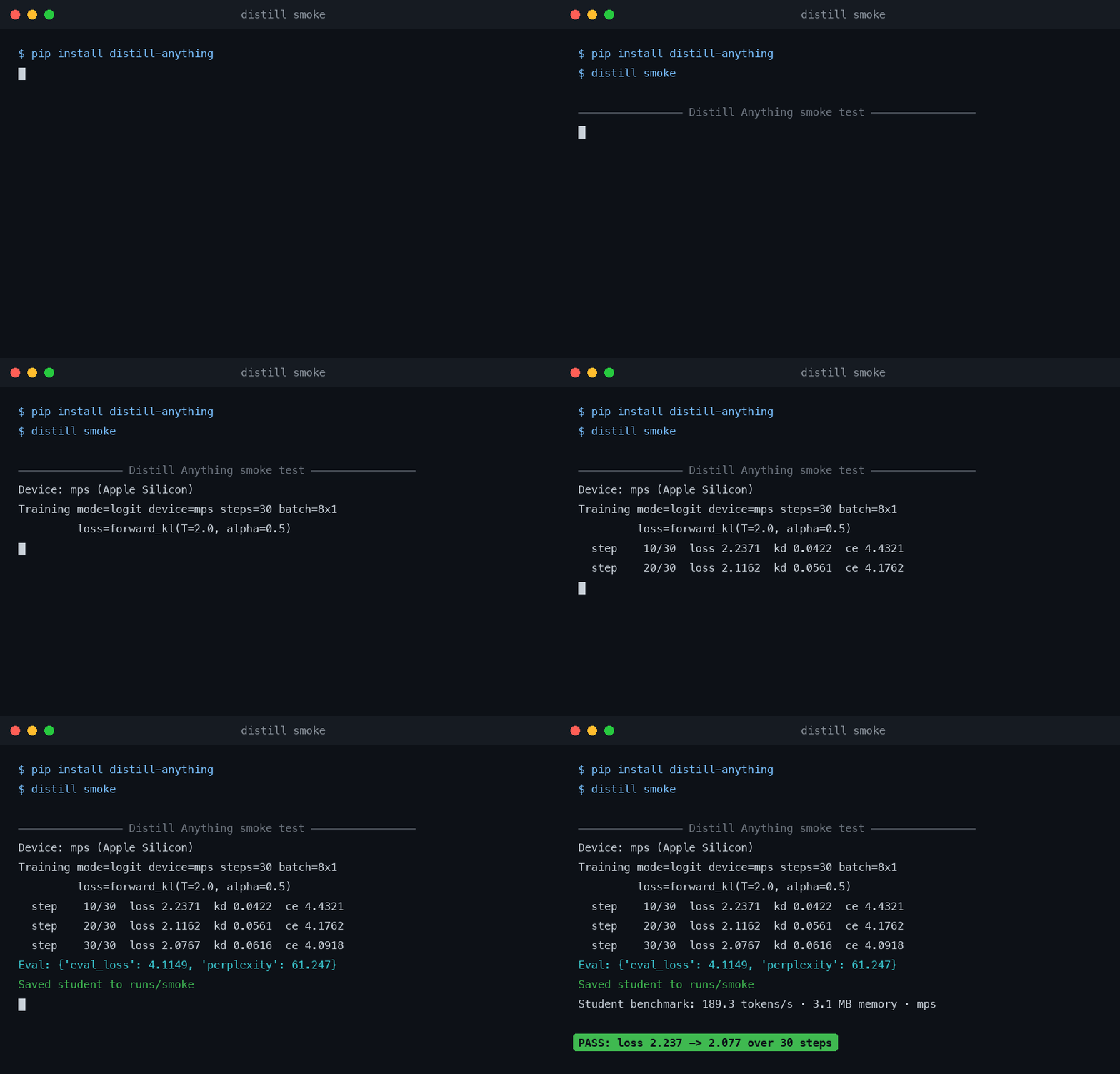
Live: distill smoke — full logit-KD pipeline, offline, <60s on a MacBook. loss 2.24 → 2.08, PASS.
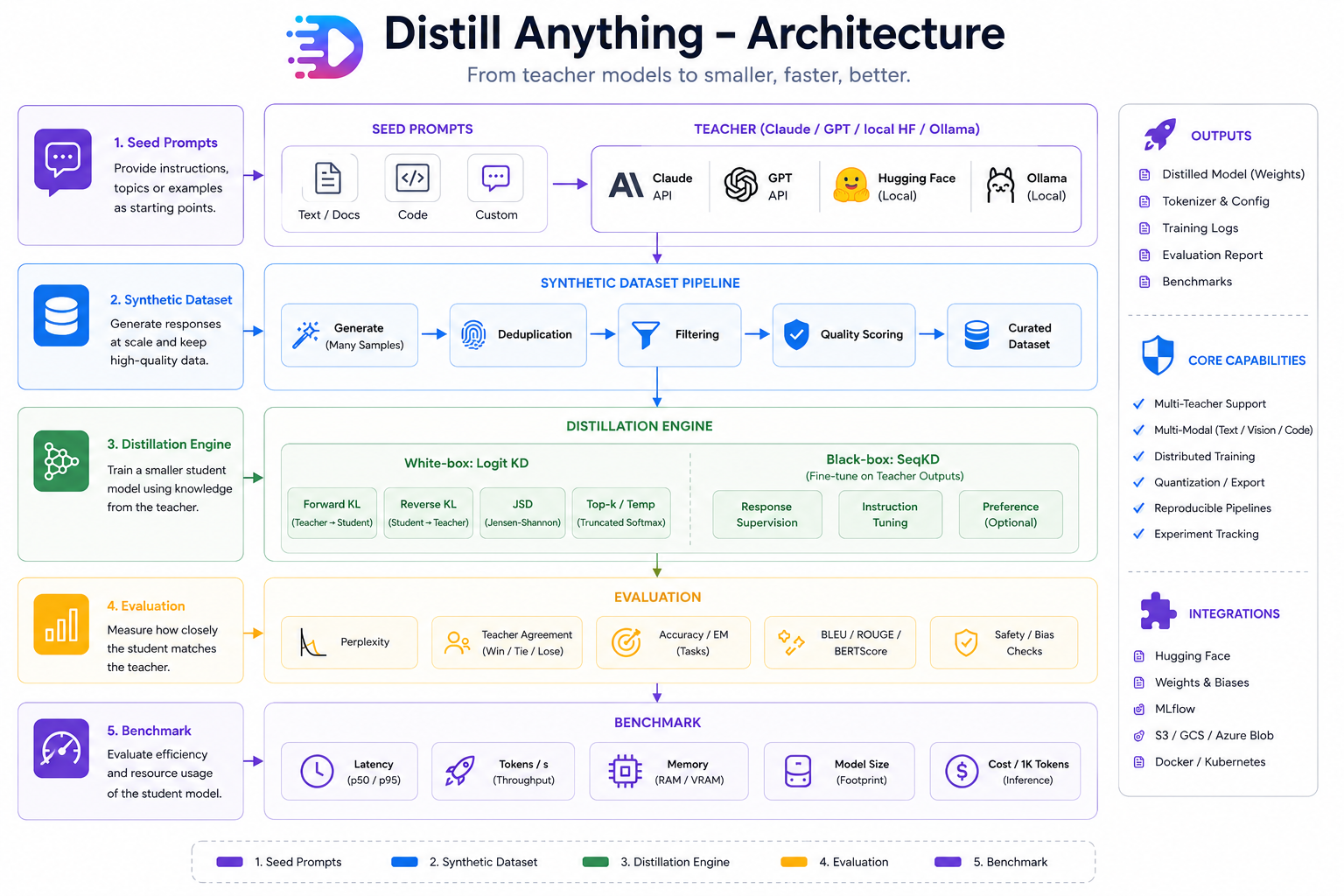
The full picture. What's shipped vs planned: status table.
What it does
- Any teacher —
claude,openai:gpt-4o-mini,ollama:llama3.2, or any localhf:model, selected by one spec string - Synthetic data —
distill generateturns seed prompts into a deduped instruction dataset, with self-instruct-style prompt expansion (--expand 5) - Quality gating — an LLM judge scores every record 1–10 before training (
--judge claude --min-score 7) - White-box logit KD — forward KL (Hinton), reverse KL (MiniLLM-style), generalized JSD, temperature scaling, and top-k truncation so 50k-vocab KD fits in laptop memory
- Black-box seqKD — no logits needed; fine-tune on what an API teacher wrote
- LLM-as-judge eval — blind A/B, position-swapped to kill judge bias → win/tie/lose and one headline number: quality retention
- Report card —
distill reportwrites a shareableREPORT.md: quality vs the teacher, p50/p95 latency, tokens/s, memory, $ per 1K tokens - LoRA / QLoRA students — freeze the base, train adapters: 1–3B students on a 16GB laptop (
[lora]extra); 4-bit QLoRA on CUDA ([qlora]) - Hardware-aware — CUDA (bf16) → Apple Silicon MPS → CPU, detected automatically; teachers load in half precision on GPU/MPS
How it works (30 seconds)
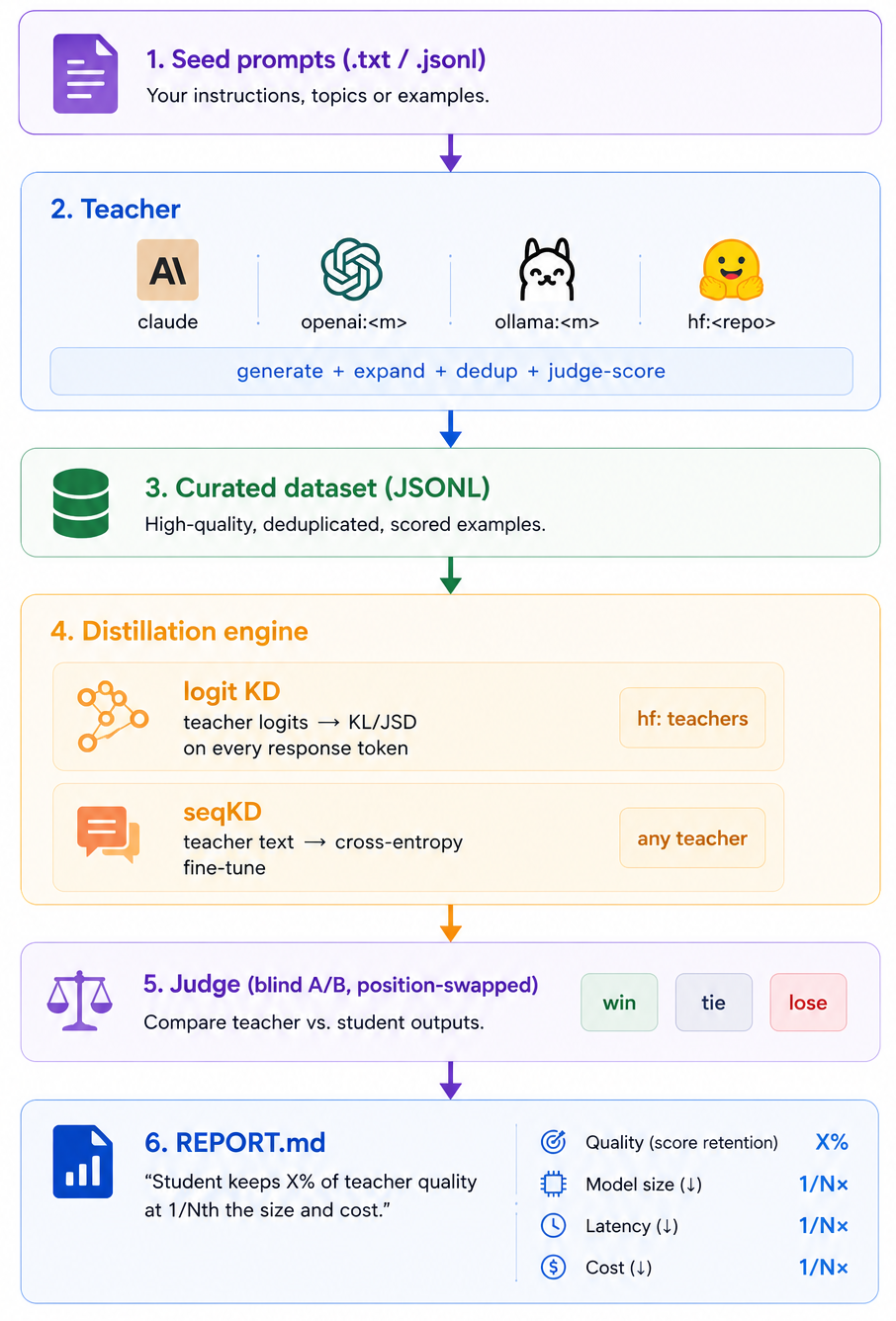
One DistillConfig YAML describes the whole run; the same recipe format works for a 135M student on a MacBook and a 7B student on an A100.
Get started (60 seconds)
# 1 — Install
pip install distill-anything                    # core (torch, transformers)
pip install "distill-anything[anthropic]"       # optional: Claude as teacher/judge
pip install "distill-anything[openai]"          # optional: OpenAI / vLLM / Ollama teachers

# 2 — Verify your machine (tiny random models, zero downloads, <1 min)
distill smoke

# 3 — First real distillation (SmolLM2-360M → 135M, ~1GB download, runs on MPS)
git clone https://github.com/AIAnytime/distillanything && cd distillanything   # example seeds + recipes
distill generate examples/data/seed_prompts.txt \
  --teacher hf:HuggingFaceTB/SmolLM2-360M-Instruct --out data/train.jsonl --expand 5
distill train recipes/mac-small.yaml
distill report runs/mac-small --dataset data/train.jsonl \
  --teacher hf:HuggingFaceTB/SmolLM2-360M-Instruct --judge hf:HuggingFaceTB/SmolLM2-360M-Instruct
Prefer Claude as the teacher? export ANTHROPIC_API_KEY=... then swap --teacher claude and distill train recipes/claude-blackbox.yaml.
Proof
We publish only what we've measured. Every number below reproduces on a stock Apple-Silicon MacBook with the commands shown — no cluster required.
End-to-end pipeline, offline, under a minute (distill smoke):
Training mode=logit device=mps steps=30 loss=forward_kl(T=2.0, alpha=0.5)
  step 10/30  loss 2.2371   →   step 30/30  loss 2.0767
PASS: loss 2.237 -> 2.077 over 30 steps
Benchmark output (distill benchmark sshleifer/tiny-gpt2 --n-runs 3 --cost-per-hour 1.20, measured on an M-series MacBook):
| Metric | Value |
|---|---|
| latency_p50_s | 0.054 |
| latency_p95_s | 0.079 |
| tokens_per_s | 262.4 |
| memory_mb | 0.4 |
| cost_per_1k_tokens_usd | 0.001271 |
A real distillation, end to end on one MacBook — the exact Quickstart above (SmolLM2-360M teaches 135M on 60 records it generated itself, ~15 min total, all local):
| Student (135M, distilled) | Teacher (360M) | |
|---|---|---|
| Parameters | 134.5M | 361.8M |
| Tokens / s (MPS) | 70.5 | 56.7 |
| Latency p50 | 0.40s | 0.76s |
| Disk | 538MB | 1447MB |
| $ / 1K tokens @ $1.20/hr | $0.0047 | $0.0059 |
- Quality retention 87.5% on 24 held-out prompts (1 win / 20 ties / 3 losses), judged blind with position swap by the teacher itself. A 360M judge is coarse — most pairs tie; point
--judge claudeat it for sharper discrimination. - Token-level teacher agreement 81%, perplexity 2.17 (3-example eval split — demo scale).
- The full unedited artifact: examples/sample-report.md, generated by
distill report.
This is the quickstart, not a leaderboard claim — 60 records and 8 optimizer steps prove the loop runs on a laptop, not the ceiling of the method.
Honest-by-construction evals: the judge sees answers blind and judges each pair twice with positions swapped — a judge that always prefers "Answer A" nets out to a tie (that exact adversarial case is in the test suite). Disagreements and unparseable verdicts count as ties, never wins. 36 tests run fully offline against tiny random models.
The report card
The question that matters is "did the student keep the teacher's quality at a fraction of the cost?" — so every run can end with a one-page answer:
distill report runs/mac-small \
  --dataset data/train.jsonl \
  --teacher hf:HuggingFaceTB/SmolLM2-360M-Instruct \
  --judge claude --n 32 --cost-per-hour 1.20
REPORT.md leads with quality retention (how often the student matches or beats the reference), then a side-by-side efficiency table (params, tokens/s, p50/p95, memory, $/1K tokens — "3.0x smaller and 3.0x faster"), sample outputs, and the training metrics. report.json sits next to it for machines.
Examples, notebook, and tests-as-docs
Three ways to learn the framework, all installing from PyPI (pip install distill-anything or uv pip install distill-anything):
📓 The notebook — examples/sample_notebook.ipynb walks the entire lifecycle with commentary: install → offline self-test → teacher-generated dataset → logit KD → rendered report card → benchmark → swapping in Claude/GPT teachers. Section 1 runs instantly offline; the full tour is ~15 min on a MacBook.
🐍 The scripts — the same flow as three standalone, heavily commented files you can copy into your own project:
| Script | What it teaches |
|---|---|
examples/01_generate_dataset.py |
Teacher specs, seed prompts, self-instruct expansion, dataset JSONL format |
examples/02_train_student.py |
Student.learn(), white-box vs black-box mode selection, the KD loss knobs |
examples/03_evaluate_and_report.py |
Blind position-swapped judging, quality retention, the REPORT.md artifact |
🧪 The tests as living docs — the suite runs offline in seconds and doubles as executable documentation:
| Test file | Read it to learn |
|---|---|
tests/test_losses.py |
The KD math contracts: non-negativity, masking, top-k truncation, backprop |
tests/test_judge.py |
How to fake a Teacher for your own tests; why position-swap kills judge bias |
tests/test_trainer.py |
Training end-to-end with tiny random models (the pattern for fast iteration) |
tests/test_report.py |
The report data shape and a full build-report integration run |
git clone https://github.com/AIAnytime/distillanything && cd distillanything
pip install "distill-anything[dev]" && pytest    # green in seconds, no GPU/keys/network
Teachers
One string selects any knowledge source — as teacher or as judge:
| Spec | Backend | KD mode |
|---|---|---|
hf:HuggingFaceTB/SmolLM2-360M-Instruct |
local Hugging Face model | white-box (logits) |
claude / claude:claude-opus-4-8 |
Anthropic API | black-box (seqKD) |
openai:gpt-4o-mini |
OpenAI API (or any compatible endpoint) | black-box |
ollama:llama3.2 |
local Ollama server | black-box |
One rule to know: logit KD requires student and teacher to share a tokenizer (same model family). Across tokenizers, use mode: seqkd — cross-tokenizer logit alignment (ULD) is on the roadmap.
Recipes
Everything is a YAML recipe (distill init writes a starter):
mode: logit                # or seqkd
teacher: { spec: hf:HuggingFaceTB/SmolLM2-360M-Instruct }
student: { model: HuggingFaceTB/SmolLM2-135M-Instruct }
data:    { path: data/train.jsonl, max_seq_len: 512 }
loss:    { kind: forward_kl, temperature: 2.0, alpha: 0.5, top_k: 256 }
train:   { output_dir: runs/out, lr: 1.0e-4, epochs: 2, batch_size: 2, grad_accum: 8 }
Or skip YAML entirely:
from distillanything import Student

student = Student("HuggingFaceTB/SmolLM2-135M-Instruct")
student.learn(teacher="claude", dataset="data/prompts_only.jsonl")   # generates missing responses, then trains
print(student.generate("Explain what a database index is."))
print(student.benchmark())
LoRA & QLoRA — big students on small hardware
Full fine-tuning caps laptop students around ~360M (AdamW keeps two moments per
weight). LoRA freezes the base and trains ~0.5% of the params, so a 1.5B student
learns from a 3B teacher on 16GB of RAM — see recipes/mac-lora.yaml:
student = Student("Qwen/Qwen2.5-1.5B-Instruct", lora={"r": 16, "alpha": 32})
student.learn(teacher="hf:Qwen/Qwen2.5-3B-Instruct", dataset="data/train.jsonl",
              gradient_checkpointing=True, batch_size=1, grad_accum=16)
Adapters merge into the base on save by default, so the output stays a plain HF
checkpoint (set merge_lora: false for tiny adapter-only saves — every distill
command loads those transparently). On CUDA, add "qlora": True to load the frozen
base in 4-bit (recipes/gpu-qlora.yaml); QLoRA is CUDA-only
because bitsandbytes has no Apple Silicon backend. Install: pip install "distill-anything[lora]".
When to use · When to skip
Great fit if you…
- want a specialized model that's 10–100x smaller than the API model you're calling today
- have (or can seed) a few hundred domain prompts and an API key or a local teacher model
- work on a laptop — everything here is sized to run and iterate on 16GB of RAM
Skip it if you…
- need RAG or prompt engineering, not a trained model — distillation is for when the task is stable and volume is high
- need cross-tokenizer logit KD, multimodal, or distributed training today (roadmap, not shipped)
- expect a hosted platform — this is a framework; you bring the compute
What's real today vs the vision
The architecture diagram is the north star, not the changelog. Every box, mapped honestly:
Legend: ✅ shipped · 🚧 partial · 🗺️ planned, not yet built
| Diagram section | Box | Status | Notes |
|---|---|---|---|
| Seed Prompts | Text / Docs, Custom | ✅ | .txt (one prompt/line) and .jsonl (prompt/messages/text) |
| Seed Prompts | Code | 🚧 | No special handling — treated as plain text, works but untuned |
| Teacher | Claude API, GPT API, Hugging Face (Local), Ollama (Local) | ✅ | hf: / claude / openai: / ollama: teacher specs |
| Synthetic Dataset Pipeline | Generate, Deduplication, Curated Dataset | ✅ | distill generate, normalized-content dedup |
| Synthetic Dataset Pipeline | Filtering | 🚧 | Empty/too-short response filter only — no content or toxicity filters yet |
| Synthetic Dataset Pipeline | Quality Scoring | ✅ | LLM-judge 1-10 scoring: distill generate --judge claude --min-score 7 |
| Distillation Engine | Forward KL, Reverse KL, JSD, Top-k/Temp | ✅ | White-box logit KD, all three divergences + top-k truncation |
| Distillation Engine | Response Supervision, Instruction Tuning | ✅ | Black-box seqKD (fine-tune on teacher-generated text) |
| Distillation Engine | Preference (Optional) | 🗺️ | No DPO/preference-based distillation yet |
| Evaluation | Perplexity | ✅ | |
| Evaluation | Teacher Agreement | ✅ | Win/tie/lose via blind, position-swapped LLM judge (distill report --judge) + token-level agreement |
| Evaluation | Accuracy/EM, BLEU/ROUGE/BERTScore, Safety/Bias Checks | 🗺️ | No task-benchmark or safety-eval harness yet |
| Benchmark | Tokens/s, Memory, Model Size | ✅ | distill benchmark |
| Benchmark | Latency | ✅ | p50/p95 over repeated runs (--n-runs) |
| Benchmark | Cost / 1K Tokens | ✅ | From measured throughput × your --cost-per-hour |
| Outputs | Model Weights, Tokenizer & Config, Training Logs, Benchmarks | ✅ | Saved to output_dir on every run |
| Outputs | Evaluation Report | ✅ | distill report writes a shareable REPORT.md + report.json per run |
| Core Capabilities | Reproducible Pipelines | ✅ | Seeded runs + full config snapshot saved alongside the checkpoint |
| Core Capabilities | Multi-Teacher Support, Multi-Modal, Distributed Training, Quantization/Export, Experiment Tracking | 🗺️ | One teacher/one device per run today; text-only; no W&B/MLflow hooks |
| Integrations | Hugging Face | ✅ | Models, tokenizers, chat templates |
| Integrations | Weights & Biases, MLflow, S3/GCS/Azure Blob, Docker/Kubernetes | 🗺️ | Not integrated yet |
| How you interact | Python SDK, CLI | ✅ | Student().learn(...) and distill ... |
| How you interact | REST API, Web UI | 🗺️ | CLI/SDK only for now |
What's inside
teachers/— oneTeacherabstraction; local HF models expose logits (white-box), API teachers expose text (black-box). Registry resolves spec strings.losses/kd.py— masked, temperature-scaled (T² gradient correction) forward KL / reverse KL / generalized JSD, with top-k support truncation and automatic vocab-padding alignment.data/— JSONL/txt loading, chat-template rendering, prompt-masked tokenization, normalized dedup, teacher-driven generation with prompt expansion.train/trainer.py— hand-rolled loop (no HF Trainer): grad accumulation, cosine LR + warmup, grad clipping, KD+CE mixing, MPS-safe autocast policy.eval/judge.py— pairwise blind judging with position-swap debiasing; absolute 1–10 scoring for dataset gating.eval/benchmark.py— p50/p95 latency, throughput, peak memory, $/1K tokens.eval/report.py— REPORT.md + report.json builder.testing.py— tiny random Llama models + in-memory char tokenizer, so the whole suite runs offline.
Compared to
Excellent distillation trainers exist — the gap this project fills is the lifecycle around the training loop:
| Primary focus | Data generation from API teachers | Blind LLM-judge → report card | Sized for laptops | |
|---|---|---|---|---|
| Distill Anything | Full lifecycle: generate → distill → judge → benchmark | ✅ | ✅ | ✅ |
| TRL (GKD) | RL/KD training methods in the HF ecosystem | — | — | GPU-oriented |
| DistillKit | KD training techniques | — | — | GPU-oriented |
| EasyDistill | KD training + data synthesis toolkit | ✅ | — | GPU-oriented |
If you already have a curated dataset and a GPU and just want a training loop, TRL's GKD trainer is great — and our loss implementations follow the same literature (Hinton KD, MiniLLM, DistiLLM).
Roadmap
Beyond closing the 🗺️ gaps in the status table:
- LoRA/QLoRA students — distill into 1–3B students on 16GB of RAM (shipped in v0.2)
- Hidden-state / feature KD with learned projectors
- Cross-tokenizer logit distillation (ULD)
- Multi-teacher voting and ensembling
- VLM, embedding, and reranker distillation
- Eval harness integration (lm-eval-harness) and regression tracking
Everything in this repo is and stays Apache-2.0. A hosted layer (GPU orchestration, dashboards, model registry) may come later — the framework is the product, not the funnel.
Development
uv venv && uv pip install -e ".[dev]"
pytest            # 36 tests, fully offline (tiny random models, fake judges)
distill smoke     # end-to-end pipeline check on your hardware
PRs welcome — the test suite needs no GPU, no API keys, and no downloads.
License
Apache 2.0 — see LICENSE.


Download files
Download the file for your platform. If you're not sure which to choose, learn more about installing packages.
Source Distribution
Built Distribution
Filter files by name, interpreter, ABI, and platform.
If you're not sure about the file name format, learn more about wheel file names.
Copy a direct link to the current filters
File details
Details for the file distill_anything-0.2.0.tar.gz.
File metadata
- Download URL: distill_anything-0.2.0.tar.gz
- Upload date:
- Size: 52.5 kB
- Tags: Source
- Uploaded using Trusted Publishing? No
- Uploaded via: uv/0.11.24 {"installer":{"name":"uv","version":"0.11.24","subcommand":["publish"]},"python":null,"implementation":{"name":null,"version":null},"distro":{"name":"macOS","version":null,"id":null,"libc":null},"system":{"name":null,"release":null},"cpu":null,"openssl_version":null,"setuptools_version":null,"rustc_version":null,"ci":null}
File hashes
| Algorithm | Hash digest | |
|---|---|---|
| SHA256 |
896752f3f5942f14fcae3fe9133684de5aaf5ab429fbefc817e7fd3b48c7b9fc
|
|
| MD5 |
a2e8c6b7c606036d4f4c84a9d4fa03be
|
|
| BLAKE2b-256 |
573d4b87f08bcaedc7f717927bf05a359ab50cfe79f56db10ac6375596db6507
|
File details
Details for the file distill_anything-0.2.0-py3-none-any.whl.
File metadata
- Download URL: distill_anything-0.2.0-py3-none-any.whl
- Upload date:
- Size: 49.4 kB
- Tags: Python 3
- Uploaded using Trusted Publishing? No
- Uploaded via: uv/0.11.24 {"installer":{"name":"uv","version":"0.11.24","subcommand":["publish"]},"python":null,"implementation":{"name":null,"version":null},"distro":{"name":"macOS","version":null,"id":null,"libc":null},"system":{"name":null,"release":null},"cpu":null,"openssl_version":null,"setuptools_version":null,"rustc_version":null,"ci":null}
File hashes
| Algorithm | Hash digest | |
|---|---|---|
| SHA256 |
163df9c7a9196906ebc9880400cc1caff482dfbafc0104a7d3a48ed041051b6c
|
|
| MD5 |
d9ac7af1140116711eef2551cb482270
|
|
| BLAKE2b-256 |
ee0a9c7cf0aecae862a8461f85490e76597c8fb676d87719afe071d6c8bfe2d9
|






