
Execute Django ORM queries directly from the admin interface

Project description
Django Admin Query Executor
A powerful Django admin extension that allows you to execute Django ORM queries directly from the admin interface. It supports complex queries including Q() objects, annotations, aggregations, and all standard Django ORM methods.


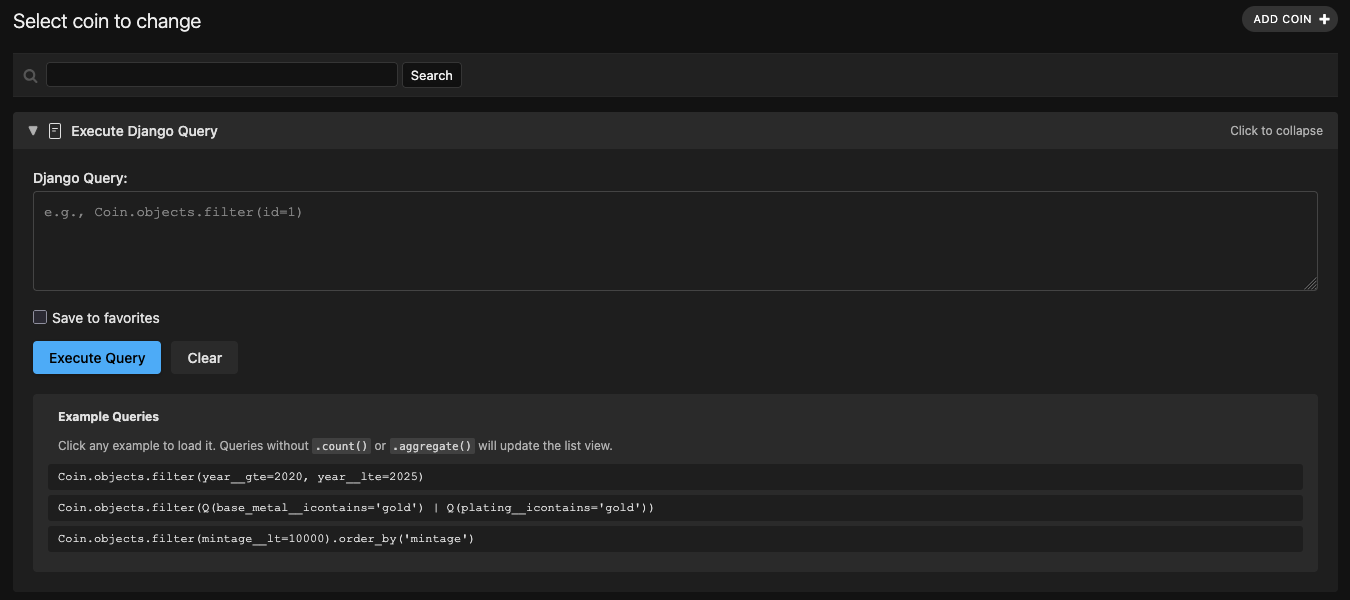
Features
- Direct Query Execution: Execute Django ORM queries directly from the admin changelist view
- Seamless Integration: Query results replace the standard admin list view
- Full Django ORM Support: Use
Q(),F(),Count(),Sum(),Avg(), and other Django model functions - Custom Imports: Add your own modules, functions, and classes to the query execution environment
- Query History: Automatically saves your recent queries for quick re-execution
- Favorite Queries: Save frequently used queries with custom names
- Collapsible Interface: Clean, collapsible UI that doesn't clutter your admin
- Comprehensive Dark Mode Support:
- Automatically adapts to system preferences
- Compatible with Django admin's built-in dark mode
- Works with popular admin themes (Grappelli, Jazzmin, etc.)
- Smooth transitions between light and dark themes
- Accessible color contrasts in both modes
- Security: Queries execute in a restricted environment with whitelisted functions
- Smart Result Detection: Automatically handles both queryset and scalar results
Installation
pip install django-admin-query-executor
Quick Start
Using in Django Admin (QueryExecutorMixin)
- Add
django_admin_query_executorto yourINSTALLED_APPS:
INSTALLED_APPS = [
    ...
    'django_admin_query_executor',
    ...
]
- Add the
QueryExecutorMixinto yourModelAdminclasses:
from django.contrib import admin
from django_admin_query_executor import QueryExecutorMixin
from .models import MyModel

@admin.register(MyModel)
class MyModelAdmin(QueryExecutorMixin, admin.ModelAdmin):
    list_display = ['id', 'name', 'created_at']

    # Optional: Define custom example queries for this model
    query_examples = [
        ("Active items", "MyModel.objects.filter(is_active=True)"),
        ("Recent items", "MyModel.objects.filter(created_at__gte=timezone.now() - timedelta(days=7))"),
        ("Count by status", "MyModel.objects.values('status').annotate(count=Count('id'))"),
    ]
Using as Standalone Function (execute_django_query)
You can also use the query executor outside the admin interface in your views, management commands, APIs, Celery tasks, or scripts:
from django_admin_query_executor import execute_django_query
from myapp.models import Book

# Execute a query from a string
result = execute_django_query(
    "objects.filter(price__gte=20).count()",
    Book
)
print(f"Books priced $20 or more: {result}")

# With custom imports
custom_imports = {
    'json': 'json',
    'timedelta': ('datetime', 'timedelta'),
}
books = execute_django_query(
    "objects.filter(created_date__gte=now() - timedelta(days=30))",
    Book,
    custom_imports=custom_imports
)
Function Signature:
execute_django_query(query_string, model, custom_imports=None)
Parameters:
query_string(str): The Django ORM query string to executemodel(Model): The Django model class to use as the base modelcustom_imports(dict, optional): Additional imports to make available in the query
Returns: QuerySet or other result (int, dict, etc.) depending on the query
Raises: ValueError if there's a syntax error or execution error in the query
Use Cases:
- Django management commands for running scheduled queries
- API endpoints that accept dynamic query strings
- Celery tasks for background query execution
- Admin actions with custom query logic
- Testing and debugging scripts
See example_usage.py for detailed examples including usage in management commands, views, APIs, and Celery tasks.
Usage (Admin Interface)
- Navigate to any model's admin changelist that uses
QueryExecutorMixin - Click "Execute Django Query" to expand the query interface
- Enter your Django ORM query (e.g.,
MyModel.objects.filter(status='active')) - Click "Execute Query"
- The admin list updates to show your query results
Query Examples
# Filter queries
Book.objects.filter(author__name__icontains='Smith')
Book.objects.filter(Q(title__icontains='Django') | Q(title__icontains='Python'))

# Annotations and aggregations
Book.objects.annotate(review_count=Count('reviews')).filter(review_count__gt=10)
Book.objects.aggregate(avg_price=Avg('price'), total_books=Count('id'))

# Complex queries with joins
Author.objects.filter(books__published_date__year=2023).distinct()
Book.objects.select_related('author', 'publisher').filter(price__lt=50)

# Counting and existence checks
Book.objects.filter(category='Fiction').count()
Book.objects.filter(reviews__rating__gte=4).exists()

# Using custom imports (see Custom Imports section)
Book.objects.filter(title__in=json.loads('[\"Book1\", \"Book2\"]'))
Book.objects.filter(created_date__gte=datetime.now() - timedelta(days=30))
Standalone Function Examples
from django_admin_query_executor import execute_django_query
from myapp.models import Book, Author

# Basic filtering
active_books = execute_django_query("objects.filter(is_active=True)", Book)

# Count query
count = execute_django_query("objects.filter(price__gte=20).count()", Book)

# Annotations
stats = execute_django_query(
    "objects.aggregate(avg_price=Avg('price'), total=Count('id'))",
    Book
)

# Complex queries with Q objects
books = execute_django_query(
    "objects.filter(Q(category='Fiction') | Q(category='Mystery'))",
    Book
)

# With custom imports
result = execute_django_query(
    "objects.filter(published_date__gte=now() - timedelta(days=30))",
    Book,
    custom_imports={
        'timedelta': ('datetime', 'timedelta'),
        'now': ('django.utils.timezone', 'now'),
    }
)
Configuration
Custom Imports
You can add custom modules, functions, and classes to the query execution environment in two ways:
Method 1: Django Settings (Global)
Add a QUERY_EXECUTOR_CUSTOM_IMPORTS setting to your Django settings file:
# settings.py
QUERY_EXECUTOR_CUSTOM_IMPORTS = {
    # Import entire modules
    'json': 'json',
    'datetime': 'datetime',
    'timedelta': 'datetime.timedelta',
    'timezone': 'django.utils.timezone',

    # Import specific functions/classes from modules
    'settings': ('django.conf', 'settings'),
    'Decimal': ('decimal', 'Decimal'),

    # Import your custom models and functions
    'Listing': 'numi.models.Listing',
    'Coin': 'numi.models.Coin',
    'custom_function': 'myapp.utils.custom_function',
}
Method 2: ModelAdmin Class Attribute (Per-Admin)
Override the custom_imports attribute in your ModelAdmin:
@admin.register(PossibleMatch)
class PossibleMatchAdmin(QueryExecutorMixin, admin.ModelAdmin):
    # Custom imports specific to this admin
    custom_imports = {
        'json': 'json',
        'settings': ('django.conf', 'settings'),
        'Listing': 'numi.models.Listing',
        'Coin': 'numi.models.Coin',
        'timedelta': ('datetime', 'timedelta'),
        'now': ('django.utils.timezone', 'now'),
    }

    query_examples = [
        ("High confidence matches", "PossibleMatch.objects.filter(textual_score__gt=0.8, image_score__gt=0.8)"),
        ("Recent matches", "PossibleMatch.objects.filter(textual_match_date__gte=now() - timedelta(days=7))"),
        ("Using settings", "PossibleMatch.objects.filter(textual_score__gte=settings.TEXTUAL_SCORE_CUTOFF)"),
        ("With JSON data", "PossibleMatch.objects.filter(id__in=json.loads('[1, 2, 3]'))"),
    ]
Import Format Examples
custom_imports = {
    # Simple module imports
    'json': 'json',                    # import json
    'os': 'os',                        # import os

    # Import specific items from modules
    'settings': ('django.conf', 'settings'),              # from django.conf import settings
    'timezone': ('django.utils', 'timezone'),             # from django.utils import timezone
    'timedelta': ('datetime', 'timedelta'),               # from datetime import timedelta
    'Decimal': ('decimal', 'Decimal'),                    # from decimal import Decimal

    # Import your custom models
    'User': ('django.contrib.auth.models', 'User'),      # from django.contrib.auth.models import User
    'MyModel': ('myapp.models', 'MyModel'),               # from myapp.models import MyModel

    # Import custom functions/utilities
    'my_function': ('myapp.utils', 'my_function'),        # from myapp.utils import my_function
    'calculate_score': ('myapp.scoring', 'calculate_score'),
}
Custom Change List Templates
The mixin automatically overrides the ModelAdmin's change_list_template if the default template is in use. If your ModelAdmin uses a custom template, the template will need to extend admin/query_executor_change_list.html:
{% extends "admin/query_executor_change_list.html" %}
Custom Example Queries
Define model-specific example queries by adding a query_examples attribute to your ModelAdmin:
class BookAdmin(QueryExecutorMixin, admin.ModelAdmin):
    query_examples = [
        ("Bestsellers", "Book.objects.filter(is_bestseller=True)"),
        ("By price range", "Book.objects.filter(price__gte=20, price__lte=50)"),
        ("Review stats", "Book.objects.annotate(avg_rating=Avg('reviews__rating')).filter(avg_rating__gte=4.0)"),
        ("Using custom imports", "Book.objects.filter(created_date__gte=now() - timedelta(days=30))"),
    ]
Customizing Query History
Control the number of queries saved in history:
class BookAdmin(QueryExecutorMixin, admin.ModelAdmin):
    query_history_limit = 10  # Default is 5
Supported Django ORM Features
Query Methods
filter(),exclude(),get()order_by(),reverse(),distinct()values(),values_list()select_related(),prefetch_related()annotate(),aggregate()first(),last(),exists(),count()
Query Expressions
Q()for complex queriesF()for field referencesCount(),Sum(),Avg(),Max(),Min()Case(),When()for conditional expressionsExists(),OuterRef(),Subquery()
Database Functions
- String functions:
Lower(),Upper(),Length(),Concat() - Date functions:
TruncDate(),Extract(),Now() - Type casting:
Cast(),Coalesce()
Dark Mode Support
The package includes comprehensive dark mode support that:
- Auto-detects your system's color scheme preference
- Integrates seamlessly with Django admin's native dark mode
- Supports popular admin themes including:
- Django's built-in dark mode
- Grappelli dark theme
- Django Jazzmin dark mode
- Django Admin Interface dark themes
- Provides smooth transitions when switching between themes
- Ensures accessibility with proper color contrasts
- Includes custom CSS variables for easy customization
Customizing Dark Mode Colors
You can override the default colors by adding CSS variables to your admin CSS:
.query-executor-container {
    --qe-bg-primary: #1a1a1a;
    --qe-text-primary: #ffffff;
    --qe-button-primary-bg: #007bff;
    /* See query_executor_dark_mode.css for all available variables */
}
Security
The query executor runs in a restricted environment with:
- Whitelisted functions and classes only
- No access to private attributes or methods
- No direct database access beyond Django ORM
- No file system or network access
- Custom imports are loaded with error handling
- Failed imports are logged but don't break functionality
Requirements
- Django >= 3.2
- Python >= 3.8
License
MIT License - see LICENSE file for details
Contributing
Contributions are welcome! Please feel free to submit a Pull Request.
API Reference
execute_django_query(query_string, model, custom_imports=None)
Standalone function for executing Django ORM queries from text strings outside the admin interface.
Parameters:
query_string(str): Django ORM query string (e.g.,"objects.filter(status='active').count()")model(django.db.models.Model): The Django model class to querycustom_imports(dict, optional): Additional modules/functions to make available- Format:
{alias: module_path}or{alias: (module_path, attribute)} - Example:
{'json': 'json', 'MyModel': ('myapp.models', 'MyModel')}
- Format:
Returns:
- QuerySet, int, dict, or other result depending on the query
Raises:
ValueError: If there's a syntax error or execution error in the query
Security:
- Queries execute in a restricted environment with whitelisted functions only
- No access to private attributes, file system, or network
- Custom imports are loaded with error handling
Example:
from django_admin_query_executor import execute_django_query
from myapp.models import Book

# Simple usage
books = execute_django_query("objects.filter(price__lt=30)", Book)

# With custom imports
result = execute_django_query(
    "objects.filter(created__gte=now() - timedelta(days=7))",
    Book,
    custom_imports={
        'timedelta': ('datetime', 'timedelta'),
        'now': ('django.utils.timezone', 'now'),
    }
)
Changelog
1.2.0 (TBD)
- Added standalone
execute_django_query()function for use outside admin interface - Function can be used in management commands, views, APIs, Celery tasks, and scripts
- Refactored internal implementation to share code between mixin and standalone function
1.1.0 (2025-01-17)
- Added custom imports support via Django settings and ModelAdmin attribute
1.0.0 (2025-07-17)
- Initial release
- Full Django ORM query support
- Query history and favorites
- Dark mode support
- Collapsible interface
Release history Release notifications | RSS feed


Download files
Download the file for your platform. If you're not sure which to choose, learn more about installing packages.
Source Distribution
Built Distribution
Filter files by name, interpreter, ABI, and platform.
If you're not sure about the file name format, learn more about wheel file names.
Copy a direct link to the current filters
File details
Details for the file django_admin_query_executor-1.2.0.tar.gz.
File metadata
- Download URL: django_admin_query_executor-1.2.0.tar.gz
- Upload date:
- Size: 25.1 kB
- Tags: Source
- Uploaded using Trusted Publishing? No
- Uploaded via: twine/6.1.0 CPython/3.13.2
File hashes
| Algorithm | Hash digest | |
|---|---|---|
| SHA256 |
c95215b122de0a9ebfec5f2079d2594155c809bd06f2c0461a3a489aa6a31d7f
|
|
| MD5 |
36be36f3b5531acd51d8932566c20be8
|
|
| BLAKE2b-256 |
33b036d9a76aafb6b177b18cac52284787e6ebe4e6a90aa945be54425aea1183
|
File details
Details for the file django_admin_query_executor-1.2.0-py3-none-any.whl.
File metadata
- Download URL: django_admin_query_executor-1.2.0-py3-none-any.whl
- Upload date:
- Size: 20.1 kB
- Tags: Python 3
- Uploaded using Trusted Publishing? No
- Uploaded via: twine/6.1.0 CPython/3.13.2
File hashes
| Algorithm | Hash digest | |
|---|---|---|
| SHA256 |
f6accf89e20b3aaba925481686f69c138bcc6abf8c0207dbbfceff7cde8b4e89
|
|
| MD5 |
ac3ce006a7228b7c2592004bbe985a01
|
|
| BLAKE2b-256 |
d5b8cad021a3f9ba1810d5d33b708cf0af03bc1828a0af3c4f58a1ecfda783b1
|






