
django-admin-select-filter





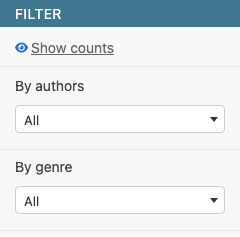
Select2-powered admin list filters for Django.
Install
pip install django-admin-select-filter
Add to INSTALLED_APPS:
INSTALLED_APPS = [
    ...
    "django_admin_select_filter",
]
Usage
ChoiceFilter
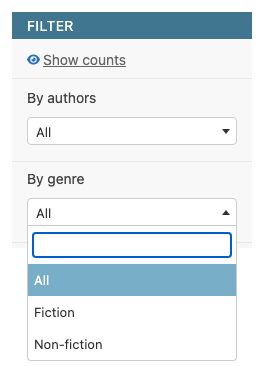
The main filter: it works on any field with discrete values — a
choices-backed CharField/IntegerField, a BooleanField, or an explicit
options list you provide yourself:
from django.contrib import admin
from django_admin_select_filter import ChoiceFilter

from myapp.models import Book


class GenreFilter(ChoiceFilter):
    parameter_name = "genre"  # reads Book.genre.choices


class StatusFilter(ChoiceFilter):
    parameter_name = "status"
    options = [("draft", "Draft"), ("published", "Published")]


@admin.register(Book)
class BookAdmin(admin.ModelAdmin):
    list_filter = [GenreFilter, StatusFilter]
Since options accepts any explicit (value, label) list, ChoiceFilter
can even filter a ForeignKey — pass one pair per related row:
class AuthorChoiceFilter(ChoiceFilter):
    parameter_name = "author"
    options = [(author.pk, str(author)) for author in Author.objects.all()]
This isn't optimal, though: options is evaluated once, when the class body
runs (at import time), so it goes stale as rows are added or renamed —
there's no live query, search, or async loading behind it. For a real
ForeignKey, use ForeignKeyFilter below instead.
ForeignKeyFilter
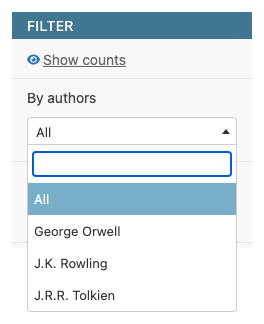
Built specifically for ForeignKey/ManyToManyFields: it queries the
related model live, supports searching through the related model's own
ModelAdmin.search_fields, and can defer loading options until the widget
is opened (see async_call further down).
from django_admin_select_filter import ForeignKeyFilter


class AuthorFilter(ForeignKeyFilter):
    parameter_name = "author"
    ordering = ["name"]


@admin.register(Book)
class BookAdmin(admin.ModelAdmin):
    list_filter = [AuthorFilter]
model is only needed when it can't be inferred. By default it's resolved by
walking parameter_name across Book's relations, following a nested lookup
(e.g. parameter_name = "author__country") segment by segment — forward or
reverse — and taking the last segment's related model. Set model explicitly
if the lookup isn't a real relation chain, or to point somewhere else.
field_list_filter()
For a one-off filter that doesn't need its own subclass, use Django's own
list_filter shorthand — a (field_name, filter_class) tuple — via
field_list_filter():
from django_admin_select_filter import ChoiceFilter, ForeignKeyFilter, field_list_filter


@admin.register(Book)
class BookAdmin(admin.ModelAdmin):
    list_filter = [
        ("author", field_list_filter(ForeignKeyFilter)),
        ("genre", field_list_filter(ChoiceFilter)),
    ]
parameter_name (and, for ForeignKeyFilter, model) is inferred from the
field automatically — including a nested lookup like "author__country" —
so the same wrapped class can be reused across as many fields as you like.
It only supports async_call = False; for an async_call filter, define a
dedicated subclass instead (field_list_filter() raises TypeError right
away if you pass it one, rather than fail silently later).
Shared options
Both filters share the same options: filter_only_used_values, async_call,
searchable, nullable and title. Both also support a nested lookup for
parameter_name (e.g. "author__status"), resolving the field — and, for
ForeignKeyFilter, the model — by walking each __-separated relation in
turn, forward or reverse.
theme sets the Select2 theme; by default Select2's own, styled like the
admin (or admin-autocomplete with django-unfold).
Set searchable = False to hide the search input entirely and get a plain
dropdown instead — best for a short, static option list.
Set multiple = True to let either filter accept several values at once:
class AuthorFilter(ForeignKeyFilter):
    parameter_name = "author"
    multiple = True
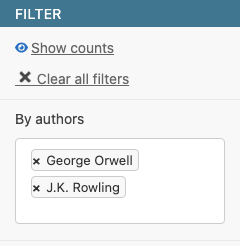
Selected values are joined in the query string with multiple_separator
("," by default) and applied with an __in lookup, so configured values
(primary keys, option values) must not contain that character. The "All"
option is dropped in this mode — clearing every selected chip already means
no filter.
Async options (async_call = True)
Set async_call = True on a filter to defer loading its options until the
Select2 widget is opened, fetching them over AJAX instead of rendering every
option upfront — useful for a related model with many rows. It requires
wiring an options endpoint: drop django_admin_select_filter_path() into
your root urlpatterns — no include() needed:
# urls.py
from django_admin_select_filter import django_admin_select_filter_path

urlpatterns = [
    ...
    django_admin_select_filter_path(),
]
Its route defaults to django_admin_select_filter/options/; pass route in
case it collides with something else in your project:
django_admin_select_filter_path(route="custom-options/")
The endpoint stays reversible as admin_select_filter:options either way —
django_admin_select_filter_path() still namespaces it internally via
include(), that's just no longer something you have to write yourself.
Pass route, view, name or as_view_kwargs to customize it further. If
you pass a custom name, set async_call_url explicitly on every
async_call filter to match it — filters resolve the default endpoint by
its default name, and have no way to discover a custom one chosen here.
Each async_call filter reads that shared endpoint through
BaseSelectFilter.async_call_url, resolved automatically at request time via
reverse("admin_select_filter:options"). Set async_call_url on a specific
filter to point it at a different view instead:
class AuthorFilter(ForeignKeyFilter):
    parameter_name = "author"
    async_call = True
    async_call_url = "/api/custom-author-options/"
If its route shares a prefix with your admin mount (e.g. both under
admin/), list django_admin_select_filter_path() before
path("admin/", admin.site.urls). Since Django 4.1, AdminSite registers a
catch-all view (AdminSite.final_catch_all_view, enabled by default) that
matches every otherwise-unmatched URL under its own prefix and raises
Http404 itself — so if the admin mount comes first, it swallows requests to
this app's options endpoint before its URLs ever get a chance to match, and
you'll see a 404 with a full HTML body (the admin's own "Page not found"
page) instead of this app's JSON response.
The filter template loads jQuery/Select2 from Django admin's bundled vendor
assets on demand, so no extra JS dependency is required. Make sure
django.contrib.staticfiles is installed and configured.
The endpoint only serves filters with async_call = True and requires the
requesting user to have view permission on the target model (checked via
ModelAdmin.has_view_permission) — anonymous or unprivileged requests get a
403, and a parameter_name matching a non-async filter gets a 404. It looks
the model up across every registered AdminSite (not just the default
django.contrib.admin.site), so a project using its own AdminSite works too.
By default it does this by calling get_list_filter() on every matching
ModelAdmin on every request. For a project with many admins or filters,
pass as_view_kwargs={"use_registry": True} to
django_admin_select_filter_path() instead: it resolves filters from a
{site: {app_label: {model_name: {parameter_name: filter}}}} map built once
and cached for the process's lifetime (admin registrations are static after
startup), turning that per-request scan into a single dict lookup. The
trade-off: it calls get_list_filter(request=None) while building the
cache, so a get_list_filter() override that depends on the request isn't
supported in this mode.
Themes
- django-unfold: works as it is, with Unfold's Select2 styles.
Translations
Ships a Spanish (es) translation; its texts otherwise come from Django's
own catalogs, so they follow the admin's language. Select2's own messages
("No results found", "Searching…") load the same translation file the
admin's autocomplete fields use for the active language.
Contributing
See CONTRIBUTING.md for development setup, running the test suite (including the browser-driven e2e tests), and pre-commit hooks.
1 maintainer

Metadata
1 maintainer
Release files for django-admin-select-filter 0.1.3
For a detailed explanation of source distributions (sdists) and built distributions (wheels), please see the package formats documentation.
Source distribution (sdist)
| File | Size | Uploaded | |
|---|---|---|---|
| django_admin_select_filter-0.1.3.tar.gz | 468.4 kB | Details |
Built distribution (wheel)
| File | Interpreter | ABI | Platform | Reset |
|---|---|---|---|---|
| django_admin_select_filter-0.1.3-py3-none-any.whl | Python 3 | none | any | Details |
Total release size: 495.7 kB
Release files / django_admin_select_filter-0.1.3.tar.gz
| Download URL | django_admin_select_filter-0.1.3.tar.gz |
|---|---|
| Size | 468.4 kB |
| Tags | Source |
|
SHA-256 checksum How to use checksums |
9941e21ec7b1b97257a7e8677405645dde9f1b4d3564068285faeabb33640f1c
|
|
BLAKE2b-256 checksum How to use checksums |
15720397e7ff447136b30ddf9b297178e20220a454cafaf19dbc5fe747aafe27
|
| Upload date | |
|
Uploaded using Trusted Publishing? What is trusted publishing? |
Yes |
| Uploaded via |
twine/7.0.0 CPython/3.13.14
|
Provenance
Provenance describes where a file came from. On PyPI, provenance is shared via attestations, which provide a verifiable record of the build or publishing details. View details, limitations and caveats.


PyPI Publish Attestation
PyPI verified that this artifact, at this checksum, originated from the publisher listed below.
Signed by GitHub Actions, verified by PyPI on Oct 7, 2026.
Transparency logRelease files / django_admin_select_filter-0.1.3-py3-none-any.whl
| Download URL | django_admin_select_filter-0.1.3-py3-none-any.whl |
|---|---|
| Size | 27.3 kB |
| Tags | Python 3 |
|
SHA-256 checksum How to use checksums |
8012314693ba5adcf939a0698c7af1495d08d4911b5a73866181dd89e1b5dd4c
|
|
BLAKE2b-256 checksum How to use checksums |
7931864e1d033cce849878c803dc2341fd5f5509ff0d649f9aa6759bab046d7a
|
| Upload date | |
|
Uploaded using Trusted Publishing? What is trusted publishing? |
Yes |
| Uploaded via |
twine/7.0.0 CPython/3.13.14
|
Provenance
Provenance describes where a file came from. On PyPI, provenance is shared via attestations, which provide a verifiable record of the build or publishing details. View details, limitations and caveats.
PyPI Publish Attestation
PyPI verified that this artifact, at this checksum, originated from the publisher listed below.
Signed by GitHub Actions, verified by PyPI on Oct 7, 2026.
Transparency log













