"Swagger for everything Swagger doesn't cover."




Full docs, screenshots, and the source live on GitHub — this page is a plain-markdown version of the same README, since PyPI's renderer doesn't support the layout GitHub does.
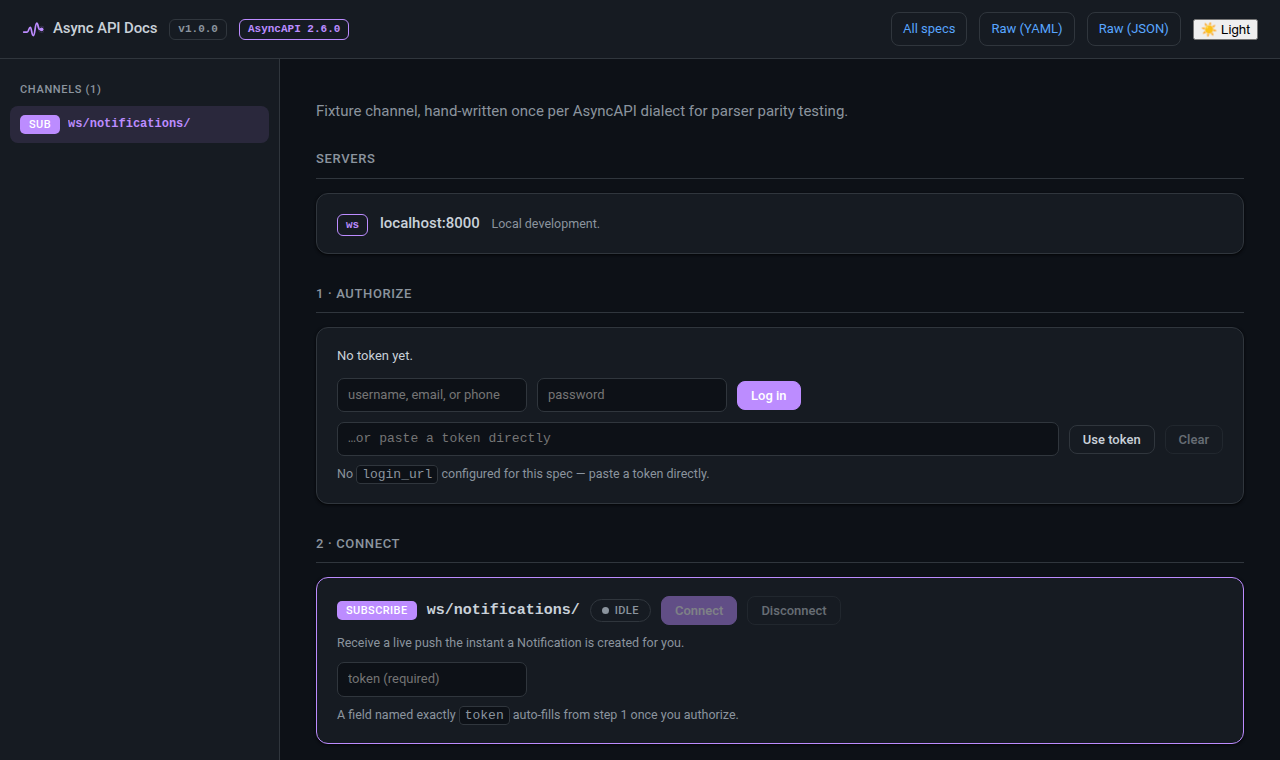
Auto-generated, interactive documentation — and a live test console — for AsyncAPI specs: WebSocket, SSE, MQTT, or any other async protocol your Django project describes with one. Install it, point it at a spec file, and get a browsable page with a sidebar of channels, a payload schema reference, and a "Try it out" console that authorizes, connects, and lets you trigger a real server-side effect to watch a frame arrive — all without leaving the page.
Supports both AsyncAPI dialects (2.x and 3.0) through one normalizer, so a spec written either way renders through the exact same templates.
Screenshots
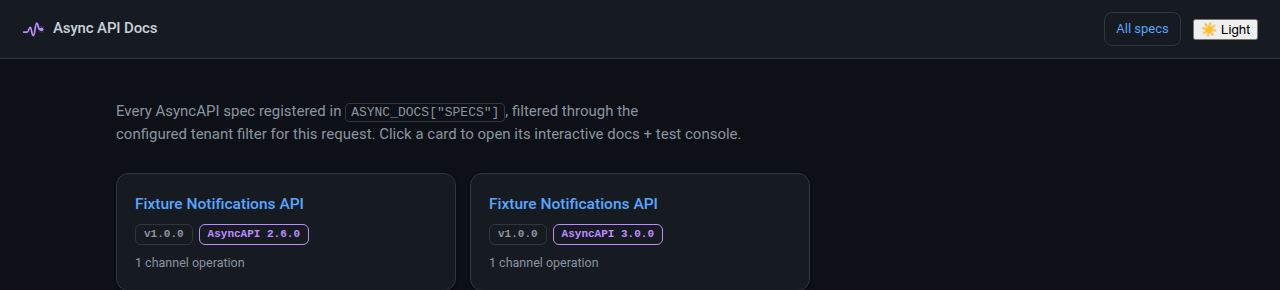
Index — one card per registered spec:
Detail — docs + a live test console:
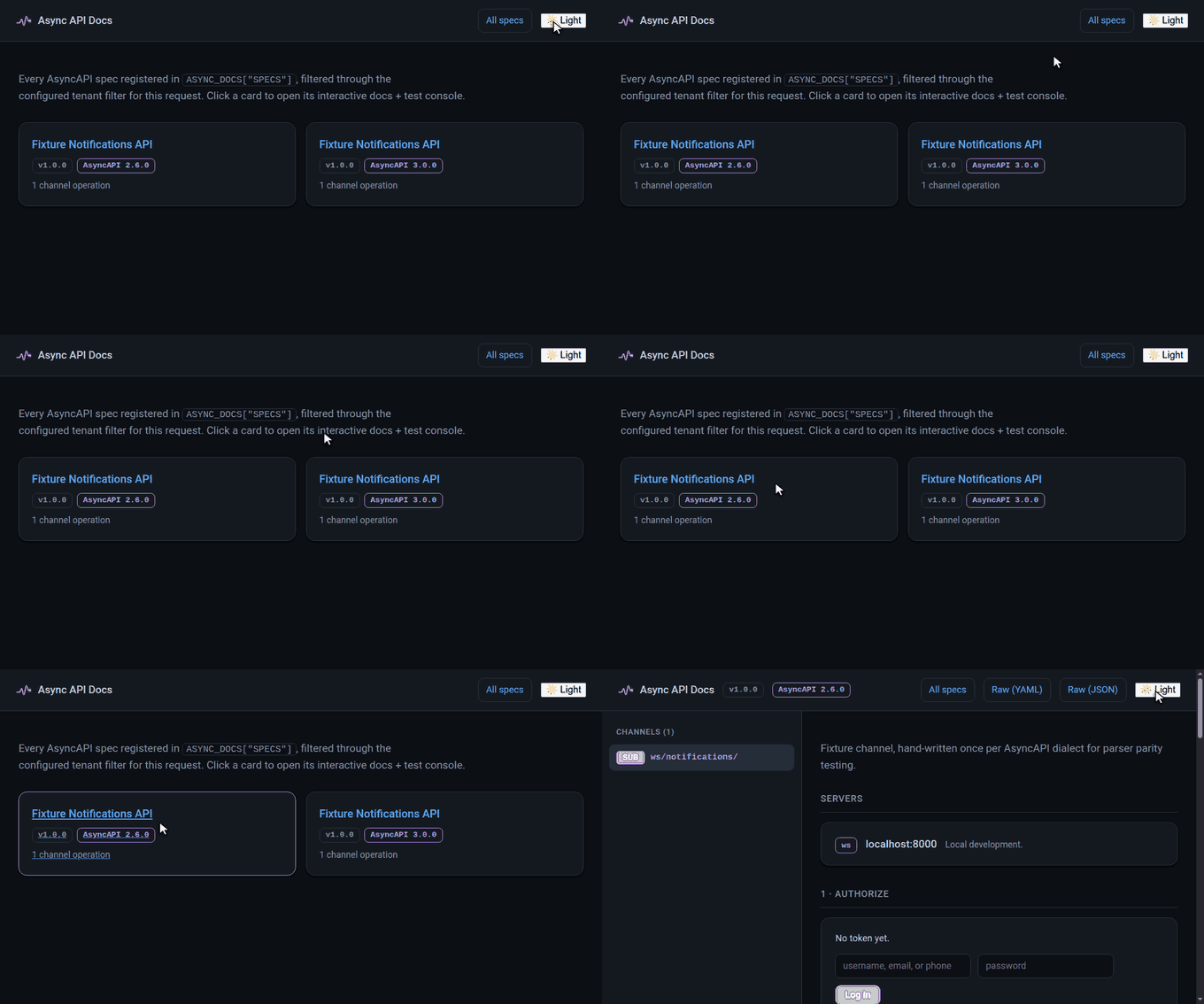
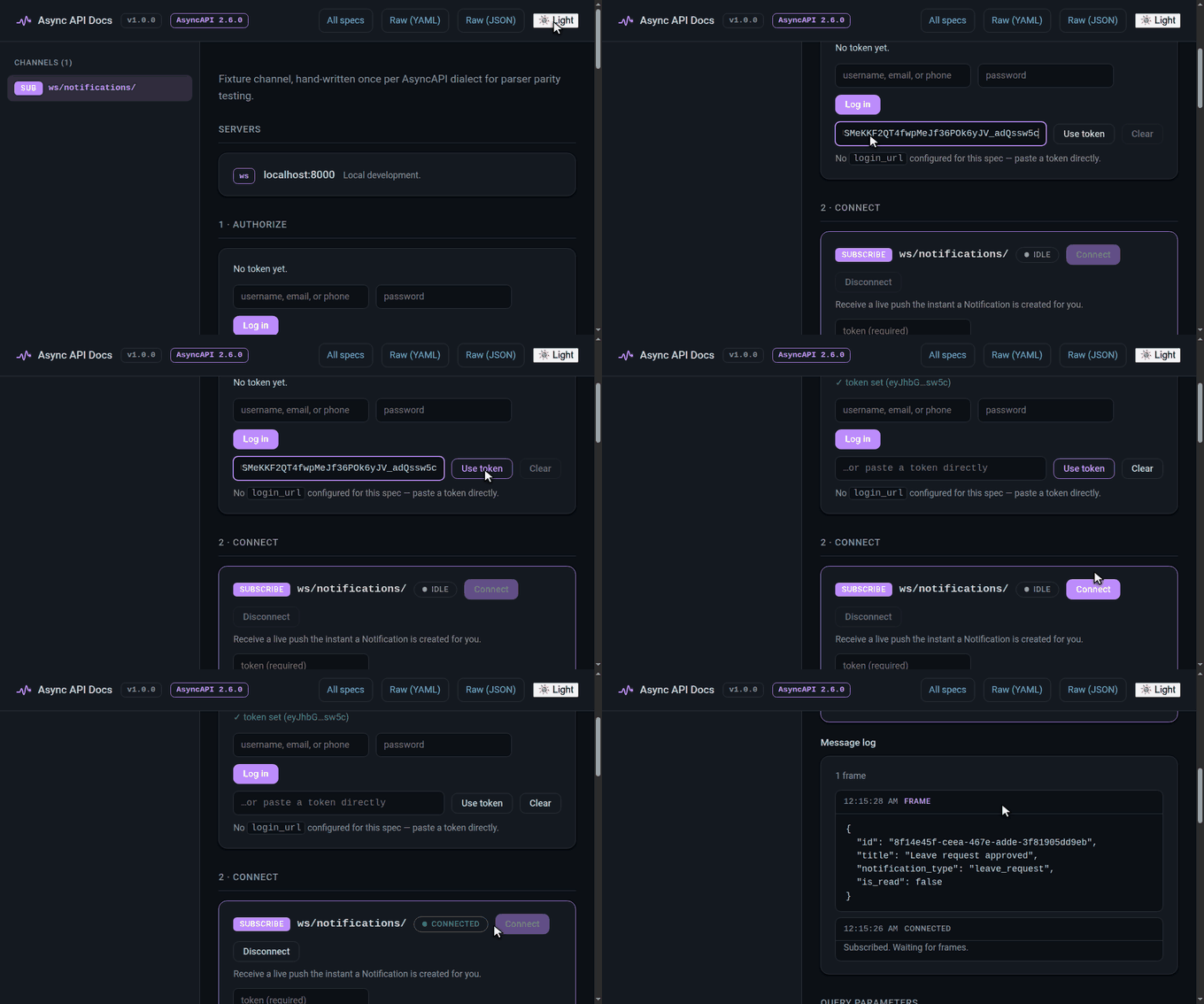
See it in action (animated): browsing the index and authorizing + connecting.
Features
- Auto-generated docs — point it at an AsyncAPI YAML file, get a full docs page. Nothing to write by hand, nothing to keep in sync manually.
- Both AsyncAPI dialects — 2.x and 3.0 render through the exact same templates via one normalizer, so a spec written either way just works.
- A real test console — authorize, connect, and trigger a server-side action to watch a live frame arrive, without leaving the page.
- Secure by default — every access denial is a
404, never a403or login redirect, so an unauthorized visitor can't even confirm a spec exists. - Multi-tenancy hooks — two extension points (
TenantResolver,TenantSpecFilter) for projects that already have real tenant isolation to plug in.
Install
1. Install the package
pip install django-asyncdocs
2. Register it and point it at a spec
# settings.py
INSTALLED_APPS = [..., "asyncdocs"]

ASYNC_DOCS = {
    "SPECS": {
        "my-channel": {
            "path": BASE_DIR / "apps" / "ws" / "asyncapi.yaml",
            "login_url": "/api/v1/auth/login/",
            "actions": {"send_test": "myproject.docs_actions.send_test"},
        },
    },
}
3. Mount the URLs
# urls.py
from django.urls import include, path

urlpatterns = [..., path("asyncdocs/", include("asyncdocs.urls"))]
Never written an AsyncAPI spec before, or don't have one yet? Start at writing-your-first-spec.md — it builds one from nothing.
Already have a spec?
getting-started.md
covers the rest (staff login, the ENABLED gate, verifying it without a
browser).
Documentation
- Getting started
- Writing your first AsyncAPI spec
- Configuration reference
- Writing test actions
- Security
- Multi-tenancy
- FAQ / troubleshooting
How it works
AsyncAPI 2.x vs 3.0, briefly. One normalizer per dialect produces the
exact same flat shape regardless of which one a spec is written in — the
dialect is recorded once (asyncapi_version) and shown as a badge; nothing
downstream branches on it.
Security, briefly. Every access denial (failed staff check, IP
allowlist, unknown or tenant-filtered slug) is a 404, never a 403 or a
login redirect — so a response never confirms a spec exists to someone who
can't see it. The console's token lives in a JS variable for the tab only,
never localStorage/sessionStorage/a URL, always masked on screen.
Multi-tenancy, briefly. Ships no working isolation — every staff user
sees every spec by default, correct for a single-tenant project. Two hooks
(TenantResolver, TenantSpecFilter) let a project that already has real
tenant isolation plug it in later as a settings change.
Full details for all three: see the docs.
License
MIT — see LICENSE.
1 maintainer

Metadata
1 maintainer
Release files for django-asyncdocs 0.1.1
For a detailed explanation of source distributions (sdists) and built distributions (wheels), please see the package formats documentation.
Source distribution (sdist)
| File | Size | Uploaded | |
|---|---|---|---|
| django_asyncdocs-0.1.1.tar.gz | 33.6 kB | Details |
Built distribution (wheel)
| File | Interpreter | ABI | Platform | Reset |
|---|---|---|---|---|
| django_asyncdocs-0.1.1-py3-none-any.whl | Python 3 | none | any | Details |
Total release size: 68.3 kB
Release files / django_asyncdocs-0.1.1.tar.gz
| Download URL | django_asyncdocs-0.1.1.tar.gz |
|---|---|
| Size | 33.6 kB |
| Tags | Source |
|
SHA-256 checksum How to use checksums |
2b2c8cfece5b80c15035f67fbb41877530de2685e07114dc056cd9c77c141874
|
|
BLAKE2b-256 checksum How to use checksums |
b49eea076f913f1b8ab474a54fdc5f8cd3d78d202abdb7f8336af52a115c3b84
|
| Upload date | |
|
Uploaded using Trusted Publishing? What is trusted publishing? |
No |
| Uploaded via |
twine/7.0.0 CPython/3.12.3
|
Release files / django_asyncdocs-0.1.1-py3-none-any.whl
| Download URL | django_asyncdocs-0.1.1-py3-none-any.whl |
|---|---|
| Size | 34.7 kB |
| Tags | Python 3 |
|
SHA-256 checksum How to use checksums |
fd1d45b0a10cf621219a22356f1c6ca5c7d9e41abe18bc36d394db08cfc60516
|
|
BLAKE2b-256 checksum How to use checksums |
177209f9d7fcd74a871d55da3481e7feca5d0580df9cc07eb4854d28c0022c2e
|
| Upload date | |
|
Uploaded using Trusted Publishing? What is trusted publishing? |
No |
| Uploaded via |
twine/7.0.0 CPython/3.12.3
|