
Django CRUD Views









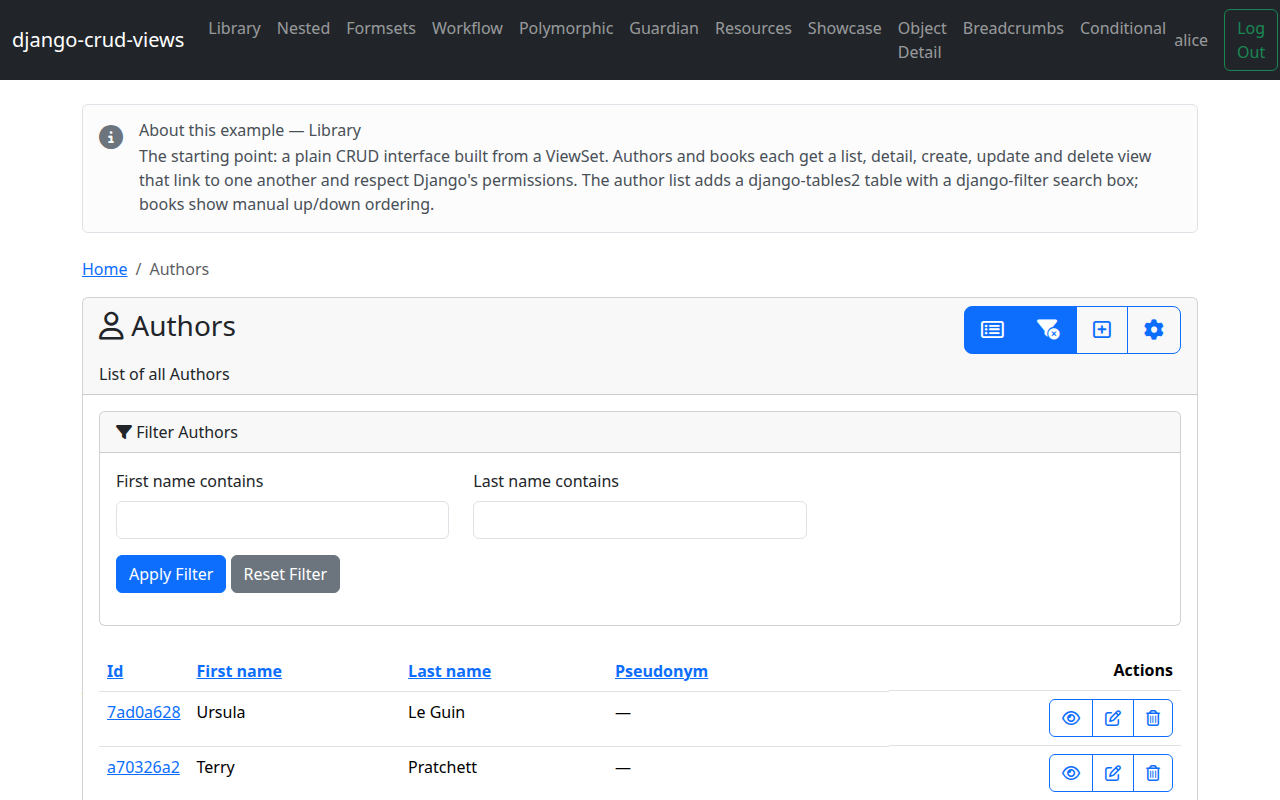
Stop hand-writing the same list, detail, create, update and delete views for every model.
Define your model, register a ViewSet, and Django CRUD Views generates the pages, wires up
every URL, and cross-links the views — using your templates and your permissions, right
inside your own app.
This is all you write
# app/views.py
import django_tables2 as tables

from crud_views.lib.viewset import ViewSet
from crud_views.lib.table import Table
from crud_views.lib.views import (
    ListViewTableMixin,
    ListViewPermissionRequired,
    CreateViewPermissionRequired,
    UpdateViewPermissionRequired,
    DeleteViewPermissionRequired,
)
from crud_views_object_detail.lib import ObjectDetailViewPermissionRequired
from .models import Author

cv_author = ViewSet(model=Author, name="author")


class AuthorTable(Table):
    first_name = tables.Column()
    last_name = tables.Column()


class AuthorList(ListViewTableMixin, ListViewPermissionRequired):
    cv_viewset = cv_author
    table_class = AuthorTable


class AuthorDetail(ObjectDetailViewPermissionRequired):
    cv_viewset = cv_author


class AuthorCreate(CreateViewPermissionRequired):
    cv_viewset = cv_author
    fields = ["first_name", "last_name"]


class AuthorUpdate(UpdateViewPermissionRequired):
    cv_viewset = cv_author
    fields = ["first_name", "last_name"]


class AuthorDelete(DeleteViewPermissionRequired):
    cv_viewset = cv_author
ObjectDetailViewPermissionRequired is provided by the crud_views_object_detail app; add it to
INSTALLED_APPS alongside crud_views.
# app/urls.py
urlpatterns = cv_author.urlpatterns
You get list, detail, create, update and delete pages, every URL wired up, the views cross-linked, and access gated by Django's permission system.
Why developers use it
- Skip the CRUD boilerplate — one ViewSet replaces a pile of near-identical class-based views and
urls.pyentries. - Views that know their siblings — automatic cross-linking that respects Django's permission system; no hand-written
reverse()wiring. - Your app, your control — your templates, URLs and permissions; built on Django's generic class-based views, not locked inside
/admin. - Batteries included — sortable, filterable, paginated tables (django-tables2, django-filter), crispy forms (django-crispy-forms), breadcrumbs, formsets, and nested parent/child URLs.
- Grows with your app — optional extensions for workflows (django-fsm-2), polymorphic models (django-polymorphic), per-object permissions (django-guardian), ordering (django-ordered-model) and non-ORM resources.
- Pluggable themes —
bootstrap5ships as the default; bring your own theme. - Fails early — Django system checks validate your configuration at startup.
Install
pip install django-crud-views
Optional extras: django-crud-views[guardian] (per-object permissions), django-crud-views[ordered] (up/down ordering), django-crud-views[all] (everything).
Try it online: the live demo runs the example project (log in as alice / alice or bob / bob; data resets daily).
Run the example project
The repository ships a runnable example project — the tutorial's library app plus one app per feature. All you need is Python 3.12+:
git clone https://github.com/jacob-consulting/django-crud-views.git
cd django-crud-views
python -m venv .venv
source .venv/bin/activate        # Windows: .venv\Scripts\activate
pip install -e ".[all,examples]"
cd examples/bootstrap5
python manage.py migrate
python manage.py seed
python manage.py runserver
Browse http://127.0.0.1:8000/ and log in with alice / alice.
These instructions are CI-tested on Linux, macOS and Windows.
If you use uv and task, the shortcut
is task dev && task run from the repository root.
What it is not
- a replacement for Django's admin interface
- a complete page building system with navigations and lots of widgets
Documentation
Full tutorial and reference: https://django-crud-views.readthedocs.io
Current version
Current version: 0.29.0
1 maintainer

Metadata
1 maintainer
Release files for django-crud-views 0.29.0
For a detailed explanation of source distributions (sdists) and built distributions (wheels), please see the package formats documentation.
Source distribution (sdist)
| File | Size | Uploaded | |
|---|---|---|---|
| django_crud_views-0.29.0.tar.gz | 2.6 MB | Details |
Built distribution (wheel)
| File | Interpreter | ABI | Platform | Reset |
|---|---|---|---|---|
| django_crud_views-0.29.0-py3-none-any.whl | Python 3 | none | any | Details |
Total release size: 2.8 MB
Release files / django_crud_views-0.29.0.tar.gz
| Download URL | django_crud_views-0.29.0.tar.gz |
|---|---|
| Size | 2.6 MB |
| Tags | Source |
|
SHA-256 checksum How to use checksums |
f867a04ee814669c1bcc671b80054281dc89e4b8ca6099cdf3d0900dc073f33b
|
|
BLAKE2b-256 checksum How to use checksums |
011e362dbfccc537297e8e073c500c53251257d73bdf7ac47e345a04a49ace97
|
| Upload date | |
|
Uploaded using Trusted Publishing? What is trusted publishing? |
Yes |
| Uploaded via |
twine/7.0.0 CPython/3.13.14
|
Provenance
Provenance describes where a file came from. On PyPI, provenance is shared via attestations, which provide a verifiable record of the build or publishing details. View details, limitations and caveats.


PyPI Publish Attestation
PyPI verified that this artifact, at this checksum, originated from the publisher listed below.
Signed by GitHub Actions, verified by PyPI on Oct 12, 2026.
Transparency logRelease files / django_crud_views-0.29.0-py3-none-any.whl
| Download URL | django_crud_views-0.29.0-py3-none-any.whl |
|---|---|
| Size | 214.4 kB |
| Tags | Python 3 |
|
SHA-256 checksum How to use checksums |
619850723a3e347b569844d6d7e71bcb41c0aa187c491fe51c11a17da2272356
|
|
BLAKE2b-256 checksum How to use checksums |
96eddd45a65714a46afff424ffc9ce9fe44f31e792069cec9d2f92d7e9bd2af8
|
| Upload date | |
|
Uploaded using Trusted Publishing? What is trusted publishing? |
Yes |
| Uploaded via |
twine/7.0.0 CPython/3.13.14
|
Provenance
Provenance describes where a file came from. On PyPI, provenance is shared via attestations, which provide a verifiable record of the build or publishing details. View details, limitations and caveats.
PyPI Publish Attestation
PyPI verified that this artifact, at this checksum, originated from the publisher listed below.
Signed by GitHub Actions, verified by PyPI on Oct 12, 2026.
Transparency log













