
django-dataclass-autoserialize
An extension of slightly modified oxan's django-dataclass-serialize (Temporary hosted here). Making it much more enjoyable to use with drf-yasg.
The goal of this package is to make the APIView code as succinctly as possible. The main pain point it is trying to solve is
- Having to define the param class and serialize separately.
- Having it nicely integrate with drf-yasg without having to duplicate information.
Install
pip install django-dataclass-autoserialize
Documentation
Simple Usage
Here is an example of a typical usage. Pull straight from Example Project
from __future__ import annotations
from django_dataclass_autoserialize import AutoSerialize, swagger_post_schema, swagger_get_schema
from dataclasses import dataclass

from rest_framework.request import Request
from rest_framework.response import Response
from rest_framework.views import APIView


@dataclass
class InputParam(AutoSerialize):
    a: int
    b: int

    @classmethod
    def example(cls) -> InputParam:
        # this is actually optional but it will show up
        # in swagger doc
        return cls(a=3, b=2)


@dataclass
class ComputeResponse(AutoSerialize):
    msg: str
    result: int

    @classmethod
    def example(cls) -> ComputeResponse:
        return cls(msg='hello world', result=5)


class AddView(APIView):

    @swagger_post_schema(
        body_type=InputParam,
        response_types={200: ComputeResponse}
    )
    def post(self, request: Request) -> Response:
        param = InputParam.from_post_request(request)
        return ComputeResponse(msg='add successfully',
                               result=param.a + param.b).to_response()


class SubtractView(APIView):
    @swagger_get_schema(
        query_type=InputParam,
        response_types={200: ComputeResponse}
    )
    def get(self, request: Request) -> Response:
        param = InputParam.from_get_request(request)
        return ComputeResponse(msg='subtract successfully',
                               result=param.a - param.b).to_response()
Then the swagger will shows up like the following
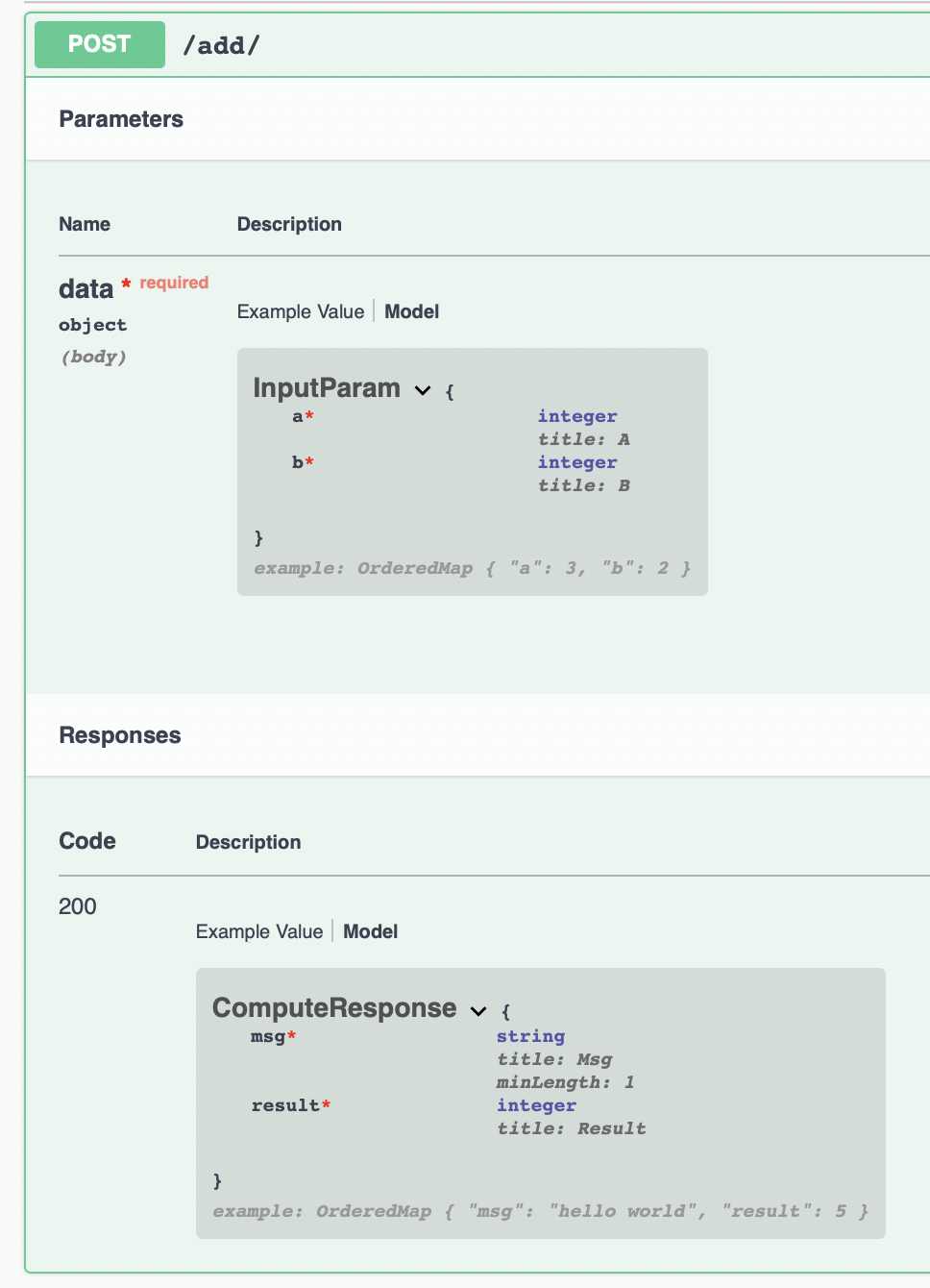
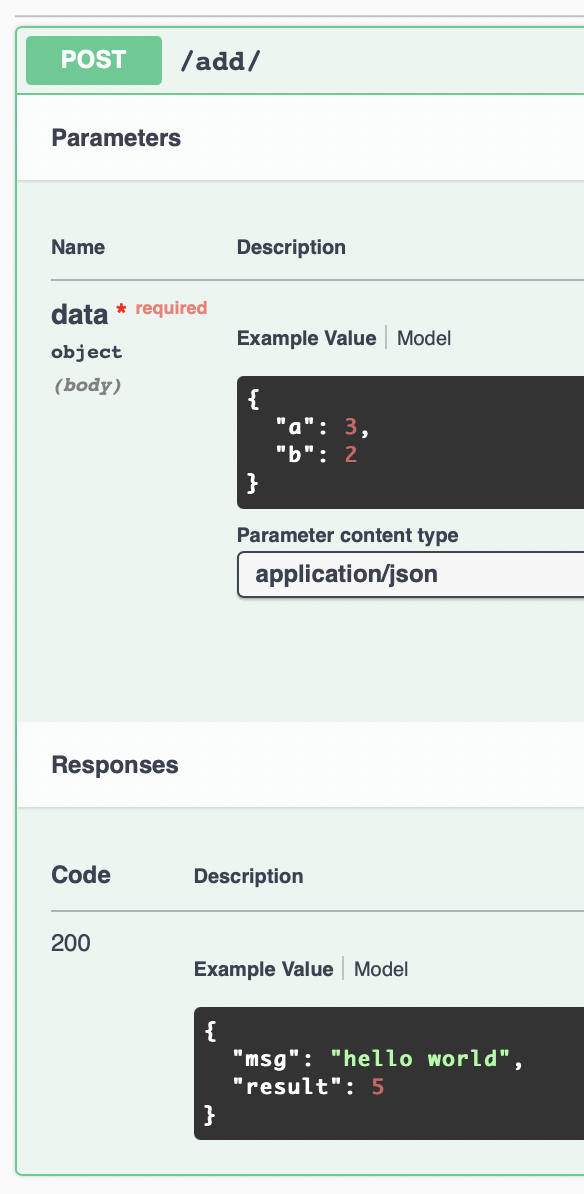
Customization
Under the hood it uses djangorestframework-dataclasses. So
all the customization that can be done for dataclass is applied here as well. For example, you can
add serializer_kwargs like so
@dataclasses.dataclass
class Person:
    email: str = dataclasses.field(metadata={'serializer_field': fields.EmailField()})
    age: int = dataclasses.field(metadata={'serializer_kwargs': {'min_value': 0}})
Validation
The validation of the object can be done by overiding
validate_data(cls, obj) method. For example
class Numbers(AutoSerialize):
    a: int
    b: int

    @classmethod
    def validate_data(cls, obj: Numbers) -> Numbers:
        from rest_framework.exceptions import ValidationError
        if obj.a + obj.b > 1000:
            raise ValidationError('too big')
        return obj
Swagger
drg-yasg integration is done through swagger_get_schema and swagger_get_schema
decorator. See simple example for the usage. keywords other than query_type/body_type and response_types
are forwarded to drf-yasg's swagger_auto_schema.
4 maintainers


Release files for django-dataclass-autoserialize 1.0.1
For a detailed explanation of source distributions (sdists) and built distributions (wheels), please see the package formats documentation.
Built distribution (wheel)
| File | Interpreter | ABI | Platform | Reset |
|---|---|---|---|---|
| django_dataclass_autoserialize-1.0.1-py3-none-any.whl | Python 3 | none | any | Details |
Release files / django_dataclass_autoserialize-1.0.1-py3-none-any.whl
| Download URL | django_dataclass_autoserialize-1.0.1-py3-none-any.whl |
|---|---|
| Size | 5.1 kB |
| Tags | Python 3 |
|
SHA-256 checksum How to use checksums |
4d5cb43fb52dbf2a578c8cc1716578866dce5456d94b1052f7c65553e6031e6f
|
|
BLAKE2b-256 checksum How to use checksums |
1aae548fd73fae07196d8709371cda33f98bedecbf2cec18c888bdaef7a620c3
|
| Upload date | |
|
Uploaded using Trusted Publishing? What is trusted publishing? |
No |
| Uploaded via |
twine/3.4.2 importlib_metadata/4.6.4 pkginfo/1.7.1 requests/2.26.0 requests-toolbelt/0.9.1 tqdm/4.62.1 CPython/3.9.6
|














