
A platform for creating and delivering learning materials via email within a Django application. It provides tools for content management, user role-based administration, and scheduler integration for automated content delivery.

Project description
Django Email Learning
A Django package for creating email-based learning platforms with IMAP integration and React frontend components.




What is django-email-learning?
django-email-learning is an open-source Django app in active beta development, designed to provide a complete email-based learning platform.
It is inspired by the Darsnameh email-learning service, which unfortunately shut down in July 2017. This library aims to revive that concept and make it accessible to anyone who wants to launch a similar service.
Before the first stable release (v1.0.0), some APIs, settings, or behavior may still evolve (including occasional breaking changes), and early adopters can help shape the roadmap through feedback, bug reports, and contributions.
Why an email learning platform?
An email learning platform is a type of e-learning system where course content is delivered directly to learners’ inboxes. Platform admins can create courses, lessons, and quizzes, and configure the timing rules that determine when each next lesson or quiz is sent.
The system exposes management commands and/or API endpoints that can be triggered by cron jobs or cloud schedulers to:
-
Track learner progress
-
Send lessons and quizzes via email
-
Handle automated transitions between course steps
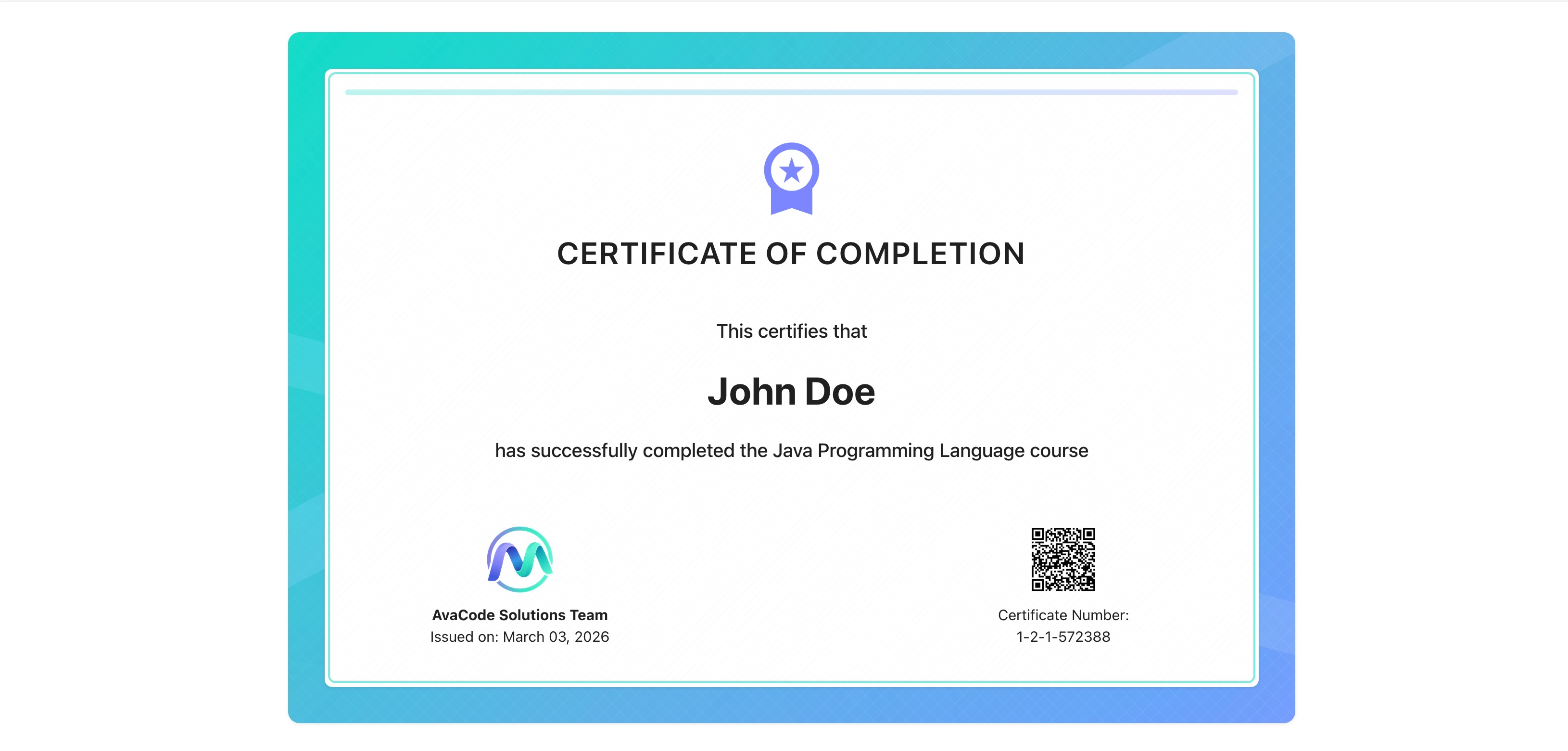
Additionally, the platform can issue online completion certificates that learners can verify using a QR code.
Why use email for e-learning?
While modern e-learning platforms often rely heavily on video content and complex web interfaces, email remains a powerful and inclusive channel. Some of the reasons:
-
Low bandwidth requirement: Email works well in regions with slow or unstable internet.
-
High accessibility: No need to install apps or log into a portal—lessons arrive directly in the inbox.
-
Resilience to censorship: Emails are often less likely to be blocked than certain websites or platforms under restrictive governments.
-
Simplicity: Email is universal, familiar, and works on virtually any device.
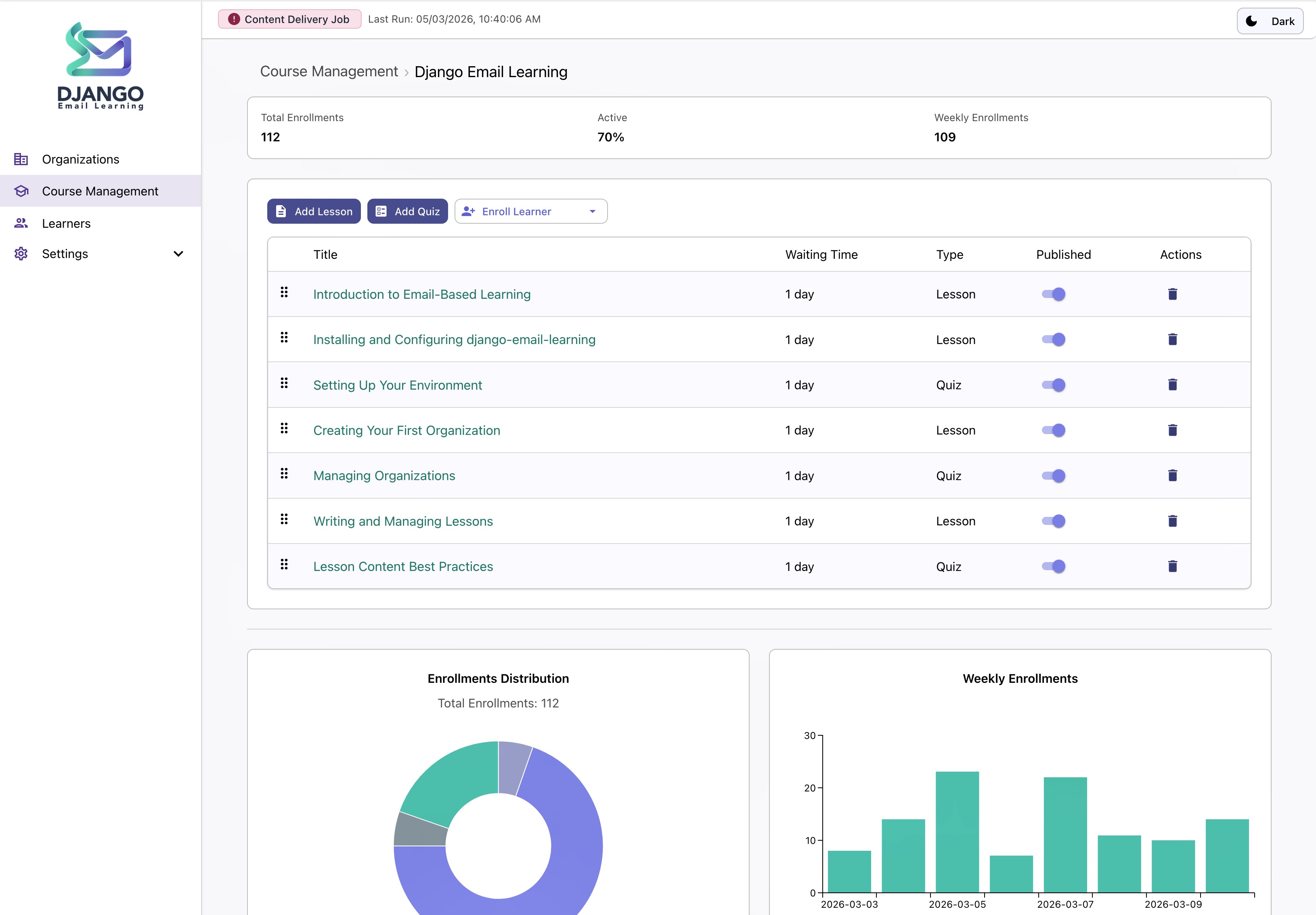
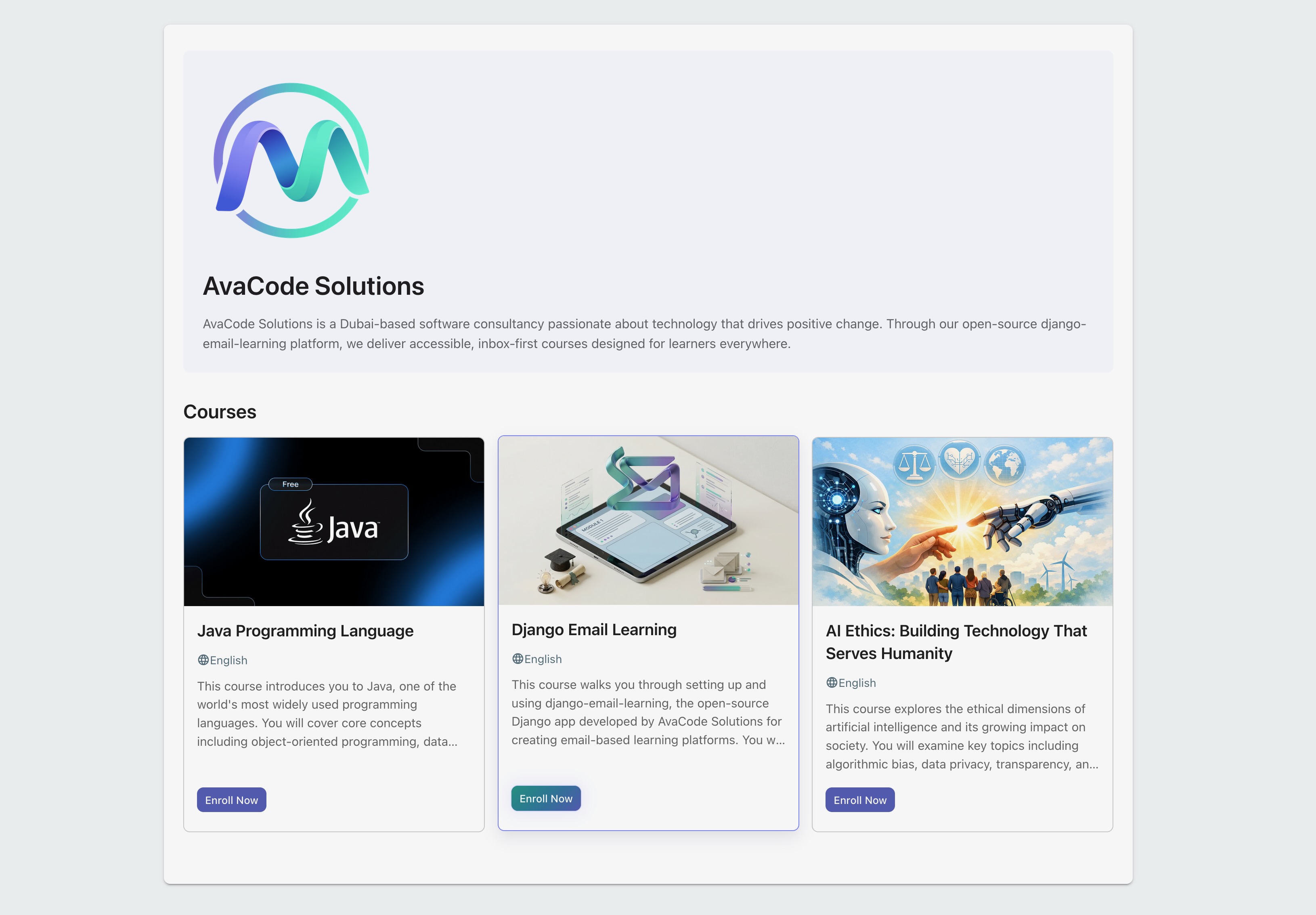
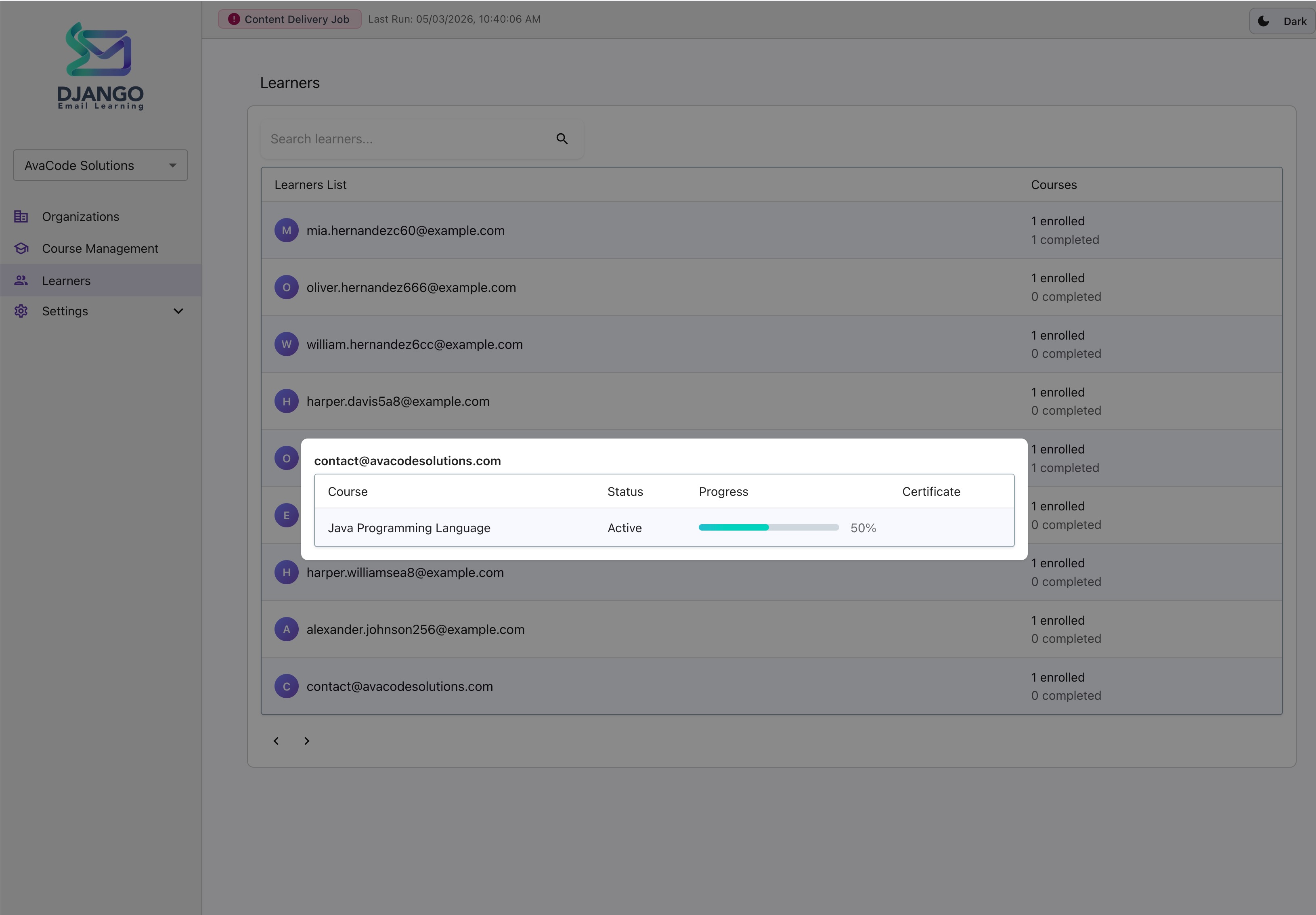
UI Preview
A quick look at the platform interface:
| Course Dashboard | Public Organization Page |
|---|---|
 |
 |
| Learner Progress | Certificate |
 |
 |
Documentation
Comprehensive documentation is available at django-email-learning.readthedocs.io, including:
- Installation Guide: Step-by-step setup instructions
- Platform Management: Creating organizations, courses, and managing learners
- Technical Reference: Management commands and configuration
- Usage Examples: Real-world implementation scenarios
Try It as a Learner
Want to experience the platform from a learner perspective? Enroll in a public course at:
Installation
This is a Django app, so we assume you already have Django installed.
1. Install the Package
pip install django-email-learning
2. Add to INSTALLED_APPS
Add django_email_learning to your INSTALLED_APPS in the Django settings file:
INSTALLED_APPS = [
    ...
    'django_email_learning',
]
3. Configure Settings
Add the required configuration for the site base URL in your Django settings:
DJANGO_EMAIL_LEARNING = {
    "SITE_BASE_URL": "<YOUR_SITE_BASE_URL_STARTING_WITH_HTTP>",
    "ENCRYPTION_SECRET_KEY": "<LONG_RANDOM_STRING>",
}
ENCRYPTION_SECRET_KEY should be a long random string used to protect sensitive values such as stored API Keys.
4. Configure Media Files
This app uses Django's MEDIA files to save organization logos. Ensure your media settings are configured correctly. See the MEDIA_URL setting for details.
5. Run Migrations
python manage.py migrate
6. Add URLs
Include the app URLs in your main Django URLs configuration:
from django.urls import path, include
from django_email_learning import urls as email_learning_urls

urlpatterns = [
    ...
    path('your_preferred_path/', include(email_learning_urls, namespace='django_email_learning')),
]
The platform will be accessible at your_preferred_path/platform/.
Access Control Notes
- Platform Access: You need to be logged in to access the
/platformsub-URL, which is used for managing courses and viewing learner progress.
Usage
Content Delivery
This app uses the email backend defined in Django settings to deliver course content. Assuming you have active courses and enrollments, you need to schedule a job that runs the content delivery management command periodically (e.g., using cron or a cloud scheduler).
Execute the content delivery job using:
python manage.py deliver_contents
You can also trigger this job via API, which is useful when running from an external scheduler (for example, cloud scheduler services):
GET /your_preferred_path/api/jobs/deliver_contents/
Authorization: Bearer <API_KEY>
This endpoint requires an API key. You can generate and manage API keys from Platform Settings > API Keys in the platform UI.
Contributing
We welcome contributions! Please read our Contributing Guide to learn about our development process, how to set up the development environment, and how to submit pull requests.
Sponsorship
Support our open-source work and community projects by sponsoring us through GitHub Sponsors or Open Collective. Depending on your sponsorship tier, we can feature your logo and link on the project’s README and documentation.

License
This project is licensed under the BSD 3-Clause License - see the LICENSE file for details.
Release history Release notifications | RSS feed


Download files
Download the file for your platform. If you're not sure which to choose, learn more about installing packages.
Source Distribution
Built Distribution
Filter files by name, interpreter, ABI, and platform.
If you're not sure about the file name format, learn more about wheel file names.
Copy a direct link to the current filters
File details
Details for the file django_email_learning-0.2.49.tar.gz.
File metadata
- Download URL: django_email_learning-0.2.49.tar.gz
- Upload date:
- Size: 905.5 kB
- Tags: Source
- Uploaded using Trusted Publishing? No
- Uploaded via: poetry/2.3.2 CPython/3.14.3 Darwin/25.3.0
File hashes
| Algorithm | Hash digest | |
|---|---|---|
| SHA256 |
6e8bde00f49ff77be38d39e7e62e19209a7459a0764cfb6b9843ad7c2ff7dfd2
|
|
| MD5 |
e7b6dadfb9b5374a795055f406d9c876
|
|
| BLAKE2b-256 |
8d50352ed140eb127355aa2cf46109f15a9717c8f67fa23ced890b8e3d34c437
|
File details
Details for the file django_email_learning-0.2.49-py3-none-any.whl.
File metadata
- Download URL: django_email_learning-0.2.49-py3-none-any.whl
- Upload date:
- Size: 989.0 kB
- Tags: Python 3
- Uploaded using Trusted Publishing? No
- Uploaded via: poetry/2.3.2 CPython/3.14.3 Darwin/25.3.0
File hashes
| Algorithm | Hash digest | |
|---|---|---|
| SHA256 |
d61c3246da101c5786fb449d24a60c661f6548c020318ee4227e7a71ed58f025
|
|
| MD5 |
248b762b06610d1604dadff0d65c3141
|
|
| BLAKE2b-256 |
922a714f1a57d6db5c0df0e72dc6d0167ed613da7fe0d8de94ffd27b1d5b0d17
|






