
django-find


Summary
django-find is a Django app that makes it easy to add complex search/filter functionality for the models in your project. It supports two different ways to search your Django models: Query-based, or JSON-based.
django-find is not a full text search engine, it searches the fields of your models. In other words, it filters on your models and provides tabular data as a result.
Features
Query-based search
By query-based, we mean that you can use statements like these to search your models:
author:"robert frost" and (title:road or chapter:2)
Add a search field to your template using a single tag
{% load find_tags %}
{% find object_list %}
{% for obj in object_list %}
  {{ obj.name }}
{% endfor %}
(object_list is a queryset that is passed to the template)
Query in your code
Just add the Searchable mixin:
from django_find import Searchable

class Author(models.Model, Searchable):
    name = models.CharField("Author Name", max_length=10)
    ...
And you are good to go:
# Query-based search returns a standard Django QuerySet that you
# can .filter() and work with as usual.
query = Book.by_query('author:"robert frost" and title:"the road"')

# You can also get a Django Q object for the statements.
q_obj = Book.q_from_query('author:"robert frost" and title:"the road"')
Query using JSON
To make it easy to do complex searches spanning multiple models, JSON-based query method is provided. It allows your to make custom searches like these:
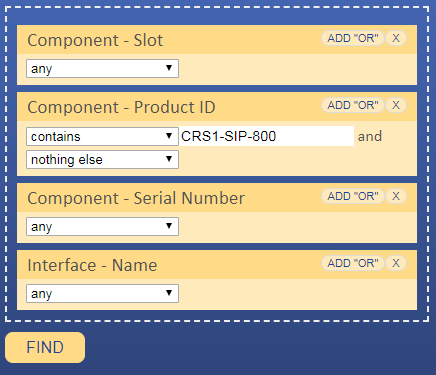
For this, a JSON-based search functionality is provided:
{
    "Author":{"name":[[["equals","test"]]]},
    "Book": {"title":[[["notcontains","c"]]]},
    "Chapter": {"content":[[["startswith","The "]]]}
}
django-find is smart in figuring out how to join those models together and return a useful result. In your code, you can load the JSON and get back the search result:
# JSON-based search exhausts what Django's ORM can do, so it does
# not return a Django QuerySet, but a row-based PaginatedRawQuerySet:
query, field_list = Book.by_json_raw('''{
    "Chapter": {"title":[[["contains","foo"]]]}
}''')
print('|'.join(field_list))
for row in query:
    print('|'.join(row))
Documentation
Full documentation, including installation instructions, is here:


Release files for django-find 1.1.0
For a detailed explanation of source distributions (sdists) and built distributions (wheels), please see the package formats documentation.
Source distribution (sdist)
| File | Size | Uploaded | |
|---|---|---|---|
| django_find-1.1.0.tar.gz | 20.7 kB | Details |
Built distribution (wheel)
| File | Interpreter | ABI | Platform | Reset |
|---|---|---|---|---|
| django_find-1.1.0-py3-none-any.whl | Python 3 | none | any | Details |
Total release size: 48.3 kB
Release files / django_find-1.1.0.tar.gz
| Download URL | django_find-1.1.0.tar.gz |
|---|---|
| Size | 20.7 kB |
| Tags | Source |
|
SHA-256 checksum How to use checksums |
38053b75d5d5f2b3cab0d4c8de12a6a95518de35eaf69452f73eea6970ceec1d
|
|
BLAKE2b-256 checksum How to use checksums |
dcfbee6318645f650d31dcf046b38892545904b6ef047e0f5edf4a8402dada91
|
| Upload date | |
|
Uploaded using Trusted Publishing? What is trusted publishing? |
Yes |
| Uploaded via |
twine/6.1.0 CPython/3.13.12
|
Provenance
Provenance describes where a file came from. On PyPI, provenance is shared via attestations, which provide a verifiable record of the build or publishing details. View details, limitations and caveats.


PyPI Publish Attestation
PyPI verified that this artifact, at this checksum, originated from the publisher listed below.
Signed by GitHub Actions, verified by PyPI on Jun 23, 2026.
Transparency logRelease files / django_find-1.1.0-py3-none-any.whl
| Download URL | django_find-1.1.0-py3-none-any.whl |
|---|---|
| Size | 27.6 kB |
| Tags | Python 3 |
|
SHA-256 checksum How to use checksums |
7def47880a428af734bd2a744d659eeccdedc79aaf2accbbc148cedd04137ff9
|
|
BLAKE2b-256 checksum How to use checksums |
1b9cf2a44e8d6bceddcb685196accbfd4e066908c37da90cd6160a9067bdc3bc
|
| Upload date | |
|
Uploaded using Trusted Publishing? What is trusted publishing? |
Yes |
| Uploaded via |
twine/6.1.0 CPython/3.13.12
|
Provenance
Provenance describes where a file came from. On PyPI, provenance is shared via attestations, which provide a verifiable record of the build or publishing details. View details, limitations and caveats.
PyPI Publish Attestation
PyPI verified that this artifact, at this checksum, originated from the publisher listed below.
Signed by GitHub Actions, verified by PyPI on Jun 23, 2026.
Transparency log













