
Django IPware
Best-effort client IP detection for Django — one call, in any view or middleware.



Quickstart
python -m pip install --upgrade django-ipware
from ipware import get_client_ip

client_ip, is_routable = get_client_ip(request)

if client_ip is None:
    ...  # no usable IP in the request
elif is_routable:
    ...  # a public internet address
else:
    ...  # private, link-local or loopback (intranet, VPN, local dev)
client_ip is a string such as "177.139.233.139" or "2606:4700::1", or None.
Python 3.10+ and Django 5.2+ are supported (tested on Python 3.10 – 3.14 with Django 5.2, 6.0 and 6.1).
On older Python or Django versions, use django-ipware<8.
Not using Django, or want more control? django-ipware is powered by python-ipware, and you can use it directly in Django, Flask, FastAPI or any WSGI/ASGI app. It also returns a
trusted_routeflag andipaddressobjects.
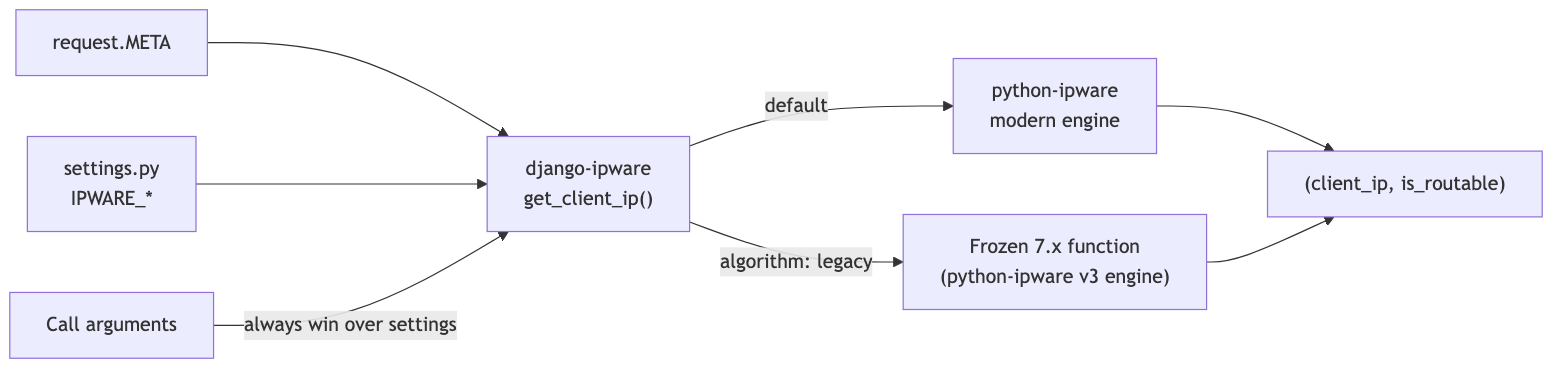
Legacy (deprecated): the frozen 7.x behavior is still available with
algorithm="legacy"orIPWARE_ALGORITHM = "legacy", but it emits aDeprecationWarningand will be removed in a future major release. See Upgrading from 7.x.
What you get
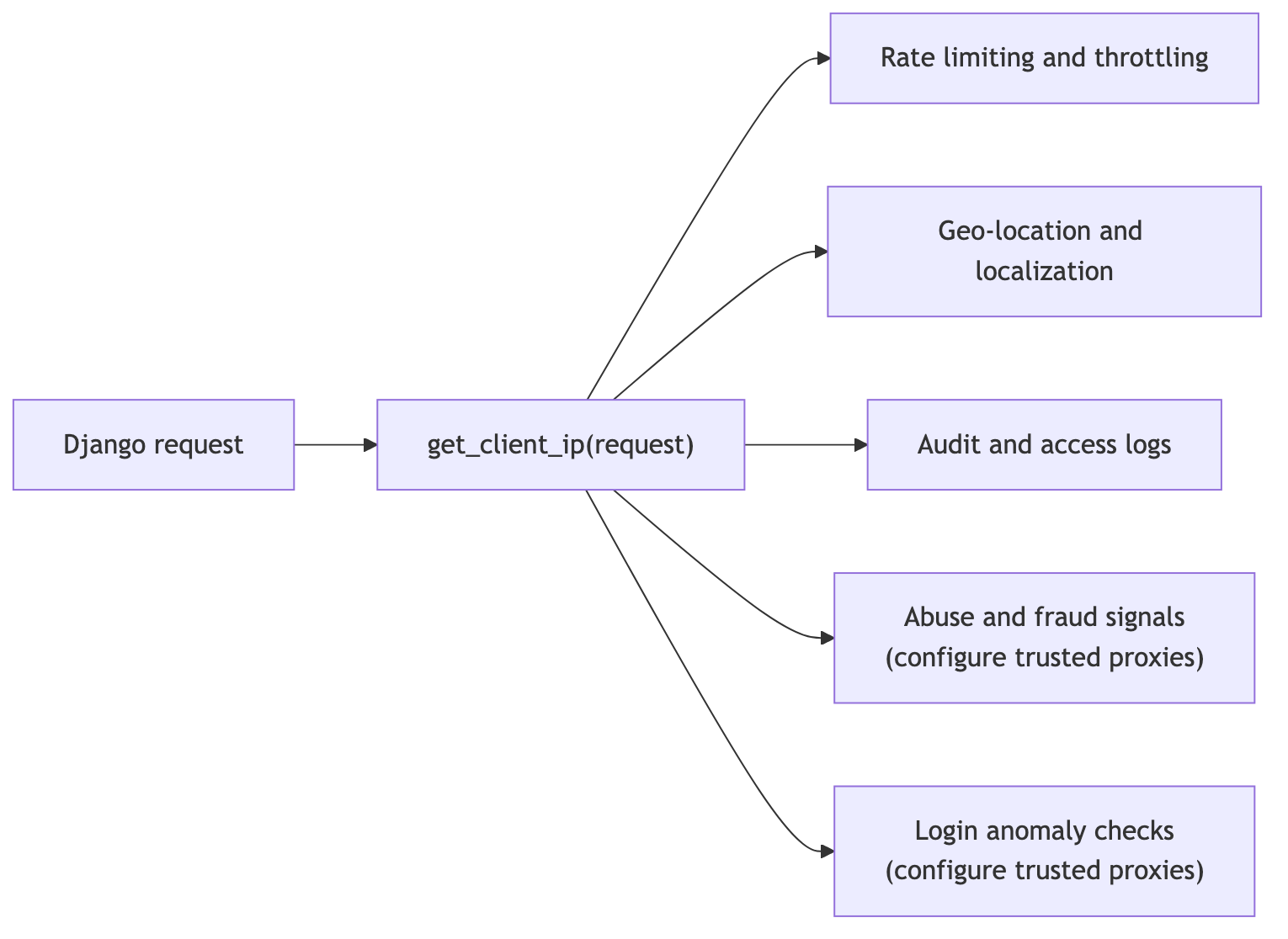
Messy, forgeable request headers in; one clean, ranked client IP out.

What it's used for
How it fits together
Security notice
Found a security issue? Please email info@neekware.com privately — do not open a public issue or pull request. See SECURITY.md.
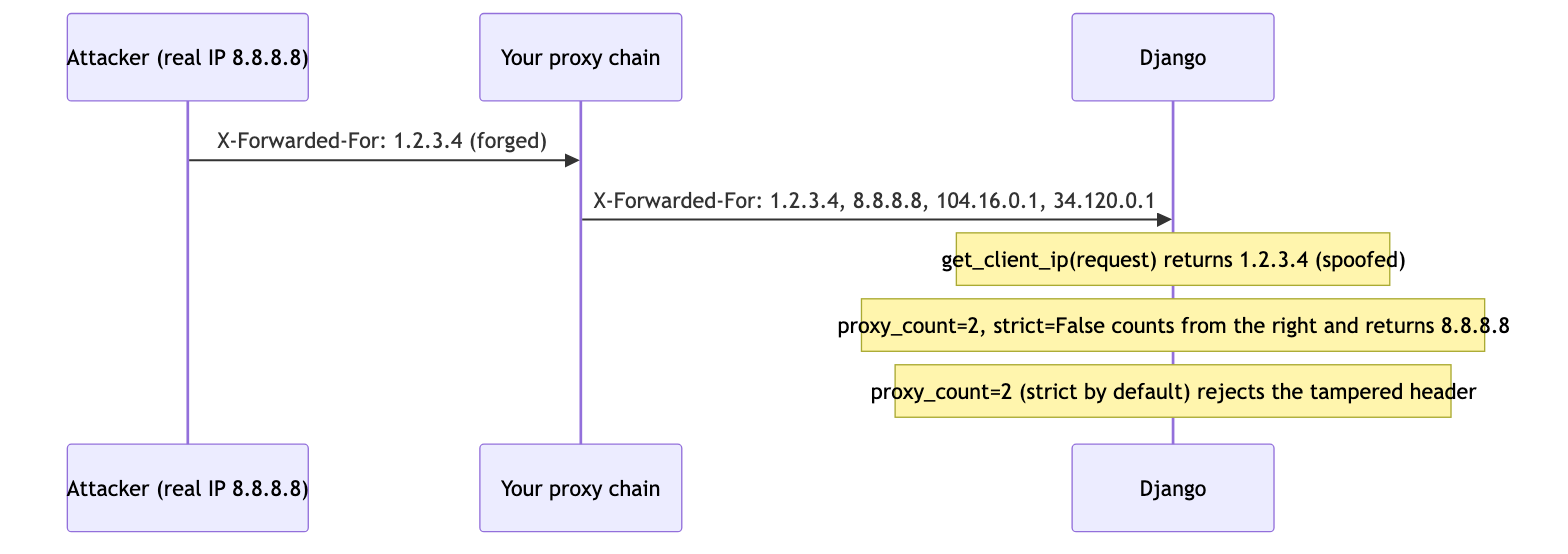
There is no perfect defense against IP address spoofing. Headers such as X-Forwarded-For are set by
clients and proxies, and can be forged. If you use django-ipware for authentication, rate limiting,
or anti-fraud, configure proxy_trusted_ips and/or proxy_count for your network topology and treat
it as one layer alongside your firewall — never as the only defense.
API
get_client_ip(
    request,
    proxy_order="left-most",     # or "right-most"
    proxy_count=None,            # expected number of proxies in front of Django
    proxy_trusted_ips=None,      # trusted proxies: IPs, CIDR networks or prefixes
    request_header_order=None,   # header keys to check, in order
    strict=None,                 # strict chain validation; default True
    algorithm=None,              # default "modern"; "legacy" for exact 7.x results
)
| Argument | Description |
|---|---|
proxy_order |
"left-most" (default) follows the de-facto client, proxy1, proxy2 order. Use "right-most" only for networks that put the client last. |
proxy_count |
Number of proxies expected after the client. 0 is valid; None disables the check. |
proxy_trusted_ips |
Trusted proxies nearest Django, one entry per hop. Each entry is a CIDR network ("100.64.0.0/10"), a complete IP matched exactly ("198.84.193.157"), or an IP prefix matched on whole octets ("10.1."). See Trusted proxies. |
request_header_order |
Header keys to search, top to bottom. Defaults to the list below. |
strict |
True (default): exactly proxy_count proxies, and any malformed entry rejects that header. False: at least that many, and bad entries are skipped. |
algorithm |
"modern" (default) uses the modern engine; "legacy" runs the frozen 7.x function. |
| Output | Description |
|---|---|
client_ip |
The client IP as a string, or None |
is_routable |
True when client_ip is a publicly routable address |
An invalid value raises ValueError: an unknown proxy_order or algorithm, a trusted proxy list
passed as a bare string, an empty or non-IP entry, a negative proxy_count, and so on.
Settings
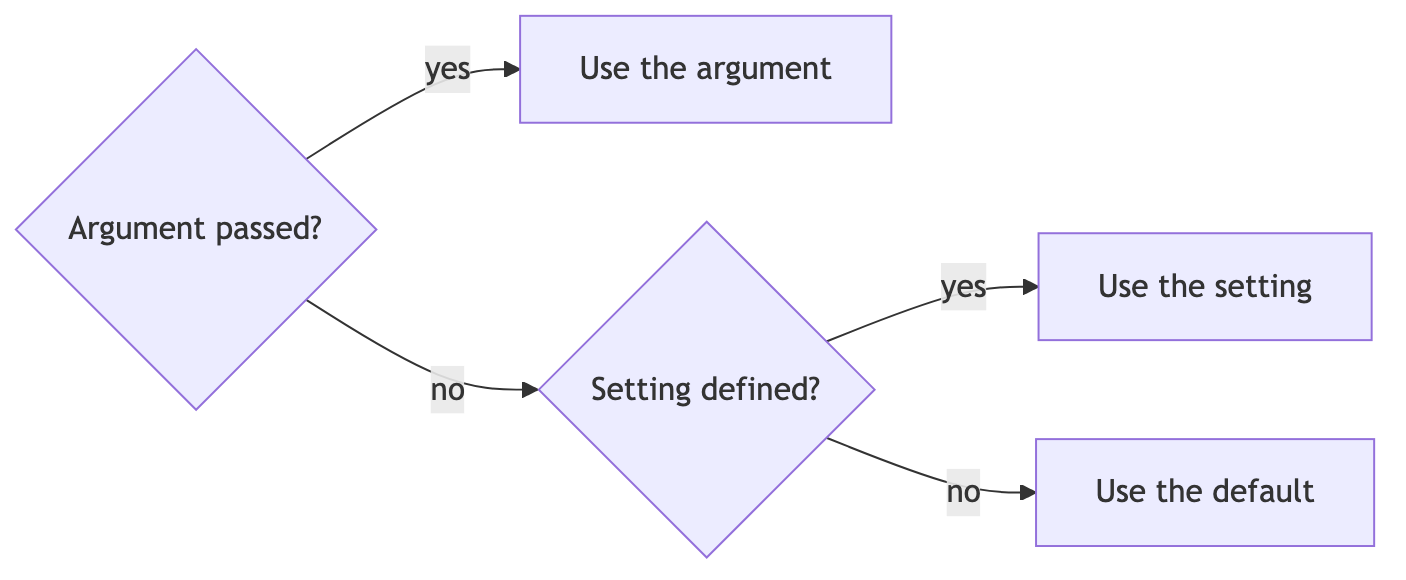
Each setting applies only when the matching argument is not passed. An explicit argument always wins.
| Setting | Argument | Default |
|---|---|---|
IPWARE_ALGORITHM |
algorithm |
"modern" |
IPWARE_META_PRECEDENCE_ORDER |
request_header_order |
the list below |
IPWARE_META_PROXY_COUNT |
proxy_count |
not enforced |
IPWARE_STRICT |
strict |
True |
Selection rules
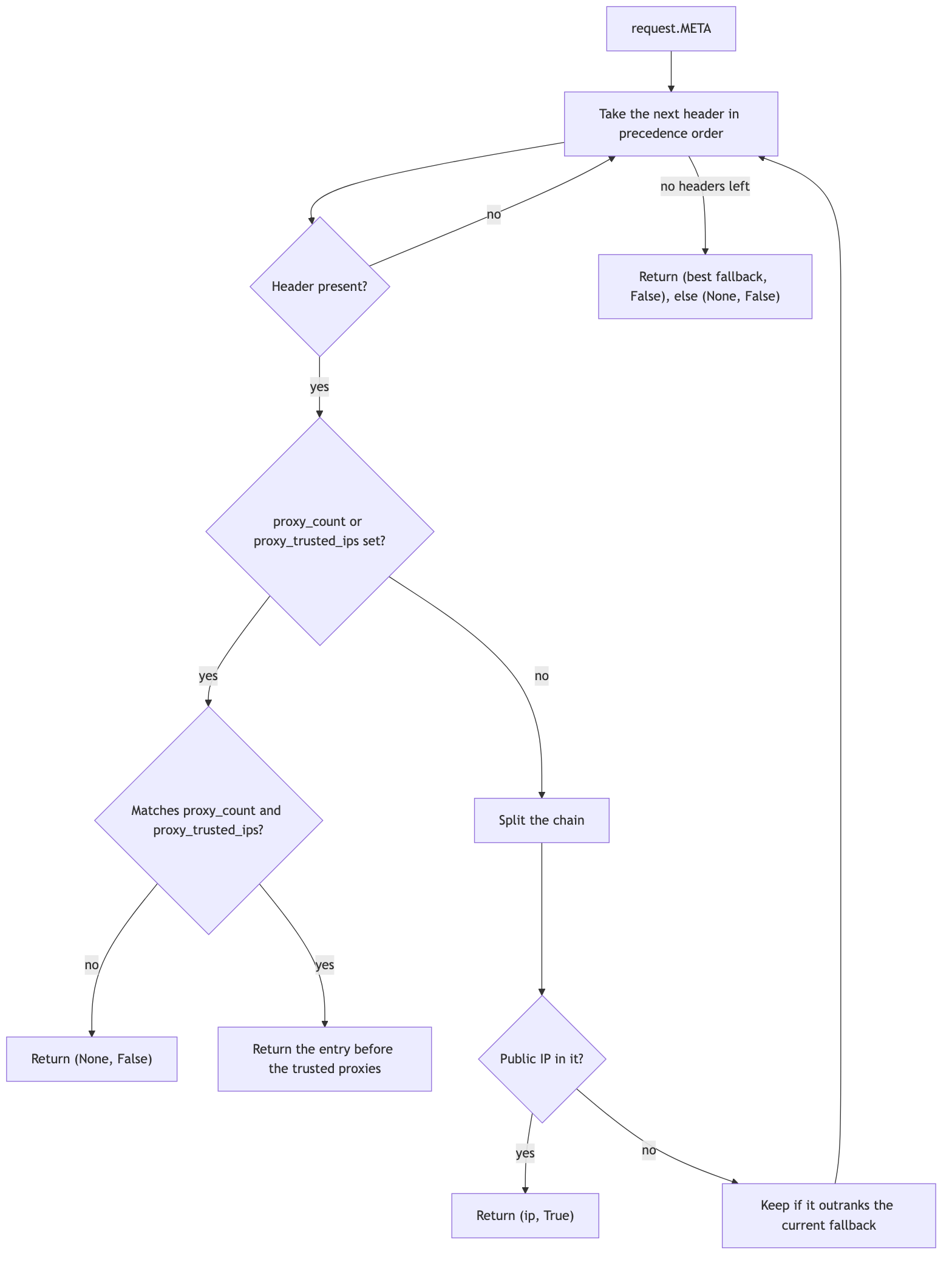
Without proxy_count / proxy_trusted_ips, headers are checked in precedence order. With either set,
the first header present decides on its own; lower headers are not consulted, and the result is
(None, False) if that header does not validate. So with proxy settings, set
IPWARE_META_PRECEDENCE_ORDER to the header your proxies write (for example
("HTTP_X_FORWARDED_FOR", "REMOTE_ADDR")). Every address is ranked:
| Rank | Addresses | is_routable |
|---|---|---|
| 1. public | globally routable | True |
| 2. private | RFC 1918, IPv6 ULA, CGNAT 100.64.0.0/10, documentation ranges |
False |
| 3. link-local | 169.254.0.0/16, fe80::/10 |
False |
| 4. loopback | 127.0.0.0/8, ::1 |
False |
| never returned | 0.0.0.0, ::, multicast, broadcast, reserved |
— |
The first public IP wins. If none is found, the best-ranked IP wins, and the earlier header wins a tie.
Within one header, the client entry depends on your proxy settings:
proxy_count/proxy_trusted_ipsset: the entry just before your trusted proxies. Entries that are empty or not IPs (unknown,for=_hidden) still count as positions, so they never shift which entry is the client.- Neither set: the first public entry in the chain, not only the first entry. So
10.0.0.1, 177.139.233.139yields177.139.233.139. That entry may be an upstream proxy rather than the client. If you need to identify private clients (intranet, VPN), setproxy_countorproxy_trusted_ipsso the client position is fixed.
Ports are stripped (1.2.3.4:8080, [2001:db8::1]:443). IPv4-mapped (::ffff:1.2.3.4) and NAT64
well-known-prefix (64:ff9b::1.2.3.4) addresses are returned as plain IPv4. RFC 7239 Forwarded
elements are read by their for= value (for="[2001:db8::1]:4711";proto=https). Malformed tokens such
as [::1, [::1]junk, or 1.2.3.4:abc are rejected rather than truncated.
Default header precedence
(
    "X_FORWARDED_FOR",           # load balancers / proxies (AWS ELB, etc.)
    "HTTP_X_FORWARDED_FOR",
    "HTTP_CLIENT_IP",            # Amazon EC2, Heroku
    "HTTP_X_REAL_IP",
    "HTTP_X_FORWARDED",          # Squid
    "HTTP_X_CLUSTER_CLIENT_IP",  # Rackspace LB, Riverbed Stingray
    "HTTP_FORWARDED_FOR",        # de facto variant
    "HTTP_FORWARDED",            # RFC 7239
    "HTTP_CF_CONNECTING_IP",     # Cloudflare
    "HTTP_TRUE_CLIENT_IP",       # Cloudflare Enterprise, Akamai
    "HTTP_FASTLY_CLIENT_IP",     # Fastly, Firebase
    "HTTP_FLY_CLIENT_IP",        # Fly.io
    "HTTP_X_APPENGINE_USER_IP",  # Google App Engine
    "X-CLIENT-IP",               # Microsoft Azure
    "X-REAL-IP",                 # NGINX
    "X-CLUSTER-CLIENT-IP",       # Rackspace Cloud Load Balancers
    "X_FORWARDED",
    "FORWARDED_FOR",
    "CF-CONNECTING-IP",
    "TRUE-CLIENT-IP",
    "FASTLY-CLIENT-IP",
    "FLY-CLIENT-IP",
    "FORWARDED",
    "CLIENT-IP",
    "HTTP_X_CLIENT_IP",          # Microsoft Azure (Django/WSGI form)
    "X-APPENGINE-USER-IP",       # Google App Engine (raw form)
    "HTTP_X_AZURE_CLIENTIP",     # Azure Front Door
    "X-AZURE-CLIENTIP",
    "HTTP_DO_CONNECTING_IP",     # DigitalOcean App Platform
    "DO-CONNECTING-IP",
    "HTTP_X_ENVOY_EXTERNAL_ADDRESS",  # Envoy / Istio
    "X-ENVOY-EXTERNAL-ADDRESS",
    "REMOTE_ADDR",               # direct connection
)
This list comes from python-ipware. Headers released earlier never move, so an upgrade can never let a new header outrank one that already resolved your requests.
Narrow it to what your infrastructure actually sets:
# settings.py
IPWARE_META_PRECEDENCE_ORDER = ("HTTP_X_FORWARDED_FOR", "REMOTE_ADDR")
If all your traffic comes through a CDN, put its header first. Only do this when Django is not reachable directly, because clients can send these headers themselves:
# settings.py: behind Cloudflare only
IPWARE_META_PRECEDENCE_ORDER = ("HTTP_CF_CONNECTING_IP", "HTTP_X_FORWARDED_FOR", "REMOTE_ADDR")
Do not combine this with proxy_count / proxy_trusted_ips: with proxy settings the first header present
decides alone, and a single-IP header such as CF-Connecting-IP never has proxy hops to match.
Trusted proxies
If Django sits behind known proxies, pass them. Requests that did not come through them are rejected.
Each entry can be:
- a complete IP, matched exactly:
"198.84.193.157"never matches198.84.193.15x, and IPv6 spelling (case, leading zeros) does not matter; - a CIDR network (IPv4 or IPv6), matched by membership. This is the recommended form for IPv6;
- an IP prefix, matched on whole octets or groups:
"10.1"and"10.1."match10.1.x.xbut not10.100.x.x.
get_client_ip(request, proxy_trusted_ips=["198.84.193.157"])                    # one proxy
get_client_ip(request, proxy_trusted_ips=["198.84.193.157", "198.84.193.158"])  # two proxies
get_client_ip(request, proxy_trusted_ips=["177.139.", "177.140"])               # prefixes for dynamic IPs
get_client_ip(request, proxy_trusted_ips=["100.64.0.0/10"])                     # CIDR network

# strict (default): X-Forwarded-For must be exactly <client>, <proxy1>, <proxy2>
# non-strict:       X-Forwarded-For may be <fake>, <client>, <proxy1>, <proxy2>
get_client_ip(request, proxy_trusted_ips=["198.84.193.157"], strict=False)

Proxy count
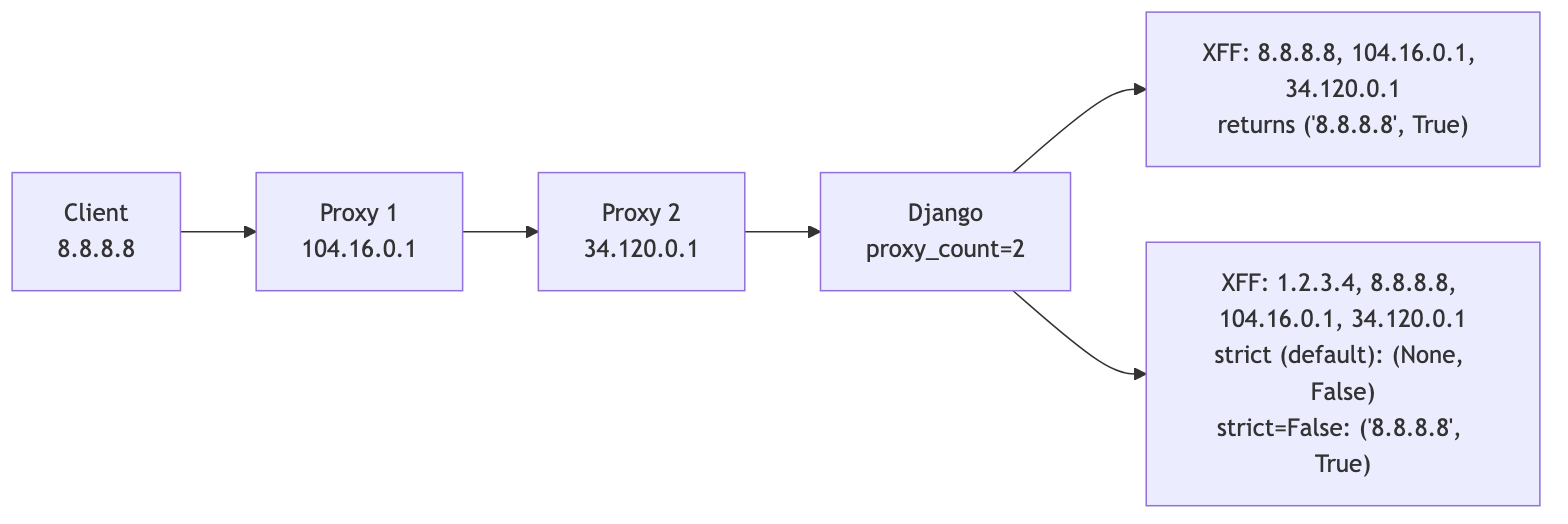
If you know how many proxies are in front of Django but not their IPs (for example, across providers):
get_client_ip(request, proxy_count=2)                # strict (default): exactly 2 proxies
get_client_ip(request, proxy_count=2, strict=False)  # at least 2 proxies
Or for the whole project:
# settings.py
IPWARE_META_PROXY_COUNT = 2
Combine both for the tightest check:
get_client_ip(request, proxy_count=1, proxy_trusted_ips=["198.84.193.157"])
Strict mode
By default, a malformed entry anywhere in a header (for example unknown, 177.139.233.139) makes that
header untrusted. Without proxy settings the next header is checked; with proxy_count /
proxy_trusted_ips the result is (None, False). Pass strict=False, or set IPWARE_STRICT = False,
to skip bad entries instead (with proxy settings they still count as positions).
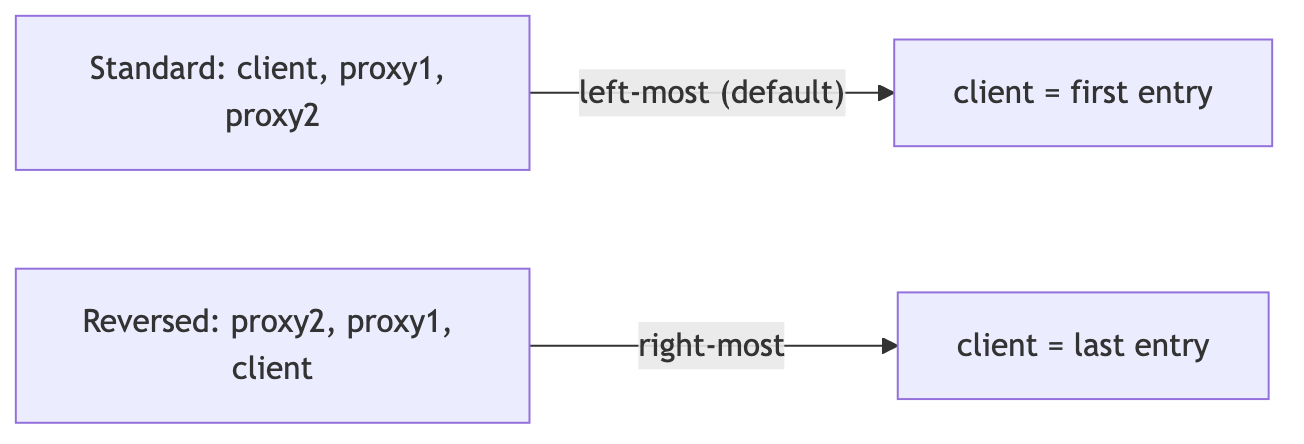
Right-most client networks
The de-facto standard puts the originating client left-most. For the rare network that puts it right-most:
get_client_ip(request, proxy_order="right-most")
See docs/nginx.md for an NGINX configuration example.
Middleware
Resolve the IP once per request and attach it:
# yourapp/middleware.py
from ipware import get_client_ip


class ClientIPMiddleware:
    def __init__(self, get_response):
        self.get_response = get_response

    def __call__(self, request):
        request.client_ip, request.client_ip_routable = get_client_ip(request)
        return self.get_response(request)
# settings.py
MIDDLEWARE = [
    # ...
    "yourapp.middleware.ClientIPMiddleware",
]
Upgrading from 7.x
Upgrade and pass nothing: you get the modern engine. If anything changes in a way you don't want, add one setting and you're back on the exact 7.x results — while still getting the 8.x/9.x package, Django 6 support and fixes. The legacy algorithm keeps the 7.x proxy-header handling and does not include the stricter handling added in 9.0; move to the default algorithm to get it.
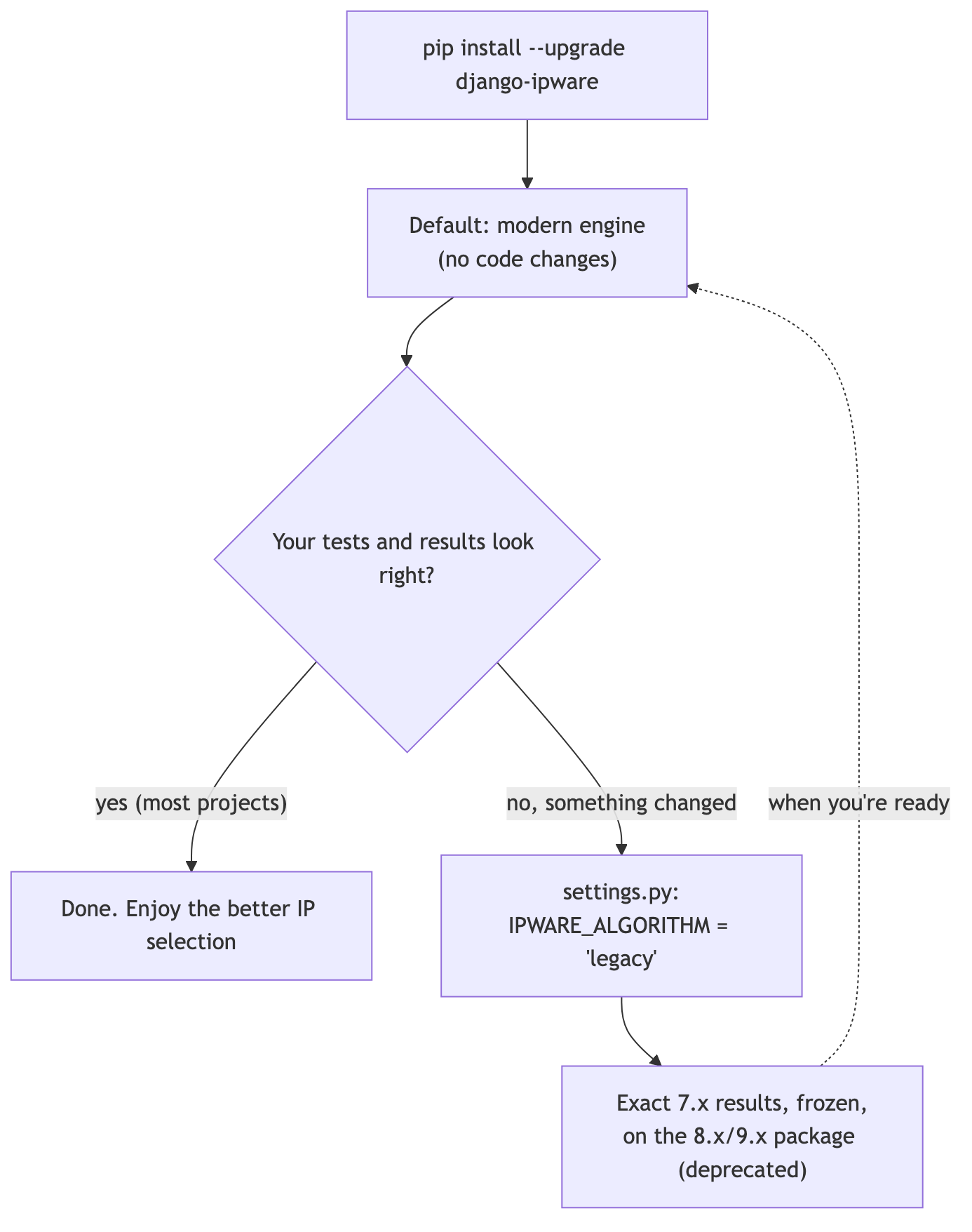
The legacy algorithm is frozen, takes no further changes, and is deprecated: selecting it emits a
DeprecationWarning, and it will be removed in a future major release. Use it for the whole project,
or per call:
# settings.py: the whole project
IPWARE_ALGORITHM = "legacy"
get_client_ip(request, algorithm="legacy")
Where the default differs from 7.x, it is always toward a better or stricter answer:
| Request | Modern (default) | Legacy (7.x) |
|---|---|---|
XFF: 10.0.0.1, 177.139.233.139 |
('177.139.233.139', True) |
('10.0.0.1', False) |
XFF: 224.0.0.1, REMOTE_ADDR: 10.0.0.5 |
('10.0.0.5', False) |
('224.0.0.1', True) (multicast) |
Forwarded: for="[2001:4860::17]:4711" |
('2001:4860::17', True) |
(None, False) |
REMOTE_ADDR: 8.8.8.8:abc |
(None, False) |
('8.8.8.8', True) |
proxy_trusted_ips=["198.84.193.15"], proxy 198.84.193.157 |
rejected (exact match) | accepted (prefix match) |
Legacy also keeps 7.x's settings quirks: IPWARE_META_PRECEDENCE_ORDER and IPWARE_STRICT override
the matching arguments, and IPWARE_META_PROXY_COUNT is ignored.
Development
python -m pip install -e '.[dev]'
ruff check .
python manage.py test                              # modern, legacy, router, and the 7.x suite on both
python -m build && python -m twine check dist/*
License
Released under the MIT license.
Maintenance
django-ipware is actively maintained with Dojo ⛩️. The legacy algorithm is frozen
for backward compatibility; all improvements target the modern engine. Need support? Reach
Neekware Inc. at info@neekware.com.
Sponsors
HeyDojo AI — creator of Dojo Workspace, your AI workspace for building, learning, and getting things done.
🚀 Created with Dojo ⛩️
1 maintainer

Metadata
1 maintainer
Release files for django-ipware 9.0.1
For a detailed explanation of source distributions (sdists) and built distributions (wheels), please see the package formats documentation.
Source distribution (sdist)
| File | Size | Uploaded | Provenance | Actions |
|---|---|---|---|---|
| django_ipware-9.0.1.tar.gz | 24.9 kB | Without provenance | Details for django_ipware-9.0.1.tar.gz |
Built distribution (wheel)
| File | Interpreter | ABI | Platform | Actions Reset |
|---|---|---|---|---|
| django_ipware-9.0.1-py3-none-any.whl | Python 3 | none | any | Details for django_ipware-9.0.1-py3-none-any.whl |
Total release size: 37.0 kB
Release files / django_ipware-9.0.1.tar.gz
| Download URL | django_ipware-9.0.1.tar.gz |
|---|---|
| Size | 24.9 kB |
| Tags | Source |
|
SHA-256 checksum How to use checksums |
3087d933d4158e64a7b0463b74ed39cd2dadb36efc3eac0bbdc72fb39c7acd43
|
|
BLAKE2b-256 checksum How to use checksums |
89256b1fa8dd7b3ea6df2d613894b3bdcc8f17ec659cbcd9cc463351a06e87f1
|
| Upload date | |
|
Uploaded using Trusted Publishing? What is trusted publishing? |
No |
| Uploaded via |
twine/7.0.0 CPython/3.13.13
|
Release files / django_ipware-9.0.1-py3-none-any.whl
| Download URL | django_ipware-9.0.1-py3-none-any.whl |
|---|---|
| Size | 12.1 kB |
| Tags | Python 3 |
|
SHA-256 checksum How to use checksums |
18700e9f116ccf6ea761931a16695fbf2db154a498de63332cce350a64632a9e
|
|
BLAKE2b-256 checksum How to use checksums |
c14439f53ae1badc257ab9ce272d31415aae0067809169f7713715690cc70821
|
| Upload date | |
|
Uploaded using Trusted Publishing? What is trusted publishing? |
No |
| Uploaded via |
twine/7.0.0 CPython/3.13.13
|
Security for django-ipware 9.0.1
Provenance
Provenance describes where a file came from. On PyPI, provenance is shared via attestations, which provide a verifiable record of the build or publishing details. View details, limitations and caveats.
No provenance found
None of the files in this release were uploaded with provenance metadata.
A note on package security
PyPI is a repository for distributing packages, not a service for auditing them. While third-party security researchers and our staff do their best to detect and remove malicious packages, PyPI cannot guarantee the quality, security or suitability of any given package.
To learn more about protecting yourself from malicious actors, visit our package security documentation.














