
Utility class for Django that helps determine the page number on which a specific object appears in a paginated list, either from a QuerySet or via a ForeignKey relationship.

Project description
django-page-resolver

This is python utility for Django that helps determine the page number on which a specific model instance appears within a paginated queryset or related object set. It also includes a Django templatetag for rendering HTMX + Bootstrap-compatible pagination with support for large page ranges and dynamic page loading.
Imagine you're working on a Django project where you want to highlight or scroll to a specific item on a paginated list — for example, highlighting a comment on a forum post. To do this, you need to calculate which page that comment appears on and then include that page number in the URL, like so:
localhost:8000/forum/posts/151/?comment=17&page=4
This allows you to directly link to the page where the target item exists.
Instead of manually figuring this out, use FlexPageResolver or PageResolverModel.
See Usage.
Installation
pip install django-page-resolver
Then you have to pass django_page_resolver to your INSTALLED_APPS:
INSTALLED_APPS = [
  ...
  'django_page_resolver',
  ...
]
Usage
Using of page-resolver to determine object's page location in paginated queryset.
There is a two ways to do so:
-
Using abstract model
PageResolverModel:from django_page_resolver.models import PageResolverModel class Comment(PageResolverModel): ... # OR class Post(PageResolverModel): ...
And then you have next API:
comment = Comment.objects.get(pk=27)
comment_page_number = comment.get_page_from_queryset(order_by='-relevancy_value', items_per_page=15)
# comment_page_number -> return 3

# OR

post = Post.objects.get(pk=120)
comment_page_number_from_post = post.get_page_from_nested_object(target_child_instance=comment, order_by='-relevancy_value', items_per_page=15)
# comment_page_number_from_post -> return 3
-
Using
page_resolverclass instance to do the same as was described above.from django_page_resolver.resolvers import page_resolver comment = Comment.objects.get(pk=27) comment_page_number = page_resolver.get_page_from_queryset( target_instance=comment, order_by='-relevancy_value', items_per_page=15 ) # comment_page_number -> return 3 # OR post = Post.objects.get(pk=120) comment_page_number_from_post = page_resolver.get_page_from_nested_object( parent_instance=post, target_child_instance=comment, order_by='-relevancy_value', items_per_page=15 ) # comment_page_number_from_post -> return 3
Parameters:
get_page_from_nested_object:
parent_instance: The parent model instance (e.g., Post). Required and uses only frompage_resolverinstance.target_child_instance: The related model instance to locate (e.g., Comment). Required.siblings_qs: Optional queryset to search in. If not provided, will use target_child_instance's model.related_name: The related name on the parent that accesses the child objects (e.g., 'comments'). (By default takesverbose_name_pluralfrom the Model's meta.)order_by: Field used to order the queryset. Default isNone.items_per_page: The pagination size (number of items per page). Required.
get_page_from_queryset:
target_instance: The instance whose page number we want to find. Required and uses only frompage_resolverinstance.queryset: Optional queryset to search in. If not provided, will use target_instance's model. (By default takes default__class__.objects.all()queryset from the Model)order_by: Field to order the queryset by. Default isNone.items_per_page: Number of items per page for pagination. Required.
And then you have it!
Front-end utilities
Prerequisites:
If you've set up page_resolver logic, you can use additional template tags and JavaScript utilities to automatically scroll to a specific instance on the page.
The JavaScript reads URL parameters that contain the unique identifier of the instance to scroll to.
Example:
-
Load
page_resolverstemplatetags in your HTML:
{% load page_resolvers %} -
Include the script and CSS styles in your HTML:
<script src="{% static 'resolvers/js/page_resolvers.js' %}"></script> <link type="text/css" href="{% static 'resolvers/css/page_resolvers.css' %}" rel="stylesheet"> -
Inside your {% for %} loop, register the object to be scrolled to:
{% register_scroll_obj_unique_pk instance_pk=comment.pk %}(You can use another unique identifier, such as a UUID.)This will mark the object as a scroll target.
-
Finally, add this tag inside the class attribute of your main HTML element:
{% classes_by_lookup_url instance_pk=comment.pk url_lookup='comment' %}(Or other unique identified like UUID)Like so:
<div class="container {% classes_by_lookup_url instance_pk=comment.pk url_lookup='comment' %}">...</div>
classes_by_lookup_urltakes the following arguments:instance_pk: The unique ID of the instance (could be UUID or another PK), that the page should scroll to.url_lookup: The name of the parameter in the URL. (Like/?comment=12&page=2, whereurl_lookupis acommentparameter name.)
(See examples in /examples/templatetags/register_instance_scroll.html within the library directory.)
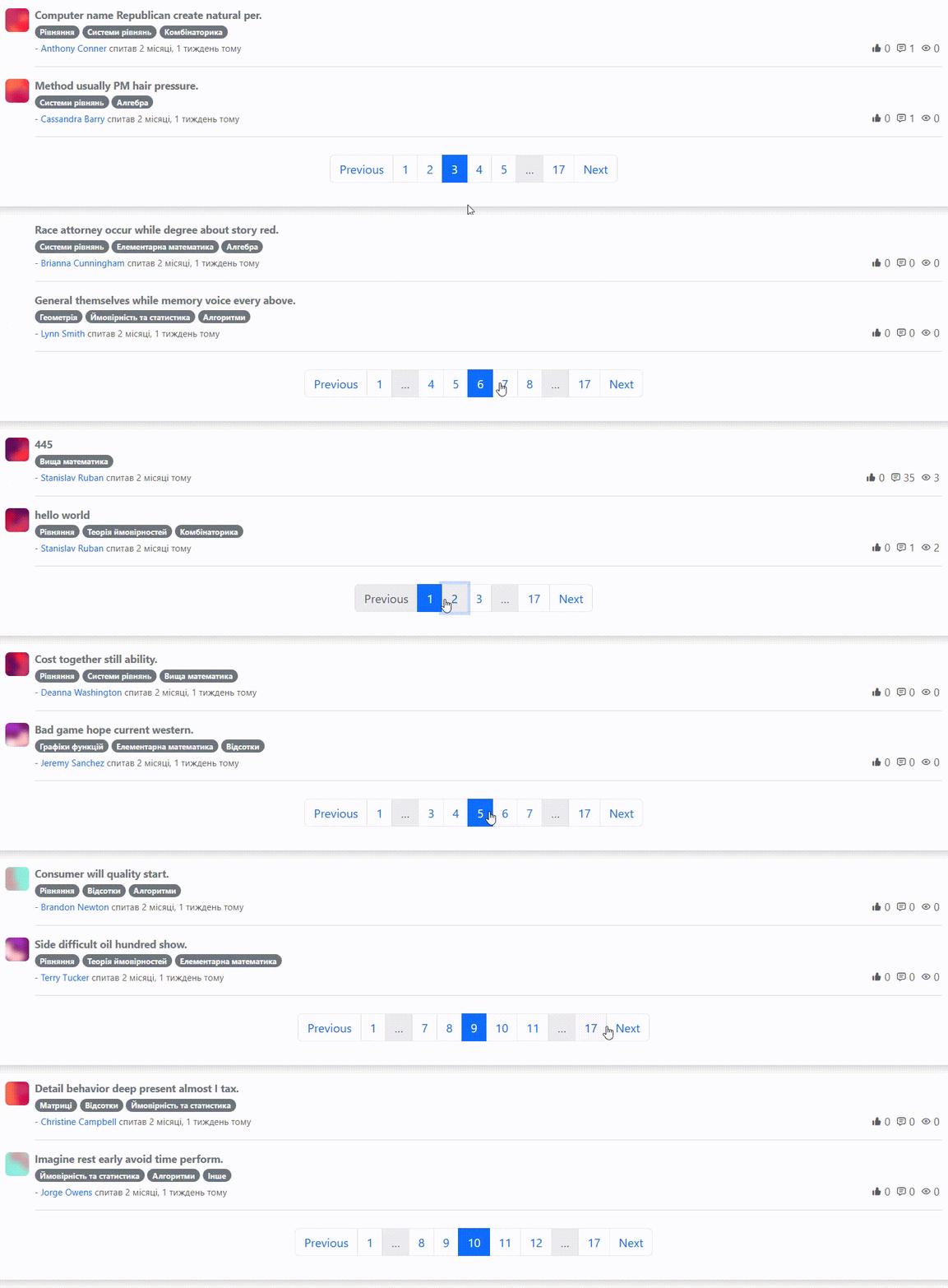
Additionaly, you can have handsome dynamic HTMX+Bootstrap HTML paginator via templatetag!
Load page_resolvers templatetags into your HTML:
{% load page_resolvers %}
Then just pass render_htmx_pagination templatetag with htmx_target argument in your HTML code like so:
{% render_htmx_pagination "#comment-list-body-js" %}
Note: You need to add render_htmx_pagination templatetag inside tag that has htmx_target selector which is you have specified.
This is required because of rerender the pagination block with objects list while htmx-request. See examples in examples folder.
That will render default bootstrap pagination with HTMX and nice-UI large pages count support and i18n. You can also add some classes to every element in pagination:
{% render_bootstrap_pagination '#post-list-js' ul_class="some-outstanding-class" li_class="more-class" a_class="text-danger" %}
And this is what you get then:
Contributing
You’re welcome to contribute to django-page-resolver by submitting pull requests, suggesting ideas, or helping improve the project in any way. Let’s make this library better together!


Download files
Download the file for your platform. If you're not sure which to choose, learn more about installing packages.
Source Distribution
Built Distribution
Filter files by name, interpreter, ABI, and platform.
If you're not sure about the file name format, learn more about wheel file names.
Copy a direct link to the current filters
File details
Details for the file django_page_resolver-0.2.0.tar.gz.
File metadata
- Download URL: django_page_resolver-0.2.0.tar.gz
- Upload date:
- Size: 8.9 kB
- Tags: Source
- Uploaded using Trusted Publishing? No
- Uploaded via: twine/6.1.0 CPython/3.12.3
File hashes
| Algorithm | Hash digest | |
|---|---|---|
| SHA256 |
cd117253af7118c9b3b2b7d3e4bd0647a1da73b08903414d426f8897e7857103
|
|
| MD5 |
5ca7d1132303d74a1aeed3d3af1f6b3b
|
|
| BLAKE2b-256 |
23ca78eaac0735449940ea1d5914d0db6ef595448e04d88152e8c9021c590c03
|
File details
Details for the file django_page_resolver-0.2.0-py3-none-any.whl.
File metadata
- Download URL: django_page_resolver-0.2.0-py3-none-any.whl
- Upload date:
- Size: 19.8 kB
- Tags: Python 3
- Uploaded using Trusted Publishing? No
- Uploaded via: twine/6.1.0 CPython/3.12.3
File hashes
| Algorithm | Hash digest | |
|---|---|---|
| SHA256 |
78437974907a8079f4924f6cbc46371307055c8d2f9897b2e601db8ec05198b5
|
|
| MD5 |
aa7d89794c34d843d0df11a90085251d
|
|
| BLAKE2b-256 |
064e5d8e2ff4ab67c40a5c9202614b2cecf62136ee8f073cd9d4310f65498f2d
|






