
A Django application for logging and displaying HTTP requests.

Project description
Django Request Logs
Django Request Logs is a reusable Django app designed to log and display HTTP requests in your project. This application allows developers to monitor incoming requests, their metadata, and responses for debugging and analysis.
Features
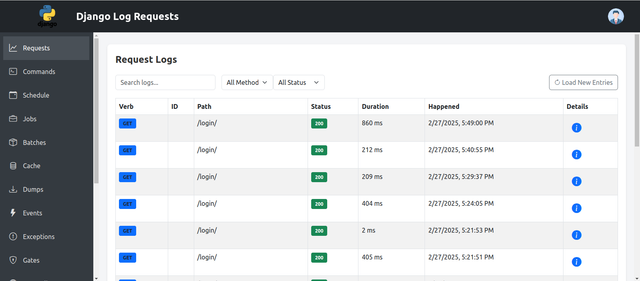
- Logs HTTP requests (method, path, status code, and duration).
- Provides middleware for lightweight logging.
- Easy-to-use admin interface to view logged requests.
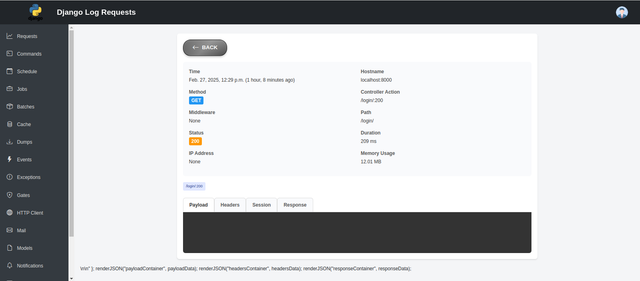
- Flexible views and templates for displaying logs.
Installation
Follow these steps to install and integrate Django Request Logs into your Django project:
Step 1: Install the Package
Install the app using pip:
pip pip install django_requests_loger
Step 2: Add to INSTALLED_APPS
Update your Django settings file (settings.py) to include the app:
INSTALLED_APPS = [
    ...,
    'django_requests_loger',
]
Step 3: Add Middleware
Insert the RequestLoggingMiddleware into the MIDDLEWARE list in your settings file:
MIDDLEWARE = [
    ...,
    'django_requests_loger.middleware.RequestLoggingMiddleware',
]
Step 4: Add Url
Add the url in project urls.py file:
urlpatterns = [
    path('', include('django_requests_loger.urls')),  # Include app URLs
]
Step 5: Run Migrations
Apply database migrations to create necessary tables:
python manage.py migrate
Dynamic Login Page Customization
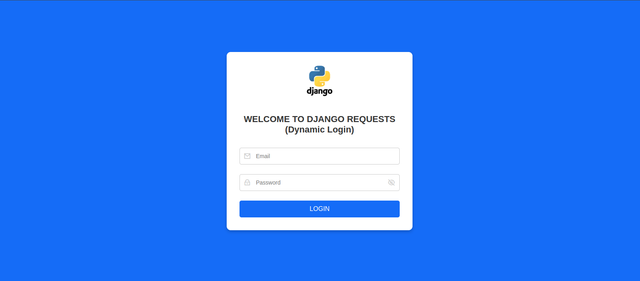
Django Request Logs also includes a dynamic login page that you can customize without modifying the template code.
- Add the Context Processor Ensure your project’s TEMPLATES configuration in settings.py includes the custom context processor:
   TEMPLATES = [
    {
        # ... other template settings ...
        "OPTIONS": {
            "context_processors": [
                # ... default context processors ...
                "django_requests_loger.context_processors.dynamic_login_settings",
                "django_requests_loger.context_processors.ui_settings",
            ],
        },
    },
]
- Override Default Values
You can override the default login page settings by adding these variables to your
settings.py:
LOGIN_PAGE_LOGO = "images/MyCustomLogo.png"  # Path to your logo in your static files
LOGIN_PAGE_HEADING = "WELCOME TO MY CUSTOM PROJECT <br>(Dynamic Login)"
If these are not set, the context processor will fall back to the default values.
- Template Usage The login template uses these context variables to display dynamic content. For example:
<img src="{% static LOGIN_PAGE_LOGO %}" alt="Logo">
<h1>{{ LOGIN_PAGE_HEADING|safe }}</h1>
The |safe filter allows HTML tags (like <br>) to be rendered correctly.
- Dynamic Request Logger Settings
You can control excluded paths, prefixes, and regex patterns for logging in
settings.py:
REQUEST_LOGGER = {
    "EXCLUDED_PATHS": [
        "/django_requests_loger/*",
        "/",
        "/django_requests_loger/",
        "/fetch-latest-logs/",
    ],
    "EXCLUDED_PREFIXES": [
        "/fetch-latest-logs/",
    ],
    "EXCLUDED_REGEX_PATTERNS": [
        r"^/django_requests_loger/\d+/$",
    ],
    # Add more keys as needed...
}
- Advanced View Configuration
DJANGO_REQUESTS_LOGER_CONFIGcontrols session timeouts, default pagination, and your “section map” for dynamic views:
DJANGO_REQUESTS_LOGER_CONFIG = {
    "SECTION_MAP": {
        "commands": "Commands",
        "schedule": "Schedule",
        "jobs": "Jobs",
        "batches": "Batches",
        "cache": "Cache",
        "dumps": "Dumps",
        "events": "Events",
        "exceptions": "Exceptions",
        "gates": "Gates",
        "http-client": "HTTP Client",
        "mail": "Mail",
        "models": "Models",
        "notifications": "Notifications",
        "queries": "Queries",
        "redis": "Redis",
        "views": "Views",
    },
    "SESSION_TIMEOUT_HOURS": 12,  # default 12 hours
    "DEFAULT_LOG_OFFSET": 0,
    "DEFAULT_LOG_LIMIT": 100,
}
- Dynamic UI Settings
django_requests_loger.context_processors.ui_settingsenables branding and sidebar customization:
DJANGO_REQUESTS_LOGER_UI = {
    "BRAND_LOGO": "images/Logo.png",  # Path in static files
    "PROJECT_NAME": "Django Log Requests",
    "SIDEBAR_LINKS": [
        {"url": "/request-logs/", "label": "Requests", "icon": "bi-graph-up"},
        {"url": "/commands/", "label": "Commands", "icon": "bi-terminal"},
        {"url": "/schedule/", "label": "Schedule", "icon": "bi-calendar-event"},
        {"url": "/jobs_view/", "label": "Jobs", "icon": "bi-briefcase"},
        {"url": "/batches/", "label": "Batches", "icon": "bi-box-seam"},
        {"url": "/cache/", "label": "Cache", "icon": "bi-database"},
        {"url": "/dumps/", "label": "Dumps", "icon": "bi-download"},
        {"url": "/events/", "label": "Events", "icon": "bi-lightning-fill"},
        {"url": "/exceptions/", "label": "Exceptions", "icon": "bi-exclamation-circle"},
        {"url": "/gates/", "label": "Gates", "icon": "bi-shield-lock"},
        {"url": "/http-client/", "label": "HTTP Client", "icon": "bi-globe"},
        {"url": "/mail/", "label": "Mail", "icon": "bi-envelope"},
        {"url": "/models/", "label": "Models", "icon": "bi-file-earmark"},
        {"url": "/notifications/", "label": "Notifications", "icon": "bi-bell"},
        {"url": "/queries/", "label": "Queries", "icon": "bi-card-list"},
        {"url": "/redis/", "label": "Redis", "icon": "bi-hdd"},
        {"url": "/views/", "label": "Views", "icon": "bi-eye"},
    ]
}
In your base template, you can reference these variables (e.g., {{ BRAND_LOGO }}, {{ PROJECT_NAME }}, SIDEBAR_LINKS) to dynamically render your sidebar or header.
Usage
Admin Panel
Logged requests can be viewed and managed through the Django admin interface:
- Navigate to
/admin/. - Look for the
Request Logssection.
Fetch Logs via API
Retrieve the latest logs using the provided API endpoint:
GET /fetch-latest-logs/
Example response:
{
  "logs": [
    {
      "id": 1,
      "method": "GET",
      "path": "/some-path/",
      "status_code": 200,
      "timestamp": "2024-11-29T12:00:00Z"
    }
  ]
}
Customizing Templates
The app includes default templates for displaying logs. These can be overridden by placing templates with the same name
in your project's templates/ directory:
request_logs.htmlrequest_log_detail.html
Development
Running Tests
Ensure the app works as expected by running the test suite:
python manage.py test django_requests_loger
Login Page:
Logs Page:
Log Detail Page:
Contributing
- Fork the repository.
- Create a feature branch:
git checkout -b feature-name
- Commit your changes and push them:
git commit -m "Add feature-name"
git push origin feature-name
- Submit a pull request.
License
This project is licensed under the MIT License. See the LICENSE file for details.
Support
For questions or support, please contact: mominalikhoker589@gmail.com.
Release history Release notifications | RSS feed


Download files
Download the file for your platform. If you're not sure which to choose, learn more about installing packages.
Source Distribution
Built Distribution
Filter files by name, interpreter, ABI, and platform.
If you're not sure about the file name format, learn more about wheel file names.
Copy a direct link to the current filters
File details
Details for the file django_requests_loger-1.1.9.tar.gz.
File metadata
- Download URL: django_requests_loger-1.1.9.tar.gz
- Upload date:
- Size: 22.3 kB
- Tags: Source
- Uploaded using Trusted Publishing? No
- Uploaded via: twine/6.1.0 CPython/3.8.20
File hashes
| Algorithm | Hash digest | |
|---|---|---|
| SHA256 |
7a37c60fcfc054970e486bdd6276d90b8d4084b36953efe7046171d92f3ad340
|
|
| MD5 |
21cee00b1f6a2ba0f4dafe5092d73347
|
|
| BLAKE2b-256 |
5ed82de73a0f3517253a38c1c1595692fcfd557a1930ae169b2f5f267563317c
|
File details
Details for the file django_requests_loger-1.1.9-py3-none-any.whl.
File metadata
- Download URL: django_requests_loger-1.1.9-py3-none-any.whl
- Upload date:
- Size: 26.5 kB
- Tags: Python 3
- Uploaded using Trusted Publishing? No
- Uploaded via: twine/6.1.0 CPython/3.8.20
File hashes
| Algorithm | Hash digest | |
|---|---|---|
| SHA256 |
133fdb1ad6a231aad8edafcd743bc8f08e79d515808630786ce0ea634ef722d4
|
|
| MD5 |
7d2b06ab13116fd2f4b87573281fb887
|
|
| BLAKE2b-256 |
ea655887cf2bff74e065dfa1800bd5ea4470a04305a3c57240f3fae3c746db3f
|






