
Django Simple URL Shortener





A small, self-hosted URL shortener built as a reusable Django application. It creates compact base-62 links, supports optional user accounts, and keeps deployment under your control.
The package is published on PyPI.
Screenshots
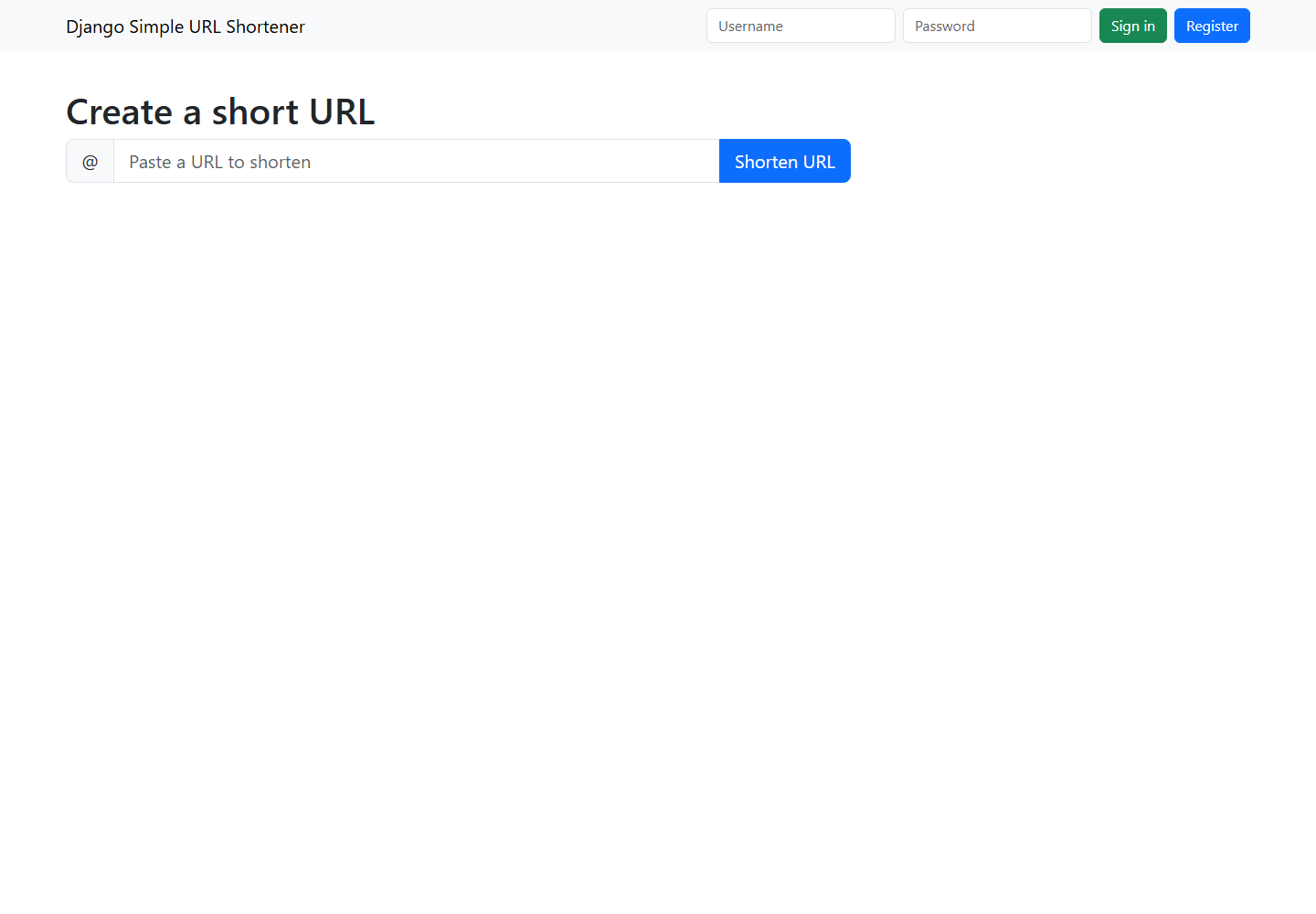
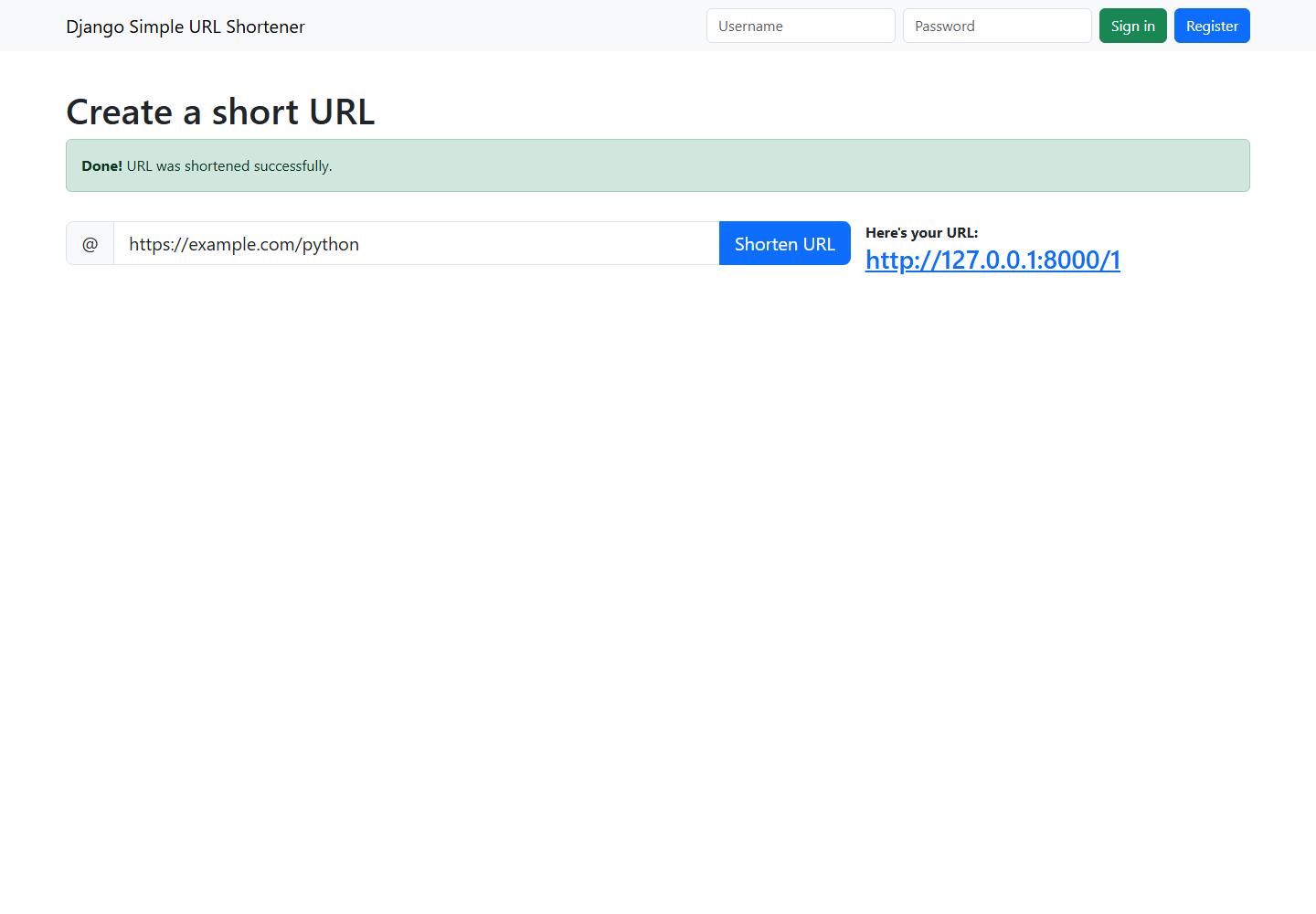
The screenshots below are generated by the repository's Playwright script.
| Home page | Shortened URL |
|---|---|
 |
 |
Features
- Shorten and permanently redirect to valid HTTP or HTTPS URLs.
- Save links for signed-in users and browse them with pagination.
- Generate compact, deterministic base-62 short codes by default, with a configurable encoder contract for custom code formats.
- Use Django's built-in authentication, forms, templates, and ORM.
- Responsive interface styled with locally bundled Bootstrap 5.3.9 assets.
- Install the Django app independently of the included demo project.
Compatibility
| Component | Supported version |
|---|---|
| Python | 3.12–3.15 |
| Django | 6.1.x |
| Database | SQLite for local development; configure Django's database settings for deployment |
The project is tested against all listed Python versions in CI. Django support follows the official Python compatibility table.
Quick start from source
git clone https://github.com/ricardodani/django-simple-url-shortner.git
cd django-simple-url-shortner
py -3.15 -m venv .venv
.\.venv\Scripts\Activate.ps1
python -m pip install --upgrade pip
python -m pip install -e .
python simple_url_shortner\manage.py migrate
python simple_url_shortner\manage.py runserver
Open http://127.0.0.1:8000/. On macOS or Linux, create and activate the
virtual environment with python3.15 -m venv .venv and
source .venv/bin/activate.
Add the app to a Django project
Install it from PyPI with:
python -m pip install django-simple-url-shortner
Register the app and its URL routes in your Django project:
# settings.py
INSTALLED_APPS = [
    # ...
    "urlshortener",
]
# urls.py
from django.urls import include, path

urlpatterns = [
    path("", include("urlshortener.urls")),
]
Run the app's migrations with python manage.py migrate. The app uses Django's
configured user model and cache backend.
Configuration and deployment
The included demo project reads these environment variables:
| Variable | Purpose | Default |
|---|---|---|
DJANGO_DEBUG |
Enable Django debug mode | true for local development |
DJANGO_SECRET_KEY |
Secret key used when debug mode is disabled | Development-only key when DJANGO_DEBUG=true |
DJANGO_ALLOWED_HOSTS |
Comma-separated allowed host names | localhost,127.0.0.1,testserver |
DJANGO_DB_PATH |
SQLite database file path | simple_url_shortner/db.sqlite3 |
For deployment, set DJANGO_DEBUG=false, provide a private
DJANGO_SECRET_KEY, configure DJANGO_ALLOWED_HOSTS, and use a production
database and cache appropriate to your workload. Never reuse the development
settings as a production configuration. See Django's
deployment checklist.
Short-code encoding
The default encoder converts each saved URL's integer database ID to base 62.
Its alphabet is 0123456789abcdefghijklmnopqrstuvwxyzABCDEFGHIJKLMNOPQRSTUVWXYZ:
10 digits plus 26 lowercase and 26 uppercase letters. It repeatedly divides
the ID by 62 and uses each remainder as a character, from right to left. For
example, 61 becomes Z and 62 becomes 10.
This is reversible base conversion, not encryption: it uses no secret and does not hide or protect IDs. Short codes should not be treated as authorization tokens or as a way to keep URLs private.
To use another encoding, subclass UrlCodeEncoder and implement
encode(value: int) -> str. The result must be a non-empty string of at most
22 ASCII letters or digits, and must not reuse codes already assigned to other
URLs. If an encoder repeatedly returns codes already in use, saving the URL
fails rather than overwriting another URL's code. Configure the dotted Python
path to the class in the Django project settings:
# myproject/url_codes.py
from urlshortener.converter import UrlCodeEncoder


class HexUrlCodeEncoder(UrlCodeEncoder):
    def encode(self, value: int) -> str:
        if value < 0:
            raise ValueError("value must be non-negative")
        return f"x{value:x}"
# settings.py
URLSHORTENER_CODE_ENCODER = "myproject.url_codes.HexUrlCodeEncoder"
The encoder is instantiated without arguments when a new URL is saved. Existing short codes are retained when their URL records are updated.
For keyed hash-based codes, configure the built-in HMAC-SHA256 encoder:
URLSHORTENER_CODE_ENCODER = "urlshortener.converter.HmacUrlCodeEncoder"
It uses Django's SECRET_KEY and the URL's database ID, truncates HMAC-SHA256
to 128 bits, and encodes those bits in base 62. The minimum fixed width to
represent 128 bits in base 62 is 22 characters
(ceil(128 / log2(62))). No finite code is literally unbreakable, but
128-bit keyed codes are impractical to guess by brute force while the secret
remains private. Changing SECRET_KEY only affects codes generated afterward;
saved codes remain stored.
If shorter codes are more important than resistance to guessing, the
ShortHmacUrlCodeEncoder produces 8-character codes (about 47.6 bits):
URLSHORTENER_CODE_ENCODER = "urlshortener.converter.ShortHmacUrlCodeEncoder"
This shorter option is intentionally weaker and should not be used when guessing or enumeration could expose sensitive destinations.
For random non-sequential codes instead, use the built-in cryptographically secure random encoder:
URLSHORTENER_CODE_ENCODER = "urlshortener.converter.RandomUrlCodeEncoder"
It chooses 16 characters independently from the 62-character alphabet using
Python's secrets module, giving about 95 bits of randomness. The database
enforces code uniqueness, and collisions are retried. This makes codes
impractical to predict or enumerate, but a short URL is still a bearer link:
anyone who obtains it can visit it. Do not use a short code as authentication
or access control.
Development
Install the development tools and Playwright:
python -m pip install -e ".[dev]"
python -m playwright install chromium
Run the unit and Django integration tests:
coverage run -m pytest
coverage report
Run lint, formatting checks, and pre-commit hooks:
ruff check .
ruff format --check .
mypy
pre-commit run --all-files
Run the Playwright end-to-end smoke test and refresh the checked-in screenshots:
python scripts/capture_screenshots.py
The script starts an isolated demo database and local Django server, exercises
URL creation and redirection in Chromium, then writes PNGs to
docs/screenshots/. Pass --output-dir PATH to write the screenshots
to another directory inside the repository or --port PORT to use a different
local port. Add --headed to watch the test run in a visible Chromium window.
For safety, output paths outside the repository are rejected.
Build and validate the distribution without publishing it:
python -m build --sdist --wheel
python -m twine check dist/*
AI and MCP integrations
AI integrations are not part of the core package. If an MCP interface is added, it should be a separate, optional adapter over the same URL-shortening operations. The adapter can use the official MCP Python SDK; Agno can consume that MCP server when an Agno-based client is useful, without making Agno a required dependency of this Django application.
Contributing
Bug reports, focused improvements, and tests are welcome. Please include the problem being solved, steps to reproduce when relevant, and the checks you ran. Pull requests require maintainer review and manual approval before merge.
License
This project is distributed under the GNU General Public License, version 2. See LICENSE.
1 maintainer

Metadata
1 maintainer
Release files for django-simple-url-shortner 0.2.2
For a detailed explanation of source distributions (sdists) and built distributions (wheels), please see the package formats documentation.
Source distribution (sdist)
| File | Size | Uploaded | Provenance | Actions |
|---|---|---|---|---|
| django_simple_url_shortner-0.2.2.tar.gz | 80.8 kB | Without provenance | Details for django_simple_url_shortner-0.2.2.tar.gz |
Built distribution (wheel)
| File | Interpreter | ABI | Platform | Actions Reset |
|---|---|---|---|---|
| django_simple_url_shortner-0.2.2-py3-none-any.whl | Python 3 | none | any | Details for django_simple_url_shortner-0.2.2-py3-none-any.whl |
Total release size: 162.8 kB
Release files / django_simple_url_shortner-0.2.2.tar.gz
| Download URL | django_simple_url_shortner-0.2.2.tar.gz |
|---|---|
| Size | 80.8 kB |
| Tags | Source |
|
SHA-256 checksum How to use checksums |
8388e8128d21dea48205047b03fa7b3214da52adb27b81e00f7870ef2a7366f1
|
|
BLAKE2b-256 checksum How to use checksums |
7864d1032ce5ea539727ca1c4aa74ebe2afc6cbd80422932c469162d10fdb408
|
| Upload date | |
|
Uploaded using Trusted Publishing? What is trusted publishing? |
No |
| Uploaded via |
twine/7.0.0 CPython/3.12.10
|
Release files / django_simple_url_shortner-0.2.2-py3-none-any.whl
| Download URL | django_simple_url_shortner-0.2.2-py3-none-any.whl |
|---|---|
| Size | 82.0 kB |
| Tags | Python 3 |
|
SHA-256 checksum How to use checksums |
20b63667af53b2db65f3cb2298b0fb365417673b008748f4af4dc1e865f7954a
|
|
BLAKE2b-256 checksum How to use checksums |
ee1abd38e1ecf67935ffbef981d1538e08b94f55fe3802971cc70175d3515f14
|
| Upload date | |
|
Uploaded using Trusted Publishing? What is trusted publishing? |
No |
| Uploaded via |
twine/7.0.0 CPython/3.12.10
|
Security for django-simple-url-shortner 0.2.2
Provenance
Provenance describes where a file came from. On PyPI, provenance is shared via attestations, which provide a verifiable record of the build or publishing details. View details, limitations and caveats.
No provenance found
None of the files in this release were uploaded with provenance metadata.
A note on package security
PyPI is a repository for distributing packages, not a service for auditing them. While third-party security researchers and our staff do their best to detect and remove malicious packages, PyPI cannot guarantee the quality, security or suitability of any given package.
To learn more about protecting yourself from malicious actors, visit our package security documentation.














