
django-sql-dashboard





Django SQL Dashboard provides an authenticated interface for executing read-only SQL queries directly against your PostgreSQL database, bringing a useful subset of Datasette to Django.
Applications include ad-hoc analysis and debugging, plus the creation of reporting dashboards that can be shared with team members or published online.
See my blog for more about this project, including a video demo.
Features include:
- Safely run read-only one or more SQL queries against your database and view the results in your browser
- Bookmark queries and share those links with other members of your team
- Create saved dashboards from your queries, with full control over who can view and edit them
- Named parameters such as
select * from entries where id = %(id)swill be turned into form fields, allowing quick creation of interactive dashboards - Produce bar charts, progress bars and more from SQL queries, with the ability to easily create new custom dashboard widgets using the Django template system
- Write SQL queries that safely construct and render markdown and HTML
- Export the full results of a SQL query as a downloadable CSV or TSV file, using a combination of Django's streaming HTTP response mechanism and PostgreSQL server-side cursors to efficiently stream large amounts of data without running out of resources
- Copy and paste the results of SQL queries directly into tools such as Google Sheets or Excel
- Uses Django's authentication system, so dashboard accounts can be granted using Django's Admin tools
Documentation
Full documentation is at django-sql-dashboard.datasette.io
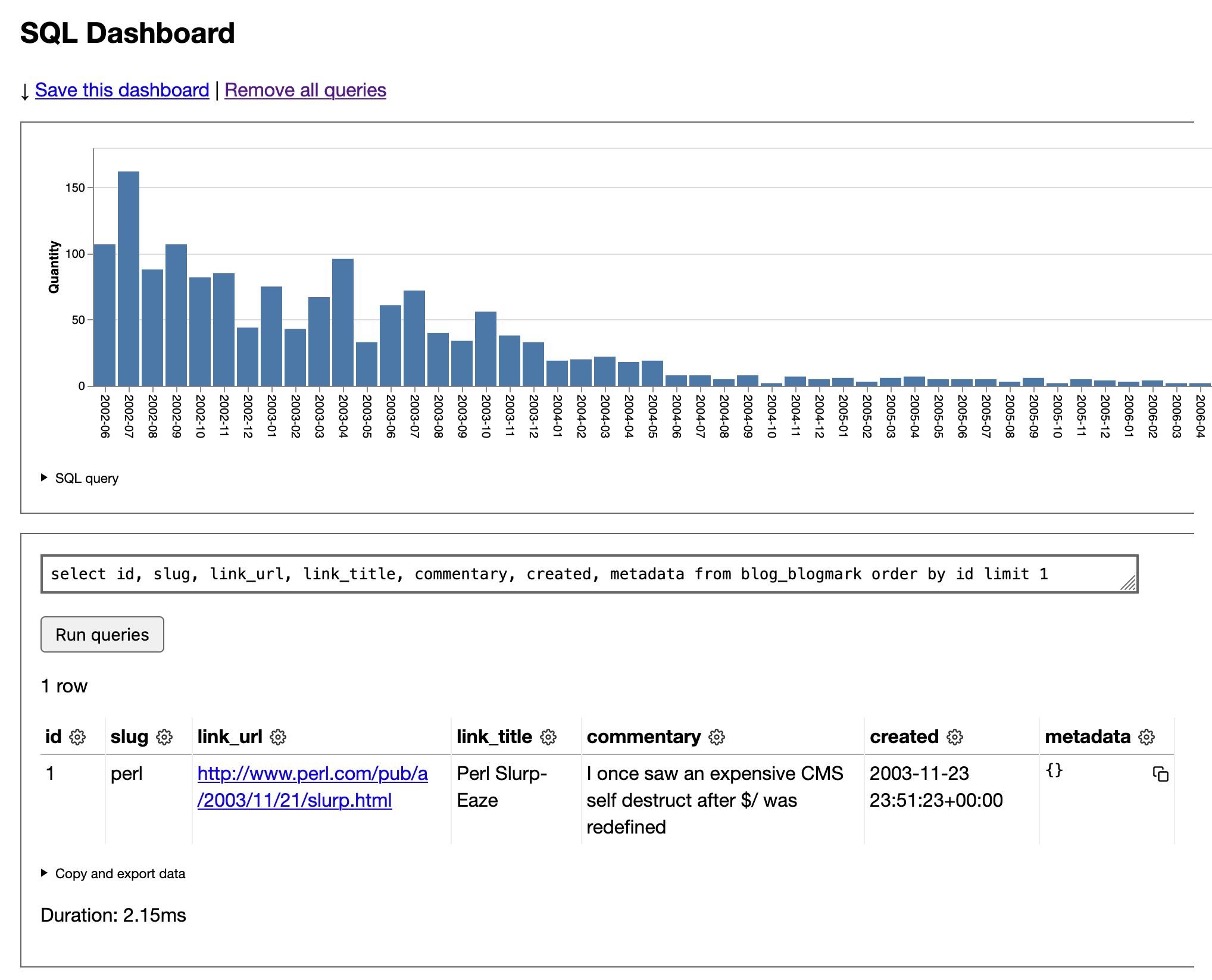
Screenshot
Alternatives
- django-sql-explorer provides a related set of functionality that also works against database backends other than PostgreSQL
1 maintainer

Metadata
1 maintainer
Release files for django-sql-dashboard 1.2
For a detailed explanation of source distributions (sdists) and built distributions (wheels), please see the package formats documentation.
Source distribution (sdist)
| File | Size | Uploaded | Provenance | Actions |
|---|---|---|---|---|
| django-sql-dashboard-1.2.tar.gz | 27.2 kB | Without provenance | Details for django-sql-dashboard-1.2.tar.gz |
Built distribution (wheel)
| File | Interpreter | ABI | Platform | Actions Reset |
|---|---|---|---|---|
| django_sql_dashboard-1.2-py3-none-any.whl | Python 3 | none | any | Details for django_sql_dashboard-1.2-py3-none-any.whl |
Total release size: 62.4 kB
Release files / django-sql-dashboard-1.2.tar.gz
| Download URL | django-sql-dashboard-1.2.tar.gz |
|---|---|
| Size | 27.2 kB |
| Tags | Source |
|
SHA-256 checksum How to use checksums |
7bc8ee6cb212d74147216e31ec392e29f5c16bdcb5cc8e76a3715f0d527713a9
|
|
BLAKE2b-256 checksum How to use checksums |
75b7ac4015ea4aa2962d20408077c03c1a4d79298e967272a7dfe5bf1d52c2ec
|
| Upload date | |
|
Uploaded using Trusted Publishing? What is trusted publishing? |
No |
| Uploaded via |
twine/4.0.2 CPython/3.12.1
|
Release files / django_sql_dashboard-1.2-py3-none-any.whl
| Download URL | django_sql_dashboard-1.2-py3-none-any.whl |
|---|---|
| Size | 35.3 kB |
| Tags | Python 3 |
|
SHA-256 checksum How to use checksums |
656e9d8ecd2d0ce6a877a732f66adb69d79c4b535c5fcbc0dc5099ef97de260a
|
|
BLAKE2b-256 checksum How to use checksums |
315c5c16c89d24b661c9ac7746b11b377acbf443f96cfa71f9c1e1283260c3bb
|
| Upload date | |
|
Uploaded using Trusted Publishing? What is trusted publishing? |
No |
| Uploaded via |
twine/4.0.2 CPython/3.12.1
|
Security for django-sql-dashboard 1.2
Provenance
Provenance describes where a file came from. On PyPI, provenance is shared via attestations, which provide a verifiable record of the build or publishing details. View details, limitations and caveats.
No provenance found
None of the files in this release were uploaded with provenance metadata.
A note on package security
PyPI is a repository for distributing packages, not a service for auditing them. While third-party security researchers and our staff do their best to detect and remove malicious packages, PyPI cannot guarantee the quality, security or suitability of any given package.
To learn more about protecting yourself from malicious actors, visit our package security documentation.














