
Django Tags Input
Ordered tags with autocomplete for Django forms and the admin. Use an existing model for labels, allow new objects where appropriate, and keep the selection order through form saves and reloads.



Try the forms | Documentation | Source
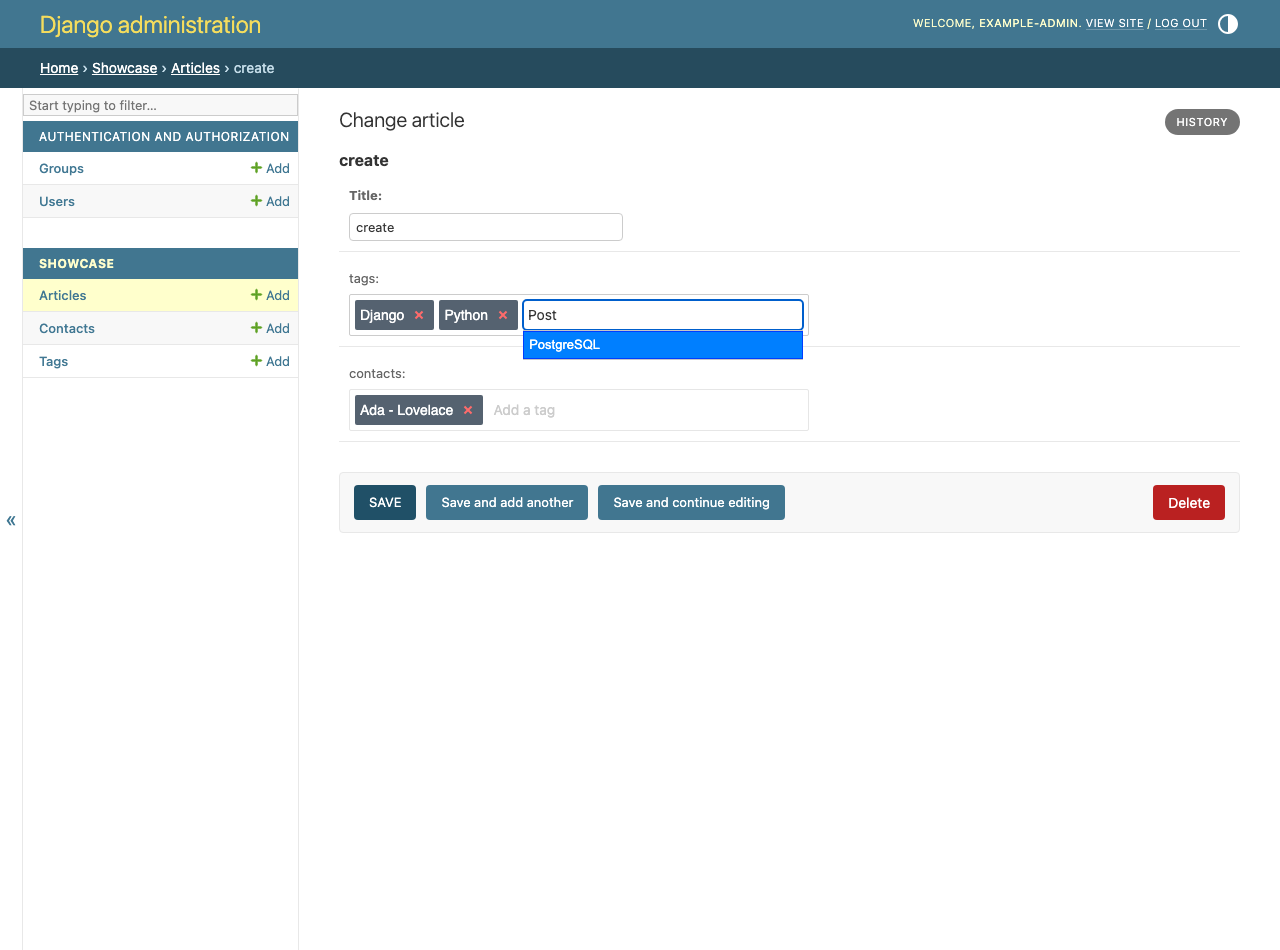
The browser example runs real Django forms and SQLite on your device. It supports tag creation, existing choices and composite contact labels. Saved tags persist across reloads. No public Django server receives them.
Install
uv add django-tags-input
Python 3.10+ and Django 5.2+ are required. Django 6.x requires Python 3.12+. The package includes the widget's JavaScript and CSS, so using it does not require Node.js or a frontend build.
Add tags to the admin
In an existing Django app named blog, give posts a relation to tag objects:
from __future__ import annotations

from django.db import models


class Tag(models.Model):
    name: models.CharField[str, str] = models.CharField(max_length=100)

    def __str__(self) -> str:
        return self.name


class Post(models.Model):
    title: models.CharField[str, str] = models.CharField(max_length=200)
    tags: models.ManyToManyField[Tag, Tag] = models.ManyToManyField(
        Tag, blank=True,
    )
Each tag is an ordinary model row. The post stores the relationship through Django's automatically created join table.
Add the widget app and its mapping to your settings:
INSTALLED_APPS += ['tags_input']

TAGS_INPUT_MAPPINGS: dict[str, dict[str, object]] = {
    'blog.Tag': {'field': 'name', 'create_missing': True},
}
The key identifies the model. field supplies the visible label, and
create_missing permits a new tag when no existing label matches.
Keep it disabled when users must choose existing objects.
Include the autocomplete route in the project's urls.py:
from django.urls import include, path

urlpatterns += [
    path('tags-input/', include('tags_input.urls', namespace='tags_input')),
]
The namespace must be tags_input. One route serves the mapped models.
Register the post with the package's admin class:
from typing import ClassVar

from django.contrib import admin
from tags_input.admin import TagsInputAdmin

from .models import Post


@admin.register(Post)
class PostAdmin(TagsInputAdmin):
    tag_fields: ClassVar[list[str]] = ['tags']
Create the tables and open a post in the admin:
uv run python manage.py makemigrations blog
uv run python manage.py migrate
uv run python manage.py runserver
The tags field now offers autocomplete. Saving a new label creates a tag
object after calling its clean() method. Existing labels become relations
in the order entered.
[!NOTE] The autocomplete endpoint does not check permissions. For private labels, restrict access in your own view or middleware and pass the permitted queryset to the form field. Suggestion filters alone do not restrict saves.
Use a form outside the admin
Use both the field and the form mixin when the order must survive saves:
from __future__ import annotations

from typing import ClassVar

from django import forms
from tags_input.admin import TagsInputFormMixin
from tags_input.fields import TagsInputField

from .models import Post, Tag


class PostForm(TagsInputFormMixin, forms.ModelForm):
    tags: TagsInputField = TagsInputField(Tag.objects.all(), required=False)

    class Meta:
        model: type[Post] = Post
        fields: ClassVar[list[str]] = ['title', 'tags']
TagsInputField validates labels against its queryset. The mixin saves the
related objects in that order. Render the form media alongside the form:
{{ form.media }}
<form method="post">
    {% csrf_token %}
    {{ form.as_p }}
    <button type="submit">Save</button>
</form>
The media loads the bundled jQuery, jQuery UI and tagsinput plugin. If your
page already loads compatible jQuery and jQuery UI, set
TAGS_INPUT_INCLUDE_JQUERY = False.
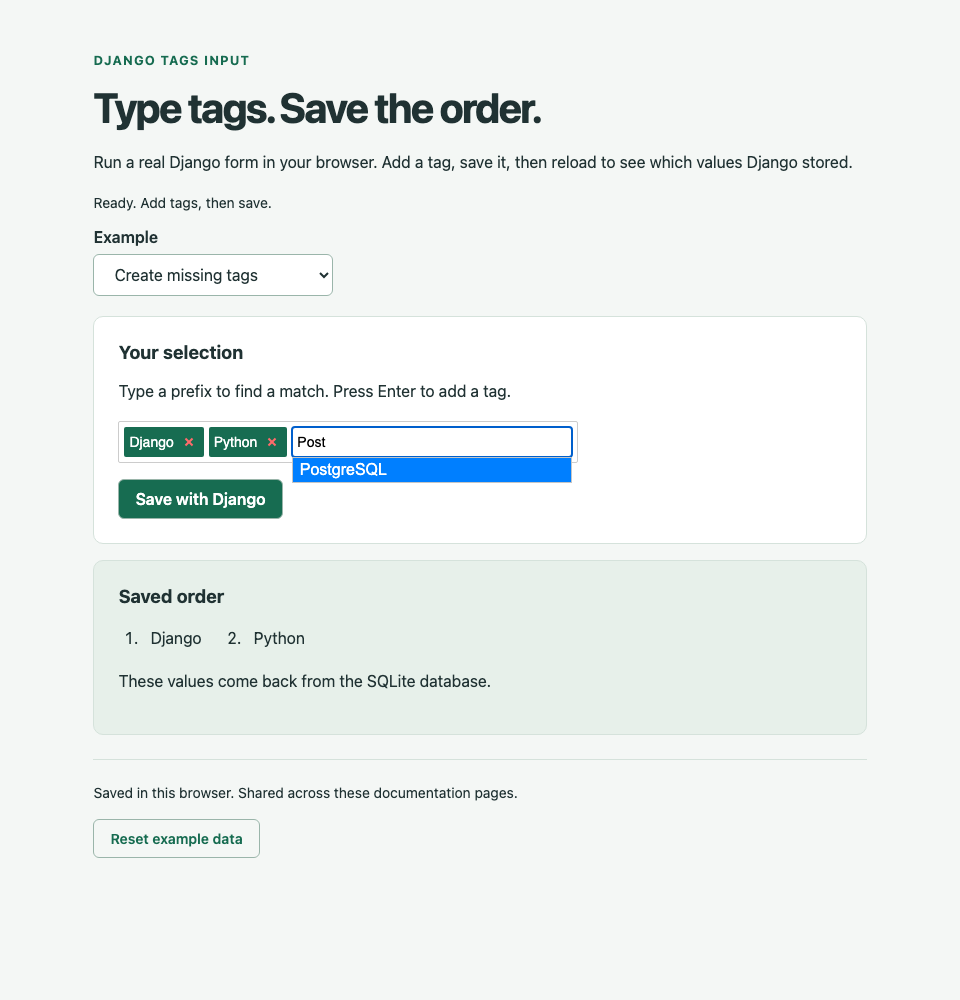
Read the saved order with tags_input.utils.get_tags(post, 'tags').
post.tags.all() uses the model or database ordering instead.
Guides and development
- Configuration: mappings, callbacks and matching rules.
- Admin and inlines: choosing fields and handling relationship signals.
- Order: how the join table records selections and where that approach applies.
- Local examples: run the same forms and inspect the admin.
- Contributing: uv, strict typing, linting, documentation and coverage checks.
The test matrix covers Python 3.10-3.14 with compatible Django 5.2, 6.0 and 6.1 releases. The project requires 100% statement and branch coverage and checks types with mypy, basedpyright and pyrefly.
2 maintainers


Release files for django-tags-input 7.0.0
For a detailed explanation of source distributions (sdists) and built distributions (wheels), please see the package formats documentation.
Source distribution (sdist)
| File | Size | Uploaded | |
|---|---|---|---|
| django_tags_input-7.0.0.tar.gz | 1.1 MB | Details |
Built distribution (wheel)
| File | Interpreter | ABI | Platform | Reset |
|---|---|---|---|---|
| django_tags_input-7.0.0-py3-none-any.whl | Python 3 | none | any | Details |
Total release size: 1.3 MB
Release files / django_tags_input-7.0.0.tar.gz
| Download URL | django_tags_input-7.0.0.tar.gz |
|---|---|
| Size | 1.1 MB |
| Tags | Source |
|
SHA-256 checksum How to use checksums |
353336d9786fe6042bbc2b3c239c94cbd09bd366fbd731eda11001d89bf156a2
|
|
BLAKE2b-256 checksum How to use checksums |
641fa85afbb9f0f1ab1203c1c3f7a4b45d3da7d460587e774b12813d7e2b9fe5
|
| Upload date | |
|
Uploaded using Trusted Publishing? What is trusted publishing? |
Yes |
| Uploaded via |
twine/7.0.0 CPython/3.13.14
|
Provenance
Provenance describes where a file came from. On PyPI, provenance is shared via attestations, which provide a verifiable record of the build or publishing details. View details, limitations and caveats.


PyPI Publish Attestation
PyPI verified that this artifact, at this checksum, originated from the publisher listed below.
Signed by GitHub Actions, verified by PyPI on Sep 7, 2026.
Transparency logRelease files / django_tags_input-7.0.0-py3-none-any.whl
| Download URL | django_tags_input-7.0.0-py3-none-any.whl |
|---|---|
| Size | 168.3 kB |
| Tags | Python 3 |
|
SHA-256 checksum How to use checksums |
5ab5bd681fb7da9f57a73072a910b79154d9f5c3b9cd1a25a6dcb9e0c0323430
|
|
BLAKE2b-256 checksum How to use checksums |
e1c59e56ba5a9fe2816c25f4427e4cba932106bf624102b535aafc193f65ccb6
|
| Upload date | |
|
Uploaded using Trusted Publishing? What is trusted publishing? |
Yes |
| Uploaded via |
twine/7.0.0 CPython/3.13.14
|
Provenance
Provenance describes where a file came from. On PyPI, provenance is shared via attestations, which provide a verifiable record of the build or publishing details. View details, limitations and caveats.
PyPI Publish Attestation
PyPI verified that this artifact, at this checksum, originated from the publisher listed below.
Signed by GitHub Actions, verified by PyPI on Sep 7, 2026.
Transparency log













