
Deep Learning for empirical DownScaling

Project description



Deep Learning for empirical DownScaling
DL4DS (Deep Learning for empirical DownScaling) is a Python package that implements state-of-the-art and novel deep learning algorithms for empirical downscaling of gridded Earth science data.
The general architecture of DL4DS is shown on the image below. A low-resolution gridded dataset can be downscaled, with the help of (an arbitrary number of) auxiliary predictor and static variables, and a high-resolution reference dataset. The mapping between the low- and high-resolution data is learned with either a supervised or a conditional generative adversarial DL model.
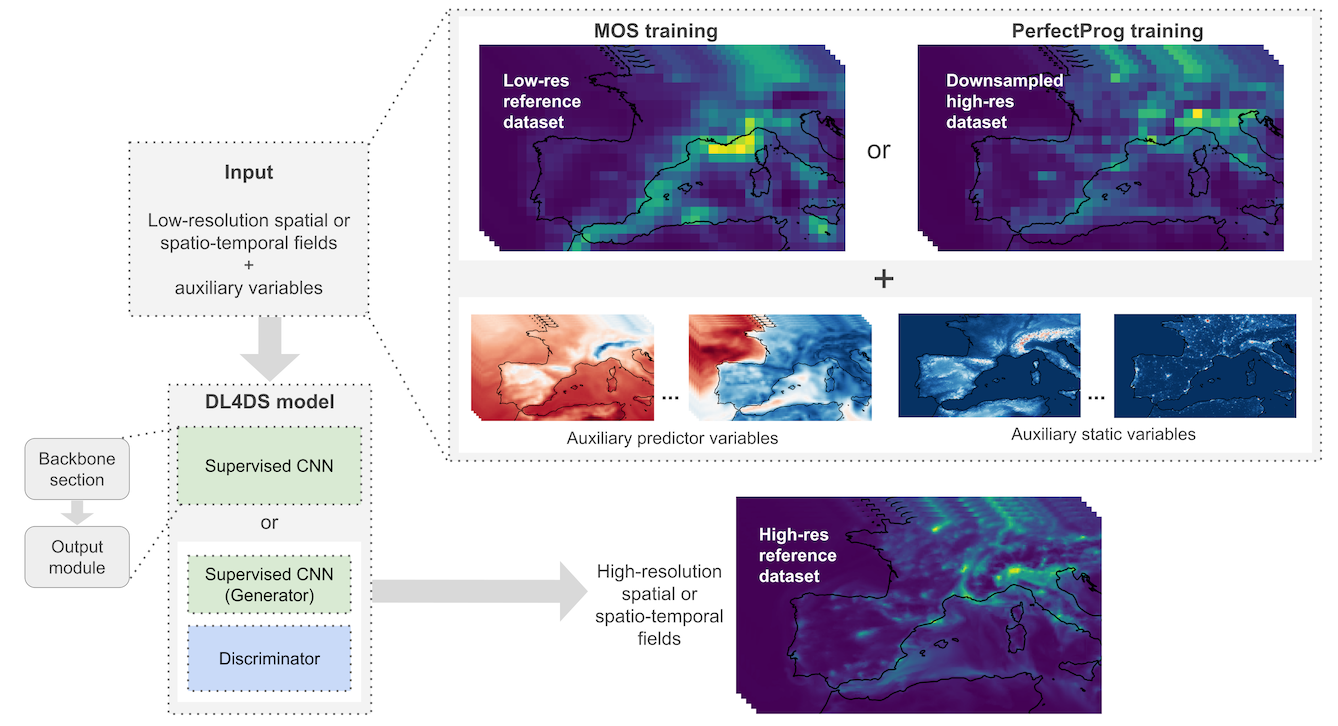
The training can be done from explicit pairs of high- and low-resolution samples (MOS-style, e.g., high-res observations and low-res numerical weather prediction model output) or only with a HR dataset (PerfectProg-style, e.g., high-res observations or high-res model output).
A wide variety of network architectures have been implemented in DL4DS. The main modelling approaches can be combined into many different architectures:
| Downscaling type | Training (loss type) | Sample type | Backbone section | Upsampling method |
|---|---|---|---|---|
| MOS (explicit pairs of HR and LR data) | Supervised (non-adversarial) | Spatial | Plain convolutional | Pre-upsampling via interpolation |
| PerfectProg (implicit pairs, only HR data) | Conditional Adversarial | Spatio-temporal | Residual | Post-upsampling via sub-pixel convolution |
| Dense | Post-upsampling via resize convolution | |||
| Unet (PIN, Spatial samples) | Post-upsampling via deconvolution | |||
| Convnext (Spatial samples) |
In DL4DS, we implement a channel attention mechanism to exploit inter-channel relationship of features by providing a weight for each channel in order to enhance those that contribute the most to the optimizaiton and learning process. Aditionally, a Localized Convolutional Block (LCB) is located in the output module of the networks in DL4DS. With the LCB we learn location-specific information via a locally connected layer with biases.
DL4DS is built on top of Tensorflow/Keras and supports distributed GPU training (data parallelism) thanks to Horovod.
API documentation
Check out the API documentation here.
Installation
pip install dl4d
Example notebooks
A first Colab notebook can be found in the notebooks folder. Click the badge at the top to open the notebook on Google Colab.
Release history Release notifications | RSS feed


Download files
Download the file for your platform. If you're not sure which to choose, learn more about installing packages.
Source Distribution
File details
Details for the file dl4d-1.8.1.tar.gz.
File metadata
- Download URL: dl4d-1.8.1.tar.gz
- Upload date:
- Size: 51.7 kB
- Tags: Source
- Uploaded using Trusted Publishing? No
- Uploaded via: twine/5.1.1 CPython/3.11.9
File hashes
| Algorithm | Hash digest | |
|---|---|---|
| SHA256 |
2fa0346dea52035cf6223cd301465028e3b0cfc2fb132ebfbab2f435e935a9a2
|
|
| MD5 |
ffa2a6c968eb833833c40676853f811c
|
|
| BLAKE2b-256 |
a6af7e663a71483162e153eddb945d4f834ed6e5b1ee85cfca1e8c244246c6a1
|






