

PyTorch Differentiable Modeling Framework







𝛿MG is a generic framework for building differentiable models that seamlessly couple neural networks with process-based equations, leveraging PyTorch's auto-differentiation for efficient, GPU-accelerated optimization. This is the fast, spiritual successor to HydroDL.
- 🤝 Hybrid Modeling — Combine NNs with process-based equations; learn physical model parameters directly from data.
- 🔁 PyTorch Integration — Efficient training, modern ML tooling, and numerical solver compatibility.
- 🧩 Modular Architecture — Swap in domain-specific components (models, loss functions, data loaders) with ease.
- ⚡ Benchmarking — Rapid deployment and replication of published MHPI results.
- 🌊 Operations-ready — CSDMS BMI compliant for NOAA-OWP's NextGen Framework and AWI's NGIAB.
Installation
uv pip install dmg
Optional extras:
uv pip install "dmg[hydrodl2]"    # MHPI hydrologic models (δHBV, etc.)
uv pip install "dmg[logging]"     # TensorBoard and W&B
uv pip install "dmg[tune]"        # Hyperparameter tuning (Optuna/Ray)
For development installs, see setup .
Quick Start
Before Running:
-
Environment: See setup.md for ENV setup. δMG must be installed with dependencies + hydrodl2 to run this notebook.
-
Data: Download our CAMELS (details here) data extraction from AWS. Then, update the data configs:
-
In camels_531.yaml and camels_671.yaml, update...
data_pathwith path tocamels_daymetv2,gage_infowith path togage_id.npy,subset_pathwith path to531sub_id.txt(camels_531 only).
-
The full 671-basin or 531-basin CAMELS datasets can be selected by setting
observations: camels_671orcamels_531in the model config, respectively.
-
-
Hardware: The NNs used in this model require CUDA support only available with Nvidia GPUs. For those without access, T4 GPUs can be used when running this notebook with δMG on Google Colab.
Running:
Use an LSTM to learn parameters for the HBV hydrologic model:
from hydrodl2.models.hbv.hbv import Hbv
from dmg.core.data.loaders import HydroLoader
from dmg.core.utils import load_nn_model
from dmg.models.delta_models import DplModel
from example import load_config, take_data_sample

config = load_config('../example/conf/config_dhbv.yaml')

# Build differentiable model: NN learns parameters for physics model.
phy_model = Hbv(config['model']['phy'])
nn = load_nn_model(config['model'], phy_model)
dpl_model = DplModel(phy_model=phy_model, nn_model=nn)

# Load data and forward.
dataset = HydroLoader(config).dataset
sample = take_data_sample(config, dataset, days=730, basins=100)
output = dpl_model(sample)
Internally, DplModel composes the NN and physics model — the NN generates parameters, the physics model produces predictions:
parameters = self.nn_model(dataset_sample['xc_nn_norm'])
predictions = self.phy_model(dataset_sample, parameters)
We recommend starting with the δHBV 1.0 tutorial (Colab), then exploring the full example notebooks. See how to run for CLI usage.
Use Cases
1. Lumped Hydrology
Lumped differentiable rainfall-runoff models 𝛿HBV 1.0 and improved 𝛿HBV 1.1p.
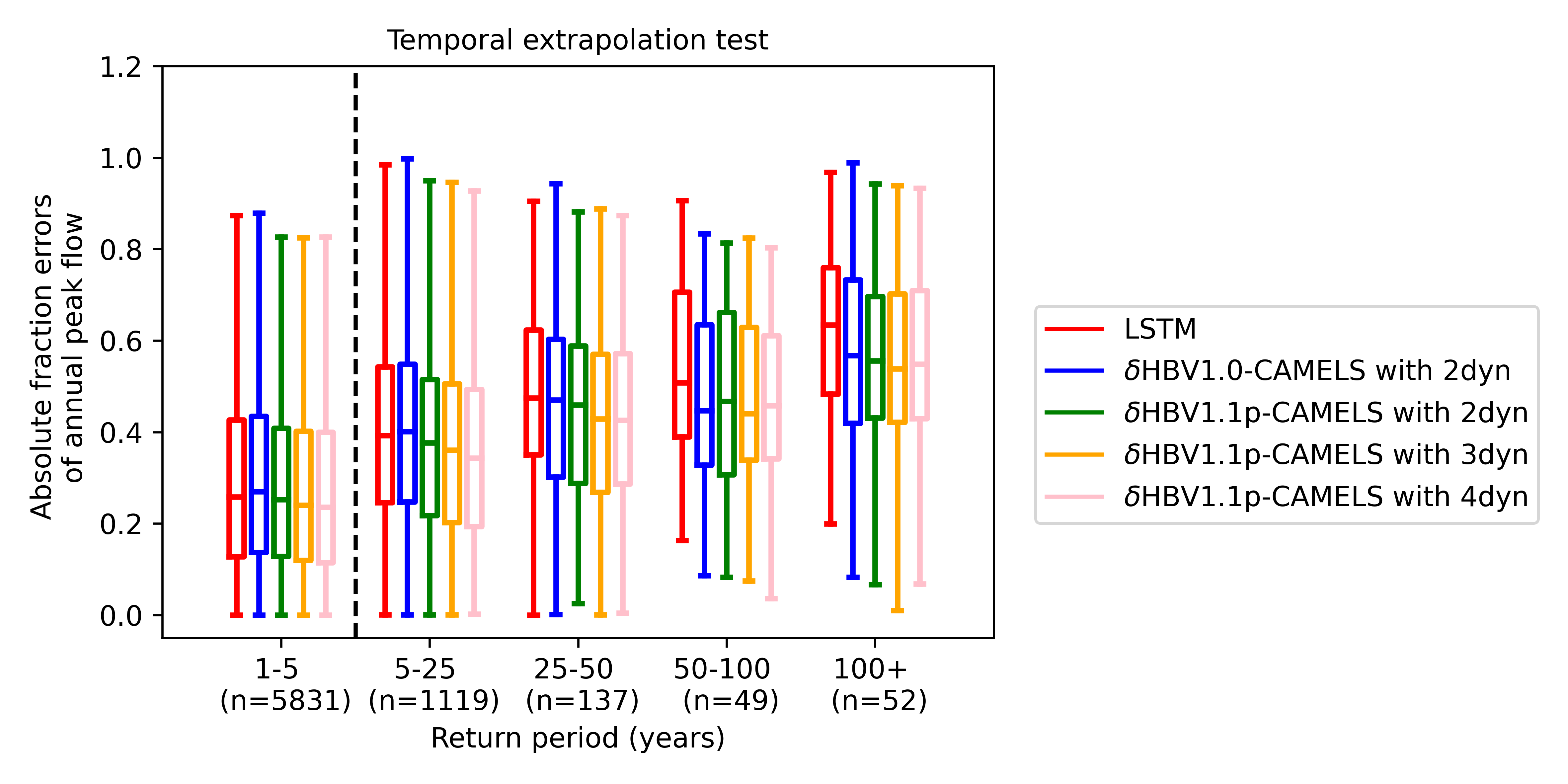
2. Unseen Extreme Events Test with 𝛿HBV 1.1p
In the unseen extreme events spatial test, we used water years with a 5-year or lower return period peak flow from 1990/10/01 to 2014/09/30 for training, and held out the water years with greater than a 5-year return period peak flow for testing. The spatial test was conducted using a 5-fold cross-validation approach for basins in the CAMELS dataset. This application has been benchmarked against LSTM and demonstrates better extrapolation abilities. Find more details and results in Song, Sawadekar, et al. (2026). The δHBV 1.1p tutorial walks through the training and evaluation of this model.
3. National- and Global-scale Distributed Modeling
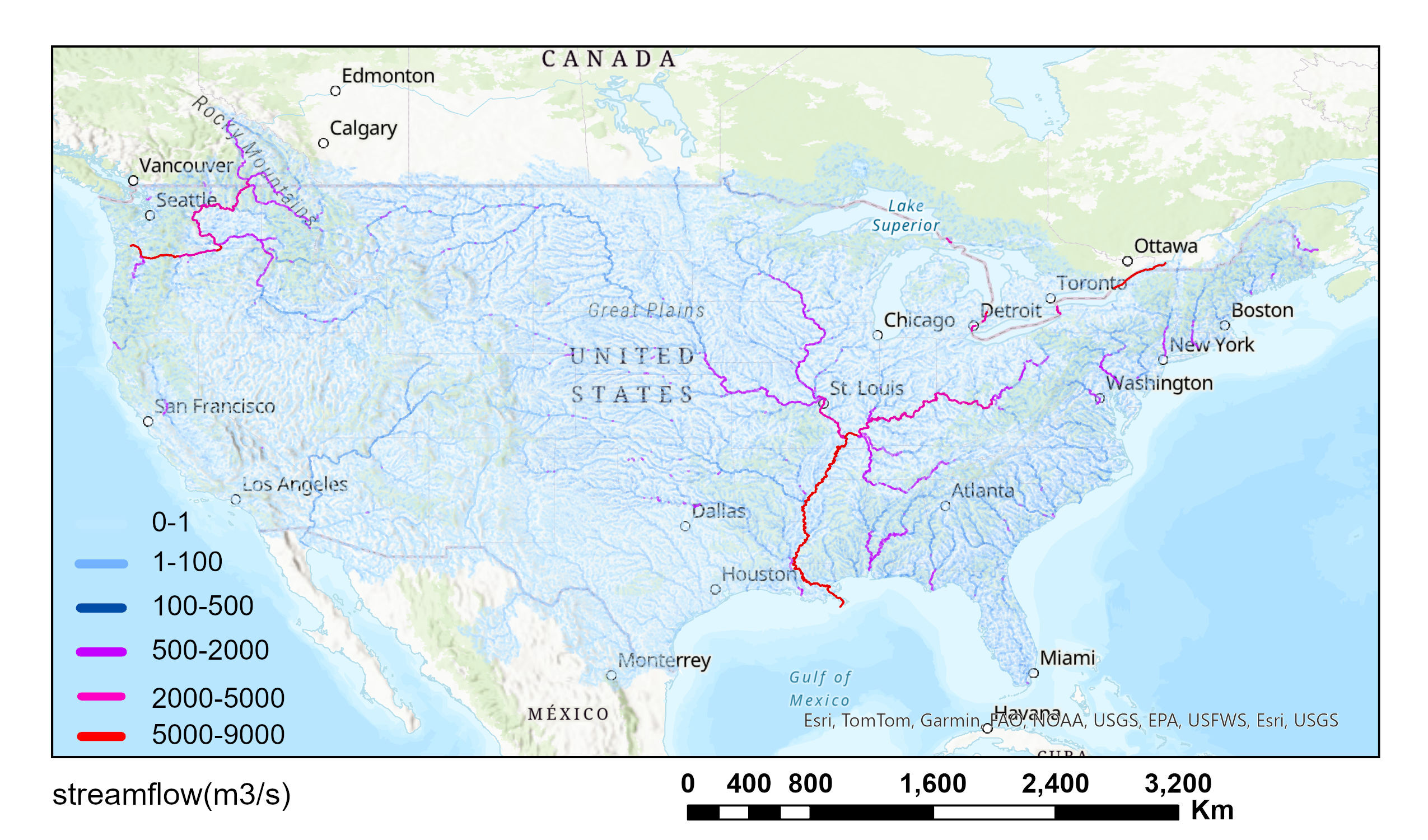
A national-scale water modeling study on approximately 180,000 river reaches (with a median length of 7 km) across CONUS using the high-resolution, multiscale, differentiable water model 𝛿HBV 2.0. This model is also operating at global scales (Ji, Song, et al., 2025) and has been used to generate high-quality, seamless simulations for both CONUS and the globe. Find more details and results in Song, Bindas, et al. (2025).
4. Global-scale Photosynthesis Modeling
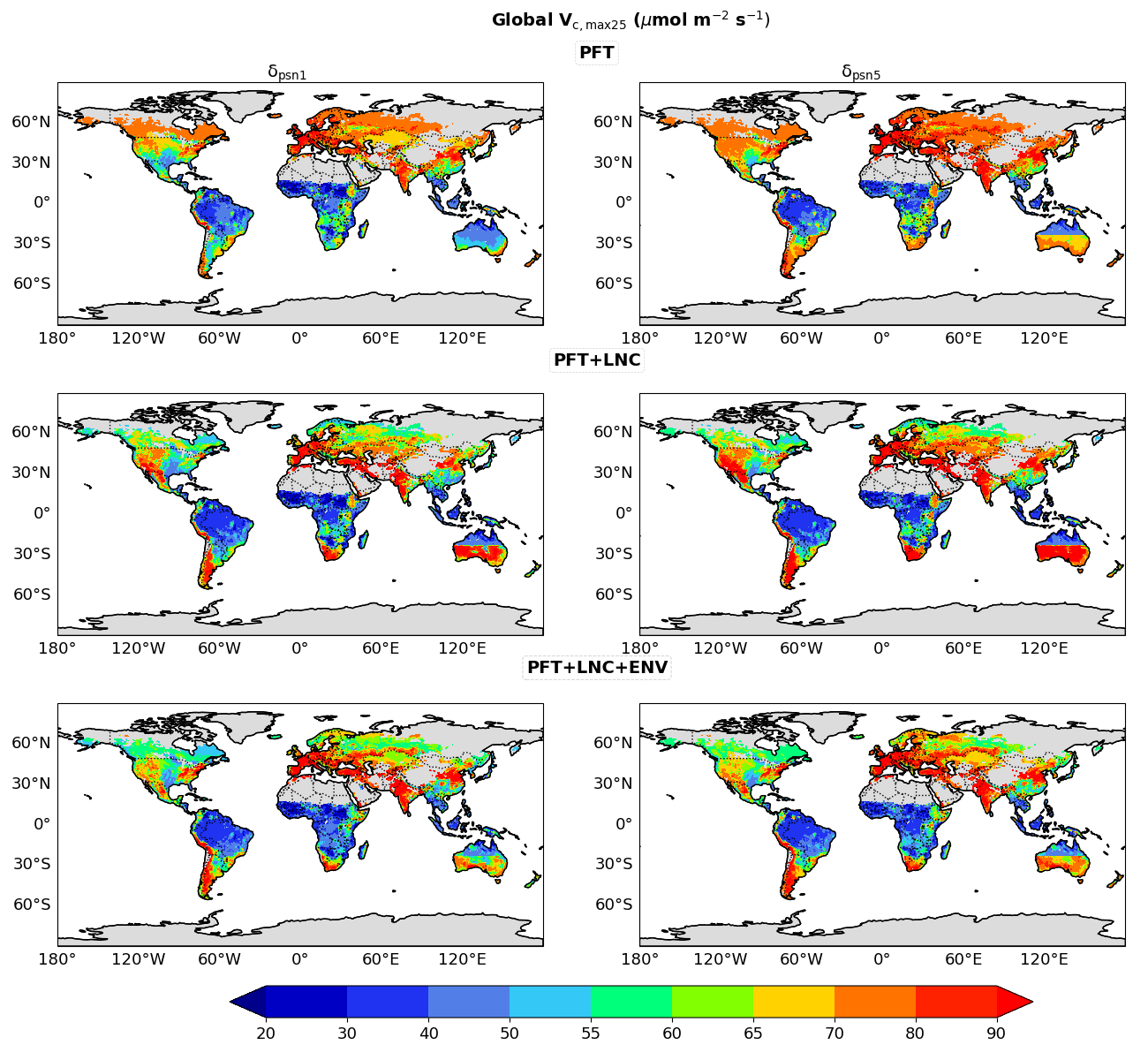
Differentiable modeling has also been applied to parameterize global-scale sapflow simulations. This work is currently in development; see Aboelyazeed et al. (2024) for more details.
Documentation
| Setup | Installation options (PyPI, pip, UV, Conda) |
| How to Run | CLI usage and custom model development |
| Configuration | Config file system and full settings glossary |
| API Reference | Public API — models, loss functions, NNs, utilities |
| Examples | Jupyter notebook tutorials |
| Changelog | Release history |
Architecture
src/dmg/
├── core/
│   ├── calc/                   # Metrics and calculation utilities
│   ├── data/                   # Data loaders and samplers
│   ├── logging/                # TensorBoard and W&B logging
│   ├── post/                   # Post-processing and plotting
│   └── utils/                  # Factory functions and helpers
├── models/
│   ├── criterion/              # Loss functions (MSE, NSE, KGE, ...)
│   ├── delta_models/           # Differentiable model types (DplModel, ...)
│   ├── neural_networks/        # NN architectures (LSTM, ANN, MLP, ...)
│   ├── phy_models/             # Physical model wrappers
│   └── model_handler.py        # High-level model manager
└── trainers/                   # Training orchestration
Ecosystem
hydrodl2— MHPI's suite of process-based hydrology models (lumped + distributed).diffEcosys— Physics-informed ML for ecosystem modeling (photosynthesis via FATES).- In development — Numerical PDE solvers, adjoint sensitivity, surrogate models, data assimilation, and more.
Citation
This work is maintained by MHPI and advised by Dr. Chaopeng Shen. If you find it useful, please cite:
Shen, C., Appling, A.P., Gentine, P. et al. Differentiable modelling to unify machine learning and physical models for geosciences. Nat Rev Earth Environ 4, 552–567 (2023). https://doi.org/10.1038/s43017-023-00450-9
BibTeX
@article{shen_differentiable_2023,
    title = {Differentiable modelling to unify machine learning and physical models for geosciences},
    volume = {4},
    issn = {2662-138X},
    url = {https://doi.org/10.1038/s43017-023-00450-9},
    doi = {10.1038/s43017-023-00450-9},
    pages = {552--567},
    number = {8},
    journaltitle = {Nature Reviews Earth \& Environment},
    author = {Shen, Chaopeng and Appling, Alison P. and Gentine, Pierre and Bandai, Toshiyuki and Gupta, Hoshin and Tartakovsky, Alexandre and Baity-Jesi, Marco and Fenicia, Fabrizio and Kifer, Daniel and Li, Li and Liu, Xiaofeng and Ren, Wei and Zheng, Yi and Harman, Ciaran J. and Clark, Martyn and Farthing, Matthew and Feng, Dapeng and Kumar, Praveen and Aboelyazeed, Doaa and Rahmani, Farshid and Song, Yalan and Beck, Hylke E. and Bindas, Tadd and Dwivedi, Dipankar and Fang, Kuai and Höge, Marvin and Rackauckas, Chris and Mohanty, Binayak and Roy, Tirthankar and Xu, Chonggang and Lawson, Kathryn},
    date = {2023-08-01},
}
Contributing
We welcome contributions! See CONTRIBUTING.md for details.
Please submit an issue to report any questions, concerns, bugs, etc.
1 maintainer

Metadata
1 maintainer
Release files for dmg 1.5.0
For a detailed explanation of source distributions (sdists) and built distributions (wheels), please see the package formats documentation.
Source distribution (sdist)
| File | Size | Uploaded | |
|---|---|---|---|
| dmg-1.5.0.tar.gz | 2.2 MB | Details |
Built distribution (wheel)
| File | Interpreter | ABI | Platform | Reset |
|---|---|---|---|---|
| dmg-1.5.0-py3-none-any.whl | Python 3 | none | any | Details |
Total release size: 2.3 MB
Release files / dmg-1.5.0.tar.gz
| Download URL | dmg-1.5.0.tar.gz |
|---|---|
| Size | 2.2 MB |
| Tags | Source |
|
SHA-256 checksum How to use checksums |
37ad56a3969081e5ae4dcad7c661476d83e11f4534d0b10dd431457fbc512f8e
|
|
BLAKE2b-256 checksum How to use checksums |
7544de6d3fdaaf9be4cdc7cc57f07abfb8b810908183f0fa5477898ef35737d5
|
| Upload date | |
|
Uploaded using Trusted Publishing? What is trusted publishing? |
Yes |
| Uploaded via |
twine/7.0.0 CPython/3.13.14
|
Provenance
Provenance describes where a file came from. On PyPI, provenance is shared via attestations, which provide a verifiable record of the build or publishing details. View details, limitations and caveats.


PyPI Publish Attestation
PyPI verified that this artifact, at this checksum, originated from the publisher listed below.
Signed by GitHub Actions, verified by PyPI on Oct 3, 2026.
Transparency logRelease files / dmg-1.5.0-py3-none-any.whl
| Download URL | dmg-1.5.0-py3-none-any.whl |
|---|---|
| Size | 141.3 kB |
| Tags | Python 3 |
|
SHA-256 checksum How to use checksums |
01d124da7010543ba85e3fdf4625373f8fbacd96313208b47a8ebd48a726cad1
|
|
BLAKE2b-256 checksum How to use checksums |
715994c6783e116a5848c5e31561dd1e0d8b72df5775b4b30aa1d4ca0bfc5d03
|
| Upload date | |
|
Uploaded using Trusted Publishing? What is trusted publishing? |
Yes |
| Uploaded via |
twine/7.0.0 CPython/3.13.14
|
Provenance
Provenance describes where a file came from. On PyPI, provenance is shared via attestations, which provide a verifiable record of the build or publishing details. View details, limitations and caveats.
PyPI Publish Attestation
PyPI verified that this artifact, at this checksum, originated from the publisher listed below.
Signed by GitHub Actions, verified by PyPI on Oct 3, 2026.
Transparency log













