
Unified multi-touch attribution library (Markov chain + Shapley value).

Project description
do-attribution
Multi-touch attribution for Python — closed-form Markov and exact Shapley, with static and epoch-based workflows behind one package.


You have customer journeys that look like "Email > Social > Purchase" and a
0/1 conversion flag per journey. do-attribution turns those journeys into
per-channel shares of the observed conversions using two statistical
allocation models:
- an absorbing-Markov-chain removal-effect model
(
MarkovAttribution, orders 1+, three removal strategies), and - a cooperative-game Shapley-value model (
ShapleyAttribution, exact factorial weights over the observed coalition lattice).
Around the two models the package ships side-by-side model comparison
(CompareAttribution), explicit conversion-endpoint handling
(conversion_labels), plain-text reporting (summary()), flat DataFrame
export (to_dataframes()), matplotlib/networkx visualizations, and temporal
epoch analysis (TemporalMarkovAttribution, TemporalShapleyAttribution,
recommend_epochs) that refits the same static models independently inside
chronological epochs.
Scope guard: these are probabilistic decompositions of observed co-occurrence between channel exposure and conversion — not causal inference. A high share means the channel is statistically associated with converting paths under the model's assumptions. It does not identify the channel that caused a conversion, and it does not replace incrementality tests or randomized experiments.
Key capabilities
- Deterministic, closed-form Markov attribution. Removal effects come
analytically from the absorbing-chain fundamental matrix
(I − Q)⁻¹— no Monte Carlo, no seed, no simulation count. Identical inputs always produce identical outputs. - Three removal-effect definitions.
removal_strategy="fail","detour"(signed effects), or"redirect_to_null"— three operational meanings of "remove this channel", selected explicitly instead of implied. - Exact Shapley values. Per-channel values use the exact factorial weight
w(s, n) = s!·(n−s−1)!/n!; raw signed values, the coalition value function, and normalized shares are all returned. - Conservation and contract guarantees. Attribution shares sum to 1,
attributed conversions conserve the observed total,
'fail'removal effects are non-negative, and absorption probabilities stay on[0, 1]— enforced by the implementation. - Model reporting. Every fitted model renders a compact ASCII
summary()or a natural-languagesummary(output_format="report")— plain Python strings with bounded, distilled detail tables (signed removal effects, top transitions and drop-offs, top coalitions, path diagnostics). - Flat DataFrame export. Temporal models expose
to_dataframes() -> dict[str, pd.DataFrame]: flat, string-keyed, Parquet/SQL-ready tables for attribution, raw model values, and sample diagnostics — no text parsing, noMultiIndex, no lazy refits. - Visualization.
plot_attribution,plot_removal_effects,plot_transition_graph,plot_coalition_values,plot_attribution_comparison, andplot_epoch_recommendationeach return amatplotlib.figure.Figure. - Temporal epoch analysis. Calendar buckets (
freq=), explicit labels (fit_by_epoch), or data-driven boundaries (recommend_epochs+fit_recommended) — every epoch is an independent static fit; complete paths are never split across epochs. - Reproducible outputs. Deterministic model fits, deterministic renderers, and deterministic tie ordering — identical inputs always produce identical reports, tables, and figures.
Core runtime dependencies are numpy and pandas.
Installation
pip install do-attribution
| Extra | Installs | Enables |
|---|---|---|
viz |
matplotlib, networkx |
all plotting helpers |
temporal |
statsmodels, ruptures |
global-signal epoch recommendation |
excel |
openpyxl |
Excel-friendly workflows |
dev |
all of the above + pytest |
running the test suite |
pip install "do-attribution[viz]"
pip install "do-attribution[temporal,viz]"
Requires Python 3.10 or newer.
Quick start
A complete, runnable analysis — ten journeys, a fitted Markov model, shares, and a readable report:
from do_attribution import MarkovAttribution

journeys = [
    "Email > Social > Purchase",
    "Search > Email > Purchase",
    "Social > Purchase",
    "Email > Search",                       # no conversion
    "Search > Social > Email > Purchase",
    "Direct > Purchase",
    "Email > Social",                       # no conversion
    "Search > Email > Social > Purchase",
    "Social > Email > Purchase",
    "Search",                               # no conversion
]
conversions = [1, 1, 1, 0, 1, 1, 0, 1, 1, 0]

model = MarkovAttribution(
    order=1,
    removal_strategy="redirect_to_null",
    conversion_labels=["Purchase"],   # endpoint token, not a channel
    return_transition_matrix=True,
)
result = model.fit(journeys, conversions)

print({ch: round(share, 4) for ch, share in result["attribution"].items()})
print(f"P(conversion | start) = {result['total_conversion_probability']:.4f}")
print(model.summary())
Output (abridged — the summary continues with top transitions, drop-off bottlenecks, and path diagnostics):
{'Direct': 0.085, 'Email': 0.3912, 'Search': 0.1913, 'Social': 0.3324}
P(conversion | start) = 0.7000
Attribution Summary
Model: MarkovAttribution
Epoch source: static
Overall: 10 paths, 7 conversions, 70.00% conversion rate

Data
+-----------+-------+-------------+---------+--------------------------------------------+
| Cohort    | Paths | Conversions | Conv. % | Top channels                               |
+-----------+-------+-------------+---------+--------------------------------------------+
| All paths | 10    | 7           | 70.00%  | Email 39.12%, Social 33.24%, Search 19.13% |
+-----------+-------+-------------+---------+--------------------------------------------+

Removal effects (raw, signed) vs normalized shares
+---------+----------------+--------+
| Channel | Removal effect | Share  |
+---------+----------------+--------+
| Email   | +0.6571        | 39.12% |
| Social  | +0.5584        | 33.24% |
| Search  | +0.3214        | 19.13% |
| Direct  | +0.1429        | 8.50%  |
+---------+----------------+--------+
The Shapley model is a drop-in alternative on the same inputs:
from do_attribution import ShapleyAttribution

shapley = ShapleyAttribution(conversion_labels=["Purchase"]).fit(journeys, conversions)
print({ch: round(share, 4) for ch, share in shapley["attribution"].items()})
# {'Direct': 0.0, 'Email': 0.375, 'Search': 0.0, 'Social': 0.625}
Lists, NumPy arrays, and pandas Series all work as path and conversion inputs.
Visual examples
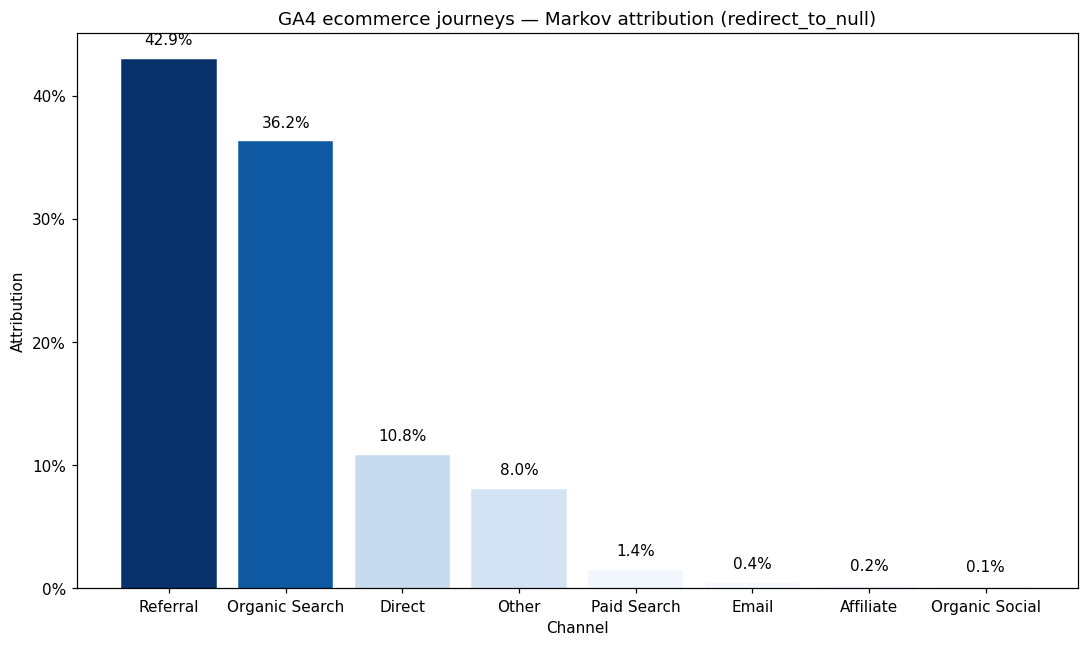
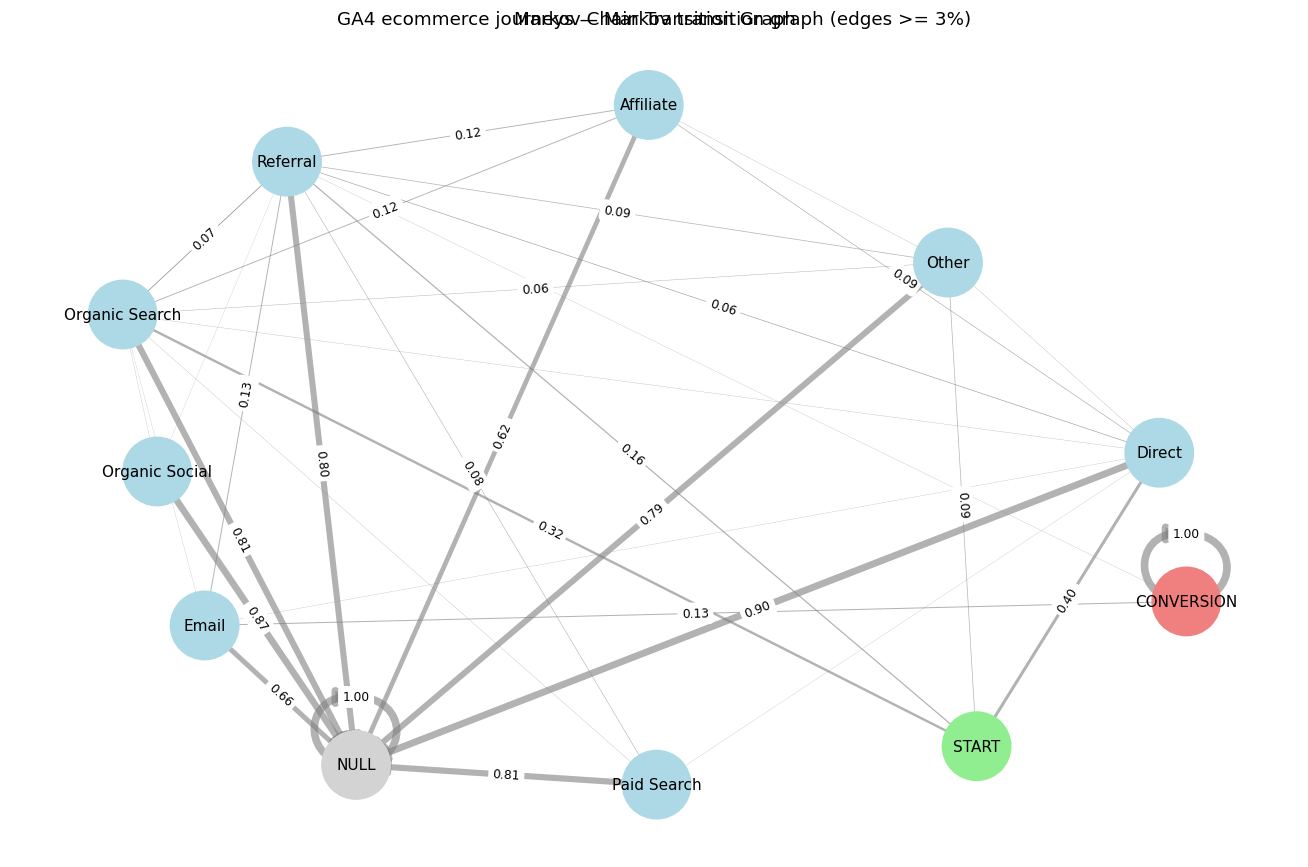
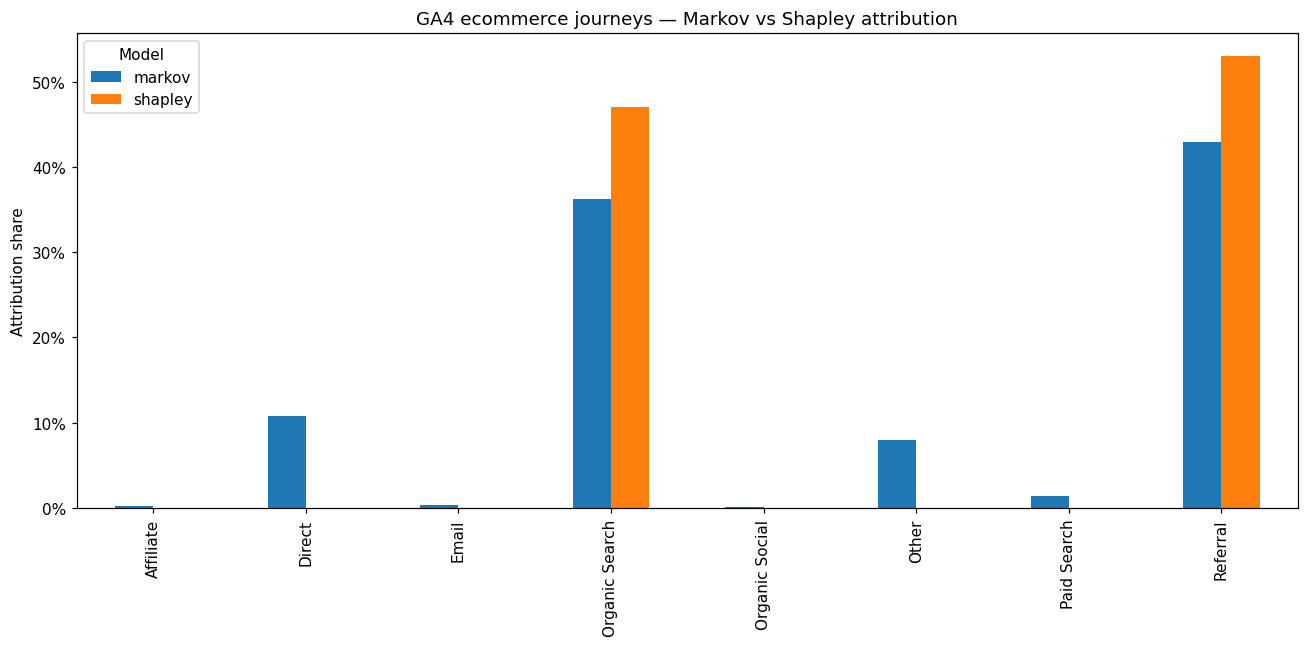
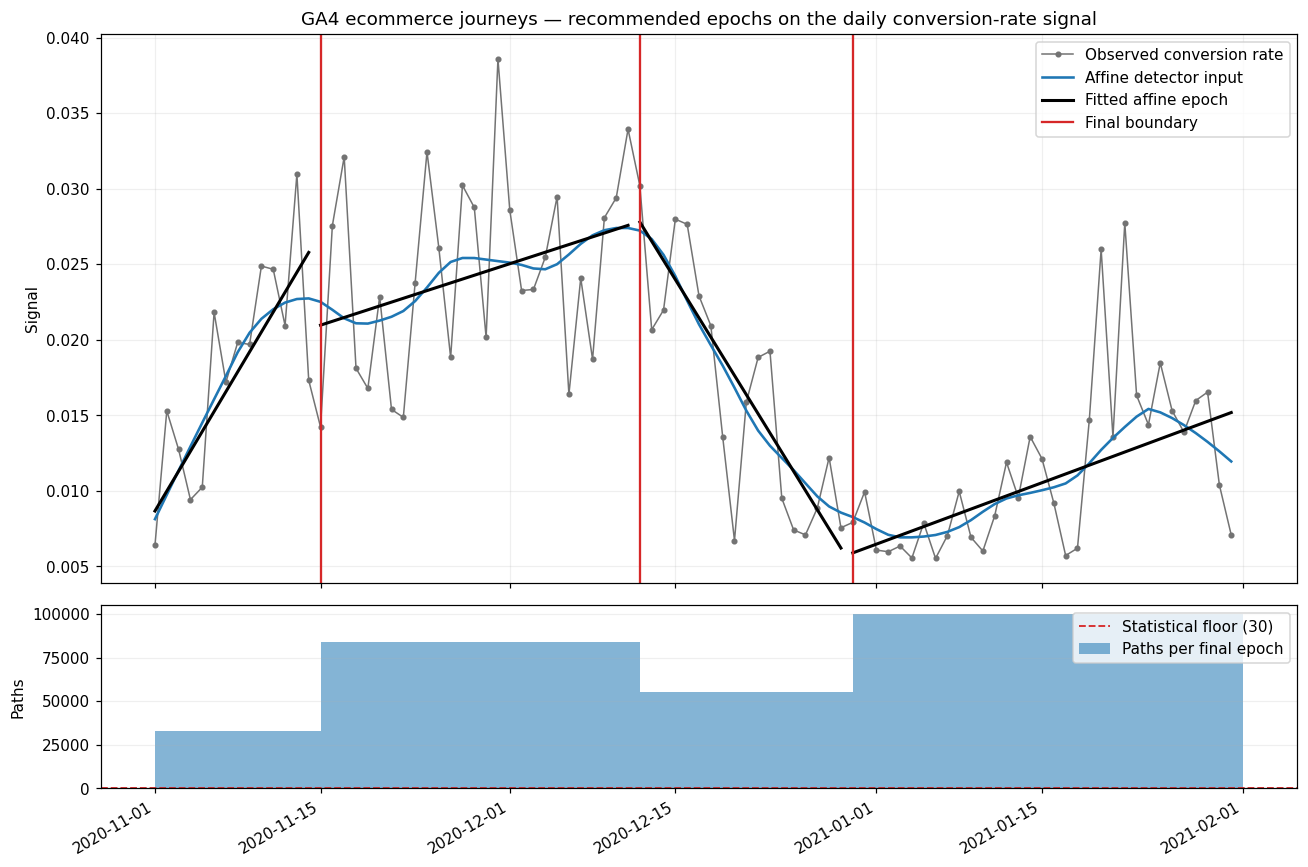
All figures below are outputs from the GA4 public ecommerce journey example
(examples/ga4_attribution_journeys.csv — 272,792 journeys, 8 channels,
Nov 2020 – Jan 2021), generated by the example notebooks with the shipped
plotting helpers.
 |
 |
plot_attribution — Markov shares across the GA4 channels |
plot_transition_graph — the fitted GA4 journey chain (edges ≥ 3%) |
 |
 |
plot_attribution_comparison — Markov vs Shapley on the same GA4 journeys |
plot_epoch_recommendation — recommended epoch boundaries on the conversion-rate signal |
plot_removal_effects (signed bars) and plot_coalition_values (top Shapley
coalitions) complete the plotting surface; every helper returns a
matplotlib.figure.Figure. The full image bank lives in
examples/images/.
Supported attribution methods
Markov removal-effect attribution
MarkovAttribution(order=k) models journeys as an absorbing Markov chain
(START, channels or sliding k-tuples of channels, CONVERSION, NULL)
and credits each channel by its removal effect, computed in closed form.
Three operational definitions of removal are provided:
| Strategy | Behavior |
|---|---|
"fail" |
Strip the channel from every path, force conversions on paths containing it to zero, rebuild the chain, recompute P(CONVERSION | START). Effects ≥ 0. |
"detour" |
Strip the channel while retaining original conversion flags, then refit. Effects are signed — a negative effect means removing the channel lowered modelled conversion probability. |
"redirect_to_null" |
Redirect the removed channel's transition mass to NULL on the fitted matrix and recompute absorption analytically — the classic removal-effect definition. |
Higher orders (order=2, order=3, …) use sliding tuples as states; short
paths are left-padded with START. fit returns attribution,
removal_effects, total_conversion_probability, and (opt-in) the
transition_matrix.
Shapley coalition attribution
ShapleyAttribution uses the value function v(S) = conversions on paths
whose unique channel set is exactly S and exact factorial weights. fit
returns attribution, raw signed shapley_values, and the observed
value_function:
shapley["value_function"]
# {('Email', 'Social'): 2, ('Email', 'Search'): 1, ('Social',): 1, ...}
Because no journey may touch every channel, the raw values can sum to zero by construction; normalization handles that regime deterministically (with a warning) instead of producing unstable shares.
Side-by-side comparison
from do_attribution import CompareAttribution

comparison = CompareAttribution(conversion_labels=["Purchase"])
comparison.fit(journeys, conversions)

comparison.attribution_frame()      #           markov  shapley
                                    # Direct    0.0263    0.000
                                    # Email     0.3947    0.375
                                    # Search    0.2018    0.000
                                    # Social    0.3772    0.625
comparison.difference_frame("markov")
The two methods answer different statistical questions and can disagree
materially without either being defective — difference_frame makes the
disagreement explicit. extra_models={...} plugs any additional
BaseAttribution implementation into the same aligned tables, so
first-touch, last-touch, or any custom baseline can sit beside the two
built-in models.
Conversion-endpoint declaration
Terminal outcome tokens ("Purchase", "Sale", …) are declared, not
guessed: conversion_labels=["Purchase"] strips them before channel
extraction, state construction, coalition enumeration, reporting, and
plotting. Labels colliding with the reserved START/CONVERSION/NULL
tokens raise ValueError; conversion_labels=None treats every token as a
channel.
Temporal epoch analysis
TemporalMarkovAttribution and TemporalShapleyAttribution are
chronological orchestrators: each complete path is assigned to exactly one
epoch by a single anchor timestamp, each epoch gets an independent static
fit, and adjacent epochs share nothing — jumps at boundaries are valid
outputs of a discontinuous piecewise model, not smoothing artifacts.
import pandas as pd
from do_attribution import TemporalShapleyAttribution

anchors = pd.to_datetime([
    "2025-01-05", "2025-01-12", "2025-02-08", "2025-02-17", "2025-04-03",
    "2025-04-21", "2025-07-09", "2025-07-19", "2025-10-02", "2025-10-18",
])

by_quarter = TemporalShapleyAttribution(
    freq="Q",                      # calendar buckets; per-year mappings supported
    min_samples_per_epoch=1,       # demo-sized floor
    conversion_labels=["Purchase"],
)
by_quarter.fit(journeys, anchors, conversions)

by_quarter.get_trend("Email")             # per-epoch share for one channel
tables = by_quarter.to_dataframes()       # flat DataFrames, ready for Parquet/SQL
list(tables)
# ['attribution', 'shapley_values', 'epoch_summary', 'channel_epoch_sample_sizes']
The Markov variant additionally exports removal_effects,
conversion_probability, and transition_matrices tables. Three entry
points cover epoch selection:
fit(paths, timestamps, conversions)— calendar frequency buckets;fit_by_epoch(paths, epoch_labels, conversions)— explicit labels;fit_recommended(paths, conversions, anchor_timestamps)— data-driven boundaries fromrecommend_epochs, which segments a global daily conversion-rate signal with a penalized piecewise-affine detector (weekly/multi-seasonal STL decomposition, robust second-difference scale with serial-correlation correction, PELT with a custom weighted affine cost), enforces minimum epoch width and path-count floors, and returns auditable left-closed, right-open boundaries. A Markov-onlysignal="transition_drift"variant segments aligned order-1 transition matrices.plot_epoch_recommendationrenders the fitted segment geometry, kept and rejected knots, and per-epoch path counts.
Sample-size diagnostics (get_epoch_summary,
get_channel_epoch_sample_sizes, order- and strategy-aware effective
floors, and the suggest_freq calendar sanity check) flag thin epochs
before you interpret an adjacent-epoch jump.
Reporting and export
Every fitted model — static, temporal, or a standalone recommendation — renders deterministic plain text:
print(model.summary())                          # compact ASCII tables
print(model.summary(output_format="report"))    # natural-language narrative
Summaries distill rather than dump: bounded top-k detail tables (signed
removal effects, top transitions and drop-offs, top coalitions, path
diagnostics) with the complete grids available programmatically via
to_dataframes() and the get_* accessors. The reporting language is
descriptive; it never labels a movement statistically significant or causal.
Detailed examples
All five notebooks run end to end on the same GA4 journey extract
(examples/ga4_attribution_journeys.csv) — a transformed journey-level
extract created from
Google's public obfuscated GA4 ecommerce sample
(Google Merchandise Store): one row per journey with an ordered channel
path, a binary conversion flag, and an anchor timestamp.
| Example | Shows |
|---|---|
examples/basic_markov.ipynb |
static Markov fit, shares, removal effects, summary, transition graph |
examples/basic_shapley.ipynb |
Shapley shares, raw values, coalition results, coalition plot |
examples/side_by_side.ipynb |
CompareAttribution aligned tables, differences, comparison plot |
examples/temporal_markov.ipynb |
weekly Markov epochs, diagnostics, to_dataframes(), epoch recommendation |
examples/temporal_shapley.ipynb |
weekly Shapley epochs, channel trends, diagnostics, epoch recommendation |
Project status
do-attribution is in pre-1.0 development. The public API may change before
version 0.1.
License and attribution
MIT © 2026 Aaron Goodin — see LICENSE.
The bundled example dataset and the figures generated from it derive from Google's public obfuscated GA4 ecommerce sample (Google Merchandise Store), transformed into a journey-level extract for demonstration. Attribution outputs describe statistical association under each model's assumptions; they are not causal effect estimates.
Release history Release notifications | RSS feed

Download files
Download the file for your platform. If you're not sure which to choose, learn more about installing packages.
Source Distribution
Built Distribution
Filter files by name, interpreter, ABI, and platform.
If you're not sure about the file name format, learn more about wheel file names.
Copy a direct link to the current filters
File details
Details for the file do_attribution-0.0.1.post1.tar.gz.
File metadata
- Download URL: do_attribution-0.0.1.post1.tar.gz
- Upload date:
- Size: 5.9 MB
- Tags: Source
- Uploaded using Trusted Publishing? No
- Uploaded via: twine/6.2.0 CPython/3.9.6
File hashes
| Algorithm | Hash digest | |
|---|---|---|
| SHA256 |
47a046955070286ea1dc9f2c761162c43e01ecc219cd4e931b904080819839c1
|
|
| MD5 |
726af1fa9be360e2ae8b0dcfcc5ad6ff
|
|
| BLAKE2b-256 |
c6627e8d6bfc33e64e3be0619e7ea974532f412c84f5ca88d9e5b15fc03c4bc5
|
File details
Details for the file do_attribution-0.0.1.post1-py3-none-any.whl.
File metadata
- Download URL: do_attribution-0.0.1.post1-py3-none-any.whl
- Upload date:
- Size: 94.5 kB
- Tags: Python 3
- Uploaded using Trusted Publishing? No
- Uploaded via: twine/6.2.0 CPython/3.9.6
File hashes
| Algorithm | Hash digest | |
|---|---|---|
| SHA256 |
ababde14407b3cfd4128cb5f7b145a68e71a97bd4e5b1df0527d84b299e9379b
|
|
| MD5 |
6e87819cfdf33c3d04e6ca8cacabf29f
|
|
| BLAKE2b-256 |
5088c826741ad9184bc91f30e1fdff1927cb65dc2653abad13115f7d3b741989
|






