
Unit testing for business documents — validate structured Markdown docs against a configurable audit standard.
Verified details
These details have been verified by PyPIProject links
GitHub Statistics
Maintainers

Project description
docassert



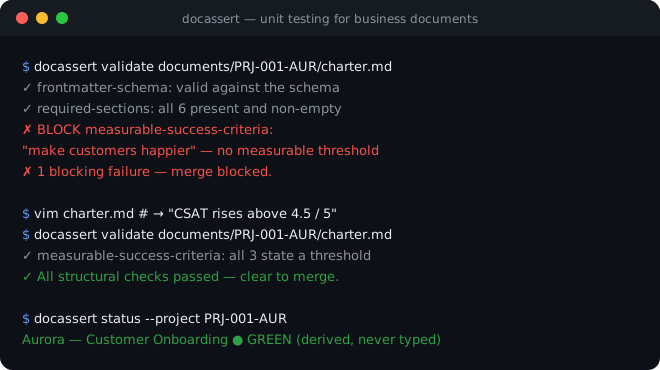
Unit testing for business documents. Validate structured Markdown documents (charters, BRDs, PRDs, risk registers, …) against a configurable audit standard: deterministic structural checks that gate a merge, plus optional AI-graded semantic checks that advise. Requirements trace end to end, and project status is derived from the documents rather than self-reported.
docassert is the reference implementation of PMO as Code — a vendor-neutral standard for running a PMO from version-controlled, declarative files. It implements the PMO as Code specification v0.3 and passes its conformance suite in CI.
Install
pipx install docassert          # recommended — installs the CLI in its own isolated env
# or:
pip install docassert
# with the AI advisory extra:
pip install "docassert[ai]"
Quickstart
docassert new project --code AUR --name "Aurora"   # anchor a project (auto-numbered id)
docassert new charter --project PRJ-001-AUR        # scaffold a charter into it
docassert validate documents/**/*.md  # unit-test your documents
docassert consistency                 # cross-document traceability + profile completeness
docassert status --index              # derived RAG per project
docassert pages --out _site           # a portfolio dashboard + a page per project
Config resolves local override → packaged default: docassert ships sensible
defaults, and your repo's own criteria/ (or schema/, profiles/,
consistency.yaml) wins when present. docassert init copies the defaults in so
you can customize them — including the doc-to-pmo Claude skill into
.claude/skills/, so Claude Code in your repo knows how to convert existing
Word/PDF documents into testable docassert documents (faithfully — gaps are
flagged as TODOs, never invented). The skill's source is
skills/doc-to-pmo/SKILL.md.
Commands
| Command | What it does |
|---|---|
docassert validate <globs> |
Validate documents against their kind's criteria. Exit code = number of blocking failures (capped at 125). Reports: --junit / --markdown / --json. |
docassert consistency |
Cross-document checks: referential integrity, coverage, required links, profile completeness. Reports: --junit / --markdown / --json. |
docassert rtm [--project ID] |
Requirements traceability matrix (Markdown or CSV). |
docassert status [--project ID] [--index] |
Derived project status (md / json / html). |
docassert pages --out DIR |
Build the portfolio site (index + a page per project + shields.io badge endpoints badge.json / badges/<ID>.json). |
docassert projects [--out] [--check] |
Generate / verify the project registry. |
docassert new <kind> --project ID |
Scaffold a document from its template with identity filled in (new project --code XYZ auto-numbers the id); suggests the next free item ids. |
docassert init [DIR] |
Scaffold the default config into a repo. |
docassert bridge <action> --repo O/N |
Execution bridge: scaffold Features/Stories from approved user stories, reconcile (police the board against the docs), status (delivery figures). Needs the GitHub CLI. |
docassert extract <file> |
Extract plain text from a source .docx / .pdf / .md / .txt (the first step of doc-to-pmo conversion). Needs the convert extra: pip install "docassert[convert]". |
Every document-reading command accepts --documents-dir (default documents/).
AI alignment grades at most alignment_limit links per run (default 25; set it
in consistency.yaml, 0 = no cap) so API cost stays bounded on large graphs.
Document kinds
Twenty kinds, each a templates/<kind>.template.md + schema/<kind>.schema.json
criteria/<kind>.criteria.yamltrio:project,charter,business-case,brd,prd,frnfr,user-story,test-cases,adr,risk-register,raci-stakeholder,qa-test-plan,data-migration-plan,release-cutover-plan,rollback-plan,hypercare-plan,runbook,status-report,post-implementation-review,benefits-realization. Adding a kind is adding a trio — no code for the common cases.
Two tiers of checks
- Structural — deterministic, blocking. Required fields and sections,
measurable success criteria, risks with owner + mitigation, resolving
references, unique ids. Plain Python, reliable enough to gate a merge.
Within this tier, integrity checks (malformed items, bad types, duplicate
ids) block at any status, while completeness checks relax to advisory on
status: draftand gate once a document is proposed — WIP is never punished. - Semantic — AI-graded, advisory. Scored via the Anthropic API and posted to
the PR — never blocking. Set
ANTHROPIC_API_KEYto enable; skipped otherwise.
Privacy
Structural checks run entirely locally — no document content leaves your
machine or CI runner. Semantic checks are the one exception: when
ANTHROPIC_API_KEY is set, the graded excerpts (section text, linked item
text) are sent to the Anthropic API for scoring. Without the key, semantic
checks are skipped and nothing is sent anywhere. Alignment grading is capped at
alignment_limit links per run (default 25). If your documents are
confidential, run without the key or review Anthropic's data-usage
policies first.
Development
python3 -m venv .venv && source .venv/bin/activate
pip install -e ".[dev]"
pytest
ruff check .
This repo ships example documents/ (four sample projects) that the test suite
validates against.
The reference deployment
pmo-as-code-pipeline is a living example — sample projects, the gate on every pull request, and a published dashboard at c4g-john.github.io/pmo-as-code-pipeline. The standard's site is c4g-john.github.io/pmo-as-code.
License
Apache-2.0 — see LICENSE and NOTICE. © 2026 C4G Enterprises Inc.
Project details
Verified details
These details have been verified by PyPIProject links
GitHub Statistics
Maintainers
Release history Release notifications | RSS feed


Download files
Download the file for your platform. If you're not sure which to choose, learn more about installing packages.
Source Distribution
Built Distribution
Filter files by name, interpreter, ABI, and platform.
If you're not sure about the file name format, learn more about wheel file names.
Copy a direct link to the current filters
File details
Details for the file docassert-0.9.0.tar.gz.
File metadata
- Download URL: docassert-0.9.0.tar.gz
- Upload date:
- Size: 83.8 kB
- Tags: Source
- Uploaded using Trusted Publishing? Yes
- Uploaded via: twine/6.1.0 CPython/3.12.9
File hashes
| Algorithm | Hash digest | |
|---|---|---|
| SHA256 |
9836e7ce363e812059f708189dc744b56e05f7a33605cce41dc731da972d04c4
|
|
| MD5 |
1cf4c7eddb236b9b6138e616e6dcbd9a
|
|
| BLAKE2b-256 |
fba19341c46c912153a183b22f34f2deb4785dc29ad3f03999788649a716fbb4
|
Provenance
The following attestation bundles were made for docassert-0.9.0.tar.gz:
Publisher:
release.yml on c4g-john/docassert
-
Statement:
-
Statement type:
https://in-toto.io/Statement/v1 -
Predicate type:
https://docs.pypi.org/attestations/publish/v1 -
Subject name:
docassert-0.9.0.tar.gz -
Subject digest:
9836e7ce363e812059f708189dc744b56e05f7a33605cce41dc731da972d04c4 - Sigstore transparency entry: 2050890653
- Sigstore integration time:
-
Permalink:
c4g-john/docassert@2d6b4348a39e06c3949559efd8a6a62cbe1326c9 -
Branch / Tag:
refs/tags/v0.9.0 - Owner: https://github.com/c4g-john
-
Access:
public
-
Token Issuer:
https://token.actions.githubusercontent.com -
Runner Environment:
github-hosted -
Publication workflow:
release.yml@2d6b4348a39e06c3949559efd8a6a62cbe1326c9 -
Trigger Event:
release
-
Statement type:
File details
Details for the file docassert-0.9.0-py3-none-any.whl.
File metadata
- Download URL: docassert-0.9.0-py3-none-any.whl
- Upload date:
- Size: 101.9 kB
- Tags: Python 3
- Uploaded using Trusted Publishing? Yes
- Uploaded via: twine/6.1.0 CPython/3.12.9
File hashes
| Algorithm | Hash digest | |
|---|---|---|
| SHA256 |
46a5fbdf8d66460211683c113298996643b0ddbd017d62e79f0965a659eb7c78
|
|
| MD5 |
3f2729baedf01f96e08604761a0d2d70
|
|
| BLAKE2b-256 |
5d7f9748f3e8ee09d35ebf3e1a7524b39760e742e9828ee81d364b4dc4ea6a0e
|
Provenance
The following attestation bundles were made for docassert-0.9.0-py3-none-any.whl:
Publisher:
release.yml on c4g-john/docassert
-
Statement:
-
Statement type:
https://in-toto.io/Statement/v1 -
Predicate type:
https://docs.pypi.org/attestations/publish/v1 -
Subject name:
docassert-0.9.0-py3-none-any.whl -
Subject digest:
46a5fbdf8d66460211683c113298996643b0ddbd017d62e79f0965a659eb7c78 - Sigstore transparency entry: 2050891269
- Sigstore integration time:
-
Permalink:
c4g-john/docassert@2d6b4348a39e06c3949559efd8a6a62cbe1326c9 -
Branch / Tag:
refs/tags/v0.9.0 - Owner: https://github.com/c4g-john
-
Access:
public
-
Token Issuer:
https://token.actions.githubusercontent.com -
Runner Environment:
github-hosted -
Publication workflow:
release.yml@2d6b4348a39e06c3949559efd8a6a62cbe1326c9 -
Trigger Event:
release
-
Statement type:






