
Turns office documents (PDF, DOCX, XLSX, PPTX, HTML, email) into retrieval-ready chunks for RAG
Verified details
These details have been verified by PyPIProject links
GitHub Statistics
Maintainers

Project description
⚡ DocMill
Document in, chunks out.


Fast, accurate, free — pick two. The quick parsers hand your embedder a wall of flat text. The accurate ones take days to get through a corpus. The ones that do both charge per page and want your documents on their servers.
DocMill is 11 MB and gives you all three. One function call, and what comes back is chunks shaped for retrieval rather than a wall of text.
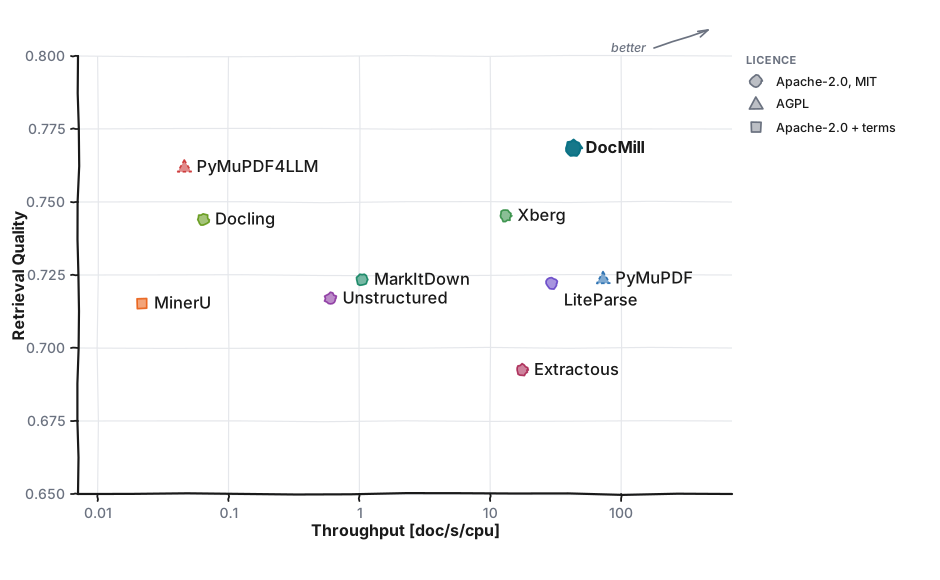
In-house evaluation: every tool runs its own extraction and its own chunker, each chunk is
embedded with nvidia/Nemotron-3-Embed-1B-BF16, and quality is recall: how often the chunk
holding the answer comes back in the top five. The full numbers — per format, per chunk
size, and where we lose — and the methodology.
- 🔥 Nearly as fast as the fastest, nearly as good as the best — and the only tools ahead of it on either axis are copyleft, a problem in most commercial products. Among the tools that are free for commercial use, DocMill leads on both axes at once.
- 🌊 It streams, in bounded memory — chunks come out while the file is still being read, and a 404 MB, 2,409-page PDF peaks at 502 MB.
- 🪶 11 MB installed, two dependencies, 20 ms to import. No GPU, no model download, no network, no server — it runs in your own process and nothing is uploaded.
- 📚 Eleven formats, one call, free for commercial use — pdf, docx, xlsx, pptx, xls, xlsb, ods, csv, html, eml, text.
📄 How it works
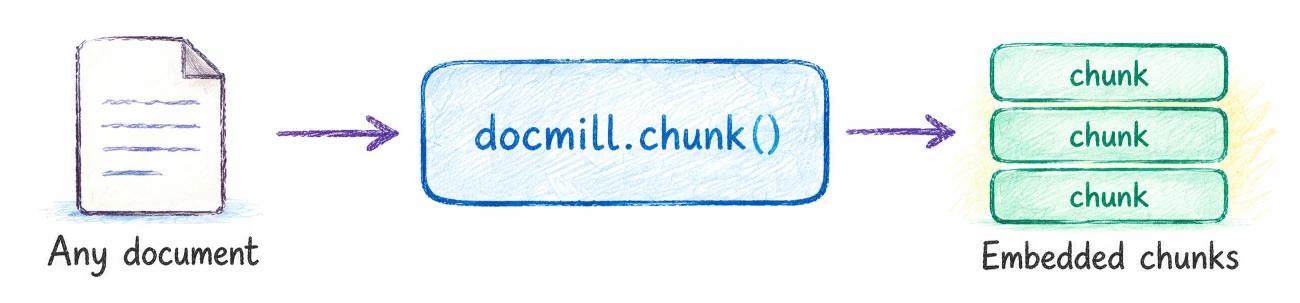
No intermediate markdown, no document object, no temporary file — readers are generators yielding blocks and the chunker consumes them lazily, so chunks come out while the file is still being read.
📦 Install
pip install docmill
Both dependencies ship prebuilt wheels for Linux (glibc and musl), macOS and Windows, on x86-64 and arm64. Nothing compiles at install time.
🚀 Quickstart
>>> import docmill
>>> chunk = next(docmill.chunk("report.docx"))
>>> print(chunk.embed_text)
Quarterly results
Revenue rose to 1200 million in EMEA.
Costs were flat.
>>> chunk.meta
{'index': 0, 'doc_id': 'report', 'title': 'Quarterly results',
 'kinds': ['heading', 'paragraph'], 'char_start': 0, 'char_end': 72}
That is the whole product: embed_text goes to your embedding model, meta to your vector store.
chunk() is a generator — a 1,000-page report starts yielding immediately and never exists in
memory whole. It takes a path, bytes, or any seekable binary file, and detects the format from
content:
docmill.chunk("report.pdf")                          # a path
docmill.chunk(response.content, name="report.pdf")   # bytes
There is a CLI too:
docmill report.pdf                 # chunks as JSON lines
docmill slides.pptx --diagnostics  # what would be missing from your index
🐍 The library
Local, not a service: no server, no network call, nothing uploaded. Six names to learn, plus the
exceptions below, and chunk is the only one most people need.
| name | what it gives you |
|---|---|
chunk(source, **opts) |
the chunks, as a generator |
extract(source, **opts) |
the blocks, before they are packed into chunks |
sniff(source) |
the format it detects — "pdf", "xlsx", … |
Diagnostics() |
what got left out; hand one in, read it after |
Limits(...) |
the knobs — target_chars, max_pages, max_rows |
FORMATS |
the eleven names it accepts |
Every failure reading a document subclasses DocmillError, so one handler is the whole contract:
try:
    for chunk in docmill.chunk(path):
        index(chunk)
except docmill.DocmillError as exc:
    quarantine(path, exc.reason)
We check that by running it: 930 real documents and 565 deliberately broken ones — truncated,
bit-flipped, zip-bombed — no crash, no hang, nothing raised that was not a DocmillError.
Parallelism is yours: cheap import, picklable chunks, no hidden thread pool. Use processes, not threads, for PDFs — PDFium is not thread-safe. DocMill refuses zip bombs before inflating them, but it is a parser, not a sandbox: isolate untrusted input in a worker with limits (SECURITY.md). Chunk boundaries are stable within a version, not across them — plan to re-embed on upgrade until 1.0.
🔦 It tells you what it could not read
With most tools, a scanned PDF or an image-only deck just yields nothing — the document is silently absent from your index. DocMill hands it back as data:
report = docmill.Diagnostics()
chunks = list(docmill.chunk("scanned.pdf", diagnostics=report))

if report.needs_ocr:      # image-dominated pages that yielded almost nothing
    route_to_ocr(path)
if report.lost_data:      # a limit bit, a part was unreadable, an attachment stayed closed
    log.warning(report.as_dict())
Not an OCR. A page with no text layer is flagged, never reconstructed, and no bundled engine or system binary is called — the output does not depend on what happens to be installed on the box.
🙏 Credits
The two dependencies do the heavy lifting, and both are permissively licensed — which is the only reason a wheel this small can read these formats at all.
- pypdfium2, binding Google's PDFium — the engine Chrome renders PDFs with. Two thirds of the cost of reading a PDF here is PDFium's C++, not ours.
- python-calamine, binding Rust's calamine — what makes a million-row sheet stream a row at a time instead of loading whole.
Three more permissively-licensed projects were read closely enough that a design idea here traces to them. DocMill contains no code from any of them — nothing copied, ported or adapted, and no copyleft source consulted at any point. CREDITS.md is the longer version.
- Unstructured — deciding that a line is a label from its shape rather than from a list of English words.
- LiteParse — joining wrapped table header lines by walking back from the body, and emitting a tabular region verbatim when its columns will not resolve.
- Xberg — whether the previous line ended in sentence-final punctuation separates a wrapped continuation from a real heading.
Closest published support for the thesis: arXiv 2603.06976 (paragraph-group chunking nearly doubles nDCG@5 over fixed-size) and arXiv 2602.16974 (simple structure-based chunking beats LLM-guided).
☕ Support
Starring the repo, opening an issue when DocMill mishandles a document, or telling someone it exists all help. If it saves you real time: buy me a coffee ☕ — a donation, no tiers, no perks.
Contributions welcome: CONTRIBUTING.md, and docs/principles.md holds the five rules that settle arguments here.
Project details
Verified details
These details have been verified by PyPIProject links
GitHub Statistics
Maintainers
Release history Release notifications | RSS feed


Download files
Download the file for your platform. If you're not sure which to choose, learn more about installing packages.
Source Distribution
Built Distribution
Filter files by name, interpreter, ABI, and platform.
If you're not sure about the file name format, learn more about wheel file names.
Copy a direct link to the current filters
File details
Details for the file docmill-0.1.2.tar.gz.
File metadata
- Download URL: docmill-0.1.2.tar.gz
- Upload date:
- Size: 346.5 kB
- Tags: Source
- Uploaded using Trusted Publishing? Yes
- Uploaded via: twine/7.0.0 CPython/3.13.14
File hashes
| Algorithm | Hash digest | |
|---|---|---|
| SHA256 |
bbd7055e7c805256167ba49cb538a2eb01f49cf05434ec77fb4dad5d0755c15a
|
|
| MD5 |
074b9ab2ac4a8bc89bee1885ece0aeda
|
|
| BLAKE2b-256 |
cea4b2460873afeb94c0cc8b4727090bc4dbaa7d3aa955da912571044992fa47
|
Provenance
The following attestation bundles were made for docmill-0.1.2.tar.gz:
Publisher:
release.yml on gergopool/docmill
-
Statement:
-
Statement type:
https://in-toto.io/Statement/v1 -
Predicate type:
https://docs.pypi.org/attestations/publish/v1 -
Subject name:
docmill-0.1.2.tar.gz -
Subject digest:
bbd7055e7c805256167ba49cb538a2eb01f49cf05434ec77fb4dad5d0755c15a - Sigstore transparency entry: 2335147176
- Sigstore integration time:
-
Permalink:
gergopool/docmill@8241ac6f392ea65732f62b5fe145080941836d5a -
Branch / Tag:
refs/tags/v0.1.2 - Owner: https://github.com/gergopool
-
Access:
public
-
Token Issuer:
https://token.actions.githubusercontent.com -
Runner Environment:
github-hosted -
Publication workflow:
release.yml@8241ac6f392ea65732f62b5fe145080941836d5a -
Trigger Event:
push
-
Statement type:
File details
Details for the file docmill-0.1.2-py3-none-any.whl.
File metadata
- Download URL: docmill-0.1.2-py3-none-any.whl
- Upload date:
- Size: 187.7 kB
- Tags: Python 3
- Uploaded using Trusted Publishing? Yes
- Uploaded via: twine/7.0.0 CPython/3.13.14
File hashes
| Algorithm | Hash digest | |
|---|---|---|
| SHA256 |
9918c910557d14103f5ac58a73dc1fbd8a5ea865e72c81df93ca0af4879a0f13
|
|
| MD5 |
3e149dc455b50f91e8b6fd53bfd9cde7
|
|
| BLAKE2b-256 |
f0bd614c42917cdc72a32b0af7f3845cbf858d195991498dbad0199e5e3d280c
|
Provenance
The following attestation bundles were made for docmill-0.1.2-py3-none-any.whl:
Publisher:
release.yml on gergopool/docmill
-
Statement:
-
Statement type:
https://in-toto.io/Statement/v1 -
Predicate type:
https://docs.pypi.org/attestations/publish/v1 -
Subject name:
docmill-0.1.2-py3-none-any.whl -
Subject digest:
9918c910557d14103f5ac58a73dc1fbd8a5ea865e72c81df93ca0af4879a0f13 - Sigstore transparency entry: 2335147187
- Sigstore integration time:
-
Permalink:
gergopool/docmill@8241ac6f392ea65732f62b5fe145080941836d5a -
Branch / Tag:
refs/tags/v0.1.2 - Owner: https://github.com/gergopool
-
Access:
public
-
Token Issuer:
https://token.actions.githubusercontent.com -
Runner Environment:
github-hosted -
Publication workflow:
release.yml@8241ac6f392ea65732f62b5fe145080941836d5a -
Trigger Event:
push
-
Statement type:






