
DoctoSAE
Sparse autoencoders for interpretable and transferable medical retrieval. Reference implementation of the ML4H 2026 paper Explanations that Transfer: Interpreting Medical Retrieval with Sparse AutoEncoders (Diane Bouchacourt and Gaëtan Brison).
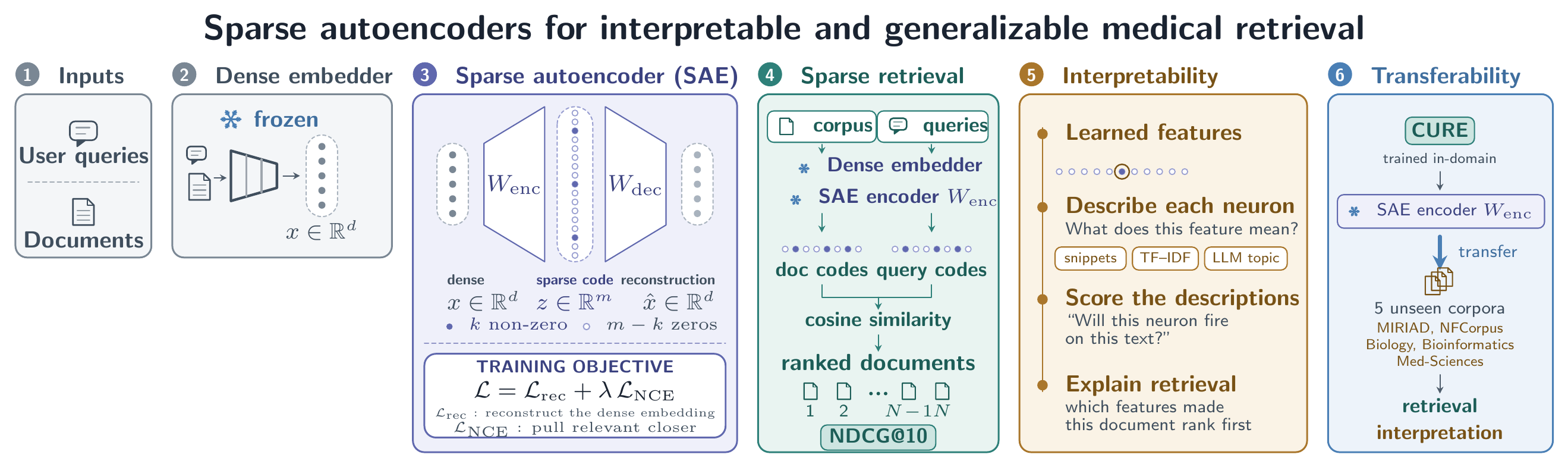
DoctoSAE trains a TopK sparse autoencoder (SAE) on the frozen embeddings of a text encoder, with a reconstruction loss and an InfoNCE loss that keeps queries close to their relevant documents. Documents are then ranked by cosine similarity of codes with at most k active features, and every feature can be described from the texts that activate it: top snippets, TF IDF terms and a topic written by an Interpreter LLM. These descriptions explain single retrievals, and they transfer to corpora the SAE never saw.
Warning: DoctoSAE is in active development and its API may change before version 1.0. It is a research tool: do not use it for diagnosis, treatment or any other clinical decision.
Install
pip install doctosae
pip install "doctosae[llm]"        # optional: LLM descriptions through any OpenAI compatible server
pip install "doctosae[local-llm]"  # optional: local LLM such as google/medgemma-4b-it
DoctoSAE needs Python 3.11 or newer. A GPU is advised for CURE; the small examples run on a laptop CPU.
Quickstart
Start from a checkpoint of the paper in the DoctoSAE collection, with no training:
from doctosae import Embedder, Interpreter, evaluate, load_dataset, load_pretrained

sae = load_pretrained("bge", k=256)                   # doctolib-lab/doctosae-bge-large-en-v1.5/k256_m3072
dataset = load_dataset("nfcorpus")                    # cure, miriad, r2med_biology, ...
data = Embedder.from_sae(sae).embed_dataset(dataset)  # the frozen encoder the SAE was trained on

print(evaluate(None, data, split="test"))  # dense embeddings: ndcg@10 0.382
print(evaluate(sae, data, split="test"))   # sparse codes: ndcg@10 0.357, as in Table 1 of the paper

interpreter = Interpreter(sae, data, split="train")
for card in interpreter.describe(interpreter.select_features(n=3)):
    print(card.to_markdown())
Or train your own SAE on the same embeddings, with the settings of the paper:
from doctosae import DoctoSAE, Trainer, TrainingConfig

my_sae = DoctoSAE(d_in=data.dim, n_latents=3 * data.dim, k=64, embedder=data.embedder)
my_sae = Trainer(my_sae, TrainingConfig(), output_dir="runs/nfcorpus/sae").fit(data).best_model
The same steps from the command line, where --sae takes a Hub checkpoint id or a folder:
SAE=doctolib-lab/doctosae-bge-large-en-v1.5/k256_m3072
doctosae embed --dataset nfcorpus --sae $SAE --output runs/nfcorpus/embeddings
doctosae evaluate --dataset nfcorpus --embeddings runs/nfcorpus/embeddings --sae $SAE
doctosae interpret --dataset nfcorpus --embeddings runs/nfcorpus/embeddings --sae $SAE \
    --output runs/nfcorpus/features --n-features 20
doctosae train --dataset nfcorpus --embeddings runs/nfcorpus/embeddings --k 64 --output-dir runs/nfcorpus/sae
What is inside
doctosae.load_dataset: CURE, NFCorpus, MIRIAD and the three R2MED subsets, downloaded from the Hugging Face Hub at pinned revisions with the splits of the paper;doctosae.load_beir_folderfor your own data.doctosae.Embedder: sentence transformers encoders; queries of the BGE v1.5 models get the retrieval instruction of their model card, the one the paper used for BGE large, and the embeddings record every setting.doctosae.DoctoSAE: the TopK SAE, saved and shared through the Hugging Face Hub (save_pretrained,push_to_hub,from_pretrained,doctosae.load_pretrained).doctosae.Trainer: the paper objective, sampler and checkpoint selection. The defaults are the values the paper holds fixed, and one point of its grid for the InfoNCE weight and temperature, which it selects per k.doctosae.evaluateanddoctosae.search: retrieval on sparse codes, NDCG@10 computed as in the paper.doctosae.Interpreter: feature selection, feature cards, Interpreter and Activation Prediction LLMs (OpenAI compatible servers, local Transformers models), and retrieval explanations as in Figure 2 of the paper.doctosaecommand line:datasets,pretrained,embed,train,evaluate,interpret,explain,push,convert.
Pretrained sparse autoencoders
The checkpoints of the paper, trained on CURE, are in the DoctoSAE collection of the Hugging Face Hub: one repository per encoder, one folder per configuration.
| Encoder | Alias | Repository | Checkpoints |
|---|---|---|---|
BAAI/bge-large-en-v1.5 |
bge |
doctolib-lab/doctosae-bge-large-en-v1.5 |
k64_m3072, k256_m3072 |
abhinand/MedEmbed-large-v0.1 |
medembed |
doctolib-lab/doctosae-medembed-large-v0.1 |
k64_m3072, k256_m3072 |
gemini-embedding-001 |
gemini |
doctolib-lab/doctosae-gemini-embedding-001 |
k128_m9216, k256_m9216 |
from doctosae import load_pretrained

sae = load_pretrained("bge", k=64)    # doctolib-lab/doctosae-bge-large-en-v1.5/k64_m3072
sae = load_pretrained("gemini")       # the smallest k: doctolib-lab/doctosae-gemini-embedding-001/k128_m9216
The smallest k is the configuration the paper interprets, k = 256 the one that retrieves best. doctosae pretrained
lists every checkpoint id. Weights trained on CURE are cc-by-nc-4.0 (noncommercial), the license of CURE.
Results from the paper
NDCG@10 (%) with BAAI/bge-large-en-v1.5, SAEs trained on CURE, mean over three seeds (Table 1 of the paper):
| BGE | CURE | NFCorpus | MIRIAD | R2MED Bioinformatics | R2MED Biology | R2MED Medical Sciences |
|---|---|---|---|---|---|---|
| original | 53.06 | 38.17 | 77.24 | 27.04 | 12.72 | 27.78 |
| k = 64 | 57.07 | 31.89 | 68.75 | 22.50 | 8.30 | 22.72 |
| k = 128 | 59.35 | 34.48 | 71.83 | 27.42 | 9.76 | 26.60 |
| k = 256 | 60.50 | 35.61 | 73.85 | 28.10 | 10.06 | 29.05 |
| dense (k = 1024) | 61.87 | 36.62 | 75.05 | 27.21 | 8.37 | 27.33 |
Links
- Source code, paper code and full documentation: https://github.com/doctolib-lab/doctosae
- Examples: https://github.com/doctolib-lab/doctosae/tree/main/package/examples
- Issues: https://github.com/doctolib-lab/doctosae/issues
- Contributing: https://github.com/doctolib-lab/doctosae/blob/main/CONTRIBUTING.md
Citation
@misc{bouchacourt2026explanationstransferinterpretingmedical,
      title={Explanations that Transfer: Interpreting Medical Retrieval with Sparse AutoEncoders},
      author={Diane Bouchacourt and Gaëtan Brison},
      year={2026},
      eprint={2611.18179},
      archivePrefix={arXiv},
      primaryClass={cs.IR},
      url={https://arxiv.org/abs/2611.18179},
}
License
The code is released under the Apache 2.0 license. Datasets keep their own licenses and are downloaded from the
Hugging Face Hub at pinned revisions (CURE is cc-by-nc-4.0, noncommercial). SAE weights trained on CURE are
cc-by-nc-4.0.
1 maintainer

Metadata
1 maintainer
Release files for doctosae 0.1.1
For a detailed explanation of source distributions (sdists) and built distributions (wheels), please see the package formats documentation.
Source distribution (sdist)
| File | Size | Uploaded | Provenance | Actions |
|---|---|---|---|---|
| doctosae-0.1.1.tar.gz | 193.6 kB | Without provenance | Details for doctosae-0.1.1.tar.gz |
Built distribution (wheel)
| File | Interpreter | ABI | Platform | Actions Reset |
|---|---|---|---|---|
| doctosae-0.1.1-py3-none-any.whl | Python 3 | none | any | Details for doctosae-0.1.1-py3-none-any.whl |
Total release size: 329.4 kB
Release files / doctosae-0.1.1.tar.gz
| Download URL | doctosae-0.1.1.tar.gz |
|---|---|
| Size | 193.6 kB |
| Tags | Source |
|
SHA-256 checksum How to use checksums |
4e771d2797a985a94c7203945847f75999c89a22e363a1739e2461444e384edf
|
|
BLAKE2b-256 checksum How to use checksums |
c14d18115e5c2deb8529037f724aead0a26d7d4b417ddd7e115b77511ff08c75
|
| Upload date | |
|
Uploaded using Trusted Publishing? What is trusted publishing? |
No |
| Uploaded via |
twine/7.0.0 CPython/3.13.5
|
Release files / doctosae-0.1.1-py3-none-any.whl
| Download URL | doctosae-0.1.1-py3-none-any.whl |
|---|---|
| Size | 135.8 kB |
| Tags | Python 3 |
|
SHA-256 checksum How to use checksums |
47ecc1a808bdf8dbcec1ab6cd0d1eb16e89d0b932905f9b8bbd81289c9eb3bd6
|
|
BLAKE2b-256 checksum How to use checksums |
9fbcb4c869eeaa3137a74160b62547dd0225fcb31c9b78b441486b89c0999145
|
| Upload date | |
|
Uploaded using Trusted Publishing? What is trusted publishing? |
No |
| Uploaded via |
twine/7.0.0 CPython/3.13.5
|
Security for doctosae 0.1.1
Provenance
Provenance describes where a file came from. On PyPI, provenance is shared via attestations, which provide a verifiable record of the build or publishing details. View details, limitations and caveats.
No provenance found
None of the files in this release were uploaded with provenance metadata.
A note on package security
PyPI is a repository for distributing packages, not a service for auditing them. While third-party security researchers and our staff do their best to detect and remove malicious packages, PyPI cannot guarantee the quality, security or suitability of any given package.
To learn more about protecting yourself from malicious actors, visit our package security documentation.














