
docxtpl-lint
A static linter for docxtpl (python-docx-template) Word templates. It points each problem to the exact table cell, reports all problems in one run, and returns exit codes your CI can use.
▶ Try it in your browser: drop a .docx and see the report. The file never
leaves your computer; the linter runs locally via Pyodide.
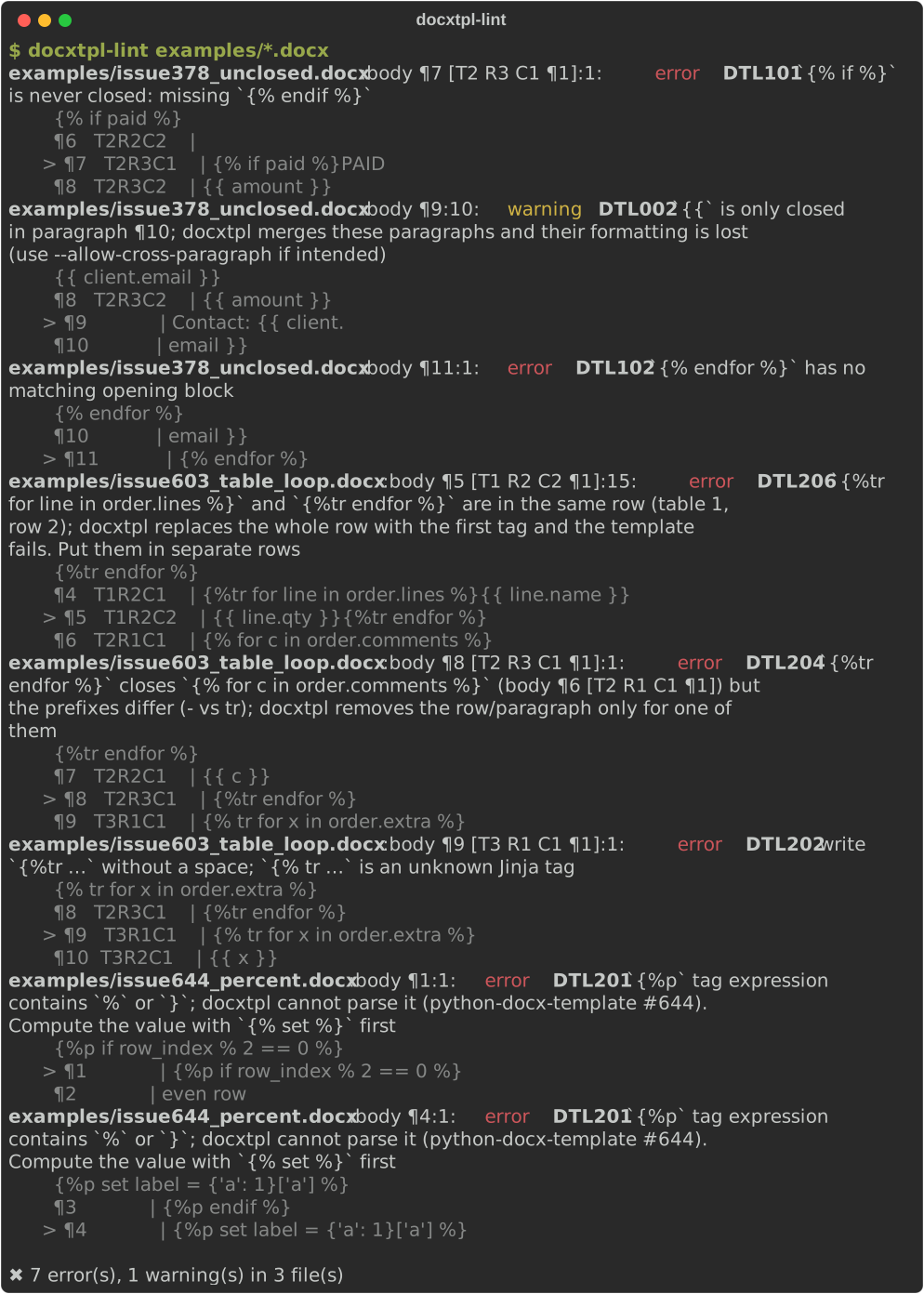
docxtpl itself only gives you this, with no location and only the first error:
jinja2.exceptions.TemplateSyntaxError: Encountered unknown tag 'endfor'. Jinja was looking for the following tags: 'elif' or 'else' or 'endif'.
Not affiliated with python-docx-template. Tested against docxtpl 0.20.2 and checked weekly against docxtpl's latest release and master.
Benchmark: docxtpl's own templates
The 40 templates in python-docx-template's tests/templates are written by the docxtpl maintainers and render correctly,
except template_error_tpl.docx, which is broken on purpose. CI lints all of them every week
(scripts/benchmark.py, benchmark/expected.json):
| version | false positives | deliberate error found |
|---|---|---|
| 0.1.0 | 7 (cellbg/colspan/vm/hm tags, Word smart quotes) |
yes (DTL102) |
| 0.2.0 | 0 | yes (DTL102) |
| 1.0.0 | 0 | yes (DTL102) |
All 40 templates are linted in about 0.1 s. Since 1.0 the benchmark also runs verify (infer sample data, then render
with the real docxtpl): 37 of 40 templates render with inferred data alone, with 0 false DTL401. The other three are the
deliberately broken template and two that need Python objects (a custom Jinja filter, a function passed in the context).
Tested adversarially (1.1)
DeepSeek designed 86 adversarial templates from the docs (cases). Each was built as
a real .docx and also rendered with docxtpl to decide disputes. The first run found 5 real problems, all fixed in 1.1:
}} inside a string literal, unclosed {% raw %}, comments counted as lost text, text in other cells of a {%tr %} row,
and noisy DTL209 next to errors. Now all 86 cases match the
adjudicated expectations in CI. Reports: DeepSeek's evaluation,
self-evaluation.
New in 1.6: escaping and a stronger verify
- DTL308 (with
--data): docxtpl renders withautoescape=Falseby default, soSmith & CobecomesSmith Coand<b>cuts the paragraph, with no error. Userender(ctx, autoescape=True)(and--autoescape) or{{ name|e }}. verifynow renders the way your code does (--jinja-env,--autoescape, several--datafiles), checks{{r}}/{{p}}too, and can keep the output with--out DIR.
New in 1.5: a more precise data contract
- List and attribute filters feed the contract:
items|sum(attribute='price')makesitems[].pricea number, and loops overitems|selectattr('ok')keep the item fields. - DTL306 (with
--data):tags|join(", ")on a string silently printsu, r, g, e, n, t; on a number it raises. - DTL307 (with
--data):{{r note }}with a plain string renders nothing. The schema and Pydantic models mark such fields asRichText/Subdoc.
New in 1.4: tracked changes and field codes
- DTL003: an unaccepted tracked deletion that still contains
{{ … }}. docxtpl renders deleted text too, so the value leaks into the revision history of every generated document. Fix: accept or reject all changes first. - Field codes (
HYPERLINK "{{ url }}") are rendered by docxtpl and are now linted and included in the data contract.
New in 1.3: Jinja correctness
- DTL104 / DTL105: unknown filters and tests (
{{ total|money }}makes docxtpl raise before rendering). If you pass your ownjinja_env, declare the names with--filters money,--tests vat, thefilters/testsconfig keys, or--jinja-env myapp.reports:jinja_env. - DTL106: a loop variable or a
setinside a loop used after the loop. It renders empty or raises; usenamespace()instead.
New in 1.2: ideas from other linters
Picked from a survey of 19 projects (docs/research/oss-survey.md, decisions D74–D86):
| Feature | Command / syntax | Borrowed from |
|---|---|---|
| Paragraph-level suppression | {# docxtpl-lint: disable-line=DTL201 #} in the paragraph, or {#p docxtpl-lint: disable-next=DTL209 #} on its own line before it (docxtpl removes that {#p paragraph when rendering) |
ruff noqa, djLint |
| Unused suppressions are reported | DTL005 | ruff RUF100 |
| Baseline for legacy template folders | --write-baseline bl.json, then --baseline bl.json (or baseline = "bl.json" in pyproject): only new findings fail. Entries are keyed by part, table cell and paragraph text, so they survive inserted paragraphs |
ESLint bulk suppressions |
| Per-rule counts | --statistics |
ruff |
| Annotated copy for Word users | --annotate out/ writes name.annotated.docx with one Word comment per paragraph with findings; the template itself is not touched |
lintxtpl |
| Pydantic v2 models for the data | docxtpl-lint infer a.docx --pydantic models.py |
datamodel-code-generator |
What's new in 1.0: from linting to data contracts
Five things no other docxtpl tool does (see docs/PLAN-v1.0.md for the reasoning):
| command | what you get | |
|---|---|---|
| 1 | docxtpl-lint infer a.docx b.docx -o schema.json --sample sample.json |
the template's data contract as JSON Schema (lists from for loops, nested fields, numbers from round/arithmetic/comparisons, optional fields from is defined/default), merged across templates with x-docxtpl-templates per field, plus sample data that renders |
| 2 | docxtpl-lint verify a.docx |
render-equivalence check: renders with the real docxtpl and unique sentinel values, then reports every {{ value }} that silently vanished (DTL401) or a render that fails (DTL402). Needs pip install "docxtpl-lint[render]" |
| 3 | docxtpl-lint diff old.docx new.docx --fail-on-breaking |
contract diff between template versions: new required fields, list ↔ object changes, optional → required are breaking; removed fields are not; renames are hinted |
| 4 | docxtpl-lint a.docx --schema schema.json |
schema conformance: every variable must be declared in the contract (DTL304), loops must be over arrays (DTL305) |
| 5 | docxtpl-lint fix a.docx |
fix suggestions as unified diffs: {% tr → {%tr, mismatched prefixes, endfro → endfor, iff → if, custmer → customer (with --data). The .docx is never rewritten; every fix kind is tested by applying it and rendering with docxtpl |
verify found a docxtpl behaviour that no rule covered: text next to a {%p %}, {%tr %} or {%tc %} tag is dropped from
the output without an error. That is now the static rule DTL209. The playground shows the fix suggestions and the
inferred schema/sample data too.
$ docxtpl-lint verify invoice.docx
invoice.docx:body ¶1:7: error DTL401 `{{ total }}` was rendered by docxtpl but its value does not appear in the output document
    {{ total }}
      > ¶1             | Total {{ total }} {%p if x %}
        ¶2             | {%p endif %}
Features
- Table-cell locations. Each issue names the part (body,
header1,footer2, footnotes), the paragraph, and for tables a path likeT1 R2 C2 > T2 R2 C1(table, row, column; nested tables supported). The offending tag text is always printed. - All block problems in one run. Unclosed
if/for, strayendfor/else, and tags that never close are found with the linter's own tag stack, so you don't fix-render-repeat. Other Jinja syntax errors are reported once per document part, as Jinja itself does. - Knows docxtpl's own tags.
{%tr %},{%tc %},{%p %},{%r %}. Each docxtpl rule has a test that renders a bad template with the real docxtpl and checks that it really breaks. - Checks templates against sample data.
--data sample.jsonchecks every variable path, including nested fields and loop items such asitems[*].price. Paths guarded withis definedor| default(...)are not reported. - Built for CI. Exit codes,
--format json|github|sarif, a GitHub Action and a pre-commit hook. - Read-only. Your
.docxis never modified. The linter reads the OOXML with lxml and does not import docxtpl (onlyverifydoes, through the optional[render]extra).
Install
Install from PyPI:
pip install docxtpl-lint
pip install "docxtpl-lint[render]"   # + verify
Usage
docxtpl-lint templates/*.docx
docxtpl-lint contract.docx --data sample.json            # + data checks (repeat --data for several contexts)
docxtpl-lint contract.docx --format json > report.json   # machine readable (schema_version: 1)
docxtpl-lint contract.docx --list-vars                   # which data does this template need?
docxtpl-lint contract.docx --lang zh                     # 中文提示
docxtpl-lint contract.docx --context 2                   # show 2 paragraphs around each issue
docxtpl-lint --list-rules
docxtpl-lint --explain DTL209                           # what a rule means, with a link to examples
docxtpl-lint infer contract.docx -o schema.json --sample sample.json
docxtpl-lint contract.docx --schema schema.json           # DTL304/305
docxtpl-lint verify contract.docx                        # needs docxtpl-lint[render]
docxtpl-lint diff v1/contract.docx v2/contract.docx --fail-on-breaking
docxtpl-lint fix contract.docx [--data sample.json]      # prints diffs, never writes
docxtpl-lint templates/*.docx --statistics               # count per rule
docxtpl-lint templates/*.docx --write-baseline bl.json   # accept today's findings ...
docxtpl-lint templates/*.docx --baseline bl.json         # ... and fail only on new ones
docxtpl-lint templates/*.docx --annotate review/         # copies with Word comments
docxtpl-lint infer contract.docx --pydantic models.py    # Pydantic v2 models
| exit code | meaning |
|---|---|
| 0 | no errors (warnings allowed unless --warnings-as-errors) |
| 1 | errors found |
| 2 | bad arguments, missing file, unreadable .docx / JSON |
Other options: --select DTL1,DTL206, --ignore DTL2 (prefix match), --allow-cross-paragraph,
--report-unused-data, --warnings-as-errors, --no-color.
--context N prints the surrounding paragraphs with their table position, so you can find the spot without opening Word.
It defaults to 1 in a terminal and 0 in CI logs and pipes.
Configuration
Put defaults in the nearest pyproject.toml. Command-line options take precedence, and unknown keys are an error (exit 2):
[tool.docxtpl-lint]
ignore = ["DTL002"]
data = ["tests/sample_context.json"]  # relative to this pyproject.toml
warnings-as-errors = true
lang = "en"                           # or "zh"
# also: select, allow-cross-paragraph, report-unused-data, context, baseline, filters, tests, jinja-env, autoescape
Use --config path/to/pyproject.toml to pick a file, or --no-config to ignore it.
To silence rules for one template, put a Jinja comment anywhere in it (docxtpl renders it as nothing):
{# docxtpl-lint: disable=DTL301,DTL002 #}. For one paragraph use disable-line= / disable-next= (see
docs/rules.md); a suppression that matches nothing is reported as DTL005.
Rules
Each rule has examples and a fix in docs/rules.md. JSON and SARIF output link to the matching entry.
| id | severity | what | docxtpl does |
|---|---|---|---|
| DTL001 | error | a {{, {% or {# is never closed |
raises |
| DTL002 | warning | a tag spans several paragraphs | merges the paragraphs, so their formatting is lost |
| DTL101 | error | unclosed if / for / with / ... |
raises, with no location |
| DTL102 | error | endX / else / elif without a block |
raises, with no location |
| DTL103 | error | other Jinja2 syntax error, incl. {% do %} / {% break %} (not enabled in docxtpl) |
raises |
| DTL201 | error | % or } inside {%p/tr/tc/r … %} |
raises (#644) |
| DTL202 | error | {% tr …: a space before the tr/tc/p/r prefix |
raises "unknown tag" |
| DTL203 | error | tr/tc tag outside a table |
raises |
| DTL204 | error | prefix mismatch, e.g. {% for %} … {%tr endfor %} |
silently loses loop rows (#603) |
| DTL205 | error | {%tr for %} and {%tr endfor %} in different tables |
silently loses rows |
| DTL206 | error | {%tr for %} and {%tr endfor %} in the same row |
raises |
| DTL207 | error | {%tc for %} and {%tc endfor %} in different rows |
silently corrupts the table |
| DTL208 | error | {% cellbg %} / {% colspan %} / {% vm %} / {% hm %} outside a table cell |
raises "unknown tag" |
| DTL209 | error | other text next to a {%p %} / {%tr %} / {%tc %} tag (same paragraph / row / cell) |
silently drops that text |
| DTL210 | error | {%p if %} … {%p endif %} in one paragraph |
raises |
| DTL301 | error | (--data) variable missing from every sample context |
renders empty or raises |
| DTL302 | warning | (--report-unused-data) top-level data key never used |
n/a |
| DTL303 | error | (--data) for over a number / boolean / null |
raises at render time |
| DTL304 | error | (--schema) variable not declared in the JSON Schema |
n/a (contract) |
| DTL305 | error | (--schema) for over a value the schema declares as number / boolean / null |
raises at render time |
| DTL401 | error | (verify) a rendered {{ value }} is missing from the output |
silently loses content |
| DTL402 | error | (verify) docxtpl fails to render with the inferred / given data |
raises |
Upstream issues → rules
| python-docx-template issue | covered by |
|---|---|
| #378: "help to locate the error in the template" | every rule's location; DTL101/102/103 |
| #603: "Why can't it loop in the table?" | DTL202, DTL204, DTL205, DTL206, DTL207 |
#644: {%p %} fails with % or } |
DTL201 |
| #538 / #391: which (nested) variables does a template use? | --list-vars, infer (JSON Schema), DTL301 |
Use in CI
GitHub Action (annotations appear on the run and in the PR):
- uses: actions/checkout@v7
- uses: yq6666-66/docxtpl-lint@v1.6.0
  with:
    files: |
      templates/**/*.docx
    args: --data tests/sample_context.json
pre-commit
repos:
  - repo: https://github.com/yq6666-66/docxtpl-lint
    rev: v1.6.0
    hooks:
      - id: docxtpl-lint
        # args: [--data, tests/sample_context.json]
Plain shell: docxtpl-lint --format github templates/*.docx
reviewdog (reads SARIF, can post PR review comments):
docxtpl-lint --format sarif templates/*.docx | reviewdog -f=sarif -name=docxtpl-lint -reporter=github-pr-review
What it does not check
- Runtime errors: unknown filters, wrong types, failing
include, macro signature mismatches, customjinja_envextensions. The linter assumes docxtpl's defaultjinja2.Environment(). - Parts docxtpl does not render: endnotes, comments, charts, embedded objects. Text boxes are checked as part of their paragraph.
¶Ncounts every<w:p>of the part, including empty paragraphs inside table cells. Use the table path and the printed snippet to find the spot in Word.- DTL201 follows the regex of docxtpl ≤ 0.20.2. If upstream relaxes it (open PR
#645), use
--ignore DTL201.
Related
lintxtpl by splittist was the first linter for docxtpl templates and can write an
annotated .docx with Word comments (docxtpl-lint 1.2 adopted that idea as --annotate). docxtpl-lint focuses on table-cell locations, docxtpl-specific rules and checks
against sample data.
Contributing
See CONTRIBUTING.md. Every new docxtpl rule needs a case in tests/rule_cases.py that renders with the real docxtpl.
License
MIT
1 maintainer

Metadata
1 maintainer
Release files for docxtpl-lint 1.6.0
For a detailed explanation of source distributions (sdists) and built distributions (wheels), please see the package formats documentation.
Source distribution (sdist)
| File | Size | Uploaded | |
|---|---|---|---|
| docxtpl_lint-1.6.0.tar.gz | 448.8 kB | Details |
Built distribution (wheel)
| File | Interpreter | ABI | Platform | Reset |
|---|---|---|---|---|
| docxtpl_lint-1.6.0-py3-none-any.whl | Python 3 | none | any | Details |
Total release size: 499.8 kB
Release files / docxtpl_lint-1.6.0.tar.gz
| Download URL | docxtpl_lint-1.6.0.tar.gz |
|---|---|
| Size | 448.8 kB |
| Tags | Source |
|
SHA-256 checksum How to use checksums |
68d5e9d5e172e9a93c3b4d292ab2a4ac4d7c4dd14fd2e30b5d65bf2b9fb4bbc8
|
|
BLAKE2b-256 checksum How to use checksums |
2a77d1746ab251a3d597e63c4540467f48c223a5a03d0173e4488c7035f5bbcc
|
| Upload date | |
|
Uploaded using Trusted Publishing? What is trusted publishing? |
Yes |
| Uploaded via |
twine/7.0.0 CPython/3.13.14
|
Provenance
Provenance describes where a file came from. On PyPI, provenance is shared via attestations, which provide a verifiable record of the build or publishing details. View details, limitations and caveats.


PyPI Publish Attestation
PyPI verified that this artifact, at this checksum, originated from the publisher listed below.
Signed by GitHub Actions, verified by PyPI on Oct 16, 2026.
Transparency logRelease files / docxtpl_lint-1.6.0-py3-none-any.whl
| Download URL | docxtpl_lint-1.6.0-py3-none-any.whl |
|---|---|
| Size | 51.0 kB |
| Tags | Python 3 |
|
SHA-256 checksum How to use checksums |
cc5efed683f8ab7bab8dbc639c89098ab855116e99c624c05cc9d00030e53686
|
|
BLAKE2b-256 checksum How to use checksums |
2e59e5d17c1ff6630caa1c641ae322e844e51c6d2ba5d7944e0df76e5e843b37
|
| Upload date | |
|
Uploaded using Trusted Publishing? What is trusted publishing? |
Yes |
| Uploaded via |
twine/7.0.0 CPython/3.13.14
|
Provenance
Provenance describes where a file came from. On PyPI, provenance is shared via attestations, which provide a verifiable record of the build or publishing details. View details, limitations and caveats.
PyPI Publish Attestation
PyPI verified that this artifact, at this checksum, originated from the publisher listed below.
Signed by GitHub Actions, verified by PyPI on Oct 16, 2026.
Transparency log













