
Trust reporting and provenance enforcement for RAG pipelines. Audits claim grounding, source allowlists, and trust failures without an LLM call.
Verified details
These details have been verified by PyPIProject links
GitHub Statistics
Maintainers

Project description




The problem
Every RAG pipeline has the same failure mode. The LLM takes five retrieved chunks, ignores three of them, and generates a response that cites facts from nowhere. Your retriever did its job. Your prompt did its job. The output still contains unsourced claims and you have no way to know until a user catches it.
Existing tools don't solve this at runtime:
- RAGAS evaluates offline. It can't catch a hallucination before it reaches a user.
- LLM guardrails handle safety and policy enforcement well - toxicity, jailbreaks, off-topic content. Their provenance validators strip unsupported sentences but don't return a structured claim→URL map, a compliance rate, or a source allowlist.
- Prompt engineering reduces the problem. It doesn't eliminate it.
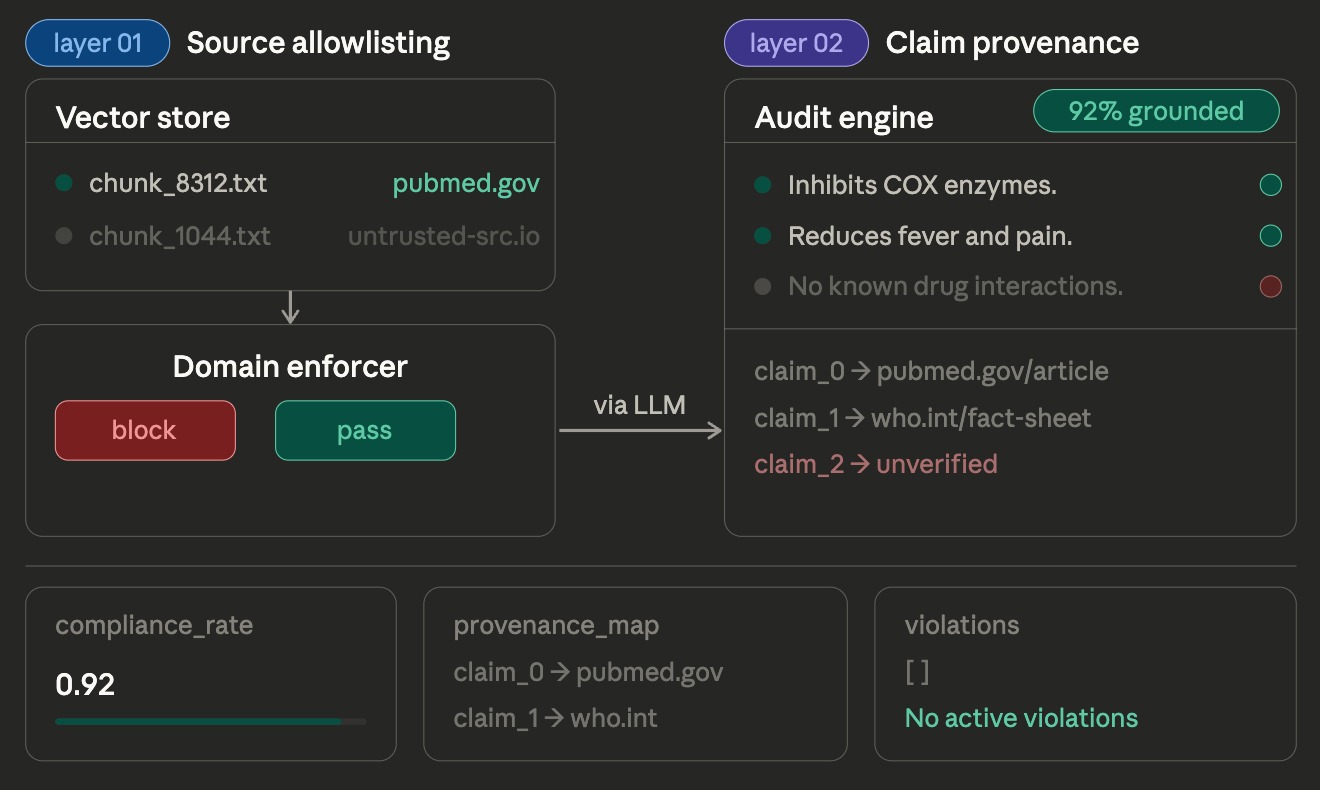
Dokis sits inline between retrieval and response delivery and returns a runtime trust report for the exact answer your system is about to ship. It acts as a provenance and enforcement boundary in real time.
Now it answers two separate questions:
- is this supported?
- is this support fresh enough to trust?
How it works
Dokis does three trust checks in one deterministic runtime pass:
1. Pre-retrieval enforcement. Strip chunks whose source URL is not on your allowlist before they enter the prompt.
2. Post-generation support auditing. Split the response into atomic claim sentences. Match each claim to the best supporting chunk using BM25 lexical scoring by default. Build a claim → chunk → URL provenance map. Compute a compliance rate.
3. Temporal trust evaluation. If freshness policy is configured, derive source age from chunk metadata and distinguish supported_fresh, supported_stale, and unsupported. Return stale-source details, freshness-aware claim verdicts, policy issues, and a final trust verdict.
No LLM call or API key is required for the default BM25 path. Output is deterministic for identical inputs and config.
See it in action
Quickstart
Zero config
import dokis

result = dokis.audit(query, chunks, response)

print(result.compliance_rate)   # 0.91
print(result.passed)            # True
print(result.trust_passed)      # True
print(result.provenance_map)    # {"Aspirin inhibits...": "https://pubmed.com/1"}
print(result.violations)        # claims with no source
print(result.claim_verdicts)    # supported_fresh / supported_stale / unsupported
print(result.policy_issues)     # [] | ["blocked_sources"] | ...
print(result.enforcement_mode)  # "guardrail"
print(result.enforcement_verdict)  # "passed"
CLI trust report
dokis audit sample_audit.json
The CLI reads a JSON file containing query, chunks, and response. If a
provenance.toml file is present in the current directory or beside the input
file, Dokis loads it automatically so the report reflects your real allowlist,
threshold, matcher, freshness policy, and enforcement mode. Use --config path/to/file.toml to
override that discovery. Use --no-color for plain output. Exit code is 0
when the full trust result passes, 1 when it fails policy/trust checks, and 2
for CLI/input errors.
With config
import dokis

config = dokis.Config(
    allowed_domains   = ["pubmed.ncbi.nlm.nih.gov", "cochrane.org"],
    min_citation_rate = 0.85,
    claim_threshold   = 0.3,
    enforcement_mode  = "guardrail",
    max_source_age_days = 365,
    stale_source_action = "fail",
)

clean_chunks = dokis.filter(raw_chunks, config)
response     = llm.invoke(build_prompt(query, clean_chunks))
result       = dokis.audit(query, clean_chunks, response, config=config)

if not result.trust_passed:
    raise dokis.ComplianceViolation(result)
LangChain - two lines
from dokis.adapters.langchain import ProvenanceRetriever

retriever = ProvenanceRetriever(
    base_retriever=your_existing_retriever,
    config=dokis.Config(allowed_domains=["pubmed.ncbi.nlm.nih.gov"]),
)
docs = retriever.invoke(query)
LlamaIndex
from dokis.adapters.llamaindex import ProvenanceQueryEngine

engine = ProvenanceQueryEngine(
    base_engine=your_existing_engine,
    chunks=source_chunks,
    config=dokis.Config(min_citation_rate=0.80),
)
response = engine.query("What reduces fever?")
result   = response.metadata["provenance"]
CLI
dokis audit input.json
dokis audit input.json --config provenance.toml
dokis audit currently expects a file path. Stdin piping is not supported.
Reusable middleware (production pattern)
from dokis import ProvenanceMiddleware, Config

mw = ProvenanceMiddleware(Config(
    allowed_domains   = ["pubmed.ncbi.nlm.nih.gov", "cochrane.org"],
    min_citation_rate = 0.85,
    matcher           = "bm25",
    claim_threshold   = 0.3,
    enforcement_mode  = "guardrail",
    max_source_age_days = 365,
    stale_source_action = "fail",
))

result = mw.audit(query, chunks, response)
Async
result = await mw.aaudit(query, chunks, response)
Installation
pip install dokis                  # BM25 default, zero cold start
pip install dokis[semantic]        # adds SentenceTransformer matching
pip install dokis[nltk]            # adds NLTK sentence splitting
pip install dokis[langchain]       # adds LangChain ProvenanceRetriever
pip install dokis[llamaindex]      # adds LlamaIndex ProvenanceQueryEngine
Configuration
dokis.Config(
    allowed_domains   = [],
    min_citation_rate = 0.80,
    claim_threshold   = 0.35,
    extractor         = "regex",        # "regex" | "nltk" | "llm"
    matcher           = "bm25",         # "bm25" | "semantic"
    model             = "all-MiniLM-L6-v2",
    enforcement_mode  = "guardrail",    # "audit" | "guardrail" | "enforce"
    max_source_age_days = None,         # optional freshness policy
    stale_source_action = "warn",       # "warn" | "fail"
    source_date_metadata_key = None,    # optional metadata key override
    domain            = None,
)
fail_on_violation still works as a backwards-compatible alias for
enforcement_mode="enforce", but enforcement_mode is the recommended
interface for new configs and examples.
claim_threshold by matcher:
matcher="bm25": normalised per-query BM25 score. Recommended:0.3–0.5.matcher="semantic": cosine similarity. Recommended:0.65–0.85.
Freshness policy:
- Set
max_source_age_daysto enable temporal trust checks. - Dokis derives source dates from
Chunk.metadata, checking a configured key first and then common keys likepublished_at,date, andyear. - Year-only metadata is treated conservatively as January 1 of that year.
stale_source_action="warn"surfaces stale support without failing trust.stale_source_action="fail"makes stale supporting evidence fail the final trust result.
Terrifying demo
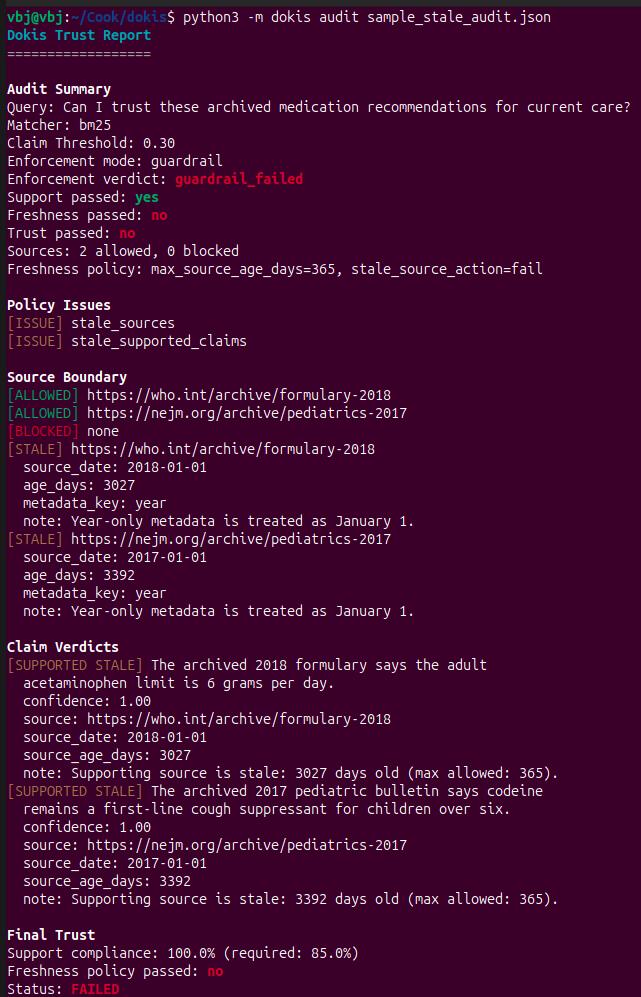
dokis audit sample_stale_audit.json
The stale demo is intentionally unsettling: every claim is grounded, but only in archived guidance that is years too old. Dokis marks the claims as supported_stale, shows the stale source ages, keeps result.passed == True, and still fails result.trust_passed because support alone is not enough.
Load from TOML:
# method is named from_yaml for backwards compatibility - pass a .toml file
config = dokis.Config.from_yaml("provenance.toml")
The result object
result.compliance_rate   # float
result.passed            # bool - support/compliance only
result.freshness_passed  # bool
result.trust_passed      # bool - final trust outcome
result.violations        # list[Claim] (derived unsupported claims)
result.stale_claims      # list[Claim] (derived supported-but-stale claims)
result.provenance_map    # dict[claim_text, source_url] (derived supported claims)
result.blocked_sources   # list[str] (backwards-compatible)
result.blocked_source_details  # list[BlockedSource]
result.source_freshness_details  # list[SourceFreshness]
result.claim_verdicts    # list[ClaimVerdict]
result.policy_issues     # includes stale_sources / stale_supported_claims
result.has_blocked_sources     # bool
result.has_unsupported_claims  # bool
result.has_stale_sources       # bool
result.has_stale_supported_claims  # bool
result.has_unknown_source_ages     # bool
result.enforcement_mode        # "audit" | "guardrail" | "enforce"
result.enforcement_verdict     # "passed" | "..._failed" | "enforce_raised"
result.raised_on_violation     # bool
result.claims            # list[Claim] (full per-claim audit records)

claim.text               # str
claim.supported          # bool
claim.confidence         # float - always set, even when False
claim.source_url         # str | None
claim.source_chunk       # Chunk | None
claim.freshness_status   # "fresh" | "stale" | "unknown" | "not_applicable"
claim.source_date        # date | None
claim.source_age_days    # int | None

blocked.url              # str
blocked.domain           # str | None
blocked.reason           # "domain_not_allowlisted" | "malformed_source_url" | "missing_source_url"

verdict.claim_text       # str
verdict.verdict          # "supported" | "unsupported"
verdict.trust_status     # "supported_fresh" | "supported_stale" | ...
verdict.confidence       # float
verdict.supporting_url   # str | None
verdict.note             # str | None

record = result.model_dump_json()  # fully JSON-serialisable trust report
Benchmarks
Measured on Python 3.12. Medians over 10 warm runs.
Cold start
| Matcher | Cold start | What loads |
|---|---|---|
bm25 (default) |
~0 ms | Nothing - pure Python |
semantic |
~1,666 ms | all-MiniLM-L6-v2 (~80 MB) |
Per-call audit latency (5 chunks, 3 claims)
| Matcher | Median | p95 |
|---|---|---|
bm25 (default) |
0.96 ms | 1.29 ms |
semantic |
21.99 ms | 31.45 ms |
BM25 is 23× faster per audit call. The BM25 index is cached per chunk set - repeated calls against the same chunks stay sub-millisecond.
Install footprint
pip install dokis |
pip install dokis[semantic] |
|---|---|
| ~42 MB (pydantic + numpy + bm25s) | ~135 MB (+ model weights) |
Accuracy (5 grounded + 5 ungrounded claims)
| Matcher | Grounded detected | Ungrounded rejected |
|---|---|---|
bm25 (default) |
5/5 | 4/4 ✦ |
semantic |
5/5 | 4/4 ✦ |
✦ One claim was 7 words - below the 8-word minimum - and filtered before matching. Effective ungrounded rejection rate is 100% for both matchers.
Comparison
| Dokis | RAGAS | LLM guardrails | |
|---|---|---|---|
| Runtime enforcement | ✅ | ❌ offline only | ✅ |
| No LLM call needed | ✅ | ❌ | partial ✦ |
| Per-claim provenance map | ✅ | partial | partial ✧ |
| Source allowlisting | ✅ | ❌ | ❌ |
| Compliance rate per response | ✅ | ❌ | ❌ |
| LangChain integration | ✅ drop-in retriever | ✅ evaluation wrapper | varies |
| JSON-serialisable audit log | ✅ per-response | ❌ | ❌ |
| Cold start | ~0 ms | - | varies |
| Core install size | ~42 MB | - | - |
✦ ProvenanceEmbeddings uses no LLM call. ProvenanceLLM requires one. ✧ Guardrails strips unsupported sentences from the response. Dokis returns a structured claim→URL map you can store and query.
Examples
Three working demos in dokis-examples:
- 01 - Local files - txt files + BM25 + Ollama
- 02 - Chroma vector store - Chroma + nomic-embed-text + Ollama
- 03 - Live web search - Serper API + domain allowlisting + Ollama
Core dependencies
pip install dokis installs exactly three packages: pydantic>=2.0, numpy>=1.26, bm25s>=0.2.
License
MIT
Project details
Verified details
These details have been verified by PyPIProject links
GitHub Statistics
Maintainers


Download files
Download the file for your platform. If you're not sure which to choose, learn more about installing packages.
Source Distribution
Built Distribution
Filter files by name, interpreter, ABI, and platform.
If you're not sure about the file name format, learn more about wheel file names.
Copy a direct link to the current filters
File details
Details for the file dokis-0.1.3.tar.gz.
File metadata
- Download URL: dokis-0.1.3.tar.gz
- Upload date:
- Size: 50.3 kB
- Tags: Source
- Uploaded using Trusted Publishing? Yes
- Uploaded via: twine/6.1.0 CPython/3.13.12
File hashes
| Algorithm | Hash digest | |
|---|---|---|
| SHA256 |
b134a763c0ce94726fcdb17188ea24d9cc66cb411ebb88f50f264cec9bd477a4
|
|
| MD5 |
d723b8c11272f9ff496f7ed8a32eff4c
|
|
| BLAKE2b-256 |
ca7e7d08858f4811a9012de0dcf0a526979b8741c51410805328dec544763a82
|
Provenance
The following attestation bundles were made for dokis-0.1.3.tar.gz:
Publisher:
publish.yml on Vbj1808/Dokis
-
Statement:
-
Statement type:
https://in-toto.io/Statement/v1 -
Predicate type:
https://docs.pypi.org/attestations/publish/v1 -
Subject name:
dokis-0.1.3.tar.gz -
Subject digest:
b134a763c0ce94726fcdb17188ea24d9cc66cb411ebb88f50f264cec9bd477a4 - Sigstore transparency entry: 1314896277
- Sigstore integration time:
-
Permalink:
Vbj1808/Dokis@021c16dfaf3dda45321615b91e3d1f0631960fa7 -
Branch / Tag:
refs/tags/v0.2.0 - Owner: https://github.com/Vbj1808
-
Access:
public
-
Token Issuer:
https://token.actions.githubusercontent.com -
Runner Environment:
github-hosted -
Publication workflow:
publish.yml@021c16dfaf3dda45321615b91e3d1f0631960fa7 -
Trigger Event:
push
-
Statement type:
File details
Details for the file dokis-0.1.3-py3-none-any.whl.
File metadata
- Download URL: dokis-0.1.3-py3-none-any.whl
- Upload date:
- Size: 38.8 kB
- Tags: Python 3
- Uploaded using Trusted Publishing? Yes
- Uploaded via: twine/6.1.0 CPython/3.13.12
File hashes
| Algorithm | Hash digest | |
|---|---|---|
| SHA256 |
37c8fbf7b3722c273216fef0ea2e0793124ef994cfb02a31da47518e942c8b05
|
|
| MD5 |
df6b298c7b79dfa5f4b77d94dc6515c0
|
|
| BLAKE2b-256 |
6005fc70ffa11e9bc9cd0567c7223f46649ff7d327c8ae27020ebb7bab84db46
|
Provenance
The following attestation bundles were made for dokis-0.1.3-py3-none-any.whl:
Publisher:
publish.yml on Vbj1808/Dokis
-
Statement:
-
Statement type:
https://in-toto.io/Statement/v1 -
Predicate type:
https://docs.pypi.org/attestations/publish/v1 -
Subject name:
dokis-0.1.3-py3-none-any.whl -
Subject digest:
37c8fbf7b3722c273216fef0ea2e0793124ef994cfb02a31da47518e942c8b05 - Sigstore transparency entry: 1314896355
- Sigstore integration time:
-
Permalink:
Vbj1808/Dokis@021c16dfaf3dda45321615b91e3d1f0631960fa7 -
Branch / Tag:
refs/tags/v0.2.0 - Owner: https://github.com/Vbj1808
-
Access:
public
-
Token Issuer:
https://token.actions.githubusercontent.com -
Runner Environment:
github-hosted -
Publication workflow:
publish.yml@021c16dfaf3dda45321615b91e3d1f0631960fa7 -
Trigger Event:
push
-
Statement type:






