
DomainLab: modular python package for training domain invariant neural networks





Distribution shifts, domain generalization and DomainLab
Neural networks trained using data from a specific distribution (domain) usually fail to generalize to novel distributions (domains). Domain generalization aims at learning domain invariant features by utilizing data from multiple domains (data sites, cohorts, batches, vendors) so the learned feature can be generalized to new unseen domains (distributions).
DomainLab is a software platform with state-of-the-art domain generalization algorithms implemented and designed by maximal decoupling of different software components thus enhancing maximal code reuse.
DomainLab
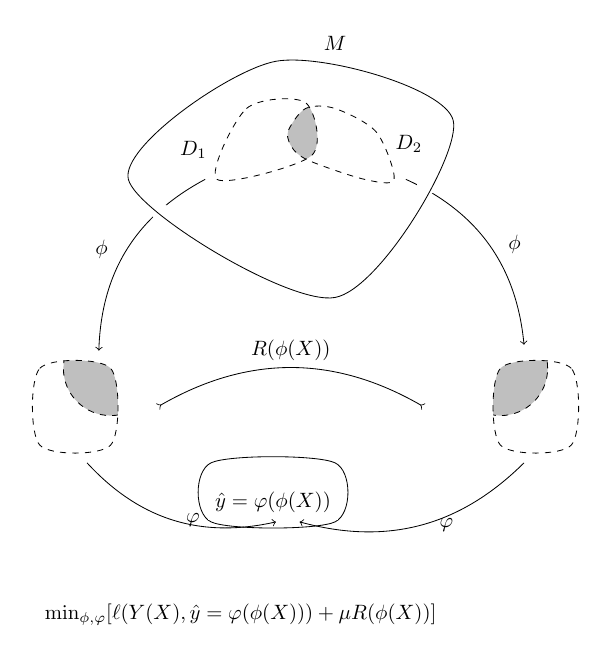
DomainLab decouples the following concepts or objects:
- task $M$: In DomainLab, a task is a container for datasets from different domains. (e.g. from distribution $D_1$ and $D_2$). The task offers a static protocol to evaluate the generalization performance of a neural network: which dataset(s) is used for training, and which dataset(s) is used for testing.
- neural network: a map $\phi$ from the input data to the feature space and a map $\varphi$ from the feature space to output $\hat{y}$ (e.g. decision variable).
- model: structural risk in the form of $\ell() + \mu R()$ where
- $\ell(Y, \hat{y}=\varphi(\phi(X)))$ is the task-specific empirical loss (e.g. cross entropy for classification task).
- $R(\phi(X))$ is the penalty loss to boost domain invariant feature extraction using $\phi$.
- $\mu$ is the corresponding multiplier to each penalty function factor.
- trainer: an object that guides the data flow to model and append further domain invariant losses like inter-domain feature alignment.
We offer detailed documentation on how these models and trainers work on our documentation page: https://marrlab.github.io/DomainLab/
DomainLab makes it possible to combine models with models, trainers with models, and trainers with trainers in a decorator pattern like the line of code below
Trainer A(
		  Trainer B(Model C(
						    Model D(network E),
							network E,
							network F
						   )
				   )
	     )
which correspond to $\ell() + \mu_a R_a() + \mu_b R_b + \mu_c R_c() + \mu_d R_d()$, where Model C and Model D share neural network E, but Model C has an extra neural network F. All models share the same neural network for feature extraction, but can have different auxiliary networks for $R()$.
Getting started
Installation
For the development version in Github, see Installation and Dependencies handling
We also offer a PyPI version here https://pypi.org/project/domainlab/ which one could install via pip install domainlab and it is recommended to create a virtual environment for it.
Task specification
We offer various ways for the user to specify a scenario to evaluate the generalization performance via training on a limited number of datasets. See detail in Task Specification
Example and usage
Available arguments for commandline
The following command tells which arguments/hyperparameters/multipliers are available to be set by the user and which model they are associated with
python main_out.py --help
or
domainlab --help
Command line configuration file
domainlab -c ./examples/conf/vlcs_diva_mldg_dial.yaml (if you install via pip)
or if you clone this the code repository for DomainLab
python main_out.py -c ./examples/conf/vlcs_diva_mldg_dial.yaml
where the configuration file below can be downloaded here
te_d: caltech                       # domain name of test domain
tpath: examples/tasks/task_vlcs.py  # python file path to specify the task
bs: 2                               # batch size
model: dann_diva                    # combine model DANN with DIVA
epos: 1                             # number of epochs
trainer: mldg_dial                  # combine trainer MLDG and DIAL
gamma_y: 700000.0                   # hyperparameter of diva
gamma_d: 100000.0                   # hyperparameter of diva
npath: examples/nets/resnet.py      # neural network for class classification
npath_dom: examples/nets/resnet.py  # neural network for domain classification
See details in Command line usage
or Programm against DomainLab API
See example here: Transformer as feature extractor, decorate JIGEN with DANN, training using MLDG decorated by DIAL
Benchmark different methods
DomainLab provides a powerful benchmark functionality. To benchmark several algorithms(combination of neural networks, models, trainers and associated hyperparameters), a single line command along with a benchmark configuration files is sufficient. See details in benchmarks documentation and tutorial
One could simply run
bash run_benchmark_slurm.sh your_benchmark_configuration.yaml to launch different experiments with specified configuraiton.
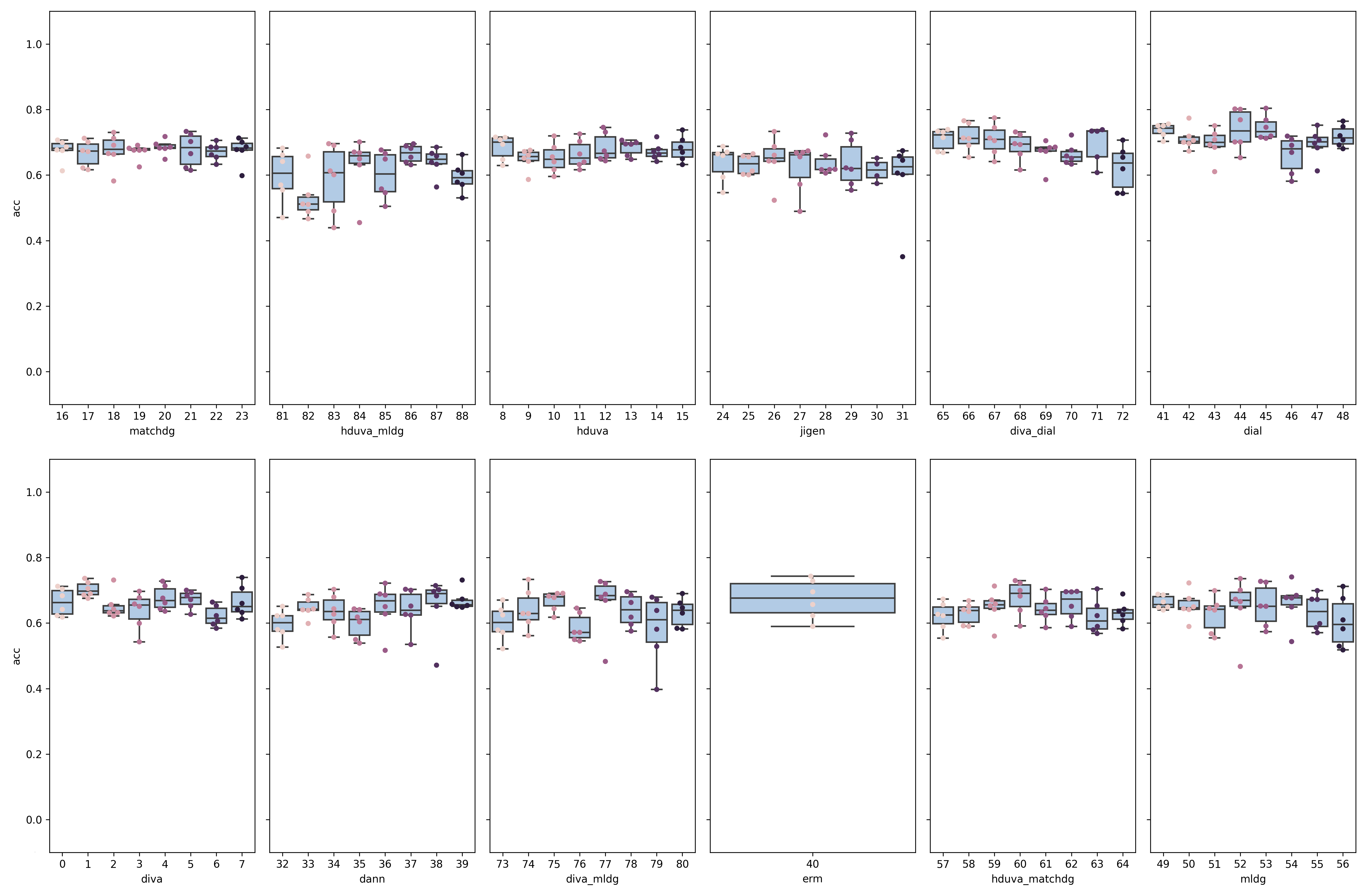
For example, the following result (without any augmentation like flip) is for PACS dataset using ResNet. The reader should note that using different neural network, whether pre-trained or not, what kind of preprocessinga and augmentation to use can lead to very different result distributions, which is one of the features DomainLab provide: the above factors get decoupled in DomainLab.
Citation
Source: https://arxiv.org/pdf/2403.14356.pdf
@misc{sun2024domainlab,
  title={DomainLab: A modular Python package for domain generalization in deep learning},
  author={Sun, Xudong and Feistner, Carla and Gossmann, Alexej and Schwarz, George and Umer, Rao Muhammad and Beer, Lisa and Rockenschaub, Patrick and Shrestha, Rahul Babu and Gruber, Armin and Chen, Nutan and others},
  journal={https://arxiv.org/pdf/2403.14356.pdf},
  year={2024}
}
3 maintainers


Metadata
3 maintainers
Release files for domainlab 0.7.1
For a detailed explanation of source distributions (sdists) and built distributions (wheels), please see the package formats documentation.
Source distribution (sdist)
| File | Size | Uploaded | |
|---|---|---|---|
| domainlab-0.7.1.tar.gz | 3.0 MB | Details |
Built distribution (wheel)
| File | Interpreter | ABI | Platform | Reset |
|---|---|---|---|---|
| domainlab-0.7.1-py3-none-any.whl | Python 3 | none | any | Details |
Total release size: 6.2 MB
Release files / domainlab-0.7.1.tar.gz
| Download URL | domainlab-0.7.1.tar.gz |
|---|---|
| Size | 3.0 MB |
| Tags | Source |
|
SHA-256 checksum How to use checksums |
476b9bc2a164034942e0c5c699b6b5387a938cdc4a38403faa7860aa41ada94b
|
|
BLAKE2b-256 checksum How to use checksums |
7742df8a6ff610598e1e0c3cb58e5a6ddb354af64a691e0e3971f18e1ff48558
|
| Upload date | |
|
Uploaded using Trusted Publishing? What is trusted publishing? |
No |
| Uploaded via |
poetry/1.8.4 CPython/3.12.4 Linux/5.15.0-126-generic
|
Release files / domainlab-0.7.1-py3-none-any.whl
| Download URL | domainlab-0.7.1-py3-none-any.whl |
|---|---|
| Size | 3.2 MB |
| Tags | Python 3 |
|
SHA-256 checksum How to use checksums |
cff9633552013520ba276ceb574e60f244ec4ed96526c16d61f97ef3aa794b14
|
|
BLAKE2b-256 checksum How to use checksums |
0edab6b23f34a46d54014e7972aba0d83642ce97592b8cda0dbe5a7f9eb12c62
|
| Upload date | |
|
Uploaded using Trusted Publishing? What is trusted publishing? |
No |
| Uploaded via |
poetry/1.8.4 CPython/3.12.4 Linux/5.15.0-126-generic
|














