
dorian
Keep code claims checkable after the next refactor.
Turn explicit claims into checks sealed beside your code. Re-run affected checks when their sources change; revoke the warrant when a load-bearing check fails.
Recorded example: httpx raised its Python requirement from >=3.8 to >=3.9.
A previously sealed claim became REVOKED (exit 4).
Captured output + pinned commits — retrospective reproduction, not deployment evidence.
Engineering: Executable README demo · Own-repo warrants 240-pair synthetic benchmark · Release history Benchmark results are historical; the last recorded rerun was at v1.2.0.
Boundary: a claim is only as strong as its checker. A symbol-existence check can miss changed behavior. Test and shell checkers execute code. Trust and execution limits
Try the runnable demo · Install · GitHub Action
Try it
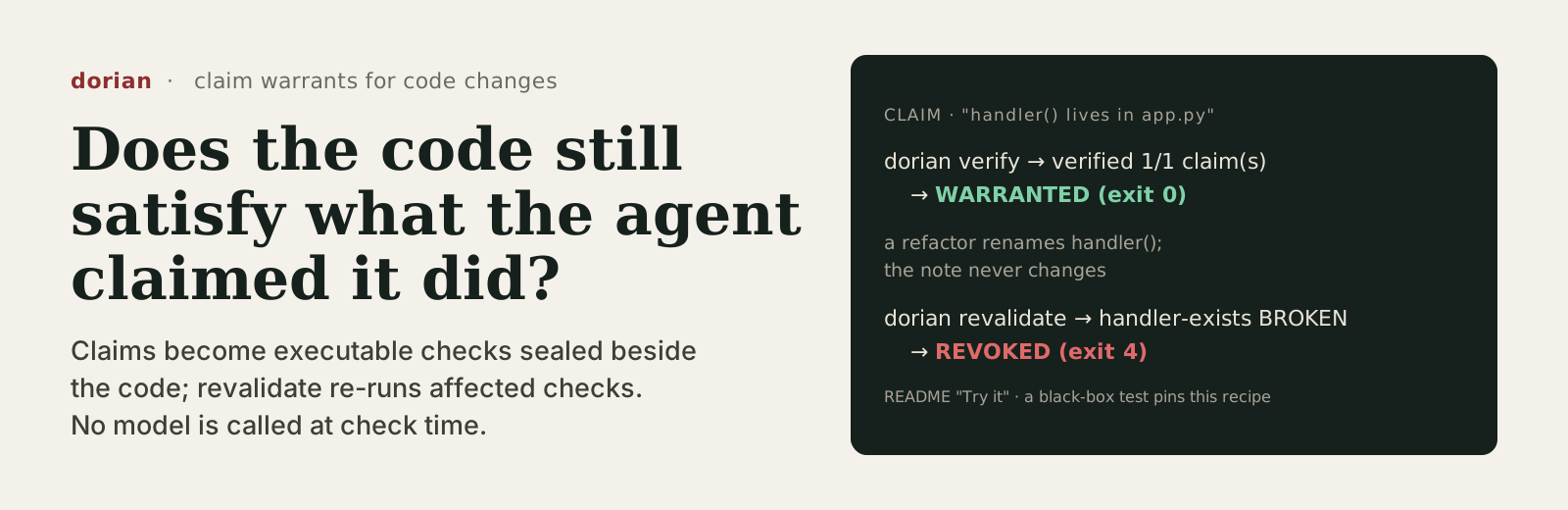
The example below seals a claim, renames its function and reports REVOKED. It uses a throwaway repository and an isolated environment; Python 3.11+ is required.
tmp=$(mktemp -d)
cd "$tmp"
python3 -m venv .venv
source .venv/bin/activate
python -m pip install dorian-vwp==1.4.1
git init -q
printf '.venv/\n' > .gitignore

printf 'def handler():\n    return 200\n' > app.py
printf '# change note\n\n`handler()` lives in app.py.\n' > note.md
git add app.py note.md .gitignore
git -c user.name=Demo -c user.email=demo@example.invalid \
  -c commit.gpgsign=false commit -q -m "app + note"

cat > claims.json <<'JSON'
{"claims": [
  {"id": "handler-exists", "text": "handler() lives in app.py.",
   "kind": "reference", "load_bearing": true,
   "checkers": [{"type": "C3", "program": "symbol:app.py::handler"}]}
]}
JSON

dorian verify note.md --claims claims.json     # -> verified 1/1 claim(s)  (exit 0)

# now a refactor renames the function the note claims exists:
printf 'def renamed():\n    return 200\n' > app.py
dorian revalidate --since HEAD                 # -> handler-exists BROKEN; WARRANTED -> REVOKED  (exit 4)
note.md never changed, but the warrant flips to REVOKED and names the claim whose check failed.
tests/test_readme_example.py runs the same steps, with the recipe's
command-local Git identity, against this checkout and pins the commands, exit codes and install
version; it does not install from PyPI. For other ways to install, see Install.
What it checks and what it does not
Verification makes no model calls (zero model tokens at check time); its strength depends on the claims, checkers and trusted execution environment.
A claim is bound to one of four checker families: C1 (a quoted span of the artifact itself),
C3 (a path, symbol, string, or regex in a file, plus the structural py-signature: /
py-const: / code: / config-value: forms), C4 (a pytest: node id), or C5 (typed data
checks on CSV/parquet files, or a shell: command). C1, C3, and typed C5 only read files; C4 and C5
shell: execute code (see Security). verify is
born-verifiable: it seals only if every claim holds right now (exit 0) and writes nothing
otherwise (exit 4). A warrant is born WARRANTED and folds on each revalidate to TRUSTED,
DEGRADED, REVOKED, or UNKNOWN (a checker could not run — never counted as broken, never
silently green).
The honest limits:
- Binding is a re-check trigger, not a behavior proof. When a claim names a symbol, dorian also
watches the file that defines it, so an edit there re-checks the claim — but the checker still
decides truth. A watched file changing never makes a claim BROKEN by itself: binding is trigger
coverage, not behavior proof. Ambiguity is skipped, not guessed — a symbol defined in more than
one file is left unwatched. Details:
docs/BINDING.md. - The gutted-body ceiling. If a function keeps its name but its behavior changes, an existence
check (
symbol:) fires the re-check and passes. Only a behavior checker (apytest:test) on the same edit catches it.--strength-gateflags load-bearing claims backed only by existence checks. - It reports whether stated claims are true against the source — never whether the code is good. Not an LLM judge, not an eval framework, not a sandbox. Full list: What dorian is not.
Security: claims are executable input
dorian verify runs every checker. C1, C3, and typed C5 only read files, but C4 (pytest:) and
C5 shell: execute code — so a claims.json or a .warrant is executable input. Treat an
agent-emitted claims.json like agent-emitted code: review it, and never run verify on claims from
an untrusted source. dorian is built for trusted, internal repositories — not public CI
taking forked pull requests by default. When you cannot trust the claims, --deny-exec (env
DORIAN_DENY_EXEC=1) makes the executable families ERROR instead of running (fail-closed, never a
silent pass), and checker_trust: base runs only base-approved checker specs on fork PRs. Neither is
a sandbox. See SECURITY.md and docs/SECURITY_BOUNDARY.md.
Install



The PyPI distribution is dorian-vwp; the import and CLI are dorian. Python 3.11+, zero runtime
dependencies, trusted publishing (latest: v1.4.1).
pip install dorian-vwp             # core
pip install 'dorian-vwp[data]'     # + duckdb for parquet data claims
pip install 'dorian-vwp[extract]'  # + anthropic for LLM claim drafting (frozen/experimental)
dorian init scaffolds a born-verifiable starter claims.json, its change note, and a workflow
file, so the first dorian verify seals green:
cd your-repo
dorian init
dorian verify dorian-change-note.md --claims claims.json   # seals the warrant — exit 0
GitHub Action
The composite Action revalidates the claims a pull request touches and posts a
sticky PR comment; with fail_on: revoked, a broken load-bearing claim blocks the PR. Read its
security notes first.
name: dorian
on: [pull_request]

permissions:
  contents: read
  pull-requests: write

jobs:
  revalidate:
    runs-on: ubuntu-latest
    steps:
      - uses: actions/checkout@v6
        with:
          fetch-depth: 0             # revalidate diffs against the PR base sha
          persist-credentials: false # the Action only reads the diff + posts via GITHUB_TOKEN
      - uses: ajaysurya1221/dorian/action@v1.4.1
        with:
          fail_on: revoked
          # install defaults to the published PyPI package (dorian-vwp); pin a
          # version or set a git source spec to install unreleased changes
Using dorian with Claude Code
One command scaffolds a project-local skill: dorian claude-code install-claim-warrants. After a
change, /dorian-claim-warrants drafts the change note + claims.json for the checkable facts the
agent claimed and prints the verify command. The model drafts; deterministic checkers evaluate the
specified claims. Review the drafted claims.json before running verify: C4 and C5 shell:
checkers execute code (Security). On later PRs,
dorian revalidate --since <base> re-runs the affected checks and revokes a warrant when a
load-bearing check fails. Add --with-hook for an opt-in, reminder-only Stop hook. Paste-ready
prompt, runnable example pack, and settings.json sample:
docs/USE_WITH_CLAUDE_CODE.md and
examples/claude-code/.
Using dorian inside AI coding loops: dorian loop preflight --since <base> re-checks the warrants a
change touched before each iteration and returns continue / repair / escalate — a steering
signal, not a halt (docs/DORIAN_LOOP_GUARD.md). dorian governance install adds a SubagentStop gate and a fail-closed PreToolUse veto for unattended runs
(docs/GOVERNANCE_DATA_MODEL.md).
Commands at a glance
dorian verify <artifact> --claims claims.json seals a warrant (--supersede <old-id> re-seals over
an earlier one, --no-quotes writes a content-free sidecar, --allow-restricted overrides the
[tool.dorian.scopes] seal-time lint). dorian revalidate --since <ref> --format md re-checks the
affected claims; md is the PR-comment body the Action posts. Also: dorian status,
dorian blast (downstream warrants are flagged recalled), dorian bindings,
dorian suggest-claims / suggest-data-checks, dorian report --audit, and the
dorian bench mutation / bench large-mutation suites (source checkout only). Full reference:
docs/COMMANDS.md.
Exit codes: 0 ok/TRUSTED · 2 usage/infra · 3 DEGRADED · 4 REVOKED/integrity · 5
ERRORED-only (checkers could not run; never conflated with broken) · 6 scope violation.
Evidence
On the historical 240-pair synthetic suite, dorian produced 5 false alarms versus the path-scope watcher's 58, while missing 5 stale pairs that the watcher detected (docs/BENCHMARK_v0.7.0.md). These results are specific to the authored fixtures.
- Synthetic benchmark. Over 240 (artifact, mutation) pairs across six invented fixture domains
with known-truth labels, claim-level revalidation flagged broken claims at precision 0.93 /
recall 0.93, versus file-change watchers at recall 1.00 but precision 0.34 (naive),
0.56 (path-scope), and 0.59 (line-aware) — 11.6x fewer false alarms than the path-scope
watcher (58 → 5) and 10.4x fewer than the line-aware one (52 → 5). Synthetic, not your
repository; measured at v0.7.0 (
docs/BENCHMARK_v0.7.0.md; compatibility notes indocs/BENCHMARK_CURRENT.md). Historical synthetic result, last rerun at v1.2.0. To reproduce from a source checkout with development dependencies installed, runuv run dorian bench large-mutation. - Retrospective public-repository check. Revalidating a warrant across two pinned httpx commits
detected the documented Python-support change. This is a scoped reproduction, not evidence of
deployment adoption or a prevented production defect. The load-bearing claim was that
encode/httpxdeclaresrequires-python = ">=3.8"; the upstream commit for #3592 ("Drop Python 3.8 support") flipped the warrant WARRANTED → REVOKED (exit 4). Full output and a from-scratch reproduction:docs/REAL_CATCH_LOG.md. One documented case, not universal validation.
Keep a change note checkable across later edits
dorian commits warrants for its own change notes. The Loop Guard warrant includes checks against implementation symbols and selected README text. Its dogfood test copies those real files into a temporary repository, seals the claims, then renames a referenced function and checks that the loop decision changes from continue to repair.
This exercises specific authored claims. It does not certify the entire README or establish a current TRUSTED result for every warrant.
Docs
docs/START_HERE.md— the docs map, by what you are trying to do.docs/OVERVIEW.md— the long-form tour, incl. what dorian is not and the roadmap.docs/COMMANDS.md— the full command reference.docs/BINDING.md— binding semantics: trigger vs. truth.docs/AGENT_CLAIMS.mdandspec/checkers.md— writing claims; the checker grammar.docs/BENCHMARK_CURRENT.md— archived benchmark results and compatibility notes.SECURITY.mdanddocs/SECURITY_BOUNDARY.md— security.docs/ROADMAP_BACKLOG.md— the structured roadmap backlog.
Contributing
git clone https://github.com/ajaysurya1221/dorian.git && cd dorian
make install && make lint && make test
Small, focused PRs with tests are welcome. Benchmark contributions carry aggregate numbers only.
Development setup, checks, and conventions: CONTRIBUTING.md.
Maintained by Ajay Surya Senthilrajan, with AI pair-programming recorded in commit trailers. See the tests, design records and release evidence linked here.
License
Apache-2.0. Protocol: VWP (Validity Warrant Protocol), spec in spec/.
Author: Ajay Surya Senthilrajan (@ajaysurya1221).
1 maintainer

Metadata
1 maintainer
Release files for dorian-vwp 1.4.1
For a detailed explanation of source distributions (sdists) and built distributions (wheels), please see the package formats documentation.
Source distribution (sdist)
| File | Size | Uploaded | |
|---|---|---|---|
| dorian_vwp-1.4.1.tar.gz | 328.2 kB | Details |
Built distribution (wheel)
| File | Interpreter | ABI | Platform | Reset |
|---|---|---|---|---|
| dorian_vwp-1.4.1-py3-none-any.whl | Python 3 | none | any | Details |
Total release size: 517.5 kB
Release files / dorian_vwp-1.4.1.tar.gz
| Download URL | dorian_vwp-1.4.1.tar.gz |
|---|---|
| Size | 328.2 kB |
| Tags | Source |
|
SHA-256 checksum How to use checksums |
da1e24e662a2eca559d438b9ad668dee36e725d79324bf7ecffbbf076936bb62
|
|
BLAKE2b-256 checksum How to use checksums |
d733848921f98144a891de2c96bf7335a4dc9a80cc522a64bb5084e722872acb
|
| Upload date | |
|
Uploaded using Trusted Publishing? What is trusted publishing? |
Yes |
| Uploaded via |
twine/7.0.0 CPython/3.13.14
|
Provenance
Provenance describes where a file came from. On PyPI, provenance is shared via attestations, which provide a verifiable record of the build or publishing details. View details, limitations and caveats.


PyPI Publish Attestation
PyPI verified that this artifact, at this checksum, originated from the publisher listed below.
Signed by GitHub Actions, verified by PyPI on Oct 14, 2026.
Transparency logRelease files / dorian_vwp-1.4.1-py3-none-any.whl
| Download URL | dorian_vwp-1.4.1-py3-none-any.whl |
|---|---|
| Size | 189.3 kB |
| Tags | Python 3 |
|
SHA-256 checksum How to use checksums |
e340d6d533c04a5e242fde905e87acbccb60ecd7c47eaf65b09a9f991997842f
|
|
BLAKE2b-256 checksum How to use checksums |
958cfd3b4541c1ae7ab4e84c8b516ed2f53e78f4d762ce19b8e1e42ecfeae356
|
| Upload date | |
|
Uploaded using Trusted Publishing? What is trusted publishing? |
Yes |
| Uploaded via |
twine/7.0.0 CPython/3.13.14
|
Provenance
Provenance describes where a file came from. On PyPI, provenance is shared via attestations, which provide a verifiable record of the build or publishing details. View details, limitations and caveats.
PyPI Publish Attestation
PyPI verified that this artifact, at this checksum, originated from the publisher listed below.
Signed by GitHub Actions, verified by PyPI on Oct 14, 2026.
Transparency log













