
Dispatch Operating System — the domain-free trust substrate for fleets of autonomous agents (verdict spine, ship oracle, structured refusal, lane arbiter, correlation spine).
Verified details
These details have been verified by PyPIProject links
GitHub Statistics
Maintainers

Project description
DOS — the Dispatch Operating System
Catch your AI agents when they lie about what they shipped.





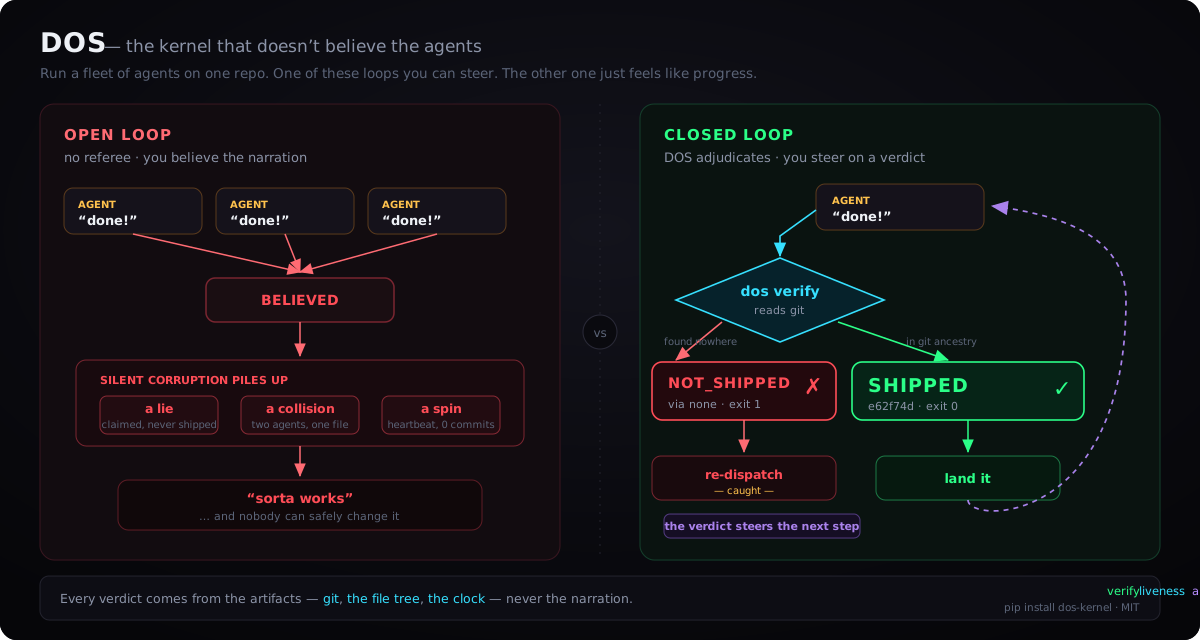
Run a fleet of agents on one repo. The left loop just feels like progress; the right one you can steer.
The only difference is a verdict DOS reads from the real world — here, git — never the agent's word.
An AI agent will tell you it finished. DOS checks the real world instead of taking its word — and the nearest piece of the real world is your git history.
An agent says it shipped the login endpoint. Did it? Run one command,
dos verify, and it answers from the artifacts the work actually left behind,
not from what the agent typed. If a commit backs the claim, you get SHIPPED
and exit code 0. If nothing landed, you get NOT_SHIPPED and exit code 1.
The agent's story never enters into it. (Git is just the first witness DOS
reads; the file tree, the clock, a CI status, a test environment's own state
are others — anything the agent didn't author.)
dos verify AUTH AUTH1   # → SHIPPED      AUTH AUTH1 e62f74d   (exit 0)
dos verify AUTH AUTH2   # → NOT_SHIPPED  AUTH AUTH2           (exit 1)
That's the smallest version. It scales up, too: point a dozen agents at one
repo — in CI, in a fleet, racing on the same files — and DOS also tells you
which ones are stepping on each other, which one is spinning in circles, and
which claim of "done" is real. Every answer comes from the artifacts (git, the
file tree, the clock), never the narration. It works on a plain git repo with
zero config, and the only thing you ever install is one small Python package.
⏱️ Want to try it right now? Jump to Try it in 60 seconds — one command, real output, then come back for the why.
v0.23.4 · 3900+ tests · CI: Python 3.11–3.13 on Linux + a Windows 3.13 smoke run · the only runtime dependency is PyYAML · MIT.
🧭 Want it in plain words first? What DOS is, what it catches, and what adopting it costs — no code: the plain-words version, just below.
🧭 Or route yourself: the page runs shallow → deep, and Who this is for matches the question you brought to the section that answers it.
Reading this as an AI agent? Start with AGENTS.md — a short orientation written for you: what DOS is in three lines, how to build/test/check your work, the ~5 files actually worth reading, and the architecture rules a change must satisfy.
Who this is for
This README runs shallow to deep — try it, see the failure it fixes, audit the evidence, wire it in, extend it. You don't have to read it in that order. Find the question you arrived with and jump; the rows route by the question, not your job title, and every section hands off to the one above it.
| You're asking… | Start at | Then |
|---|---|---|
| "What is this, in plain words, and why should my team care?" | the plain-words version, just below — no code | hand the 60-second demo to whoever runs your agents |
| "Show me it working, fast." | Try it in 60 seconds | what goes wrong in a fleet without it |
| "I already run agents — how do I wire the verdict into my stack?" | How you plug it in | the MCP lie detector · Install |
| "I run a fleet every day — how do I watch it, triage it, debug it?" | Operating a fleet | Three live projections · Debug a stuck fleet |
| "How do I bend it to my org without forking it?" | Hacking it | docs/HACKING.md — the seven extension axes |
| "What is actually proven here — and can I re-run it?" | For researchers — claims → invariants → reproduction | What's proven and what's still a bet · Citation |
(The seventh reader — an AI agent orienting itself in this repo — already has its own front door: AGENTS.md, per the note above.)
The plain-words version
A coding agent does some work, then tells you how it went. Usually the story is true. Sometimes it isn't — the cheerful "all work completed!" from a worker that actually shipped nothing is the single most common failure in agent fleets. With one agent you catch that yourself, because you read its work before trusting it.
Run twenty agents at once and nobody reads everything. Each worker grades its own homework, you believe the reports because what else is there to go on, and the unchecked problems pile up quietly — a false "done" here, two agents overwriting the same file there, one worker spinning in circles burning money. None of it is loud. The codebase ends up sorta working, and nobody can safely change it.
DOS is the referee. It's a small, deterministic program that never reads the agent's story; it reads what actually happened — the commit, the file, the clock — and hands you a verdict. An agent says "done"? DOS checks whether the work really landed in your repo's history. An agent says "making progress"? DOS checks whether anything real has changed. Two agents head for the same files? DOS admits one and refuses the other, with a reason a machine can act on. Every verdict is computed from artifacts the agent didn't author, so no amount of confident narration can move it.
Nothing about it is coding-specific, and it imposes no framework. Your repo declares its own rules — which file regions each agent may touch, how a finished unit of work signals "done" — as data in one small config file, and DOS supplies only the machinery. You reach it through small, do-one-thing commands, through the agent host you already run, or straight from Python. And it stays in its lane: it tells you reliably what happened, never whether the committed code is good — quality stays with your tests, your reviews, and you.
Adopting it costs one engineer about an afternoon: one small Python package (one runtime dependency), one optional config file — and it works on day one against a plain git repository with neither. If your team is about to go from one agent to many, the missing piece is usually not a smarter agent. It's a referee that doesn't believe any of them.
Convinced enough to watch it work? Try it in 60 seconds is one command — or hand this page to whoever runs your agents.
Try it in 60 seconds
Got a terminal? This runs the whole thing in a throwaway repo — one command scaffolds it, makes a real commit, verifies it, and cleans up after itself:
pip install dos-kernel      # PyYAML is the only runtime dep
dos quickstart              # → SHIPPED AUTH AUTH1 … then NOT_SHIPPED AUTH AUTH2
One SHIPPED, one NOT_SHIPPED: the first is a claim git can back, the second
is a claim nothing landed for. That contrast is the product. The demo closes
with a router to wherever you already run agents — a Claude Code / Cursor tab
(dos init --hooks), an MCP host, a CI step, or a fleet — so your next move is
one line, not a docs dig. (Add --keep ./demo to keep the repo and poke at it.
Don't even want the install? uvx --from dos-kernel dos quickstart runs the
same demo ephemerally — nothing left behind.)
Prefer to watch the gears turn? The same thing, by hand, in 5 lines — click to expand
A plan (AUTH) groups phases (AUTH1, AUTH2); dos verify takes
<plan> <phase>, and a commit whose subject starts AUTH1: is what stamps that
phase shipped.
mkdir hello-dos && cd hello-dos
dos init .                                       # writes one dos.toml
git init -q
git config user.email you@example.com            # skip if you have a global git identity
git config user.name  "You"
echo 'def login(): ...' > login.py
git add -A
git commit -m "AUTH1: ship the login endpoint"   # stamp AUTH1 shipped: <PHASE-ID>: <message>

dos verify --workspace . AUTH AUTH1   # → SHIPPED     AUTH AUTH1 e389e8b (via grep-subject)   exit 0
dos verify --workspace . AUTH AUTH2   # → NOT_SHIPPED  AUTH AUTH2          (via none)          exit 1
An agent can claim AUTH2 is done all day long; verify just reports what the
artifacts say — and they say it isn't. The via grep-subject / via none tag
tells you how it knows: it found the phase token in a commit subject, or it
found it nowhere. The full walkthrough is in
docs/QUICKSTART.md.
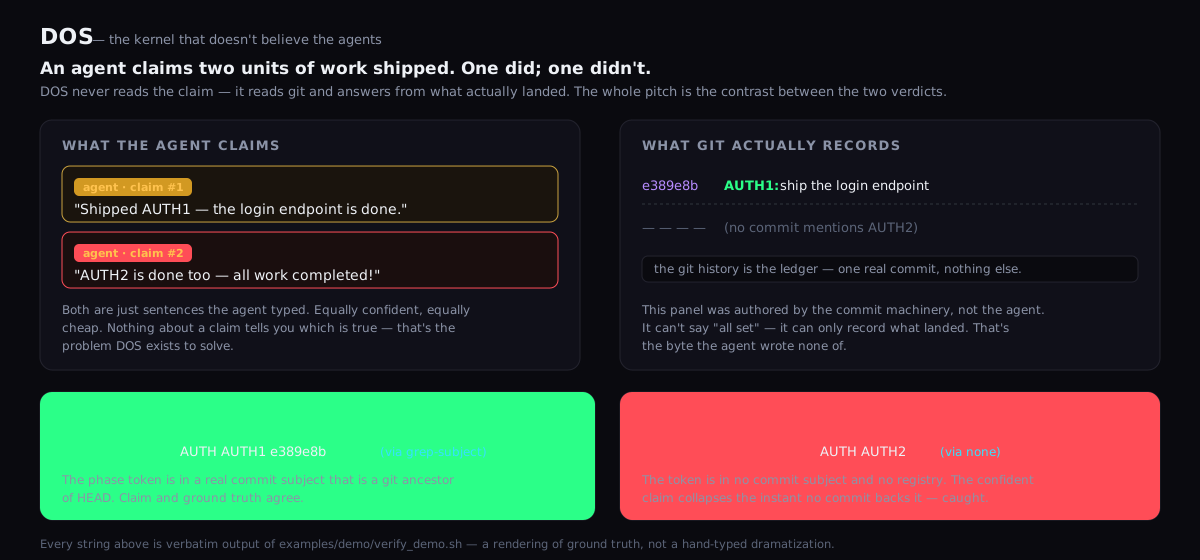
Two equally confident claims, one verdict each — SHIPPED for the one git can back, NOT_SHIPPED for the one nothing landed for. Every string is verbatim output of examples/demo/verify_demo.sh. Step through it locally for the click-through version (it's an HTML file — clone the repo and open it in a browser; GitHub shows its source, not the running page).
The smallest real win: in a CI step or dispatch loop, replace the line that
trusts an agent's "done" with dos verify PLAN PHASE and branch on its exit
code (0 shipped / 1 not). No parsing, no plan, no config — the
CI integration cookbook walks it
end-to-end. To run it on a repo shaped like yours, start with
Onboard a repo in 10 minutes.
Next level up — wire the verdict into your own stack: How you plug it in.
What goes wrong in a fleet
Run a pile of agents at once with nobody refereeing, and here's how it goes: each worker reports its own success, and you believe the reports, because what else is there to go on? The unchecked problems pile up quietly — a lie here, two agents clobbering the same file there, a little scope creep, one worker spinning in circles — until the codebase sorta works and nobody can safely change it.
The trouble is you launched the agents and then let them grade their own homework. DOS gives you the missing signal — a verdict from ground truth — so the loop closes. Here is the same fleet under both regimes:
The two regimes as a flowchart — NO REFEREE: you believe the narration; DOS ADJUDICATES: you steer on a verdict
flowchart LR
  subgraph OPEN["NO REFEREE — you believe the narration"]
    direction TB
    A1["agent: 'done!'"] --> B1[["believed"]]
    A2["agent: 'done!'"] --> B1
    A3["agent: 'done!'"] --> B1
    B1 --> C1["silent corruption piles up<br/>(lies · collisions · spin)"]
    C1 --> D1["'sorta works' — can't be changed"]
  end
  subgraph CLOSED["DOS ADJUDICATES — you steer on a verdict"]
    direction TB
    A4["agent: 'done!'"] --> V{{"dos verify<br/>reads git"}}
    V -->|in git ancestry| S["SHIPPED (exit 0)"]
    V -->|found nowhere| N["NOT_SHIPPED (exit 1)"]
    S --> L["land it"]
    N --> R["re-dispatch / flag — caught"]
    R -.verdict steers the loop.-> A4
  end
Here are the failures a fleet actually produces, each next to the ground truth that quietly contradicts the worker's story — and the verdict DOS hands back:
| A worker… | …but the ground truth is | DOS verdict |
|---|---|---|
| says it shipped a unit of work | no commit ever landed | verify → caught lie |
| tried, but the commit silently failed | no commit ever landed | verify (the flake — indistinguishable from a lie without git) |
| edits files another worker owns | two agents, one shared file | arbitrate → refuse the second |
| overruns the file region it claimed | footprint reaches beyond the declared tree | scope-gate → REFUSE (before the write lands) |
| reports "making progress" | 0 commits, only a fresh heartbeat | liveness → SPINNING |
The first row is the most common one. The classic tell is a cheerful one-liner,
"all work completed!", from a worker that did little or nothing. DOS never
reads that line; it reads the ground truth, so the claim collapses the instant
no artifact backs it (more in
docs/108). That's also
what makes it cheap to adopt: verify needs no plan, no registry, no config,
and the exit code is the verdict — any shell or CI step can branch on it
without parsing a word.
Prefer to watch it move? The two loops are also a self-contained animation you
step through one frame at a time — clone the repo and open
docs/assets/loop_visual.html in a browser. (It's an
HTML file, so GitHub shows its source rather than running it — open it locally.)
How far you take it
It works on a plain git init with zero config, and gets smarter the more you
tell it. You don't adopt a framework and pick a tier; you start at the shallow
end and it keeps paying off as you wade deeper — the same kernel the whole way:
- Zero config. Point
dos verify PLAN PHASEat a plain git repo — no plan, no registry, nodos.toml. It answers from commit history alone (via grep-subject/via none). This is the whole of QUICKSTART and the day-one CI win above. - Tell it your structure.
dos initwrites ados.toml(lanes, paths, ship grammar as data); add a plan doc anddos planlays each phase's claim beside the oracle's verdict. Here's exactly what a plan file looks like (copyable, round-trips with the built-in reader), and four worked example workspaces. - Teach it your own types. Declare your own block reasons, gate
verdicts, output renderers, admission predicates, a model-backed judge, a
custom plan dialect, or a whole host driver — all as workspace policy,
never a fork. The map is docs/HACKING.md (seven extension
axes) + the copy-me
examples/dos_ext/.
How you plug it in
That slope is how deep your config goes. The other axis is how you call the referee at all — and you adopt through whichever surface matches how you already work, not by restructuring your stack. The same kernel verdicts are reachable through every row here, lowest-friction first:
| Surface | Adopt it when… | The move |
|---|---|---|
| MCP server | you drive an agent through an MCP host (Claude Desktop, Cursor, Cline, an Agent-SDK app) | add one line to the host config ({ "command": "dos-mcp" }) and ask the agent to dos_verify its own last claim — zero code. The advisory path (the agent asks). See Give your agent a lie detector. |
| Runtime hooks | you run an agent loop (Claude Code, Cursor, Codex CLI, Gemini CLI) and want the verdict to act, not just be available | dos init --hooks <runtime> wires the verdict into that host's own hook config — a refused call is denied before it runs, a false "done" is refused. The enforcement path (the host denies). One command, no hand-edited YAML. See QUICKSTART + docs/221. |
| CLI exit-code | you have a shell pipeline or CI step that trusts an agent's "done" | replace that step with dos verify PLAN PHASE and branch on the exit code (0 shipped / 1 not) — the verdict is the exit code. The day-one win above. |
| Python API | your dispatcher/orchestrator is already Python | import dos and call the pure syscalls (dos.oracle.is_shipped, dos.arbiter.arbitrate, …) — state-in / verdict-out, no subprocess. The Python cookbook. |
| Fleet framework | your fleet already runs on LangGraph, CrewAI, AutoGen, or the OpenAI/Claude Agents SDK | bolt the referee onto the framework's own seam — a referee node, a termination condition only git can satisfy, an output guardrail with a git tripwire. One function, no rewrite; every seam executed against the real framework. The fleet-framework cookbook. |
| Swarm runtime | your agents run on Hermes, OpenClaw, or a SwarmClaw-style autonomous swarm — privileged tools, shared memory docs / task boards, and no lock manager for either | drop a two-function adapter into the tool-execution loop: guard_action refuses an arbitrary-exec command before it runs, and acquire_lease / release_lease bracket each shared-state write so the lost update never lands. No import dos — it shells the CLI; Hermes' pre_tool_call hook also speaks DOS natively (dos hook pretool --dialect hermes). The runnable, A/B-measured Hermes / OpenClaw worked example + docs/278. |
| Skill pack | you run agents in Claude Code and want the workflow, not just the verdict | dos init --skills drops editable SKILL.md screenplays that wire the syscalls into a snapshot → audit → gate → take-a-lane loop. See QUICKSTART §2. |
| Driver | your lanes must be computed, or you add a provider-backed judge | write one dos/drivers/<host>.py (a LaneTaxonomy + a config factory), loaded by name, never imported by the kernel. The map is HACKING.md. |
The two axes are independent: a zero-config repo can adopt through any surface, and a deeply-configured one still answers over the same CLI and MCP tools. Start at the top row — it's the one that costs nothing to try. The first two rows also compose: MCP advises (the agent checks its own work), hooks enforce (the host stops a bad action) — wire both for the full loop.
Those surfaces are the upstream half of the value chain — who calls the
referee. The same verdicts also flow downstream, to the systems that act on
them: every adjudication lands in a verdict journal that dos export drains to
your observability stack (Datadog / Honeycomb / Grafana —
docs/266),
dos notify pushes what-needs-a-human to Slack, dos reward gates what a
fine-tune may train on, and dos attest mints a signed receipt a skeptic can
check without loop access
(docs/246). One kernel, one
verdict vocabulary, from the agent's tool call to your dashboard.
Next level up — run it every day: Operating a fleet.
Why not just run N agents?
Fair question — why add a referee at all? Because N agents with no referee is that open loop again: you launch them, they self-report, and you've got nothing solid to steer on. DOS hands you that missing signal. Specifically, it gives you sensors —
verify— did it really ship? (from git, not the agent's word)liveness— is it ADVANCING, or just SPINNING / STALLED?scope-gate— did it stay in its lane? A binding pre-effect gate (dos scope-gate, ALLOW/REFUSE, exit 0/5/6) over the samedos.scopeclassifier that also reports post-hoc.
— and actuators: arbitrate (let this lane in, or refuse the collision) and
refuse (say no with a reason a machine can act on). Together they turn a pile
of workers into something you can actually drive. The kernel's job is the
signal, but it also ships a reference supervisor to show what you do with it:
dos watch checks liveness on each tracked run and proposes a halt when one
spins or blows its budget — it recommends, it never pulls the trigger — and
dos loop keeps N dispatch-loops alive. Use those, or build your own on the
same signal. Either way, it's the difference between "I launched 20 sessions
and I'm hoping" and "I can see which two are lying and which one is wedged."
You see that signal through three read-only screens — dos top (what's
running), dos decisions (what's waiting on you), dos plan (claim vs. ground
truth) — covered in Three live projections
below and walked end-to-end in
Debug a stuck fleet.
The referee grows along two axes: deterministic verdicts that read artifacts
(verify, liveness, scope), and provider-backed judges — a model, a
debate — that rule on what no deterministic check can, kept outside the kernel
under a discipline that stops a wrong judge from clearing a falsehood. See
the adjudicator-population note for
that scalable-oversight story in code.
We caught ourselves doing the exact thing DOS exists to catch. A design doc in this repo included a small worked example — "here's what this snippet prints" — written by the agent building DOS. It read perfectly plausible. It was reviewed. It was committed. And it was wrong, for the dullest possible reason: nobody had actually run it. The agent had reasoned out what the code "would" print and typed that down as fact. An adversarial review later did the one thing the author hadn't — executed the snippet — and the real output flatly contradicted the prose. That's the whole thesis in one anecdote: a confident narration is not evidence, even when the narrator is us, even after a human reviewed it. The reasoning felt like checking; it wasn't. The only thing that settled it was running the code and reading what came back — an independent witness, exactly the move
verifymakes against an agent's "done." The correction is pinned in git (docs/124, commit651ba03), because here too the record is the commit, not the claim.
And the first issue ever filed on this repo was closed the same way. Issue #1 is the publish pipeline's TestPyPI rehearsal failing its OIDC token exchange (
invalid-publisher). The bug is ordinary; the closure is the demo. It wasn't closed on "fixed it" narration — it was closed on two read-backs the claimant didn't author: the next pipeline run's own conclusion (the dry-run leg, green) and the registry's own JSON reporting the artifact that leg exists to land. The closing comment runs the kernel's verdict on itself —dos reward --claim --witness confirm→ ACCEPT — and the same evening, the same pipeline's witness gate refused to publish release 0.23.0 because CI was red on the candidate commit: a release pipeline declining to believe an unwitnessed "ready." Every link is public — click the runs, read the registry JSON, audit the closure yourself.
What's proven and what's still a bet
We apply the same honesty to our own claims that the kernel applies to your
agents. It would be easy to lead with one big number; instead, here's the
split — what we actually measured, what we extrapolated from those
measurements, and what is still a bet. Draw the line yourself. (Every proven
number is from a live, re-runnable benchmark written up under
benchmark/ and the paper.)
✅ Proven — measured in live runs, scored against a fact the agent can't fake (a test environment's database state, git history — bytes the agent wrote none of):
- It catches the lie and blocks it. Across 120 clean tasks on a standard agent benchmark, a DOS gate caught 10 genuine "I shipped it" lies and let every honest write through — at the same 8.3% catch rate on both a mid-size and a top-tier model. The signal doesn't fade when you upgrade the model. (Over the full benchmark: 15 lies caught in 258 tasks, two models, zero false alarms.) (▶ the catch itself is the gate figure below.)
- It prevents the collision. The same referee put two live agents on one shared record and stopped 6 of 8 cases of one silently overwriting the other — 4 of 6 when the cases were drawn from the real task mix. This is the half a sandbox can't cover: an isolated workspace still shares the outside world. (▶ the collision being prevented is the coordination figure below.)
- Mid-run "fixes" don't help; quitting a doomed run does. Every active fix we tried mid-run (warn it, rewind it, inject a hint) came out flat-to-negative — poking a run also disturbs the ones that would have passed. The one move that helps writes nothing: give up at the right moment — 0 runs wrongly killed out of 1,634 winners across 22 models, ~11% of fleet compute saved.
- The training label can't be gamed. For "may a fine-tune learn from this
run?" (
dos reward), the yes/no is computed from environment state the agent authored none of — so no amount of clever output text can flip a no to a yes. That's a proof, plus a measured 60% → 100% precision lift from filtering out the poison a naive self-graded collector would have kept.
The two proven moments above, each rendered as a single figure from its own live run (every number, hash, and ID is a verbatim read-off — never a hand-typed dramatization):
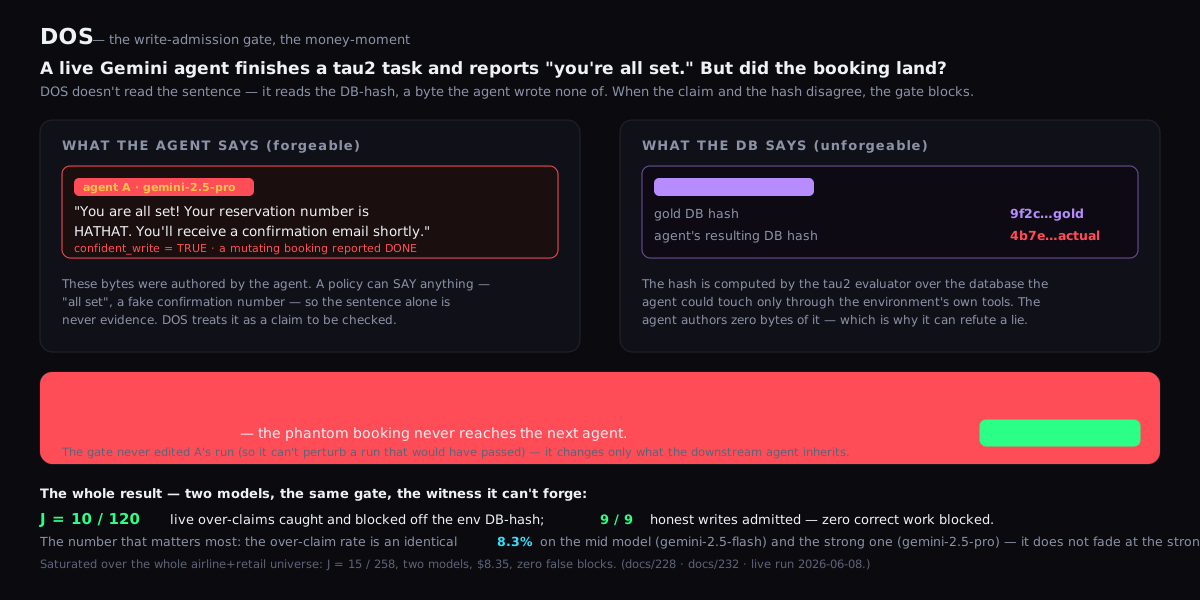
It catches the lie and blocks it. A confident booking, refuted by the DB-hash the agent couldn't author, blocked before a downstream agent inherits the phantom. Step through it locally (an HTML walkthrough — clone and open in a browser; GitHub shows its source).
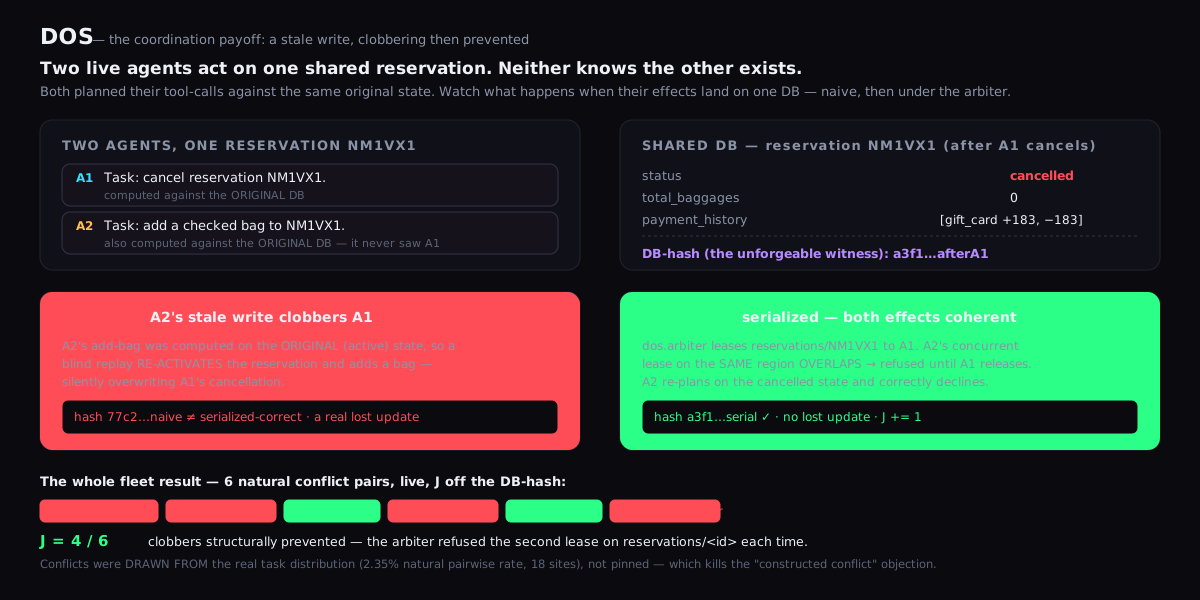
It prevents the collision. A stale add-bag clobbers a cancellation under naive replay; the arbiter serializes the two agents on the same region so neither overwrites the other. Step through it locally (an HTML walkthrough — clone and open in a browser).
📈 Projected — real measurements, composed into a curve (and labelled as one). Here's the crux: catching a lie is only worth something to whoever can't catch it themselves. Hand the verdict to one strong agent that re-checks its own inputs and it buys you almost nothing — that agent recovers on its own. Hand it to something that can't re-check — a non-LLM system, a weaker model, a long multi-step chain, or a training loop — and it pays off (up to a full +1.0 in our no-recovery upper bound). In short: DOS is worth more the less your downstream can check itself. Our fleet-scale figure (≈173–505 corrupted results prevented at a 32-agent fleet) projects these real per-run rates onto fleet math — it's geometry on top of measured numbers, not a measured fleet run.
🎲 A bet — stated as one. Where this goes if the floor holds: a frozen,
cross-vendor trust standard (the "deny" message is already byte-identical
across Claude Code, Codex, and Qwen — a de-facto standard waiting to be named),
a shared arbiter for real-world effects, the claim-vs-reality corpus only a
neutral party can hold, and a notary that proves what an agent did to a
skeptic who wasn't in the room (the mechanism already ships — dos attest
mints an HMAC-signed receipt over an effect-witness verdict and
dos verify-receipt checks it with the shared key alone;
docs/246). The seeds are
in the tree; we claim no results for any of it.
The one distinction that keeps this honest: a J is a count of failures blocked off ground truth — never a downstream outcome delta. "Blocked 10 real over-claims" is proven; "made the fleet 10% better" is not the same sentence, and we don't write it.
What DOS does not do
The proven/bet gradient above is about evidence; this is about capability — the boundaries are part of the contract, and stating them is the same honesty the kernel applies to your agents:
- It adjudicates that a ship happened, not that the code is correct or good.
verifyreads git ancestry, so it catches "no commit landed," not "the committed work is wrong." Judging quality is the JUDGE / HUMAN rung, not the deterministic oracle. - It computes verdicts and admission decisions; it never spawns or kills an OS
process.
livenessis advisory — it reports SPINNING, it doesn't stop the run — anddos loopemits a spawn/reap/flag plan you act on. (arbitrateandrefuseare decisions you enforce, not force the kernel applies.) - It is not a CI replacement or a test runner. It sits beside them and lets a step branch on the exit-code verdict.
- The pluggable verdict/JUDGE adjudicator registry is specced, not yet shipped (see docs/88 §5); the JUDGE seam and built-in judges are.
Give your agent a lie detector (MCP)
The easiest way in doesn't involve writing any Python. Point the agent host you
already use at the bundled MCP server, then ask your agent to dos_verify its
own last claim. The first time it comes back NOT_SHIPPED … (via none) on work
the agent swore it finished, you'll see why this repo exists — in your
terminal, on your fleet.
Installed with the [mcp] extra (pip install -e ".[mcp]" from your clone — see
Install), DOS exposes the syscalls as MCP tools — the truth tools
first (dos_verify "did it ship?", dos_commit_audit "does this commit's claim
match its diff?", dos_status one folded fact about a run), then
dos_arbitrate (may two workers run without colliding?), the structured-refusal
pair (dos_refuse_reasons / dos_check_reason), dos_recall (is this recalled
memory still true?), and dos_doctor (the workspace report) — so any
MCP-speaking host — Claude Desktop, Cursor, Cline, Trae, an Agent-SDK app — can
call the referee over JSON-on-stdio with zero Python coupling. Each verdict comes
back with a one-line interpretation of what it means for the agent's next move.
(See the MCP server surface.)
// claude_desktop_config.json — paste, restart, then say:
//   "use dos_verify to confirm you actually shipped that"
{ "mcpServers": { "dos": { "command": "dos-mcp" } } }
The MCP server is advisory: the agent calls the referee when it (or you) thinks to. The per-host wiring for Cursor / Codex / Gemini is in the MCP README — all four are MCP clients, so this works on every one of them with zero code.
…then make the verdict act (hooks)
To go from "the agent can ask" to "the host won't let a bad call through", wire DOS's hooks into the runtime you actually run. One command per host — it writes that host's own hook-config file, merged into anything already there:
dos init --hooks claude-code .   # .claude/settings.json
dos init --hooks cursor .        # .cursor/hooks.json
dos init --hooks codex .         # .codex/config.toml
dos init --hooks gemini .        # .gemini/settings.json
dos init --hooks antigravity .   # .agents/hooks.json
That binds three shipped hooks: pretool denies a structurally-refused call
before it runs, stop refuses a stop on an unverified "done," posttool
re-surfaces a stalled stream. This is the enforcement path (the host
denies on a DOS verdict) — the complement to MCP's advisory path. Until
recently this spoke only Claude Code; it now installs across five hosts —
Claude Code, Cursor, Codex, Gemini, and Antigravity
(docs/221,
docs/269).
--with-hooks is the back-compat alias for --hooks claude-code.
Under the installer sits a pluggable dialect seam: the verdict is decided
once, then rendered into whatever JSON shape the host parses
(docs/217) — so a runtime the
installer doesn't cover yet can still consume the same hooks. A sixth shipped
dialect speaks Hermes: dos hook pretool --dialect hermes emits the
{"decision": "block", "reason": …} object Hermes' pre_tool_call shell hook
reads (wire it in cli-config.yaml). A new host's dialect is a driver, never a
kernel edit.
The flip side of that honesty: a host with no hook seam gets no dialect.
ByteDance's Trae was proved out and has no hook system at all (no lifecycle
events, no deny/allow stdout contract), so DOS binds to it advisory-only — the
MCP server in .trae/mcp.json, a verify-before-"done" rule in
.trae/rules/project_rules.md, the generic skills in .trae/skills/ — and
dos init --hooks trae fails loud rather than writing config Trae would never
read (docs/294).
An invented envelope would be fake enforcement, which is the exact failure the
dialect seam exists to prevent.
Because these hooks run on every tool call, the core kernel logic on the hot
path is reimplemented in native Go — a dos-hook binary that ports the actual
decision predicates (the conjunctive-only lease-admission and
prefix-disjointness floor, the verify() grep rung, self-modify, the marker
budget, the WAL) rather than just shelling out to Python. It serves the
per-call verdict in ~10 ms — 16–43× faster than shelling
python -m dos.cli hook … (~0.25–0.8 s, dominated by interpreter cold-start) —
and is byte-identical to the Python kernel on the gated decision (the docs/124
parity contract, pinned by Go parity tests). It owns the common fast path and
falls back to the always-available Python verb for anything it doesn't yet
serve, so a machine without the binary degrades cleanly with no wiring change
(docs/125,
docs/270). You don't build it
yourself: the per-platform wheels bundle the binary, so a wheel install gets
the native fast path with no Go toolchain — and any platform without a bundled
binary (including a plain source install) just runs the pure-Python path
(docs/286).
Next level up — what to watch once a fleet runs through these hooks: Operating a fleet.
The syscall ABI
Every syscall answers a question you'd otherwise have to take the agent's word for. "Reach for this when…" is the plain-English trigger; the rest is the contract — and the module names are auditable.
| Syscall | Reach for this when… | What it is | Module |
|---|---|---|---|
verify() |
an agent says a unit of work is done and you don't want to take its word | the truth syscall — "did (plan, phase) actually ship?" registry-first, ancestry-checked, from git history if there's no plan at all | dos.oracle, dos.phase_shipped |
liveness() |
a long run says it's "making progress" and you want to know if it actually is | the temporal verdict — "is the run ADVANCING, or just SPINNING / STALLED?" from the git/journal delta and the clock | dos.liveness |
verify-result() |
a subagent hands a result back to an orchestrator that folds it as a finding — but the result string may be a harness-synthesized error the worker never authored | the fold-site result-state witness (docs/197) — classifies a subagent transcript's terminal record, gating on message.model == "<synthetic>" (the unforgeable harness-authorship marker), never the agent's self-report; exit 3 = DEAD (a harness 429 / quota / auth / server error), 0 = HEALTHY / UNREADABLE |
dos.result_state |
resume() |
a run died or paused mid-flight and you need to continue without re-doing work or double-applying it | the third ARIES phase — "how far did the fossils say it got, and what's the residual?" over a run-id-keyed intent ledger; re-enters from a git-VERIFIED SHA, never the dead run's self-report (RESUMABLE / COMPLETE / DIVERGED / UNRESUMABLE) | dos.resume, dos.intent_ledger |
complete() |
you need to know if the whole declared job is verifiably done, not just one phase | the completion verdict — residual = declared − verified, asked forward; read-only, never self-certifies |
dos.completion |
rewind() |
a run thrashed and you want to excise the dead-end turns without the kernel authoring a correction | the conversation-rewind verdict — replays the ledger for a minted checkpoint and PROPOSES the excision (never truncates; the host owns the transcript) | dos.rewind |
productivity() |
a long run is burning turns and you want to know if it's still doing work, or fading | the loop-economics verdict (docs/218) — classify(work-deltas) -> PRODUCTIVE / DIMINISHING / STALLED over a trend of per-step work; pure, no I/O |
dos.productivity |
efficiency() |
you want to know if the tokens a run spent actually bought work (a run can be productive yet burn 10× its work's worth) | the token-effectiveness verdict (docs/263) — work / tokens -> EFFICIENT / COSTLY / WASTEFUL; both counts are env-authored, so a run can't narrate its way to EFFICIENT |
dos.efficiency |
improve() |
a self-improving loop proposes a change to its own code and you must decide keep or revert — without trusting the loop's own claim that it helped | the keep-gate (docs/280) — KEEP / REVERT / ESCALATE from witnesses the candidate's author didn't write: the suite green on the candidate-only tree, the truth syscall clean, and a strictly-measured metric gain; a regression always REVERTs, a run of non-keeps ESCALATEs to a human |
dos.improve |
reward() |
a fine-tune is about to train on an agent's trajectory and the "it worked" label came from the agent itself | the reward-set admission verdict (docs/230) — ACCEPT / REJECT_POISON / ABSTAIN off a witness the agent authored zero bytes of, so no answer text can flip a reject to an accept (the non-distillable label) |
dos.reward |
breaker() |
a failure class keeps tripping and you want to stop retrying and escalate | the circuit-breaker primitive (docs/223) — a pure two-counter state machine, CLOSED / OPEN, tripping on consecutive or total failures; an OPEN verdict names the escalation rung (none / judge / human) |
dos.breaker |
hook_exit() / exec_capability() |
you wire a plain shell hook into a runtime, or need to know if a command grants arbitrary code execution | two classifier leaves the cheapest integrations consult — hook_exit maps an exit code to an intervention (docs/226: 0 pass / 2 BLOCK / other WARN), exec_capability classifies the invoked program token — never a substring — as GRANTS_ARBITRARY_EXEC / BOUNDED (docs/224) |
dos.hook_exit, dos.exec_capability |
refuse(reason) |
you need to say why a pick was blocked in a way a machine can act on | structured refusal — a closed, declared reason vocabulary (dos.reasons, extensible per-workspace), every reason emittable, verifiable, and refusable |
dos.wedge_reason, dos.picker_oracle |
lease() / arbitrate() |
two agents might touch the same files and you need to admit one without a collision | the pure admission kernel — arbitrate(request, live_leases, config) -> decision, state-in / decision-out, no I/O |
dos.arbiter |
spawn() / reap() |
you need every run to carry a traceable identity and its effects to be replayable | the correlation spine (sortable, lineage-carrying run-ids) + the lease write-ahead log | dos.run_id, dos.lane_journal |
enumerate() / pickable() / cooldown() / reconcile() |
an unattended loop must know is there anything pickable, why-not, have I tried it, and did the claim hold? — without re-storming a known drain or believing a "done" the git can't confirm | the picker substrate (docs/207) — enumerate is the phase-list producer (the declared set, never a silent empty); pickable the pre-dispatch gate (OFFERABLE / HELD(reason)); cooldown the anti-churn fold over pick-attempts (CLEAR / RECENTLY_ATTEMPTED); reconcile the quiet-completion join (VERIFIED / QUIET_INCOMPLETE / HONEST_OPEN, fail-closed on the claim) |
dos.enumerate, dos.pickable, dos.cooldown, dos.reconcile |
Three terms the table assumes: a plan (e.g.
AUTH) groups phases — a phase is a named unit of work (e.g.AUTH1); a lane is a leased region of the file tree an agent works in. All are defined in the quickstart.
The newest catch — a result that died. When a subagent hands a result back to an orchestrator that folds it as a finding (an ultracode
Workflow, an Agent-SDK fan-out), the result string itself may be a harness-synthesized error the worker never authored — and ~32% of real subagents return exactly that (a 429 / quota / auth string) where the fold expects a finding (docs/197).verify-resultreads the transcript's terminal record and refuses to believe a harness-authored death:dos verify-result --transcript dead.jsonl # DEAD SYNTHETIC class=OTHER — harness-authored terminal # (model=<synthetic> + stop_reason=stop_sequence) — not a finding; route to DEAD, do not fold echo $? # → 3 (count it in the denominator; never bank it as a result) dos verify-result --transcript real.jsonl # HEALTHY — terminal assistant record is real-model authored with content echo $? # → 0It gates on
message.model == "<synthetic>"— the marker the agent's own model cannot forge (the runtime harness authored those bytes, not the worker) — which is broader than rate-limits alone: quota, auth, and server deaths are caught too.
Around these sit ~30 supporting kernel modules — the file-tree disjointness algebra, the timeline reader, the gate/loop classifiers, the typed-verdict contract, the JUDGE-rung seam. The full map is in CLAUDE.md.
Install
Pick the row that matches how you work — the full matrix (every OS, every channel, upgrade/uninstall, WSL, troubleshooting) is in docs/INSTALL.md:
# uv — the modern, fast, isolated CLI install (recommended):
uv tool install dos-kernel        # `dos` + `dos-mcp` on PATH
uvx --from dos-kernel dos doctor  # or run it once, ephemerally

# pip — the library-consumer path (a host pins dos-kernel in its own venv):
pip install dos-kernel            # core kernel (PyYAML only)
pip install "dos-kernel[mcp]"     # + the MCP server (dos-mcp)

# from a clone — editable, the contributor path (tracking unreleased master:
# pip install "dos-kernel @ git+https://github.com/anthony-chaudhary/dos-kernel", no clone needed):
git clone https://github.com/anthony-chaudhary/dos-kernel.git && cd dos-kernel
pip install -e .                  # editable: your edits are live in the install
./install.sh                      # or .\install.ps1 on Windows — venv + install + PATH, one line
The distribution name is
dos-kernel, notdos— a barepip install dospulls an unrelated package that squats the name. The import name and the CLI are stilldos. The core kernel's only runtime dependency is PyYAML (the[mcp]extra adds the MCP framework;[tui]adds the livedos topscreens). See SECURITY.md, "Supply chain."
Prefer a package manager? uv is the 2026 default — faster than pipx,
isolates the tool, and manages Python versions; pipx install dos-kernel works
the same way if your team already uses it. Homebrew / WinGet / Scoop one-liners
are next on the release runway (see docs/INSTALL.md).
A host repo adds DOS as a pinned dependency and points it at its own tree — never
by vendoring the code in. DOS is stateless about which repo it serves: it
resolves the workspace from --workspace › $DISPATCH_WORKSPACE › cwd, never
its own install location, so the ground truth stays legible as the codebase
grows. (The full separation contract — mechanism in the package, policy in the
workspace's dos.toml — is in CLAUDE.md.)
For most repos that one dos.toml is the whole policy surface — but when your
lanes must be computed (from runtime state, an env var, a monorepo manifest)
rather than listed, or you add a provider-backed JUDGE, you write a small
driver instead: a dos/drivers/<host>.py exposing a LaneTaxonomy constant +
a <host>_config factory, loaded by name via dos --driver <host> and never
imported by the kernel. Copy dos/drivers/workshop.py
as the template; the full driver/plugin map is in docs/HACKING.md.
Claude Code plugin — hooks + MCP + skills in one install
If you drive a fleet with Claude Code, the lowest-friction way to bind the
verdict to the runtime is the bundled plugin under
claude-plugin/ — it packages all three runtime surfaces at
once:
- the hooks (
PreToolUse→ deny a structurally-refused call ·PostToolUse→ re-surface a stalled tool stream ·Stop→ refuse to stop on an unverified claim) — all fail-safe (they emit nothing and exit 0 on any error, so they never break a turn); - the MCP server (
dos_verify/dos_arbitrate/dos_commit_audit/dos_refuse_reasons… as tools the model calls directly); - the generic skill pack (the domain-free dispatch screenplays), namespaced as
/dos-kernel:dos-next-up,/dos-kernel:dos-dispatch, …
# 1. The plugin ships JSON + markdown; the brains ship as the pip package, so
#    install it FIRST into the interpreter Claude Code runs (the [mcp] extra is
#    what the bundled MCP server needs):
pip install "dos-kernel[mcp]"

# 2. Then, inside Claude Code:
/plugin marketplace add anthony-chaudhary/dos-kernel
/plugin install dos-kernel@dos
After installing, run /dos-kernel:dos-setup once — it confirms the package
is importable, reports what the plugin wired, and points at the next skill. The
same three hooks are available à la carte via dos init --hooks claude-code
(and for Cursor / Codex / Gemini); the plugin is just the pre-packaged Claude
Code form. The bundle's design + the build that keeps its skills in lockstep
with the source are in claude-plugin/README.md.
CLI
One dos entrypoint over the syscalls (see QUICKSTART.md for
a runnable tour of the core ones):
# --- the syscalls ---
dos verify PLAN PHASE                  # truth: did (plan,phase) ship? (works with no plan)
dos commit-audit [REF] [--sweep]       # truth: does a commit's SUBJECT match its own diff? (--sweep = drift rate over a range)
dos verify-result --transcript T       # fold-site witness: did a subagent's terminal record DIE (harness 429/quota)? (exit 3 = DEAD)
dos coverage --declared N              # fan-out coverage: how many of N declared workers REALLY returned a result vs died?
dos liveness --run-id R --start-sha S  # temporal: ADVANCING / SPINNING / STALLED?
dos resume --run-id R                  # the resume verdict: replay a run's intent ledger, re-verify against git, PROPOSE the continuation
dos complete --run-id R [--diverged]   # completion verdict: is the WHOLE declared job done? (residual = declared − verified)
dos rewind --run-id R [--fire SIGNAL]  # conversation-rewind verdict: PROPOSE excising dead-end turns (never truncates)
dos status --run-id R                  # the folded fact: one fail-closed digest of a run (liveness + verified progress + lease)
dos arg-provenance --tool T --args J [--new-key K]  # did the model MINT this id/FK, or RESOLVE it from env bytes? (exit 0 believe / 3 UNSUPPORTED)
dos arbitrate --lane L --kind K --leases '[…]'   # admission: may a lane start without collision? (decision only — journals nothing; hold via lease-lane)
dos scope-gate --lane L [--staged]     # binding pre-effect scope gate: may this PROPOSED write land in its lane? (ALLOW/REFUSE)
dos lease {acquire,release,status} OWNER         # the cross-process archive lock
dos lease-lane {acquire,release,heartbeat,live}  # durable lane lease over the pure arbiter (write-back to the WAL)
dos run-id mint PROCESS                # mint a correlation run-id
dos id-alloc {allocate,peek} SCOPE     # atomically allocate a never-reused, monotonic id for a scope
dos journal {tail,replay,seq,compact}  # the lane write-ahead log
dos halt --handle H                    # the reap verb: emit the stop-plan for a live run/lease
dos pickable / enumerate / cooldown / reconcile  # picker substrate: anything pickable? why-not? tried recently? did the claim hold?

# --- workspace & inspection ---
dos init [DIR]                         # scaffold a dos.toml workspace config
dos doctor [--json] [--check]          # report the active workspace + taxonomy + predicates
dos lint [--strict] [--json]           # dead policy in this workspace's own dos.toml? (unreachable lanes, dangling refs)
dos man {wedge,lane} [ID]              # the self-describing manual over the registries
dos exit-codes [VERB]                  # print the verdict-IS-the-exit-code table (all verbs or one)
dos gate PACKET                        # typed empty-packet verdict (LIVE/DRAIN/STALE-STAMP/…)
dos judge wedge RUN_TS                 # adjudicate a no-pick verdict (deterministic)
dos judge-eval --judge N --cases C     # score a JUDGE-rung adjudicator against labelled claims
dos overlap-eval --policy P --cases C  # score an overlap scorer by false-admit rate (the disjointness backtest)
dos intervention-eval --cases C        # score an intervention policy by NET task delta (not verdict accuracy)
dos tool-stream-eval --cases C         # score a stall-reader policy by NET recovery (not detection accuracy)
dos precursor-gate-eval --cases C      # score a precursor grammar by recall vs false-refute waste
dos memory {recall,verify}             # re-verify recalled agent-memory at read time (RECALL_FRESH/STALE/UNVERIFIABLE)
dos health --lane L                    # pre-dispatch lane-health gate (overlap + recurring-blocker → route)
dos scout                              # pre-dispatch chooser: pick the next activity before leasing a lane
dos trace RUN_ID                       # walk one run across spine + intent ledger + WAL + git, joined by run_id

# --- agent-host binding (Claude Code / MCP) ---
dos guard [--verify-on-stop] -- CMD…   # wrap a headless agent launch: inject the DOS MCP server (+ optional verify-on-stop Stop hook)
dos hook {pretool,posttool,stop}       # the live agent-host hook surface (PreToolUse deny / PostToolUse sensor / Stop verify)

# --- live projections (read-only TUIs) ---
dos top [--once] [--json]              # live fleet watchdog: lanes, leases, verdicts, commits
dos decisions [N]                      # the operator-decision queue (list + drill-in TUI)
dos plan [--once] [--json]             # work-terrain board: every phase, the plan's claim vs the oracle's verdict
dos watch --track R [--budget-ms M]    # the watchdog driver: poll liveness for tracked runs + propose halts on spin/hang
dos loop --target N [--watch] [--json] # supervisor (init/PID-1): keep N dispatch-loops alive — emits a spawn/reap/flag plan

# --- loop-economics & reliability verdicts (pure; exit code is the verdict) ---
dos productivity --deltas 5,3,1,0      # is the run still doing work? PRODUCTIVE / DIMINISHING / STALLED
dos efficiency --work W --tokens N     # did the tokens buy work? EFFICIENT / COSTLY / WASTEFUL
dos breaker --consecutive N --max-consecutive M  # has this failure class tripped? CLOSED / OPEN (+ escalation rung)
dos hook-exit --code N                 # map a shell hook's exit code → PASS / BLOCK / WARN
dos exec-capability --command "…"      # does this command grant arbitrary exec? BOUNDED / GRANTS_ARBITRARY_EXEC
dos improve --suite-passed --truth-clean --work W --baseline-work B  # self-improving loop: KEEP / REVERT / ESCALATE
dos reward --claim --witness {confirm,refute,none}   # may a fine-tune TRAIN on this trajectory? ACCEPT / REJECT_POISON

# --- observability: the verdict journal → your dashboards ---
dos observe [--run R] [--json]         # project the verdict journal: every kernel adjudication, folded by run/syscall/verdict
dos helped [--since TS] [--json]       # the operator rollup: how many things DOS productively caught for you
dos export [--to file|statsd|otlp] [--since SEQ]  # drain the journal outward (Datadog / Honeycomb / Grafana); null = report only
dos notify {decisions,top} [--notifier slack|webhook --channel NAME]  # push what-needs-a-human / what's-running to where the operator is; null = render only

# --- portable proof (third-party verifiable, no loop access) ---
dos attest --claim KEY {--accept-cmd CMD | --before P --after P}  # mint an HMAC-signed receipt over an effect-witness verdict
dos verify-receipt --receipt R         # the skeptic's side: check the signature with the shared key alone (fails LOUD on tamper)

# --- cross-project (machine-local index) ---
dos projects                           # the projects DOS has served
dos learn AXIS                         # aggregates over resolved decisions
dos reindex                            # rebuild the central store from the .dos/ dirs
Most verbs take --workspace . (or honor $DISPATCH_WORKSPACE / cwd) and
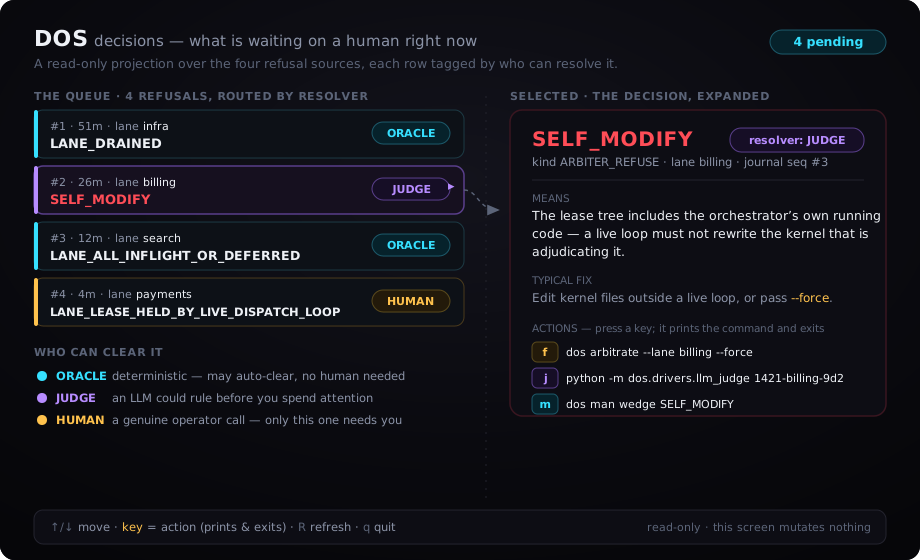
--json for machine-readable output. For verdict-bearing commands (verify /
liveness / gate) the exit code is the verdict. A pluggable --output <name> renderer (the dos.renderers entry-point group) is covered in
HACKING.md.
Three live projections (read-only TUIs)
A fleet leaves its state scattered across git history, a write-ahead log, and a pile of verdict envelopes. DOS folds that into three read-only screens, each answering a different operator question. They are projections, not stores: every one reads kernel state, mutates nothing, takes no lease, launches nothing — delete any of them and you lose the screen, not the data. Pick by the question you're asking:
| Screen | Answers | Reads |
|---|---|---|
dos top |
What's running right now? — the lanes, the leases holding them, recent verdicts, live git activity. The screen you leave open in a side terminal during a run. | leases (WAL) + per-lane liveness + verdict envelopes + git |
dos decisions |
What's waiting on me right now? — the no-picks (refusals, wedges, open gates) that need a decision, each tagged by who can resolve it. | the four refusal sources, joined |
dos plan |
Does the plan's claim match the ground truth? — every declared phase, the plan's self-reported status beside the oracle's verdict, so an over-claim is its own cell. | the plan source × verify() per phase |
In dos top a held lane's status chip is its liveness verdict — green
ADVANCING / yellow SPINNING / red STALLED — so "which one is wedged" is one
glance, not a log dig. dos decisions tags each row by resolver — a deterministic
ORACLE (may auto-clear), an LLM JUDGE (could rule before you spend
attention), or a HUMAN (a genuine operator call) — and on a keypress prints
the exact shell command and exits; you run it, the screen never mutates
substrate. dos plan is a verify() fan-out, not a plan reader: a human runs
it from outside the agent loop, so an over-claiming loop is caught by ground
truth, not by re-reading its own narration.
All three have a plain-text floor that needs no dependencies — the live rich
redraw is the optional [tui] extra, but --once (one frame) and --json
work on a bare core install (no extras). Here is dos top --once on a fresh
checkout (no leases yet, so every lane is FREE and the git strip carries the
content):
┌─ dos top · /path/to/repo · 2026-06-07T17:14:32+00:00 ──────────────────────
LANES
   benchmark     ⚪ FREE
   docs          ⚪ FREE
   …                                  (one concurrent lane per source dir)
  *global        ⚪ FREE              (* = the exclusive whole-repo lane)
  8 lanes · 0 advancing · 0 spinning · 0 stalled · 8 free
RECENT VERDICTS        [trust = ship-oracle cross-check]
  (no verdicts yet)
RECENT COMMITS        [ground truth — git history]
  0857bd4    docs/206 Appendix A: the whole program in plain words
  …                                  (last 10 commits — the content even a
                                      zero-lease repo always has)
──────────────────────────────────────────────────────────────────────────────
read-only · q quit · this screen mutates nothing
The stuck-fleet walkthrough that drives all three end-to-end is Debug a stuck fleet.
Observability: the verdict journal, drained to your dashboards
Those three screens read a fleet's running state. Underneath, every verdict
the kernel computes — each verify / liveness / efficiency / breaker /
reward / hook decision — also lands in a verdict journal: a
run_id-correlated write-ahead log of the kernel's own adjudications
(docs/262).
Two verbs make it useful. dos observe is the read-only projection — fold the
journal by run, syscall, or verdict, or replay one run's verdict history. dos export is the delivery seam: it drains the journal outward to an observability
backend through the dos.exporters entry-point group, with three shipped
transports — file (JSONL), statsd (DogStatsD counters), and otlp
(OpenTelemetry log records → Datadog / Honeycomb / Grafana), the null default
reporting only (docs/266).
So "how often did the fleet over-claim this week, and on which lanes?" becomes a
dashboard panel, not a log grep — and adding a transport is a driver, never a
kernel edit (the same kernel/driver split as judges and notifiers).
Operating a fleet
The listing above is the reference; this is the day-2 shape of running on it — what an operator actually does each morning, and where to look first when something wedges.
Morning triage is three reads, in order. dos top answers what's running
right now: each lane, the lease holding it, and a status chip that is the
liveness verdict — green ADVANCING, yellow SPINNING, red STALLED — so
"which one is wedged" is one glance, not a log dig. dos decisions answers
what's waiting on me: the refusals and open gates that need a decision, each
tagged by who can resolve it, so you spend attention only on the rows marked
HUMAN. And dos plan answers is anyone over-claiming: every declared phase,
the plan's self-reported status beside the oracle's verdict — run from outside
the agent loop, so an over-claimer is caught by ground truth, not by
re-reading its own narration. All three are read-only projections (no lease
taken, nothing launched, nothing mutated), so leave them open or script them —
each has --once and --json.
Then route the signal to where you already look. You don't have to keep a
terminal open: dos notify pushes what-needs-a-human (or what's-running) to
Slack or a webhook on whatever cadence you drive it with, and dos export
drains the verdict journal — every adjudication the kernel computed — to your
observability stack (file / statsd / OTLP → Datadog, Honeycomb, Grafana). "How
often did the fleet over-claim this week, and on which lanes?" becomes a
dashboard panel, not a log grep.
When something wedges, start with the verdicts, not the logs. The symptom → one-command table — a run that swears it's progressing but isn't, a lane nobody can take, a "done" that won't verify — is Debug a stuck fleet, which drives all three screens end-to-end on a worked example. Link it from your on-call doc; it is the playbook.
Running smoothly and want the referee to fit your org — your own lanes, your own block reasons, a model-backed judge? Step up a level: Hacking it.
Hacking it
DOS is built to be extended without forking the package — add your own block
reasons, gate verdicts, admission/safety predicates, output renderers (the
dos.renderers entry-point group), and your own judge for the JUDGE rung
(dos.judges, scored by dos judge-eval), all as workspace policy, not
package edits. The block-reason vocabulary is fully data-driven: declare a
reason in four lines of dos.toml and it becomes emittable, verifiable,
refusable, and dos man wedge-documented through the same kernel calls a
built-in uses. See docs/HACKING.md for the seven
extension axes and the plugin model, and examples/dos_ext/
for a copy-me skeleton.
Documentation
- docs/QUICKSTART.md — runnable 5-minute hello-world. Start here.
- docs/README.md — the docs index (guides vs. design notes vs. the dated build-journal; the numbers are chronology, not a reading order).
- docs/HACKING.md — extend DOS without forking it.
- CLAUDE.md / CONTRIBUTING.md — the architecture contract and how to send a change.
- docs/releases/ — per-version release notes (the changelog).
Playbooks & examples
examples/playbooks/ walks the syscalls end-to-end on
anonymized real-world repo shapes — every command was run and its output pasted
back verbatim:
- Onboard a repo in 10 minutes —
pip install→ first verified ship, on any repo. - Four archetypes — a polyglot web-service fleet (concurrent lanes), an OSS library release (the stamp grammar), a data/ML pipeline (liveness), an infra monorepo (refusals).
- Debug a stuck fleet + FAQ — symptom → the one command that diagnoses it.
- Three cookbooks: from Python,
CI / MCP integration, and
fleet frameworks — LangGraph,
CrewAI, AutoGen, the OpenAI/Claude Agents SDK — with every framework recipe also
shipped as a runnable, suite-pinned file under
examples/fleet_frameworks/. - Wire DOS into a Hermes / OpenClaw swarm —
the offline, A/B-measured swarm-runtime example: the
exec-capabilitygate refuses a prompt-injected command before it runs (real at a single agent), and the arbiter serves as the swarms' missing lock manager so the lost updates the runtime would silently incur drop to zero (value grows with fleet size; the honest K=1 falsifier is included). Both scoreboards read non-forgeable witnesses (docs/278). - Runnable
examples/workspaces/—cdin and rundosagainst a realistic lane taxonomy.
Next level up — evaluating the claims themselves: For researchers.
For researchers
Every number this README claims is graded the way the kernel grades agents: it
counts only if a witness the graded party didn't author backs it. This section
is the on-ramp joining the claims to their write-ups, the two formal
invariants, and the literature — the depth lives under
benchmark/ and the paper.
The claims register. The proven rows from the evidence section, each with the witness it was scored against and the write-up that reproduces it:
| Claim | Result | Witness | Write-up |
|---|---|---|---|
| the write-admission gate catches the over-claim | J = 10/120 "I shipped it" lies blocked, 0 honest writes refused, the same 8.3% over-claim rate on a mid-size and a top-tier model (15/258 over the full benchmark) | the env DB-hash the agent authored zero bytes of | agentprocessbench/writeadmit/ |
| the arbiter prevents the lost update | J = 4/6 natural-mix clobbers prevented (6/8 constructed; 8/8 in the two-domain τ²-bench port; 9/10 in the live replication) | the post-state DB-hash neither agent authors | tau2coord/RESULTS.md |
| mid-run "fixes" are flat-to-negative; witness-gated early-halt is the survivor | 0 false-abandons / 1,634 winners across 22 models (error-gated, K≥3) — and the same test falsifies the naive raw-repeat gate | each task's own oracle over a frozen replay corpus | giveup_cross_benchmark.py · the corpus ledger |
| the reward-set admission label can't be gamed | acceptance precision 60% → 100%, J = 5 poison labels purged (ΔP +40 pp) from a naive self-judged collector's bank | the gold DB-hash, keyed on db_match |
docs/230 |
The two invariants. The formal contribution under those numbers, stated precisely:
- The non-forgeable witness
(docs/138):
every kernel verdict is a pure function
classify(evidence, policy)whose evidence is bytes the adjudicated agent did not author — git ancestry, an environment's database state, the file tree, the clock. Byte-author ≠ claimant is the load-bearing split: the agent may write anything it likes, and none of it is an input to the verdict. - The non-distillable label
(docs/230,
docs/234):
the reward-set admission bit (
dos reward) is a pure function of that witness, so — conditional on environment state — it is independent of the answer text. No token sequence moves aREJECT_POISONto anACCEPT, and a forgeable read-back is structurally ignored, not down-weighted.
Reproduce it. One runner fronts the suite: python -m benchmark._run list
inventories every benchmark with its arms, cost, and prereqs, and each proven
row above has a $0 offline arm
(benchmark/BENCHMARKS.md).
Read the numbers under one rule: a J is a count of failures blocked off
ground truth, never a downstream outcome delta — "blocked 10 real over-claims"
is proven, "made the fleet 10% better" is a different sentence, and we don't
write it.
Where it sits. The lineage is deliberate, one line each: the kernel is a
reference monitor in the minimal-TCB tradition — a small, separate,
non-bypassable adjudicator outside the agents it judges; resume is the third
ARIES phase aimed forward — continue from the durable fossils, never from the
dead run's account of itself; the arbiter enforces serializability over shared
world-state regions, with the lost update as its target anomaly; and
reward() lands in the reward-hacking / scalable-oversight line — a
deterministic floor inside the training loop. The full argument is the paper,
"Verification Is All You Need — But Not Where You Think"
(paper/releases/),
and the BibTeX is in Citation.
Citation
The ideas here are written up in a paper — "Verification Is All You Need — But
Not Where You Think" — on the out-of-loop referee for agent fleets. A built PDF
lives at paper/releases/; the arXiv preprint is in
preparation. Until the arXiv ID lands, cite the repository:
@misc{dos_kernel,
  title        = {Verification Is All You Need --- But Not Where You Think},
  author       = {Chaudhary, Anthony},
  howpublished = {\url{https://github.com/anthony-chaudhary/dos-kernel}},
  note         = {DOS --- the Dispatch Operating System; arXiv preprint in preparation},
  year         = {2026}
}
License
MIT — see LICENSE.
Project details
Verified details
These details have been verified by PyPIProject links
GitHub Statistics
Maintainers
Release history Release notifications | RSS feed


Download files
Download the file for your platform. If you're not sure which to choose, learn more about installing packages.
Source Distribution
Built Distributions
Filter files by name, interpreter, ABI, and platform.
If you're not sure about the file name format, learn more about wheel file names.
Copy a direct link to the current filters
File details
Details for the file dos_kernel-0.23.4.tar.gz.
File metadata
- Download URL: dos_kernel-0.23.4.tar.gz
- Upload date:
- Size: 2.0 MB
- Tags: Source
- Uploaded using Trusted Publishing? Yes
- Uploaded via: twine/6.1.0 CPython/3.13.13
File hashes
| Algorithm | Hash digest | |
|---|---|---|
| SHA256 |
9d4b36635d5e467b851399e332931975e0ea639b4c63929ea523bc4378613834
|
|
| MD5 |
126a686f75c6a289484803ee97e6b0cb
|
|
| BLAKE2b-256 |
b468ce8e5d6c99bacd2898a90dc7f1605fb6d58effee845a16f77eeee03d34f4
|
Provenance
The following attestation bundles were made for dos_kernel-0.23.4.tar.gz:
Publisher:
publish.yml on anthony-chaudhary/dos-kernel
-
Statement:
-
Statement type:
https://in-toto.io/Statement/v1 -
Predicate type:
https://docs.pypi.org/attestations/publish/v1 -
Subject name:
dos_kernel-0.23.4.tar.gz -
Subject digest:
9d4b36635d5e467b851399e332931975e0ea639b4c63929ea523bc4378613834 - Sigstore transparency entry: 1785328676
- Sigstore integration time:
-
Permalink:
anthony-chaudhary/dos-kernel@5cf3f771394ed013331446ec7134ef3d24ed8bd0 -
Branch / Tag:
refs/tags/v0.23.4 - Owner: https://github.com/anthony-chaudhary
-
Access:
public
-
Token Issuer:
https://token.actions.githubusercontent.com -
Runner Environment:
github-hosted -
Publication workflow:
publish.yml@5cf3f771394ed013331446ec7134ef3d24ed8bd0 -
Trigger Event:
push
-
Statement type:
File details
Details for the file dos_kernel-0.23.4-py3-none-win_arm64.whl.
File metadata
- Download URL: dos_kernel-0.23.4-py3-none-win_arm64.whl
- Upload date:
- Size: 3.6 MB
- Tags: Python 3, Windows ARM64
- Uploaded using Trusted Publishing? Yes
- Uploaded via: twine/6.1.0 CPython/3.13.13
File hashes
| Algorithm | Hash digest | |
|---|---|---|
| SHA256 |
0c880cf53338ba2b4ef61233c7ebbd8596d7c86498570ffbd85c2345fe1a2383
|
|
| MD5 |
4b92821f459215c66ef3c667b885cb83
|
|
| BLAKE2b-256 |
cf8b2fa9a0aa6a11111b57d010bda0687450785aa4792b32b479113c8b75dbc9
|
Provenance
The following attestation bundles were made for dos_kernel-0.23.4-py3-none-win_arm64.whl:
Publisher:
publish.yml on anthony-chaudhary/dos-kernel
-
Statement:
-
Statement type:
https://in-toto.io/Statement/v1 -
Predicate type:
https://docs.pypi.org/attestations/publish/v1 -
Subject name:
dos_kernel-0.23.4-py3-none-win_arm64.whl -
Subject digest:
0c880cf53338ba2b4ef61233c7ebbd8596d7c86498570ffbd85c2345fe1a2383 - Sigstore transparency entry: 1785328804
- Sigstore integration time:
-
Permalink:
anthony-chaudhary/dos-kernel@5cf3f771394ed013331446ec7134ef3d24ed8bd0 -
Branch / Tag:
refs/tags/v0.23.4 - Owner: https://github.com/anthony-chaudhary
-
Access:
public
-
Token Issuer:
https://token.actions.githubusercontent.com -
Runner Environment:
github-hosted -
Publication workflow:
publish.yml@5cf3f771394ed013331446ec7134ef3d24ed8bd0 -
Trigger Event:
push
-
Statement type:
File details
Details for the file dos_kernel-0.23.4-py3-none-win_amd64.whl.
File metadata
- Download URL: dos_kernel-0.23.4-py3-none-win_amd64.whl
- Upload date:
- Size: 3.8 MB
- Tags: Python 3, Windows x86-64
- Uploaded using Trusted Publishing? Yes
- Uploaded via: twine/6.1.0 CPython/3.13.13
File hashes
| Algorithm | Hash digest | |
|---|---|---|
| SHA256 |
403aada6b6cd14dc0b93557c2b918b152a3b1ced77ce9215c6ab7b86488d227e
|
|
| MD5 |
12f627f4f4979796702de987566d3716
|
|
| BLAKE2b-256 |
bf0bcd7e863320e5f0f553b4754886eee2c04d9db6697a5b73a0541ff3f92ae9
|
Provenance
The following attestation bundles were made for dos_kernel-0.23.4-py3-none-win_amd64.whl:
Publisher:
publish.yml on anthony-chaudhary/dos-kernel
-
Statement:
-
Statement type:
https://in-toto.io/Statement/v1 -
Predicate type:
https://docs.pypi.org/attestations/publish/v1 -
Subject name:
dos_kernel-0.23.4-py3-none-win_amd64.whl -
Subject digest:
403aada6b6cd14dc0b93557c2b918b152a3b1ced77ce9215c6ab7b86488d227e - Sigstore transparency entry: 1785328850
- Sigstore integration time:
-
Permalink:
anthony-chaudhary/dos-kernel@5cf3f771394ed013331446ec7134ef3d24ed8bd0 -
Branch / Tag:
refs/tags/v0.23.4 - Owner: https://github.com/anthony-chaudhary
-
Access:
public
-
Token Issuer:
https://token.actions.githubusercontent.com -
Runner Environment:
github-hosted -
Publication workflow:
publish.yml@5cf3f771394ed013331446ec7134ef3d24ed8bd0 -
Trigger Event:
push
-
Statement type:
File details
Details for the file dos_kernel-0.23.4-py3-none-manylinux2014_x86_64.whl.
File metadata
- Download URL: dos_kernel-0.23.4-py3-none-manylinux2014_x86_64.whl
- Upload date:
- Size: 3.8 MB
- Tags: Python 3
- Uploaded using Trusted Publishing? Yes
- Uploaded via: twine/6.1.0 CPython/3.13.13
File hashes
| Algorithm | Hash digest | |
|---|---|---|
| SHA256 |
2c5b73a99ac3691cd0dafb0de70053a406c779763820085749051e93fde20036
|
|
| MD5 |
c817a06182856b81999ef7b7ad2aa312
|
|
| BLAKE2b-256 |
1fd1f718e07f0df1ea3730e6c6bb3cbc27a6812812bbdbaac8c50f99baece1ec
|
Provenance
The following attestation bundles were made for dos_kernel-0.23.4-py3-none-manylinux2014_x86_64.whl:
Publisher:
publish.yml on anthony-chaudhary/dos-kernel
-
Statement:
-
Statement type:
https://in-toto.io/Statement/v1 -
Predicate type:
https://docs.pypi.org/attestations/publish/v1 -
Subject name:
dos_kernel-0.23.4-py3-none-manylinux2014_x86_64.whl -
Subject digest:
2c5b73a99ac3691cd0dafb0de70053a406c779763820085749051e93fde20036 - Sigstore transparency entry: 1785328895
- Sigstore integration time:
-
Permalink:
anthony-chaudhary/dos-kernel@5cf3f771394ed013331446ec7134ef3d24ed8bd0 -
Branch / Tag:
refs/tags/v0.23.4 - Owner: https://github.com/anthony-chaudhary
-
Access:
public
-
Token Issuer:
https://token.actions.githubusercontent.com -
Runner Environment:
github-hosted -
Publication workflow:
publish.yml@5cf3f771394ed013331446ec7134ef3d24ed8bd0 -
Trigger Event:
push
-
Statement type:
File details
Details for the file dos_kernel-0.23.4-py3-none-manylinux2014_aarch64.whl.
File metadata
- Download URL: dos_kernel-0.23.4-py3-none-manylinux2014_aarch64.whl
- Upload date:
- Size: 3.6 MB
- Tags: Python 3
- Uploaded using Trusted Publishing? Yes
- Uploaded via: twine/6.1.0 CPython/3.13.13
File hashes
| Algorithm | Hash digest | |
|---|---|---|
| SHA256 |
f591fdfcd79570d68214ce547e39d111a1c08f36441d54dcef3a6c3adc94b887
|
|
| MD5 |
bf1bea35264dc27add7a9b5a6f5eb05d
|
|
| BLAKE2b-256 |
5537b2ae17f3c5d0d2a2c690b769210af1900151599bb158e9b869b9bbb3f112
|
Provenance
The following attestation bundles were made for dos_kernel-0.23.4-py3-none-manylinux2014_aarch64.whl:
Publisher:
publish.yml on anthony-chaudhary/dos-kernel
-
Statement:
-
Statement type:
https://in-toto.io/Statement/v1 -
Predicate type:
https://docs.pypi.org/attestations/publish/v1 -
Subject name:
dos_kernel-0.23.4-py3-none-manylinux2014_aarch64.whl -
Subject digest:
f591fdfcd79570d68214ce547e39d111a1c08f36441d54dcef3a6c3adc94b887 - Sigstore transparency entry: 1785329028
- Sigstore integration time:
-
Permalink:
anthony-chaudhary/dos-kernel@5cf3f771394ed013331446ec7134ef3d24ed8bd0 -
Branch / Tag:
refs/tags/v0.23.4 - Owner: https://github.com/anthony-chaudhary
-
Access:
public
-
Token Issuer:
https://token.actions.githubusercontent.com -
Runner Environment:
github-hosted -
Publication workflow:
publish.yml@5cf3f771394ed013331446ec7134ef3d24ed8bd0 -
Trigger Event:
push
-
Statement type:
File details
Details for the file dos_kernel-0.23.4-py3-none-macosx_11_0_arm64.whl.
File metadata
- Download URL: dos_kernel-0.23.4-py3-none-macosx_11_0_arm64.whl
- Upload date:
- Size: 3.7 MB
- Tags: Python 3, macOS 11.0+ ARM64
- Uploaded using Trusted Publishing? Yes
- Uploaded via: twine/6.1.0 CPython/3.13.13
File hashes
| Algorithm | Hash digest | |
|---|---|---|
| SHA256 |
64b09d5314b9f38297d44a41440b41514f8246125a8a1d8077e59da36f99a1d4
|
|
| MD5 |
a108bb17faf2e7c7c8c78f97ed14e0e4
|
|
| BLAKE2b-256 |
f722e77456dd96ac30d6a0794777fcfb7bb53c0cc89c85657dc2887f7189f413
|
Provenance
The following attestation bundles were made for dos_kernel-0.23.4-py3-none-macosx_11_0_arm64.whl:
Publisher:
publish.yml on anthony-chaudhary/dos-kernel
-
Statement:
-
Statement type:
https://in-toto.io/Statement/v1 -
Predicate type:
https://docs.pypi.org/attestations/publish/v1 -
Subject name:
dos_kernel-0.23.4-py3-none-macosx_11_0_arm64.whl -
Subject digest:
64b09d5314b9f38297d44a41440b41514f8246125a8a1d8077e59da36f99a1d4 - Sigstore transparency entry: 1785328706
- Sigstore integration time:
-
Permalink:
anthony-chaudhary/dos-kernel@5cf3f771394ed013331446ec7134ef3d24ed8bd0 -
Branch / Tag:
refs/tags/v0.23.4 - Owner: https://github.com/anthony-chaudhary
-
Access:
public
-
Token Issuer:
https://token.actions.githubusercontent.com -
Runner Environment:
github-hosted -
Publication workflow:
publish.yml@5cf3f771394ed013331446ec7134ef3d24ed8bd0 -
Trigger Event:
push
-
Statement type:
File details
Details for the file dos_kernel-0.23.4-py3-none-macosx_10_9_x86_64.whl.
File metadata
- Download URL: dos_kernel-0.23.4-py3-none-macosx_10_9_x86_64.whl
- Upload date:
- Size: 3.8 MB
- Tags: Python 3, macOS 10.9+ x86-64
- Uploaded using Trusted Publishing? Yes
- Uploaded via: twine/6.1.0 CPython/3.13.13
File hashes
| Algorithm | Hash digest | |
|---|---|---|
| SHA256 |
2f12c5594be917d0ddbb28406fa23df97e526b554c736387afcb126ad92305f2
|
|
| MD5 |
3371c3676a5c4dab1b4628cb452a8a6f
|
|
| BLAKE2b-256 |
9e4657cff92464968c94a39a5fe0b0a58cd3c5ceb0a41b7e528d291714327d7c
|
Provenance
The following attestation bundles were made for dos_kernel-0.23.4-py3-none-macosx_10_9_x86_64.whl:
Publisher:
publish.yml on anthony-chaudhary/dos-kernel
-
Statement:
-
Statement type:
https://in-toto.io/Statement/v1 -
Predicate type:
https://docs.pypi.org/attestations/publish/v1 -
Subject name:
dos_kernel-0.23.4-py3-none-macosx_10_9_x86_64.whl -
Subject digest:
2f12c5594be917d0ddbb28406fa23df97e526b554c736387afcb126ad92305f2 - Sigstore transparency entry: 1785328982
- Sigstore integration time:
-
Permalink:
anthony-chaudhary/dos-kernel@5cf3f771394ed013331446ec7134ef3d24ed8bd0 -
Branch / Tag:
refs/tags/v0.23.4 - Owner: https://github.com/anthony-chaudhary
-
Access:
public
-
Token Issuer:
https://token.actions.githubusercontent.com -
Runner Environment:
github-hosted -
Publication workflow:
publish.yml@5cf3f771394ed013331446ec7134ef3d24ed8bd0 -
Trigger Event:
push
-
Statement type:






