
DPBench
A benchmark for evaluating coordination in multi-agent LLM systems under simultaneous resource contention.



Overview
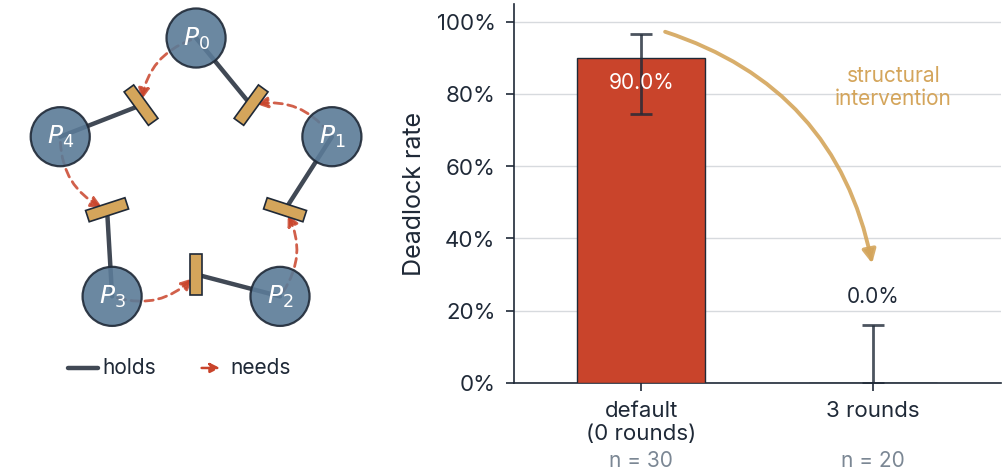
DPBench adapts the Dining Philosophers problem into a controlled testbed where the action protocol, the communication structure, and the group size each vary independently. Each episode reports four metrics (deadlock rate, throughput, fairness, message-action consistency) with Wilson and t-based 95% confidence intervals. On a single model, the benchmark captures what changes when the protocol changes.
Read the full paper on arXiv.
Installation
pip install dpbench
Optional provider extras for the example experiments:
pip install "dpbench[openai]"
pip install "dpbench[anthropic]"
pip install "dpbench[google]"
pip install "dpbench[xai]"
Quickstart
from dpbench import Benchmark

def my_model(system_prompt: str, user_prompt: str) -> str:
    """Your LLM call here. Returns the agent's response as a string."""
    ...

results = Benchmark.run(
    model_fn=my_model,
    system_prompt="...",
    decision_prompt="...",
    philosophers=5,
    episodes=30,
    mode="simultaneous",
    communication=False,
)

print(f"Deadlock rate: {results['deadlock_rate']:.1%}")
print(f"Throughput:    {results['avg_throughput']:.3f}")
print(f"Fairness:      {results['avg_fairness']:.3f}")
Prompt templates used in the paper are in experiments/prompts/. Full parameter documentation is in the Benchmark.run docstring.
Reproducing the paper experiments
git clone https://github.com/najmulhasan-code/dpbench.git
cd dpbench
pip install -e .

# Provider API keys for the LLMs you want to evaluate
cp .env.example .env

python experiments/scripts/run.py
python experiments/scripts/aggregate.py
python experiments/scripts/generate_figures.py
Experiments are configured by experiments/configs/conditions.yaml and experiments/configs/models.yaml.
Citation
If you use DPBench in your work, please cite:
@misc{hasan2026dpbenchstructuraldeterminantsmultiagent,
      title={DPBench: Structural Determinants of Multi-Agent LLM Coordination Under Simultaneous Resource Contention},
      author={Najmul Hasan and Prashanth BusiReddyGari},
      year={2026},
      eprint={2602.13255},
      archivePrefix={arXiv},
      primaryClass={cs.AI},
      url={https://arxiv.org/abs/2602.13255},
}
License
Licensed under the MIT License.
1 maintainer

Metadata
1 maintainer
Release files for dpbench 0.2.1
For a detailed explanation of source distributions (sdists) and built distributions (wheels), please see the package formats documentation.
Source distribution (sdist)
| File | Size | Uploaded | |
|---|---|---|---|
| dpbench-0.2.1.tar.gz | 28.9 kB | Details |
Built distribution (wheel)
| File | Interpreter | ABI | Platform | Reset |
|---|---|---|---|---|
| dpbench-0.2.1-py3-none-any.whl | Python 3 | none | any | Details |
Total release size: 59.5 kB
Release files / dpbench-0.2.1.tar.gz
| Download URL | dpbench-0.2.1.tar.gz |
|---|---|
| Size | 28.9 kB |
| Tags | Source |
|
SHA-256 checksum How to use checksums |
3687550fdbab32049cd4a2620f65d8a268152feeb792d96076becd679119b382
|
|
BLAKE2b-256 checksum How to use checksums |
0db20a654439ffaad0e61f09b36ee63b04dcd458049b932625a4ef29b793336a
|
| Upload date | |
|
Uploaded using Trusted Publishing? What is trusted publishing? |
No |
| Uploaded via |
twine/6.2.0 CPython/3.12.4
|
Release files / dpbench-0.2.1-py3-none-any.whl
| Download URL | dpbench-0.2.1-py3-none-any.whl |
|---|---|
| Size | 30.6 kB |
| Tags | Python 3 |
|
SHA-256 checksum How to use checksums |
f306e2f2f5769728bb73a3573c58eee03d750e375a1451dcae225e697b7dcb0b
|
|
BLAKE2b-256 checksum How to use checksums |
b1b2d41173734bb19dfeef5c7dd617d00bdb7f4f39a0bb821a55d2171714d471
|
| Upload date | |
|
Uploaded using Trusted Publishing? What is trusted publishing? |
No |
| Uploaded via |
twine/6.2.0 CPython/3.12.4
|














