
DRCinv — Audio Compression/Expansion Model-Based Inversion
DRCinv is a Python implementation of forward dynamic range compression and expansion, together with model-based inversion for audio signal reconstruction.
This repository accompanies the research work:
H. Sun, D. Fourer, and H. Maaref, “Hybrid Model-Driven Inversion of Audio Dynamic Range Compression and Expansion,” submitted to IEEE/ACM Transactions on Audio, Speech, and Language Processing, 2026.
Project page: https://hdrc-inv.github.io/ Source code: https://github.com/dfourer/DRCinv
Publication status: The project page describes the paper as submitted. Update the citation and add the DOI when the final bibliographic details are available.
Overview
Dynamic range compression and expansion are widely used to modify the amplitude dynamics of audio signals. DRCinv provides functions to simulate these processes and estimate the original signal from processed audio using a model-based inversion approach.
The implementation exposes two principal functions:
drc_forward: apply dynamic range compression or expansion.drc_inverse: estimate the original signal from the processed signal, given the model parameters.
Installation
Install from the project directory during development:
python -m pip install -e .
Once the drcinv distribution is published on PyPI, it can be installed with:
pip install drcinv
The package requires Python 3.10 or later, NumPy and SciPy.
Quick start
import numpy as np
from drcinv import drc_forward, drc_inverse

Fs = 44100
x = 0.1 * np.sin(2 * np.pi * 440 * np.arange(Fs) / Fs)

# [threshold (dBFS), ratio, envelope attack/release (s),
#  gain attack/release (s), detector order]
q = [-20, 4, 0.01, 0.1, 0.01, 0.1, 2]

# Compress and reconstruct
processed = drc_forward(x, Fs, q, mode="comp")
reconstructed = drc_inverse(processed, Fs, q, mode="comp")
The parameter vector is q = [L, R, tau_v_att, tau_v_rel, tau_g_att, tau_g_rel, p], where L is the threshold in dBFS, R is the ratio, the four tau values are time constants in seconds, and p is the detector order (1 for peak, 2 for RMS-like detection).
Set mode="comp" for downward compression or mode="exp" for downward expansion. The inverse function also supports the numerical solver option optim="hybr" (default) or optim="brentq".
Illustrations
The following plots reproduce the visual material linked from the project webpage. Image paths are relative to this README and assume that the corresponding PNG files are stored in docs/.
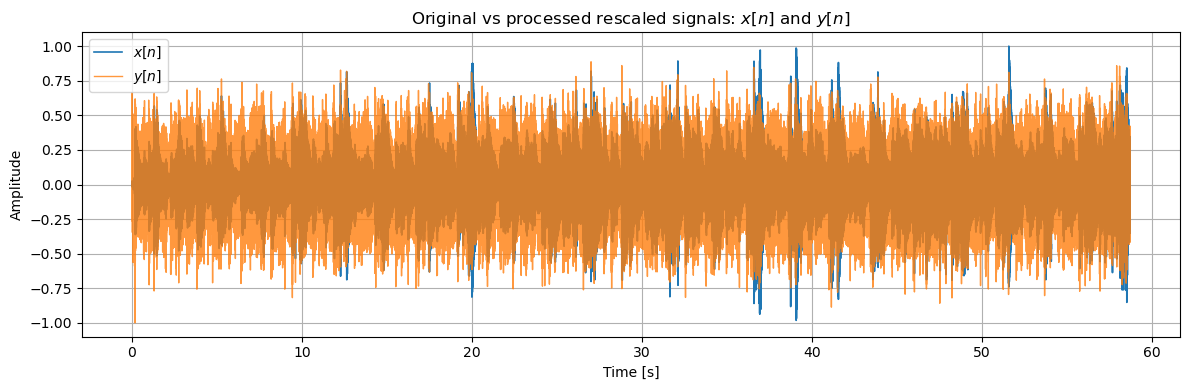
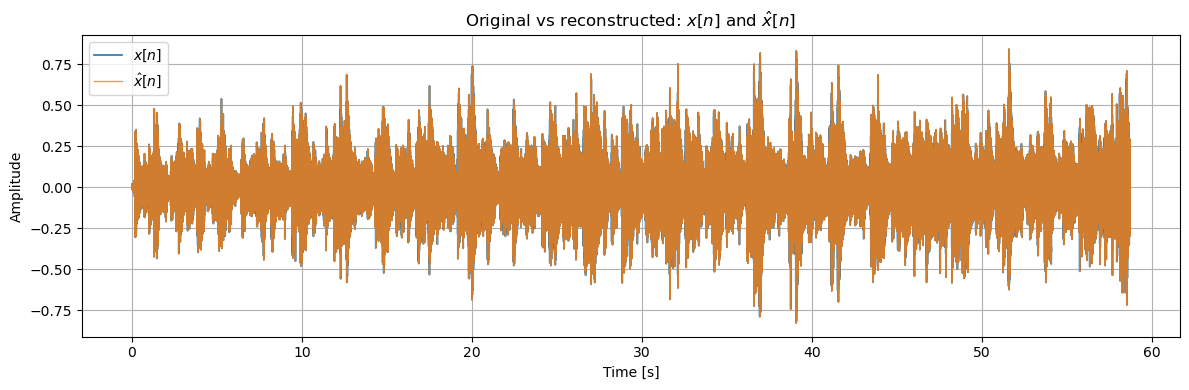
Compressor
Original vs. processed signal
Original vs. reconstructed signal
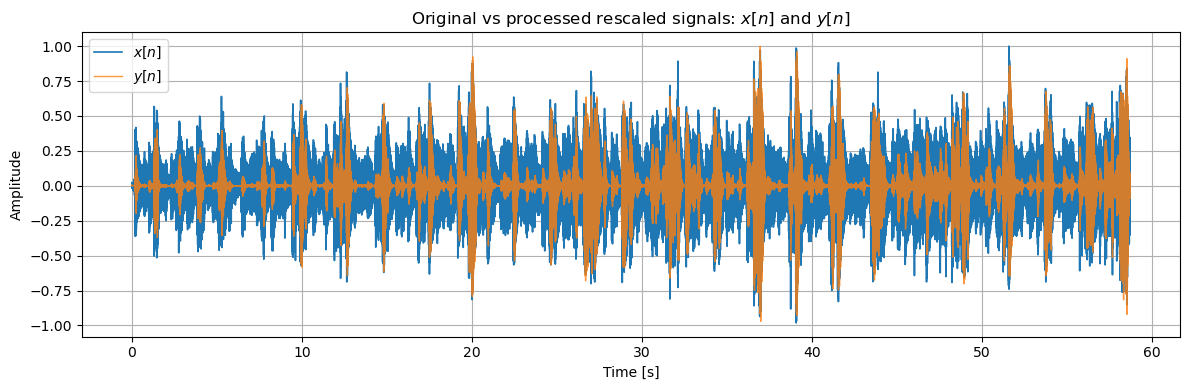
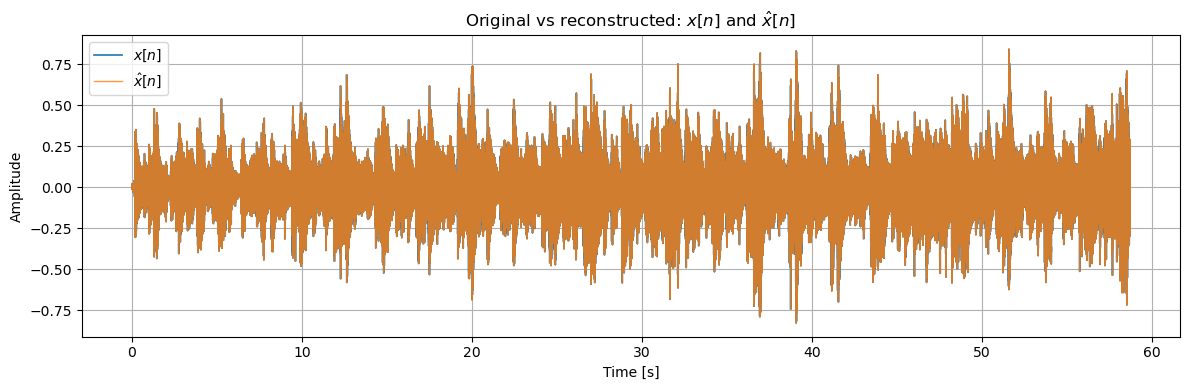
Expander
Original vs. processed signal
Original vs. reconstructed signal
Full audio demonstration
The repository includes examples/demo_drcinv.py, a complete audio example that reads examples/input.mp3, applies forward DRC, reconstructs the original signal, and evaluates reconstruction accuracy and processing speed.
Install the library locally and the dependencies required by the example:
python -m pip install -e .
python -m pip install soundfile matplotlib
Run from the repository root:
python examples/demo_drcinv.py
The example loads the MP3 relative to its own location, so it can find examples/input.mp3 regardless of the working directory. Stereo audio is converted to mono by averaging the channels. The code uses a peak-normalization helper for the listening files; the actual forward and inverse computations use the unnormalized signal.
Choose compression or expansion
At the beginning of examples/demo_drcinv.py, choose the processing mode and inverse solver:
mode = "exp"     # "comp" (compression) or "exp" (expansion)
optim = "hybr"   # "hybr" or "brentq"
The example defines separate parameter vectors for compression and expansion. The compression settings are:
q = [-45.0, 8.0, 0.001, 0.150, 0.0005, 0.200, 2]
The expansion settings are:
q = [-10.0, 4.0, 0.003, 0.050, 0.002, 0.080, 2]
Forward processing and reconstruction
The core of the example is:
from drcinv import drc_forward, drc_inverse

# x and Fs are loaded from the input audio file; q and mode are set above.
y = drc_forward(x, Fs, q, mode=mode)
x_rec = drc_inverse(y, Fs, q, mode=mode, optim=optim)

error = x - x_rec
print(f"Max error: {np.max(np.abs(error)):.3e}")
print(f"RMSE: {np.sqrt(np.mean(error**2)):.3e}")
Here x is the original audio, y the compressed or expanded audio, and x_rec the reconstructed signal. The full example also reports forward and inverse computation times, maximum and root-mean-square reconstruction errors, changes in RMS level, real-time factors (RTF), and inverse processing speed relative to real time.
Generated audio and figures
Running the demonstration writes the following listening files to the current working directory (where the command is launched):
x_listen_comp.wav,y_listen_comp.wav,x_rec_listen_comp.wavin compression mode;x_listen_exp.wav,y_listen_exp.wav,x_rec_listen_exp.wavin expansion mode.
It also saves individual plots for the original, processed, and reconstructed waveforms, plus comparisons between the original and reconstructed signals and between normalized original and processed signals. The comparison plots are saved as both PDF and PNG; the other plots are saved as PDF. The script calls plt.show() to display the figures interactively.
The PNGs under docs/ are the figures included in the Illustrations section above; the demonstration does not automatically write to docs/.
Automated tests
The demonstration is an executable example, not a pytest test. Automated tests belong in tests/test_drcinv.py and should contain functions named test_*:
python -m pip install -e ".[test]"
python -m pytest tests/ -v
Citation
If you use this software in academic work, please cite the associated paper. The following entry is provisional and should be updated after publication:
@article{sun2026drcinv,
  title   = {Hybrid Model-Driven Inversion of Audio Dynamic Range Compression and Expansion},
  author  = {Sun, H. and Fourer, D. and Maaref, H.},
  journal = {IEEE/ACM Transactions on Audio, Speech, and Language Processing},
  year    = {2026},
  note    = {Submitted manuscript}
}
License
See the LICENSE file for the terms applicable to this software. Ensure that the license file is included before public distribution.
Links
1 maintainer

Metadata
1 maintainer
Release files for drcinv 0.1.3
For a detailed explanation of source distributions (sdists) and built distributions (wheels), please see the package formats documentation.
Source distribution (sdist)
| File | Size | Uploaded | Provenance | |
|---|---|---|---|---|
| drcinv-0.1.3.tar.gz | 5.9 kB | Without provenance | Details |
Built distribution (wheel)
| File | Interpreter | ABI | Platform | Reset |
|---|---|---|---|---|
| drcinv-0.1.3-py3-none-any.whl | Python 3 | none | any | Details |
Total release size: 10.8 kB
Release files / drcinv-0.1.3.tar.gz
| Download URL | drcinv-0.1.3.tar.gz |
|---|---|
| Size | 5.9 kB |
| Tags | Source |
|
SHA-256 checksum How to use checksums |
f5cfe1ff5c59aa2cea4d0003664a472a6ac478f025c46a89de7c21c419579792
|
|
BLAKE2b-256 checksum How to use checksums |
effef51ee5ab8db49609b3026ef41a28cc754c8c84ad1891069d1396030b71e4
|
| Upload date | |
|
Uploaded using Trusted Publishing? What is trusted publishing? |
No |
| Uploaded via |
twine/7.0.0 CPython/3.12.3
|
Release files / drcinv-0.1.3-py3-none-any.whl
| Download URL | drcinv-0.1.3-py3-none-any.whl |
|---|---|
| Size | 4.8 kB |
| Tags | Python 3 |
|
SHA-256 checksum How to use checksums |
94dfc355935bd29de72f2b45e8fc82270e29717a4193d4db19ae8e4ed213c589
|
|
BLAKE2b-256 checksum How to use checksums |
f6e7030665a394cf4d2fea6cdbf1d9b5f19a24cfd40b2183817d6aba28fc6ff2
|
| Upload date | |
|
Uploaded using Trusted Publishing? What is trusted publishing? |
No |
| Uploaded via |
twine/7.0.0 CPython/3.12.3
|
Security for drcinv 0.1.3
Provenance
Provenance describes where a file came from. On PyPI, provenance is shared via attestations, which provide a verifiable record of the build or publishing details. View details, limitations and caveats.
No provenance found
None of the files in this release were uploaded with provenance metadata.
A note on package security
PyPI is a repository for distributing packages, not a service for auditing them. While third-party security researchers and our staff do their best to detect and remove malicious packages, PyPI cannot guarantee the quality, security or suitability of any given package.














