
Dreamer - self-evolving context for your coding agents
Get started · Feedback and pruning · Extensions · Blogpost
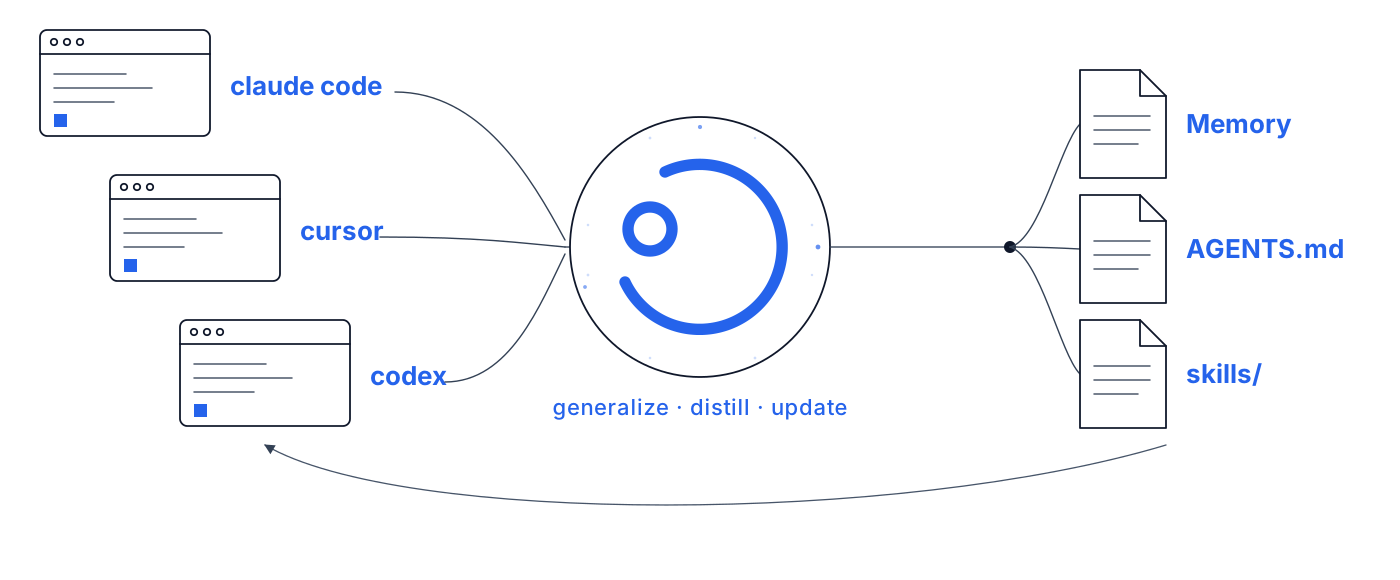
Dreamer keeps your team's AGENTS.md and skills up to date with what your
coding agents learn while they work. It runs as a self-hostable MCP server
that collects memories from every agent on the team and, on a schedule,
regenerates the context bundle the next session reads.
Team-wide memory. Memories from every agent on the team pool into a single store and feed a single context bundle, instead of staying on one workstation.
Any coding CLI. Anything that speaks MCP submits memories through the
same submit_memory tool, including Claude Code, Cursor, Codex, and custom
agents.
Extendible by config. STM store, LTM store, context store, dream engine,
auth, triggers, and hooks are Python Protocols wired up from YAML. Swap
any default by pointing at a different class.
Memory that prunes itself. Agents report whether context guidance held up in practice. Dreams reinforce confirmed entries and retire contradicted ones, archiving rather than deleting.
Dreamer is part of the broader LUML effort to build open infrastructure for autonomous ML agents.


Get started
Dreamer requires Python 3.12 or later. The defaults extra pulls in SQLite
for STM, the Claude Agent SDK for dreaming, APScheduler for cron triggers,
and gitpython for the post-dream commit hook.
pip install 'dreamer-server[defaults]'
Scaffold a project.
dreamer init
This writes a dreamer.yaml, a workspace/ with memory/ and context/
subdirectories, and a .gitignore that keeps the SQLite database out of
git.
Issue a token for your agents to send in the Authorization header.
dreamer-simple-auth token create --db ./dreamer.db --name my-token
Sanity-check the config. The loader resolves every component, runs the protocol-conformance check, and prints the wired graph and per-slot multi-tenancy table.
dreamer config check
Run the server.
dreamer serve
Point Claude Code or any MCP client over streamable-http at
http://localhost:8080/mcp/ with Authorization: Bearer <token>. The
server advertises a submit_memory tool whose accepted types come from your
config — out of the box observation, failure, and code_snippet — plus
the confirm_context and flag_context feedback tools described below.
Cron is the default trigger. To fire a one-shot dream from the command line:
dreamer dream --trigger external
Feedback and pruning
Generated context marks guidance derived from long-term memory with a
visible [mem: <slug>] marker and instructs agents to report back through
two MCP tools. confirm_context records that the guidance proved useful.
flag_context records that it proved wrong, with the observed evidence.
Flags may name target slugs, quote the misleading text, or carry neither.
Feedback goes through the same pipeline as submit_memory, but the dream
receives confirmations as a single aggregate report, and the scaffolded
threshold trigger excludes feedback types from its count. Feedback alone
does not trigger a dream.
Each dream applies a conservative policy. Evidenced flags outweigh missing
confirmations, and age is only a tiebreaker. A single flag weakens a
well-confirmed entry; corroborated flags supersede it. Retiring an entry
moves it to an archive/ subtree with retirement frontmatter, and every
decision is logged in archive/LOG.md.
The store enforces safety rails at commit time:
ltm_store:
  class: dreamer.contrib.ltm.markdown.MarkdownLTMStore
  params:
    root: ./workspace/memory
    max_autonomous_removals: 5   # archival moves are exempt
    enforce_pinned: true         # `importance: pinned` entries stay put
    on_guard_violation: fail     # or `warn`
A violating commit fails before any mutation and the batch returns to STM for the next run.
Extensions
Dreamer is config-assembled. dreamer.yaml wires module.path.ClassName
references into a component graph. Every slot sits behind a Python
Protocol defined in dreamer.api, including the STM store, the LTM
store, the context store, the dream engine, auth, triggers, and hooks. The
shipped defaults are chosen to get a team running in a few minutes, and
every one of them can be swapped.
stm_store:
  class: dreamer.contrib.stm.sqlite.SQLiteSTMStore
  params:
    path: ./data/stm.db

ltm_store:
  class: dreamer.contrib.ltm.markdown.MarkdownLTMStore
  params:
    root: ./workspace/memory

context_store:
  class: dreamer.contrib.context.markdown.MarkdownContextStore
  params:
    root: ./workspace/context

dream_engine:
  class: dreamer.contrib.dream.claude_agent.ClaudeAgentDreamEngine

triggers:
  - class: dreamer.contrib.triggers.cron.CronTrigger
    params:
      schedule: "0 */6 * * *"
To plug in your own component, write a class that satisfies the protocol. For example, a Postgres-backed STM store:
from typing import ClassVar
from dreamer.api.compat import implements
from dreamer.api.stores import STMStore

@implements(STMStore, version=1)
class PostgresSTMStore:
    multi_tenant: ClassVar[bool] = True

    def __init__(self, *, dsn: str) -> None:
        ...

    async def submit(self, memory, *, ctx): ...
    async def claim_batch(self, *, ctx): ...
Then reference it from dreamer.yaml:
stm_store:
  class: my_pkg.stores.PostgresSTMStore
  params:
    dsn: ${env:POSTGRES_DSN}
dreamer config check validates the protocol version, signatures,
parameter kinds, and capability requirements before the server boots. The
same shape of change covers a graph-backed long-term memory store, an OIDC
auth backend, or a Slack notification hook in place of the git commit.
dreamer.testing.conformance ships abstract pytest classes for each
protocol. The cases cover idempotency, lease isolation, expired-lease
reclamation, tenant-scope leakage, and the purge_consumed contract. Any
compliant implementation should pass them.
from dreamer.testing.conformance.stm_store import STMStoreConformance

class TestPostgresSTMStore(STMStoreConformance):
    @pytest.fixture
    async def store(self):
        return PostgresSTMStore(dsn="postgresql://...")
License
MIT. See LICENSE.
1 maintainer

Release files for dreamer-server 0.2.0
For a detailed explanation of source distributions (sdists) and built distributions (wheels), please see the package formats documentation.
Source distribution (sdist)
| File | Size | Uploaded | |
|---|---|---|---|
| dreamer_server-0.2.0.tar.gz | 247.2 kB | Details |
Built distribution (wheel)
| File | Interpreter | ABI | Platform | Reset |
|---|---|---|---|---|
| dreamer_server-0.2.0-py3-none-any.whl | Python 3 | none | any | Details |
Total release size: 399.8 kB
Release files / dreamer_server-0.2.0.tar.gz
| Download URL | dreamer_server-0.2.0.tar.gz |
|---|---|
| Size | 247.2 kB |
| Tags | Source |
|
SHA-256 checksum How to use checksums |
ba001769c01ad21bd7c567b8112fba2b082a101672fa7e8a5e7b7e4ac69ab238
|
|
BLAKE2b-256 checksum How to use checksums |
9bb8d95912ef3c378cf8fe7238382ccdb2231748c572d14c587138c496f10a4c
|
| Upload date | |
|
Uploaded using Trusted Publishing? What is trusted publishing? |
Yes |
| Uploaded via |
twine/6.1.0 CPython/3.13.12
|
Provenance
Provenance describes where a file came from. On PyPI, provenance is shared via attestations, which provide a verifiable record of the build or publishing details. View details, limitations and caveats.


PyPI Publish Attestation
PyPI verified that this artifact, at this checksum, originated from the publisher listed below.
Signed by GitHub Actions, verified by PyPI on Jul 12, 2026.
Transparency logRelease files / dreamer_server-0.2.0-py3-none-any.whl
| Download URL | dreamer_server-0.2.0-py3-none-any.whl |
|---|---|
| Size | 152.7 kB |
| Tags | Python 3 |
|
SHA-256 checksum How to use checksums |
727005446b0e6bf06ec11a0581c5c7898862c1239f067d767505c0fa50078b69
|
|
BLAKE2b-256 checksum How to use checksums |
8042ec2e951a9645505cbdbcf00e4ed695b77f6a2b862e9744acfd29ea881106
|
| Upload date | |
|
Uploaded using Trusted Publishing? What is trusted publishing? |
Yes |
| Uploaded via |
twine/6.1.0 CPython/3.13.12
|
Provenance
Provenance describes where a file came from. On PyPI, provenance is shared via attestations, which provide a verifiable record of the build or publishing details. View details, limitations and caveats.
PyPI Publish Attestation
PyPI verified that this artifact, at this checksum, originated from the publisher listed below.
Signed by GitHub Actions, verified by PyPI on Jul 12, 2026.
Transparency log













