
This release is a pre-release and may not be stable for production use.
Dream-RSI SDK · Beta
Bring your agent. Preserve verified quality. Account for every model request.
An independent, unofficial Python SDK inspired by Dream-RSI research. Maintained by TheAstrayDev, who is not a Google or Google DeepMind employee. This is a personal research initiative, not a commercial Google development, official SDK or endorsed product.
Python 3.11+ · zero core third-party dependencies · Apache-2.0 · version 0.3.0b2.
Install
python -m pip install --pre --upgrade dreamrsi==0.3.0b2
For a source checkout, install with python -m pip install -e ..
The package includes the Python API and the dreamrsi command. Publishing policy
packages to GitHub additionally requires GitHub CLI (gh).
What's new 0.3.0b2
Live Inspector makes recorded exploration visible in a local browser: animated active branches, node details, optional policy reasons, history playback and policy comparisons on recorded worlds. Pan, zoom and collapse branches; inspect raw quality and the preparation/application call ledger separately. Incomplete tokens and dollar usage stay unknown.
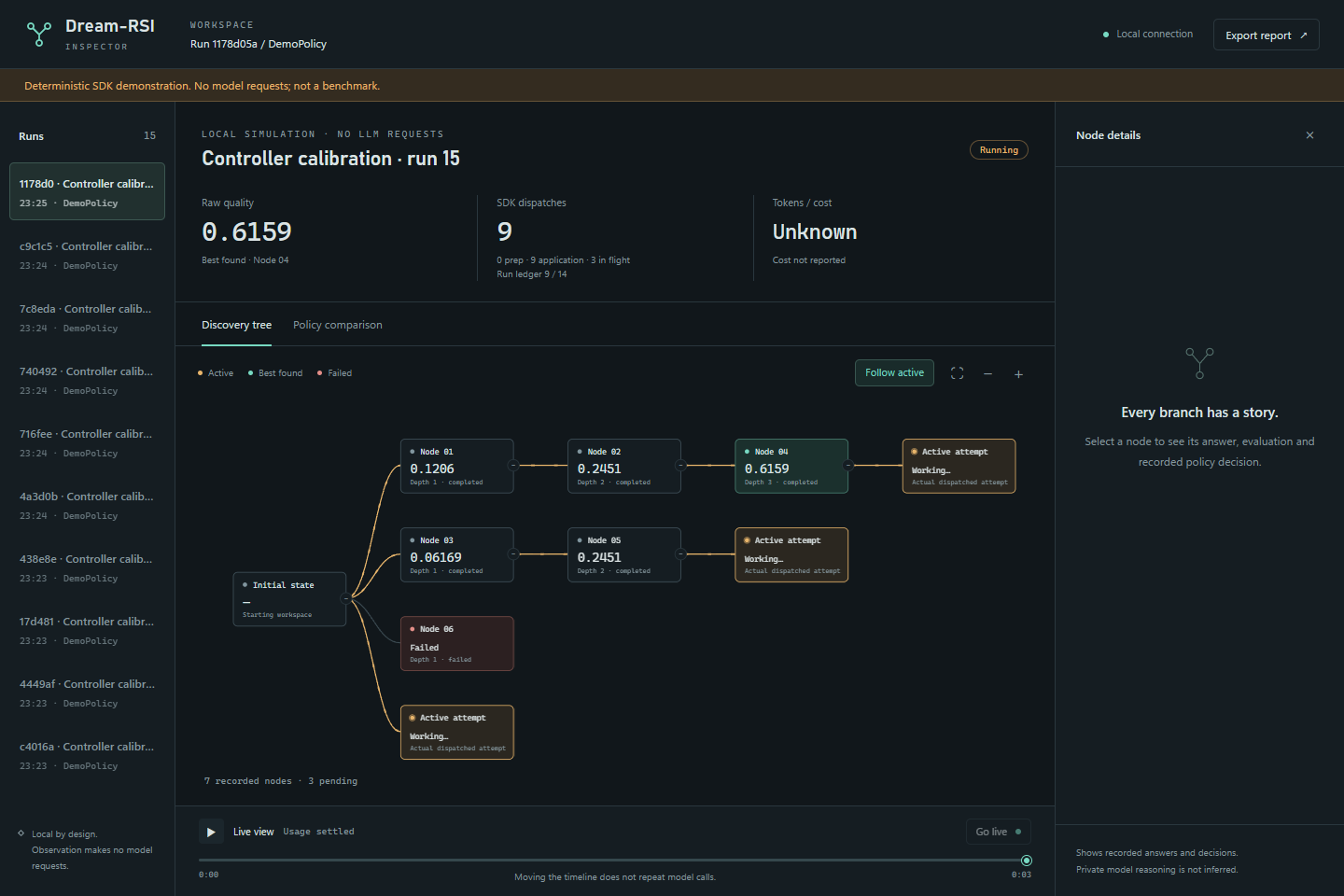
Try the interface without an API key:
dreamrsi watch --demo
The demonstration uses no LLM and is not a performance benchmark. Create a short runnable application and record your first tree:
dreamrsi init
python dreamrsi_app.py
dreamrsi watch
Replace the generated agent and evaluator with your integration. init refuses
to overwrite an existing file. Attach LiveInspector() to an existing runtime
with DreamRSI(..., inspector=inspector) and keep the context manager open during
execution. The observer uses a local SQLite journal and does not steer search.
Persistent policy memory remains a separate explicit integration.
dreamrsi doctor checks local setup; dreamrsi inspect FILE validates a policy/tree
bundle. result.report() prints a concise per-run summary. Export a selected run
as a self-contained HTML report with the viewer's Export report button or
dreamrsi watch --export report.html.
No hosting, Node.js, CDN or additional runtime dependency is required. The server
is read-only and binds to loopback. Capture can contain private task data; use
include_content=False when appropriate and review reports before sharing them.
Observer CPU/disk overhead can affect very tight time limits. The default
StrictReplay comparison makes no agent/evaluator calls; custom components keep
their own behavior. Comparisons do not promote policies or prove unseen-task quality.
See the Inspector guide, release notes and verification record. Existing quality protection and all-in accounting remain available below.
Quality protection and all-in accounting
QualityContract protects the supplied original policy's search and complete
batches. Stop only when the best valid raw quality exactly reaches a proven task
maximum. Unknown bounds continue the original search. The actual returned answer
is selected by raw quality rather than a work-penalized composite score.
from dreamrsi import Budget, DreamRSI, EconomyPlan, QualityContract

rsi = DreamRSI(
    agent=my_agent,
    evaluator=my_evaluator,
    policy=my_original_policy,
    budget=Budget(model_calls=4),
    quality=QualityContract(id="exact-quality-v1", upper_bound=1.0),
    economy=EconomyPlan(baseline_calls_per_task=4, horizon=6),
)
result = await rsi.run(task)
Replace these application integrations. Use 1.0 only when it is a sound global
bound for the feasible answer domain. Strict mode requires no policy training.
Custom raw-quality extractors, local task-bound functions and an evaluated initial
candidate are supported. Reference and SDK budgets and initial candidates must match.
Use an otherwise identical contract with certified_stopping=False for the full
reference, preserving quality metadata in both arms. The no-loss argument compares
the same response trajectory, not independent stochastic runs or different time cutoffs.
EconomyPlan recalculates preparation headroom from actual spending, historical
costs and the unfinished deployment floor before each request. Completed-task
counters survive recovery; measured strict payback uses actual deployment costs.
Purpose-tagged ledgers count reported
nested provider calls and failed requests. Unknown tokens/dollars remain unknown.
The economic target does not truncate quality-preserving fallback search.
The sandbox now has finite small, balanced and large presets and JSON profile
save/load. All supported language features remain enabled in each preset; individual
limits and allowlists are configurable. A bounded validated-code cache keeps fresh
execution state and checks. Local paired interpreter timings improved by 2.90x with
one frontier node and 1.41x with eight; these are not model-call savings.
from dreamrsi import PolicySandbox, SandboxConfig

sandbox = PolicySandbox.from_preset("large", max_steps=2_000_000)
SandboxConfig.preset("large").save("sandbox.json")
sandbox = PolicySandbox.from_file("sandbox.json")
Raw-quality callbacks receive isolated records. Built-in stores atomically reserve holdouts, and nested source policies retain their sandbox profile during recovery.
Existing applications retain empirical policy development without a quality
contract. Set preserve_policy=False explicitly to enable policy rewrites with
the contract. Holdout evidence does not prove universal no-loss transfer.
The public PolicyDeveloper protocol, versioned schema rejection, legacy bundle
checks and installed-wheel CLI/sandbox gates form the Beta integration surface.
Nested certified artifacts require 0.3.0b1 or newer. See the
Beta notes,
quality proof
and all-in guide.
Third-party policy and replay packages
Portable JSON bundles and GitHub-hosted package sharing transfer recorded experience. Community developers can distribute policy versions and recorded discovery trees; recipients import them into local SQLite memory with their own agent, quality metric, task-family contract and acceptance rules. These replay datasets contain observed search transitions, not model weights. Saved policies can avoid repeated development when they meet the recipient's quality floor; new tasks still run the recipient's agent.
dreamrsi list
dreamrsi install OWNER/REPOSITORY
dreamrsi save my-policy-pack --all
dreamrsi publish .dreamrsi/packages/exports/my-policy-pack.dreamrsi.json
Use a real package reference for OWNER/REPOSITORY. Export requires previously saved
memory; publication requires GitHub CLI and creates a public repository. See the
complete walkthrough
for the diagram, executable integration example, and compatibility requirements.
Basic agent integration
from dreamrsi import Budget, DreamRSI

rsi = DreamRSI(
    agent=lambda task: task.upper(),
    evaluator=lambda answer: float(len(answer)),
    budget=Budget(model_calls=4),
)
result = rsi.run_sync("hello")
print(result.best)  # HELLO
This example demonstrates integration, not quality improvement. Stateful adapters support
generate/evaluate/refine tasks. Replay uses recorded outcomes without new discovery calls.
LLMPolicyDeveloper writes and iteratively rewrites executable source from measured feedback.
Persistent champion reuse and recorded-history replay can avoid repeated development.
Promotion uses independent validation and paired raw-quality/probe evidence.
Broad end-to-end economics remain unverified; the narrow follow-up below has
separate limits.
The SDK includes configurable Docker-free policy interpreters, optional process execution,
held-out validation, SQLite recovery and reported token/USD accounting.
Measured experiments
Latest local follow-up: real Bonsai Q2 answers and structural transfer
An isolated experimental Lasso module using the SDK's QualityContract hooks
started with empty memory and eight new application tasks. Local Bonsai Q2
generated preparation and fallback answers; a mathematical active-pattern transfer
made no model requests when exact rational KKT checks certified the new answer.
This module is not included in the installed SDK and did not generate policy code.
| Recovered matched comparison, eight tasks | Baseline | Experimental Dream path |
|---|---|---|
| Calls, including preparation | 16 | 10 |
| Matched input + output tokens | 36,960 | 23,102 |
| Exact global optima | 4/8 | 6/8 |
Raw quality was equal or better on every paired task after a separate control repeat. The fresh campaign saved 37.5% of calls, including two preparation calls; four application tasks needed no LLM request. One baseline request timed out, so the original preregistered success flag remains false. The affected control was repeated separately, and all 28 actual calls are retained in accounting. Complete control token usage and dollar ROI remain unknown. Adding 12 earlier research calls gives 22 Dream-side calls; historical research has not paid back against this series's 16-call matched baseline.
This is a small two-feature Lasso follow-up, with two nonoptimal Dream answers. A conventional exact solver also needs zero LLM calls on these tasks. It does not prove universal SDK savings or an advantage over classical optimization. See the figure and verification record.
Earlier policy-development records remain available in the linked experiment documentation.
- Full documentation and roadmap
- Bonsai Q2 experiment
- GPT-6 Luna experiment
- Integration and recovery
- Sandbox configuration
- Issues
- Original Dream-RSI paper
Beta integration contracts are documented; pre-release APIs may still evolve. Generated source runs in a bounded Python-syntax subset, not arbitrary Python. External state isolation and remote cancellation require adapter support. Usage caps depend on accurate provider reports and ceilings. Research-scale performance and broad generalization remain unverified.
1 maintainer

Metadata
1 maintainer
Release files for dreamrsi 0.3.0b2
For a detailed explanation of source distributions (sdists) and built distributions (wheels), please see the package formats documentation.
Source distribution (sdist)
| File | Size | Uploaded | |
|---|---|---|---|
| dreamrsi-0.3.0b2.tar.gz | 165.2 kB | Details |
Built distribution (wheel)
| File | Interpreter | ABI | Platform | Reset |
|---|---|---|---|---|
| dreamrsi-0.3.0b2-py3-none-any.whl | Python 3 | none | any | Details |
Total release size: 348.7 kB
Release files / dreamrsi-0.3.0b2.tar.gz
| Download URL | dreamrsi-0.3.0b2.tar.gz |
|---|---|
| Size | 165.2 kB |
| Tags | Source |
|
SHA-256 checksum How to use checksums |
9eb6022ec702262e62e203b0ada1e09048624740926074f9a5958929396849be
|
|
BLAKE2b-256 checksum How to use checksums |
5398d3a489ba02225dc849087330bfb602ea60ccd8be9a2ce2b1ad48876f117a
|
| Upload date | |
|
Uploaded using Trusted Publishing? What is trusted publishing? |
Yes |
| Uploaded via |
twine/7.0.0 CPython/3.13.14
|
Provenance
Provenance describes where a file came from. On PyPI, provenance is shared via attestations, which provide a verifiable record of the build or publishing details. View details, limitations and caveats.


PyPI Publish Attestation
PyPI verified that this artifact, at this checksum, originated from the publisher listed below.
Signed by GitHub Actions, verified by PyPI on Oct 8, 2026.
Transparency logRelease files / dreamrsi-0.3.0b2-py3-none-any.whl
| Download URL | dreamrsi-0.3.0b2-py3-none-any.whl |
|---|---|
| Size | 183.5 kB |
| Tags | Python 3 |
|
SHA-256 checksum How to use checksums |
ec2c799845b741c8b3a5374160f3c6aabae9806e540e547c9bc53c7dd4b5c026
|
|
BLAKE2b-256 checksum How to use checksums |
ceb136ad67fce1ed81088855dc298b4cc2e17ca85f07d81660fcdd419bac675b
|
| Upload date | |
|
Uploaded using Trusted Publishing? What is trusted publishing? |
Yes |
| Uploaded via |
twine/7.0.0 CPython/3.13.14
|
Provenance
Provenance describes where a file came from. On PyPI, provenance is shared via attestations, which provide a verifiable record of the build or publishing details. View details, limitations and caveats.
PyPI Publish Attestation
PyPI verified that this artifact, at this checksum, originated from the publisher listed below.
Signed by GitHub Actions, verified by PyPI on Oct 8, 2026.
Transparency log













