
Drop-in pydantic-powered serializers for Django REST Framework. 2-3x faster on large payloads.
Verified details
These details have been verified by PyPIProject links
GitHub Statistics
Maintainers

Project description
drf-fastserializers
DRF serializers, pydantic-core inside.





2-3x faster
.dataon existing endpoints. One line added.
Drop FastSerializerMixin into your existing serializer and .data
switches to pydantic-core's Rust JSON encoder. No rewrite. Same DRF
surface.
from rest_framework import serializers
from drf_fastserializers import FastSerializerMixin, FastJSONRenderer

class TxnSerializer(FastSerializerMixin, serializers.ModelSerializer):
    class Meta:
        model = Txn
        fields = ["id", "name", "amount", "txn_date"]

class TxnListView(ListAPIView):
    serializer_class = TxnSerializer       # unchanged
    renderer_classes = [FastJSONRenderer]  # add this
    queryset = Txn.objects.all()
That's the migration. If TxnSerializer translates cleanly the endpoint
gets the speedup on the next request. If it doesn't (say, because of a
SerializerMethodField), you get a one-time warning and .data falls
back to standard DRF. The endpoint keeps working either way.
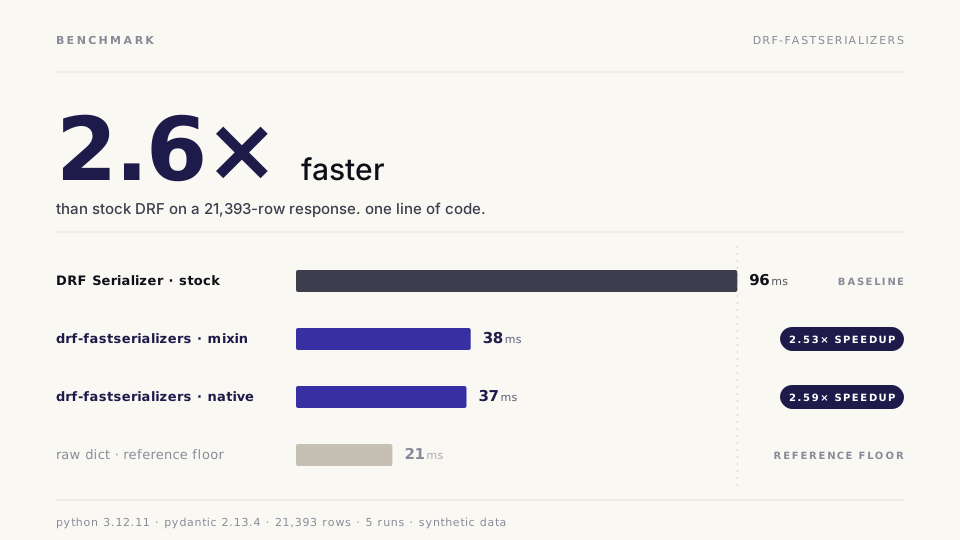
Benchmark
Full table
21,393 synthetic rows, ~3 MB JSON, 5 runs each. Python 3.12, pydantic 2.13, DRF 3.17.
| Strategy | median_ms | min_ms | speedup |
|---|---|---|---|
DRF Serializer (stock) |
96 | 96 | 1.00x |
| drf-fastserializers (mixin) | 37 | 35 | 2.64x |
| drf-fastserializers (native) | 36 | 34 | 2.65x |
Raw dict via JSONRenderer (reference floor, no validation) |
20 | 20 | 4.80x |
Speedup is anchored on stock DRF. Reproduce on your hardware:
uv run python -m benchmarks.bench         # text output
uv run python -m benchmarks.plot          # regenerate docs/bench.svg
benchmarks/bench.py ships with the repo and uses synthetic data only.
Real-world gaps widen further on ModelSerializer paths (because of
ORM hydration overhead) and on payloads with nested models. In
production workloads we've seen 3-4x speedups on ModelSerializer
endpoints.
Install
uv add drf-fastserializers
# or
pip install drf-fastserializers
Requires Python 3.12+, pydantic 2.7+ (v3 supported), DRF 3.14+.
How it compares
| stock DRF | drf-pydantic | django-ninja | drf-fastserializers | |
|---|---|---|---|---|
| Drop into existing DRF generics | ✅ | ✅ | ❌ | ✅ |
| Rust JSON encode (pydantic-core) | ❌ | ❌ | ✅ | ✅ |
| Migrate one endpoint at a time | ✅ | ✅ | ❌ | ✅ |
| Keeps DRF auth / perms / throttling | ✅ | ✅ | ❌ | ✅ |
| Strictly typed schemas | ❌ | ✅ | ✅ | ✅ |
| No serializer rewrite required | ✅ | ❌ | ❌ | ✅ |
drf-pydantic generates DRF serializers from pydantic models, which
keeps DRF in the request path and gives no speed win. django-ninja
replaces DRF wholesale. drf-fastserializers swaps only the encoder
inside DRF, so you keep the rest of your stack and migrate per
endpoint.
Migrating an existing serializer
Drop in the mixin
from drf_fastserializers import FastSerializerMixin

class TxnSerializer(FastSerializerMixin, serializers.ModelSerializer):
    class Meta:
        model = Txn
        fields = ["id", "name", "amount", "txn_date"]
FastSerializerMixin must come first in the MRO. On the first
.data access it translates the DRF field list into a pydantic schema,
caches it per class, and switches .data to the Rust path. many=True
is handled via a FastListSerializer wrapper installed automatically.
Add the renderer
REST_FRAMEWORK = {
    "DEFAULT_RENDERER_CLASSES": [
        "drf_fastserializers.FastJSONRenderer",
    ],
}
FastJSONRenderer subclasses JSONRenderer and falls back to stock
encoding for error responses, hand-rolled dicts, the browsable API, and
anything else it doesn't recognize. Safe as a project-wide default. Set
renderer_classes per view if you want to roll it out gradually.
When auto-translation fails
If a serializer has a SerializerMethodField or a custom field with an
overridden to_representation, the mixin emits a warning and falls
back to standard DRF .data. Three ways to fix it:
1. Move the computation upstream, into a queryset annotation or a
model property. Then drop the SerializerMethodField.
# before
class TxnSerializer(FastSerializerMixin, serializers.ModelSerializer):
    formatted_amount = serializers.SerializerMethodField()

    def get_formatted_amount(self, obj):
        return f"${obj.amount:,.2f}"

# after
class Txn(models.Model):
    @property
    def formatted_amount(self) -> str:
        return f"${self.amount:,.2f}"

class TxnSerializer(FastSerializerMixin, serializers.ModelSerializer):
    formatted_amount = serializers.CharField(read_only=True)
2. Switch to explicit translation via from_drf and
@computed_field:
from pydantic import computed_field
from drf_fastserializers import from_drf

_Base = from_drf(TxnSerializer, exclude=("formatted_amount",))

class FastTxnOut(_Base):
    @computed_field
    @property
    def formatted_amount(self) -> str:
        return f"${self.amount:,.2f}"

class TxnListView(ListAPIView):
    serializer_class = FastTxnOut.drf
    renderer_classes = [FastJSONRenderer]
Or pass computed= to skip the subclass step:
FastTxnOut = from_drf(
    TxnSerializer,
    computed={
        "formatted_amount": (lambda self: f"${self.amount:,.2f}", str),
    },
)
Each entry maps a field name to a (callable, return_type) tuple. The
callable receives the validated pydantic instance and its result is
exposed as a @computed_field on the generated schema.
3. Opt out for this serializer. Set Meta.fast = False. The mixin
stops trying, the warning goes away, and the endpoint stays on DRF.
Field mapping
Full DRF to pydantic field mapping table
| DRF field | Pydantic type |
|---|---|
CharField, EmailField, URLField, SlugField, RegexField |
str |
IntegerField |
int |
FloatField |
float |
DecimalField |
Decimal |
BooleanField |
bool |
DateField / DateTimeField / TimeField / DurationField |
date / datetime / time / timedelta |
UUIDField |
UUID |
IPAddressField, FileField, ImageField |
str |
ChoiceField |
str |
JSONField |
Any |
DictField, HStoreField |
dict |
ListField(child=X) |
list[mapped(X)] |
Serializer(...) (nested) |
nested FastSerializer (recursive) |
ListSerializer(...) |
list[nested FastSerializer] |
PrimaryKeyRelatedField |
int |
StringRelatedField, HyperlinkedRelatedField, SlugRelatedField |
str |
SerializerMethodField |
not supported, see workarounds above |
Field options carried through:
| DRF option | Effect on pydantic field |
|---|---|
required=False |
non-required with default=None (or empty container for ListField/DictField) |
allow_null=True |
type widened to T | None |
default=... |
becomes the pydantic default |
source="a.b.c" |
becomes AliasPath("a", "b", "c") |
Pagination
Standard DRF pagination works without changes:
class TxnListView(ListAPIView):
    serializer_class = TxnSerializer
    renderer_classes = [FastJSONRenderer]
    pagination_class = LimitOffsetPagination
    queryset = Txn.objects.all()
The renderer recognizes {"results": <FastPayload>, "next": ..., "count": ...}
and splices the Rust-encoded list bytes into the paginator's wrapper.
Deriving schemas from Django models
When you'd rather skip the DRF serializer step entirely, derive a schema straight from your Django model:
from drf_fastserializers import from_model, FastJSONRenderer

TxnOut = from_model(Txn, fields=["id", "name", "amount", "txn_date"])

class TxnListView(ListAPIView):
    serializer_class = TxnOut.drf
    renderer_classes = [FastJSONRenderer]
    queryset = Txn.objects.all()
from_model walks Model._meta and maps each concrete Django field to
its pydantic equivalent (nullability, defaults, FK PK types, callable
defaults via default_factory). Pass fields="__all__" to include
every concrete field, or exclude=(...) to drop a subset.
Defining schemas natively (new code)
For new endpoints, skip the DRF serializer and define a pydantic schema directly. Same renderer, tighter types, less boilerplate.
from datetime import date
from decimal import Decimal
from drf_fastserializers import FastSerializer, FastJSONRenderer

class Flags(FastSerializer):
    is_nsf: bool = False
    is_refund: bool = False

class TxnOut(FastSerializer):
    id: int
    name: str
    amount: Decimal | None = None
    txn_date: date
    flags: Flags
    tags: list[str] = []

class TxnListView(ListAPIView):
    serializer_class = TxnOut.drf
    renderer_classes = [FastJSONRenderer]
    queryset = Txn.objects.all()
FastSerializer is a pydantic.BaseModel. Everything pydantic does
(nested models, @computed_field, validators, model_config, enums)
works.
TxnOut.drf is a class-level descriptor returning a DRFAdapter
subclass bound to the schema. It quacks like
rest_framework.serializers.Serializer:
serializer = TxnOut.drf(instance=qs, many=True)
serializer.data            # FastPayload, encoded on render
serializer.is_valid()      # validates incoming request data
serializer.errors          # DRF-shape: {"field": ["msg", ...]}
serializer.validated_data  # pydantic instances
Input validation in a view:
class TxnCreateView(APIView):
    def post(self, request):
        serializer = TxnIn.drf(data=request.data)
        serializer.is_valid(raise_exception=True)
        txn = serializer.validated_data
        Txn.objects.create(**txn.model_dump())
        return Response(status=201)
Errors land in DRF's standard shape:
{
  "amount": ["Input should be a valid decimal"],
  "flags.is_nsf": ["Input should be a valid boolean"]
}
Partial updates
Pass partial=True at construction (matches DRF). Every field becomes
optional with default None, and
validated_data.model_dump(exclude_unset=True) returns only the keys
the client actually sent.
class TxnPatchView(APIView):
    def patch(self, request, pk):
        serializer = TxnIn.drf(data=request.data, partial=True)
        serializer.is_valid(raise_exception=True)
        Txn.objects.filter(pk=pk).update(
            **serializer.validated_data.model_dump(exclude_unset=True)
        )
        return Response(status=200)
Rust input path with FastJSONParser
Stock DRF parses JSON into a Python dict, then is_valid re-walks that
dict to validate it. FastJSONParser skips the first pass and hands
raw request bytes directly to pydantic-core's validate_json. Add it
to parser_classes per view, or to DEFAULT_PARSER_CLASSES globally.
class TxnCreateView(APIView):
    parser_classes = [FastJSONParser]
    renderer_classes = [FastJSONRenderer]

    def post(self, request):
        serializer = TxnIn.drf(data=request.data)
        serializer.is_valid(raise_exception=True)
        Txn.objects.create(**serializer.validated_data.model_dump())
        return Response(status=201)
Middleware or tests that read request.data still get a dict. The
parser returns a lazy-decoded proxy that triggers json.loads on the
first non-validator access.
values_fields() projection helper
Spell the queryset projection once, on the schema:
qs = Txn.objects.values(*TxnOut.values_fields())
Returns the field names declared on TxnOut in declaration order.
Pass exclude=(...) to drop specific fields.
Explicit factory
Prefer an explicit import over the .drf descriptor? Use drf_serializer:
from drf_fastserializers import drf_serializer

class TxnListView(ListAPIView):
    serializer_class = drf_serializer(TxnOut)
Both forms return the same cached DRFAdapter subclass.
OpenAPI schemas via drf-spectacular
Install the extra and import the extension module once during app
startup, typically in your AppConfig.ready():
pip install 'drf-fastserializers[spectacular]'
# myapp/apps.py
class MyAppConfig(AppConfig):
    name = "myapp"

    def ready(self):
        import drf_fastserializers.spectacular  # noqa: F401
Every FastSerializer-backed view is then rendered into the OpenAPI
schema using model_json_schema(). Nested models, enum choices,
validators, and @computed_fields all carry through. No
@extend_schema boilerplate needed for the common case.
How it works
Stock DRF serializers iterate field objects in Python on every response. That overhead dominates response time for endpoints returning thousands of rows.
drf-fastserializers skips DRF's field pipeline. On .data access the
serializer hands back a FastPayload marker carrying the validated
pydantic instances plus a TypeAdapter. FastJSONRenderer recognizes
the marker and routes encoding to TypeAdapter.dump_json, which is
implemented in Rust as part of
pydantic-core. Bytes go
straight to the HTTP response. No Python-side json.dumps step.
flowchart LR
    View["DRF View"] --> Data["serializer.data"]
    Data --> Marker["FastPayload<br/>(adapter + instances)"]
    Marker --> Renderer["FastJSONRenderer"]
    Renderer -->|Rust dump_json| Bytes[("bytes")]
    Bytes --> Response["HTTP Response"]

    classDef rust fill:#dea584,stroke:#8b4513,color:#000
    classDef drf fill:#a30000,stroke:#600,color:#fff
    class Renderer,Marker rust
    class View,Data,Response drf
For payloads the renderer doesn't recognize (error responses, plain
dicts, the browsable API, paginated wrappers), it falls back to stock
JSONRenderer. The library never breaks code paths it doesn't
explicitly handle.
Pydantic v2 and v3
Built against the stable pydantic surface used by both v2.7+ and v3.x
(BaseModel, TypeAdapter, ConfigDict, ValidationError,
model_dump_json). The pyproject spec is pydantic>=2.7,<4. The
PYD_V3 flag is exposed for downstream code that needs to branch.
What this library is not
- Not a
ModelSerializerreplacement that auto-infers fields from a Django model. Usefrom_drf(MyModelSerializer)to lift an existing one, or declare fields explicitly in aFastSerializer. - Not a framework. Keep your DRF generics, viewsets, routers, permissions, auth backends, throttling, filtering. Only the serializer and renderer paths change. Migrate one endpoint at a time.
- Not a drf-spectacular replacement. For the common case, install the
[spectacular]extra and letmodel_json_schema()flow through; for anything custom, declare response shapes with@extend_schema.
License
MIT
Project details
Verified details
These details have been verified by PyPIProject links
GitHub Statistics
Maintainers


Download files
Download the file for your platform. If you're not sure which to choose, learn more about installing packages.
Source Distribution
Built Distribution
Filter files by name, interpreter, ABI, and platform.
If you're not sure about the file name format, learn more about wheel file names.
Copy a direct link to the current filters
File details
Details for the file drf_fastserializers-0.2.1.tar.gz.
File metadata
- Download URL: drf_fastserializers-0.2.1.tar.gz
- Upload date:
- Size: 20.1 kB
- Tags: Source
- Uploaded using Trusted Publishing? Yes
- Uploaded via: twine/6.1.0 CPython/3.13.12
File hashes
| Algorithm | Hash digest | |
|---|---|---|
| SHA256 |
41b9e9a991ebcedbfc36c77cf81b13f86f1210de6296020f8500df034c79fbef
|
|
| MD5 |
f33c5c3c88fb63e92807313c51e15aa3
|
|
| BLAKE2b-256 |
7790caf388301030a54d4afef9601946d399ffdcb5b1052af83873d9dca5e2b7
|
Provenance
The following attestation bundles were made for drf_fastserializers-0.2.1.tar.gz:
Publisher:
publish.yml on ankitksr/drf-fastserializers
-
Statement:
-
Statement type:
https://in-toto.io/Statement/v1 -
Predicate type:
https://docs.pypi.org/attestations/publish/v1 -
Subject name:
drf_fastserializers-0.2.1.tar.gz -
Subject digest:
41b9e9a991ebcedbfc36c77cf81b13f86f1210de6296020f8500df034c79fbef - Sigstore transparency entry: 1624986039
- Sigstore integration time:
-
Permalink:
ankitksr/drf-fastserializers@36625ad47674a241c2c51839c0eac4374809f057 -
Branch / Tag:
refs/tags/v0.2.1 - Owner: https://github.com/ankitksr
-
Access:
public
-
Token Issuer:
https://token.actions.githubusercontent.com -
Runner Environment:
github-hosted -
Publication workflow:
publish.yml@36625ad47674a241c2c51839c0eac4374809f057 -
Trigger Event:
push
-
Statement type:
File details
Details for the file drf_fastserializers-0.2.1-py3-none-any.whl.
File metadata
- Download URL: drf_fastserializers-0.2.1-py3-none-any.whl
- Upload date:
- Size: 25.2 kB
- Tags: Python 3
- Uploaded using Trusted Publishing? Yes
- Uploaded via: twine/6.1.0 CPython/3.13.12
File hashes
| Algorithm | Hash digest | |
|---|---|---|
| SHA256 |
ce2482a978c69e8e571341cb36e857d67cc7481dfb88daca5358f2d488a9ca06
|
|
| MD5 |
f02dbf7ce888ebac9a0fbc36ee9dfd71
|
|
| BLAKE2b-256 |
6f0fba6040d55e8dfaf6eb770dadd55c9a5fe40e081f7626f156dadab58426e7
|
Provenance
The following attestation bundles were made for drf_fastserializers-0.2.1-py3-none-any.whl:
Publisher:
publish.yml on ankitksr/drf-fastserializers
-
Statement:
-
Statement type:
https://in-toto.io/Statement/v1 -
Predicate type:
https://docs.pypi.org/attestations/publish/v1 -
Subject name:
drf_fastserializers-0.2.1-py3-none-any.whl -
Subject digest:
ce2482a978c69e8e571341cb36e857d67cc7481dfb88daca5358f2d488a9ca06 - Sigstore transparency entry: 1624986137
- Sigstore integration time:
-
Permalink:
ankitksr/drf-fastserializers@36625ad47674a241c2c51839c0eac4374809f057 -
Branch / Tag:
refs/tags/v0.2.1 - Owner: https://github.com/ankitksr
-
Access:
public
-
Token Issuer:
https://token.actions.githubusercontent.com -
Runner Environment:
github-hosted -
Publication workflow:
publish.yml@36625ad47674a241c2c51839c0eac4374809f057 -
Trigger Event:
push
-
Statement type:






