
DRIFT — drought events from the space–time component tree




DRIFT (Drought Regions Identified From the space–time component Tree) detects drought events in gridded standardized indices (SPI, SPEI, soil-moisture percentiles) without fixing a single threshold. It builds the max-tree of the deficit field over time, latitude and longitude and selects events inside that hierarchy with volume-weighted topological persistence, a noise-adaptive persistence threshold and lineage inheritance. One tree gives two nested levels: drought episodes and the pulses they contain.
The package also provides everything needed to test a drought-event detector: a synthetic benchmark with known events (Gaussian scenarios and irregular shapes from real droughts), three reference detectors, tracking metrics (HOTA, object F1, partition agreement), event confidence and a surrogate significance test.
Contents
- Why DRIFT
- Installation
- Quickstart
- How it works
- Evaluation metrics
- Benchmark
- Tests and validation
- Package structure
- Documentation · Citation · License
Why DRIFT
A drought catalogue built by labelling connected cells below one threshold (for example SPI ≤ −1) changes with that threshold: a strict one breaks droughts into pieces, a lenient one chains separate droughts into multi-year objects. DRIFT keeps all thresholds at once in a component tree and lets each event take its own effective threshold:
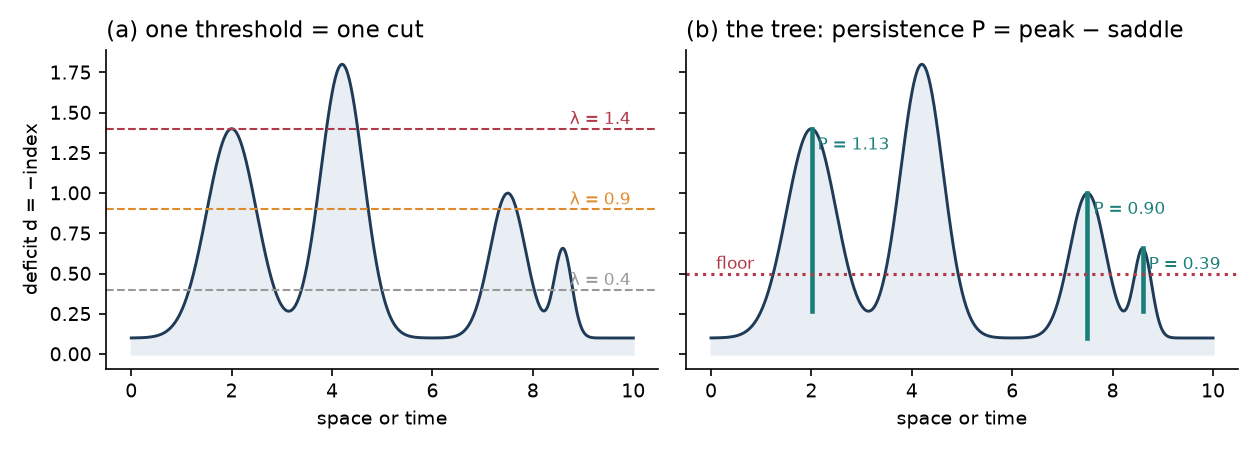
(a) Each threshold gives a different set of events. (b) In the tree, each maximum is a branch with a persistence P = peak − saddle; shallow branches created by noise are absorbed, droughts separated by deep saddles are kept.
Installation
pip install drift-drought
Python ≥ 3.10. Dependencies: NumPy, SciPy, pandas, Higra (component trees), Numba,
scikit-image, scikit-learn and xarray. Extras: [plot] (matplotlib), [test] (pytest), [docs] (Sphinx).
Quickstart
import numpy as np
import driftdrought as dd

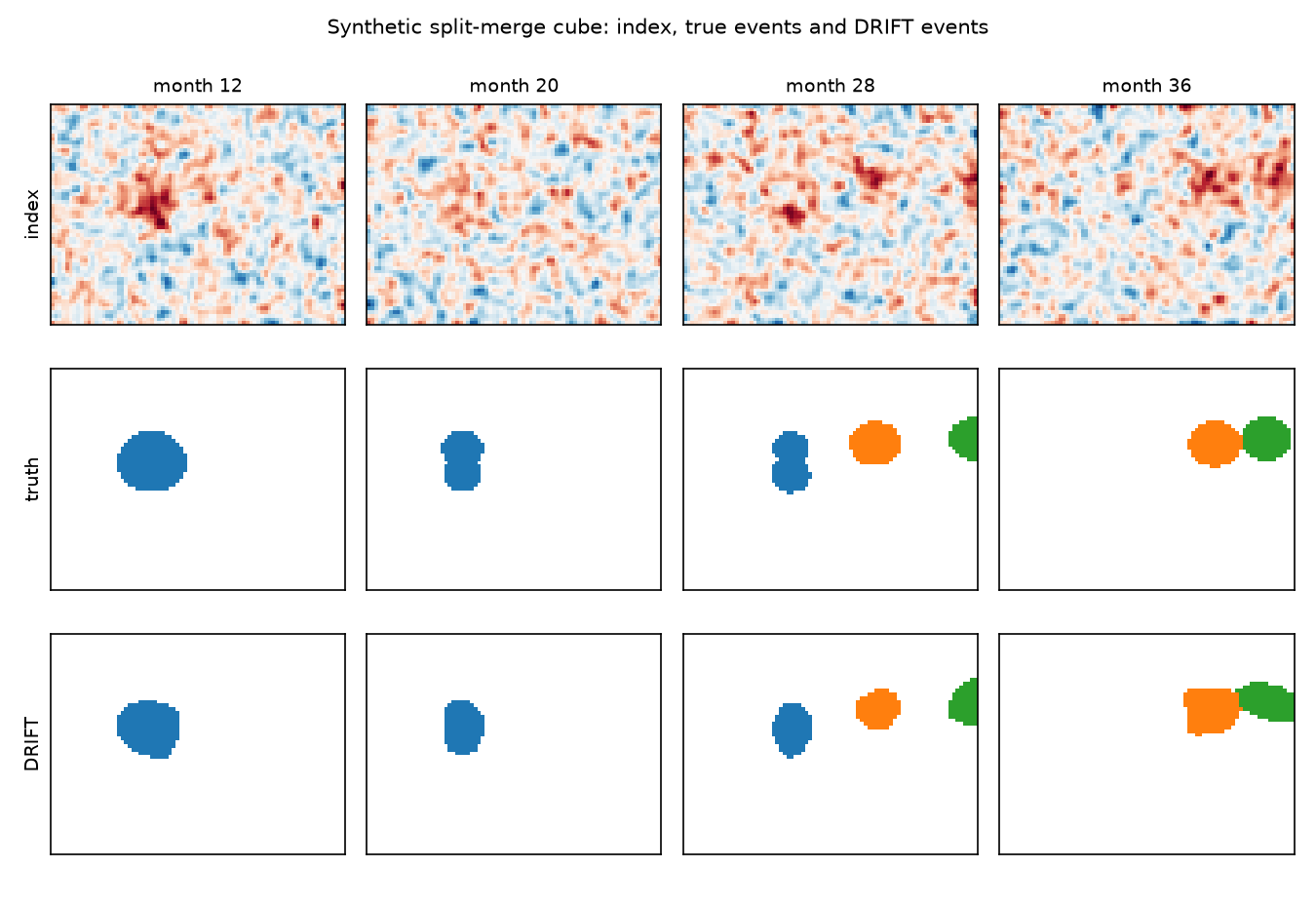
# a benchmark cube (60 months x 60 x 80 cells): one drought splits, two converge
index, truth, meta = dd.synthetic.generate("S3_splitmerge", noise=0.6, seed=3)
area = np.ones(index.shape[1:])                      # unit cells; dd.cell_area_km2() on a lat-lon grid

labels, info = dd.detect(dd.smooth(index, 2.5), area, v_min=50, floor=0.5,
                         footprint="watershed", ext_floor=0.5)

print(dd.metrics.hota(truth, labels, area))          # HOTA 0.574, DetA 0.628, AssA 0.525
print(dd.metrics.object_match(truth, labels, area, iou_thr=0.25)["f1_iou25"])   # 0.86
print(dd.event_table(labels, index, area))           # start, end, duration, volume, peak month...
On real data:
spi3 = xr.open_dataset("spi3.nc").spi3                         # (time, lat, lon), NaN over sea
area = dd.cell_area_km2(spi3.lat.values, 0.25)[:, None] * np.ones(spi3.lon.size)
area[np.isnan(spi3.values[0])] = 0
x = dd.smooth(spi3.values, 2.5)
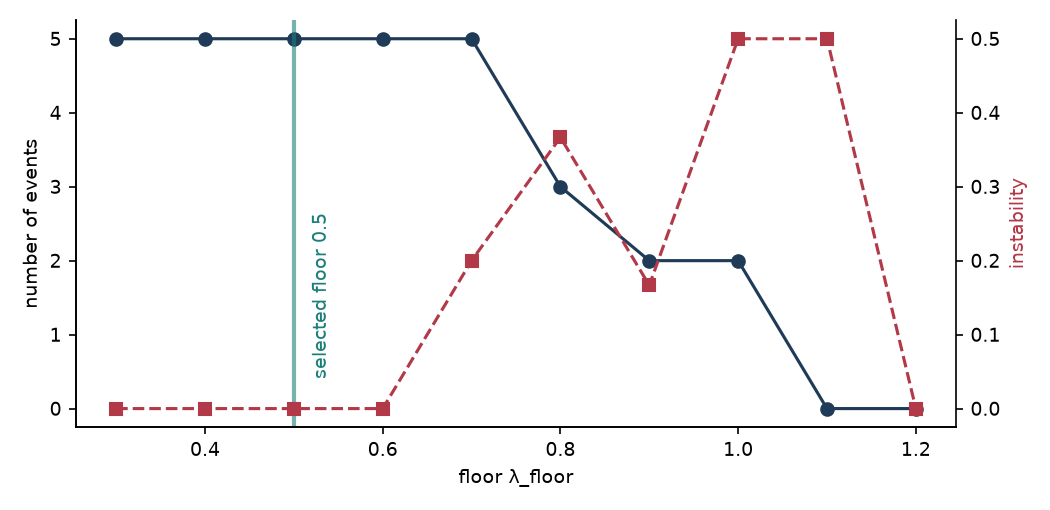
floor, scan = dd.select_floor(x, area, v_min=2e6)              # event-count stability rule
episodes, info = dd.detect(x, area, v_min=2e6, floor=floor)    # km2 x months
pulses, _ = dd.detect(x, area, v_min=2e6, floor=floor, selection="leaf")
The complete script is examples/quickstart.py.
How it works
| Step | What DRIFT does | Parameter |
|---|---|---|
| 1. Deficit field | d = −index, optionally smoothed with a 3-D Gaussian |
smooth(index, sigma) |
| 2. Component tree | max-tree of d with 26-connectivity in time and space |
— |
| 3. Significant nodes | volume ≥ v_min and deficit ≥ floor |
v_min, floor |
| 4. Persistence | branch persistence P = peak − saddle; branches with P < π are absorbed | persistence="auto:k": π = k · 1.4826 · MAD of the high-pass residual |
| 5. Volume weighting | P_V = P · (V / v_min)^γ, so large droughts survive shallow saddles | pers_gamma (γ = 1) |
| 6. Lineage inheritance | an event born inside an older event (share ≥ q of its first footprint) takes its identity | inherit (q = 0.75) |
| 7. Footprint | birth component, or watershed growth into cells with deficit ≥ ext_floor |
footprint, ext_floor |
| 8. Floor | the floor where the number of events is most stable | select_floor |
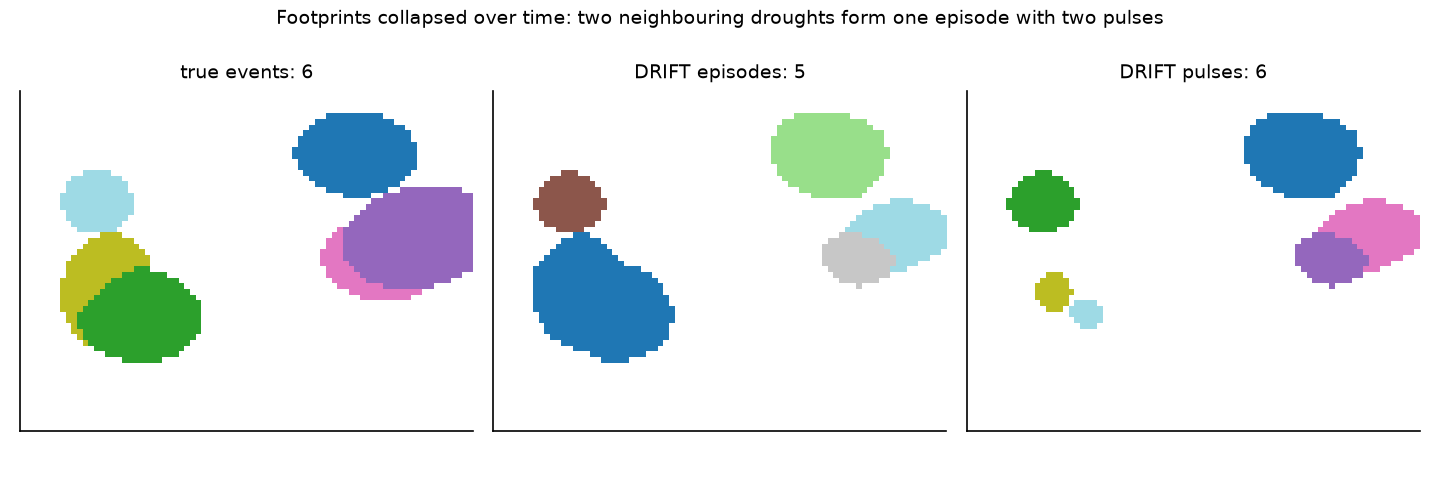
Episodes and pulses. selection="persistence_vl" (default) returns episodes; selection="leaf" returns the
pulses nested in them:
Event attributes. confidence.parameter_confidence gives each event a confidence (mean best IoU with runs of
perturbed parameters; with another precipitation product it becomes a product confidence), and
significance.surrogate_test tests each event against phase-randomized surrogates of the field (family-wise and
Benjamini–Hochberg p-values).
Evaluation metrics
| Metric | Function | Meaning |
|---|---|---|
| IoU | — | area-weighted space–time intersection over union of a true and a detected event |
| Precision, recall, F1 | metrics.object_match |
one-to-one matching of events (Hungarian) with IoU ≥ 0.5; f1_iou25 uses IoU ≥ 0.25 |
| Mean IoU, volume error | metrics.object_match |
quality of the matched footprints |
| Events detected vs true | metrics.object_match (n_pred, n_gt) |
exposes fragmentation (too many) and chaining (too few) |
| HOTA | metrics.hota |
Higher Order Tracking Accuracy (Luiten et al., 2021): √(DetA · AssA), averaged over IoU thresholds 0.05–0.95 |
| DetA | metrics.hota |
detection accuracy: drought cells found in the right months |
| AssA | metrics.hota |
association accuracy: each drought keeps one identity through time |
| ARI, VI | metrics.partition_agreement |
adjusted Rand index and variation of information between two partitions |
Equations and interpretation: metrics page of the documentation.
Benchmark
synthetic.generate reproduces the known-truth cubes of the DRIFT article; synthetic.generate_irregular places
real drought shapes — from your own catalogue (build_library) or from the bundled library of 99 droughts of the
Amazon and Orinoco basins (example_library) — so DRIFT can be tuned to the scale of the target region.
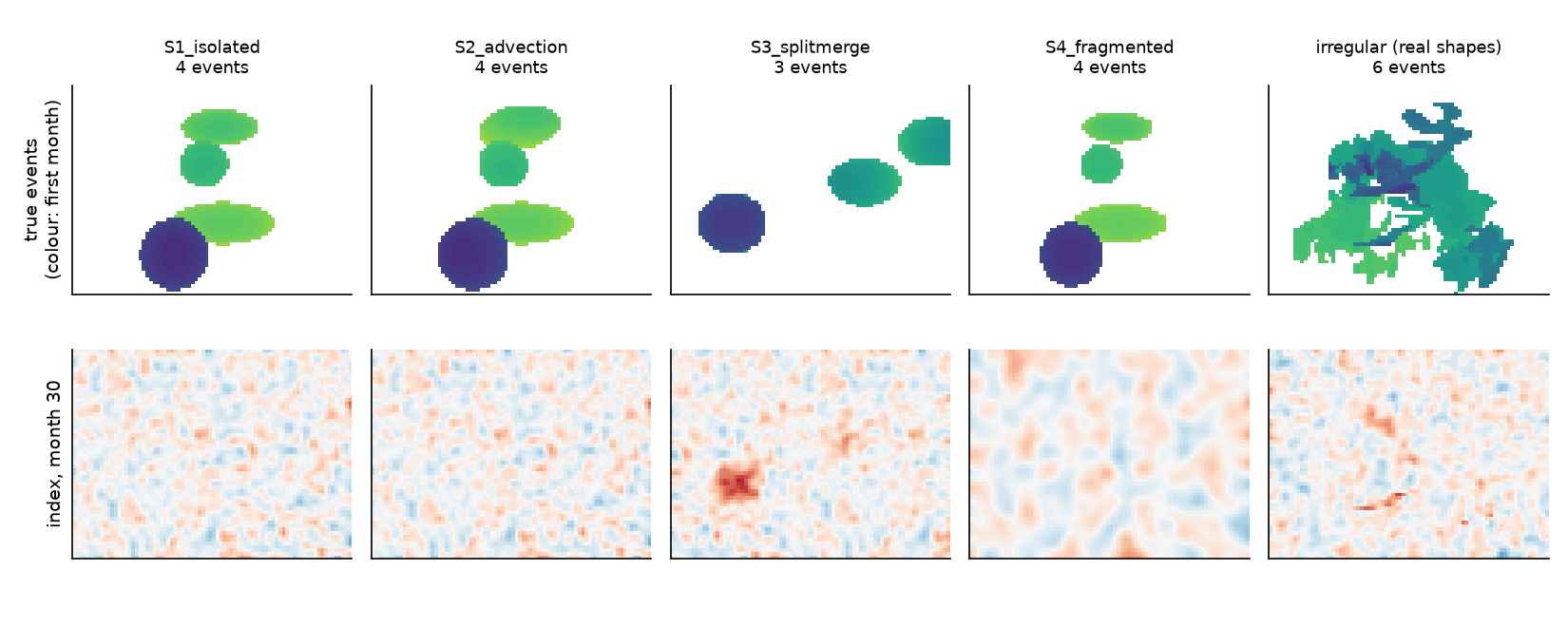
| Scenario | What it tests |
|---|---|
S1_isolated |
recovery of separated events |
S2_advection |
continuity of migrating events |
S3_splitmerge |
identity through a split and two converging droughts |
S4_fragmented |
weak events on strongly correlated noise |
| irregular | non-convex, multi-core events with the geometry of observed droughts |
Mini benchmark (examples/make_figures.py: four scenarios × two noise levels × ten seeds, configurations selected in
the article):
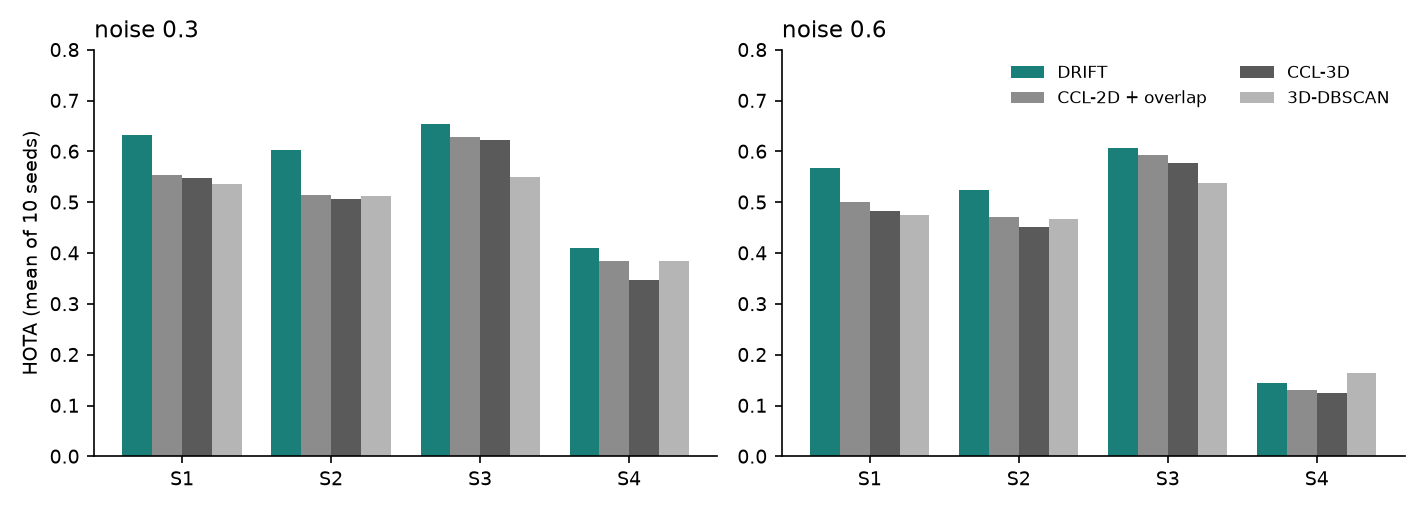
| Method | HOTA (noise 0.3) | HOTA (noise 0.6) | AssA (0.6) | F1, IoU ≥ 0.25 (0.6) | Events detected (0.6; true 4.6) |
|---|---|---|---|---|---|
| DRIFT | 0.575 | 0.461 | 0.496 | 0.78 | 6.8 |
| CCL-2D + overlap | 0.520 | 0.424 | 0.460 | 0.67 | 10.8 |
| CCL-3D | 0.506 | 0.409 | 0.430 | 0.69 | 4.0 |
| 3D-DBSCAN | 0.496 | 0.411 | 0.447 | 0.68 | 5.3 |
In the article (20 seeds, held-out selection of every method) DRIFT reached HOTA 0.579 and 0.459 against at most 0.530 and 0.428, was best in seven of eight scenario–noise combinations and, re-tuned on irregular events from observed droughts, remained best on average. Weak events in strongly correlated noise (S4) are hard for every method, and at the smoothing that maximizes HOTA the split in S3 is not reported as a split (DRIFT keeps one identity instead).
Tests and validation
The test suite runs on GitHub Actions for Python 3.10, 3.11 and 3.12 on every push.
| Test | What it checks |
|---|---|
test_generator_is_deterministic |
same scenario, noise and seed → same cube and truth |
test_detect_recovers_isolated_events |
HOTA > 0.4 and F1 (IoU ≥ 0.25) > 0.6 on isolated events |
test_all_selection_rules_run |
the five selection rules run and return events |
test_nan_cells_are_never_events |
cells outside the domain are never labelled |
test_merge_branches_joins_a_split |
lineage inheritance gives one identity to a lobe born inside an event |
test_baselines_and_confidence |
reference detectors run; a catalogue has confidence 1 against itself |
test_select_floor_returns_candidate |
the floor rule returns a candidate floor and the full scan |
test_surrogate_test_small |
the significance test returns valid family-wise and FDR p-values |
test_example_library |
the bundled real-shape library loads and builds cubes |
pip install -e ".[test]"
pytest -v
Equivalence with the article. Before release, detect was checked against the research implementation used in
the article on the four benchmark scenarios: the label cubes were identical voxel by voxel.
Package structure
| Module | Contents |
|---|---|
driftdrought.core |
detect, smooth, select_floor, event_table, merge_branches, cell_area_km2 |
driftdrought.indices |
SPI, SPEI and soil-moisture index fitted per calendar month |
driftdrought.synthetic |
benchmark cubes (S1–S4), build_library, example_library, generate_irregular |
driftdrought.baselines |
CCL-2D with overlap tracking, CCL-3D, 3D-DBSCAN |
driftdrought.metrics |
HOTA (DetA, AssA), object matching, partition agreement |
driftdrought.confidence |
event confidence against perturbed parameters or another input product |
driftdrought.significance |
phase-randomized surrogate test, family-wise and FDR p-values |
Documentation
https://drift-drought.readthedocs.io — installation, quickstart, method with equations, metrics, benchmark, tests, gallery and the full API reference generated from the docstrings.
Citation
If you use DRIFT, please cite the software and the article (see CITATION.cff, or "Cite this repository" on GitHub):
Sanchez H., K. A. (2026). DRIFT: Drought Regions Identified From the space–time component Tree (software). Zenodo. https://doi.org/10.5281/zenodo.24409548 (all versions; version 0.1.1: https://doi.org/10.5281/zenodo.24409549)
Sanchez H., K. A. (2026). DRIFT for detecting and tracking spatiotemporal drought events with component trees. Water Resources Research (submitted).
License
MIT © 2026 Karel A. Sanchez H. (see LICENSE).
1 maintainer

Metadata
1 maintainer
Release files for drift-drought 0.1.2
For a detailed explanation of source distributions (sdists) and built distributions (wheels), please see the package formats documentation.
Source distribution (sdist)
| File | Size | Uploaded | Provenance | Actions |
|---|---|---|---|---|
| drift_drought-0.1.2.tar.gz | 815.5 kB | With provenance | Details for drift_drought-0.1.2.tar.gz |
Built distribution (wheel)
| File | Interpreter | ABI | Platform | Actions Reset |
|---|---|---|---|---|
| drift_drought-0.1.2-py3-none-any.whl | Python 3 | none | any | Details for drift_drought-0.1.2-py3-none-any.whl |
Total release size: 1.2 MB
Release files / drift_drought-0.1.2.tar.gz
| Download URL | drift_drought-0.1.2.tar.gz |
|---|---|
| Size | 815.5 kB |
| Tags | Source |
|
SHA-256 checksum How to use checksums |
e23065a64717336510d8948f4cbaba7cfec0ac652a6eb59948b625162b0aacea
|
|
BLAKE2b-256 checksum How to use checksums |
773a617a72319b7096666d3994aa79424aa7e8ab0f31a87cfed98aca98540349
|
| Upload date | |
|
Uploaded using Trusted Publishing? What is trusted publishing? |
Yes |
| Uploaded via |
twine/7.0.0 CPython/3.13.16
|
Provenance
Provenance describes where a file came from. On PyPI, provenance is shared via attestations, which provide a verifiable record of the build or publishing details. View details, limitations and caveats.


PyPI Publish Attestation
PyPI verified that this artifact, at this checksum, originated from the publisher listed below.
Signed by GitHub Actions, verified by PyPI on Nov 21, 2026.
Transparency logRelease files / drift_drought-0.1.2-py3-none-any.whl
| Download URL | drift_drought-0.1.2-py3-none-any.whl |
|---|---|
| Size | 433.5 kB |
| Tags | Python 3 |
|
SHA-256 checksum How to use checksums |
908db52f645c976380b8ca242a5f8e1efc70479405318543cf8793867a5bfe4e
|
|
BLAKE2b-256 checksum How to use checksums |
8e53f5168e7e253fea0b33786b0efe66397e53115f64c6f57aed30029c2d7b8e
|
| Upload date | |
|
Uploaded using Trusted Publishing? What is trusted publishing? |
Yes |
| Uploaded via |
twine/7.0.0 CPython/3.13.16
|
Provenance
Provenance describes where a file came from. On PyPI, provenance is shared via attestations, which provide a verifiable record of the build or publishing details. View details, limitations and caveats.
PyPI Publish Attestation
PyPI verified that this artifact, at this checksum, originated from the publisher listed below.
Signed by GitHub Actions, verified by PyPI on Nov 21, 2026.
Transparency logSecurity for drift-drought 0.1.2
Provenance
Provenance describes where a file came from. On PyPI, provenance is shared via attestations, which provide a verifiable record of the build or publishing details. View details, limitations and caveats.
Full provenance
Both files in this release have been uploaded with provenance metadata.
Attestation for drift_drought-0.1.2.tar.gz
PyPI Publish Attestation
PyPI verified that this artifact, at this checksum, originated from the publisher listed below.
Signed by GitHub Actions, verified by PyPI on Nov 21, 2026.
Transparency logA note on package security
PyPI is a repository for distributing packages, not a service for auditing them. While third-party security researchers and our staff do their best to detect and remove malicious packages, PyPI cannot guarantee the quality, security or suitability of any given package.
To learn more about protecting yourself from malicious actors, visit our package security documentation.













