
DrumScript
DrumScript is an open-source Python library and CLI tool for drum audio analysis and transcription. Give it a recording — a full mix or an isolated drum stem — and it will generate PDF sheet music, MIDI files, and MusicXML output. The DrumScript model is a deterministic classifier, and doesn't use AI/machine learning. Built for drummers and by drummers, it is - and always will be - an open-source community tool.
Python >=3.9
Workflow Status


- Features
- Project Structure
- Installation
- Quick Start
- CLI Usage
- Contributing
- Testing
- Benchmarking
- Traffic
- FAQs
- Changelog
- Acknowledgements
- Similar projects
- License
Public Alpha (v0.1.4+) — ongoing since June 2026
- We're looking for early adopters and feedback
- Feedback on the classification model, and help shape v1.0.0.
- In particular we are interested in hearing from everyone:: drummers (coding not required!), sound engineers and academics in Music Information Retrieval with an interest in deterministic drum/percussion classifications.
- For beta release, we are planning to (amongst other things) improve the classification model, fix any user-suggested bugs, implement user-suggested feature requests and most importantly build a WebGPU/ONNX/WASM UI that will be free to use for all.
See the Roadmap for what's planned.
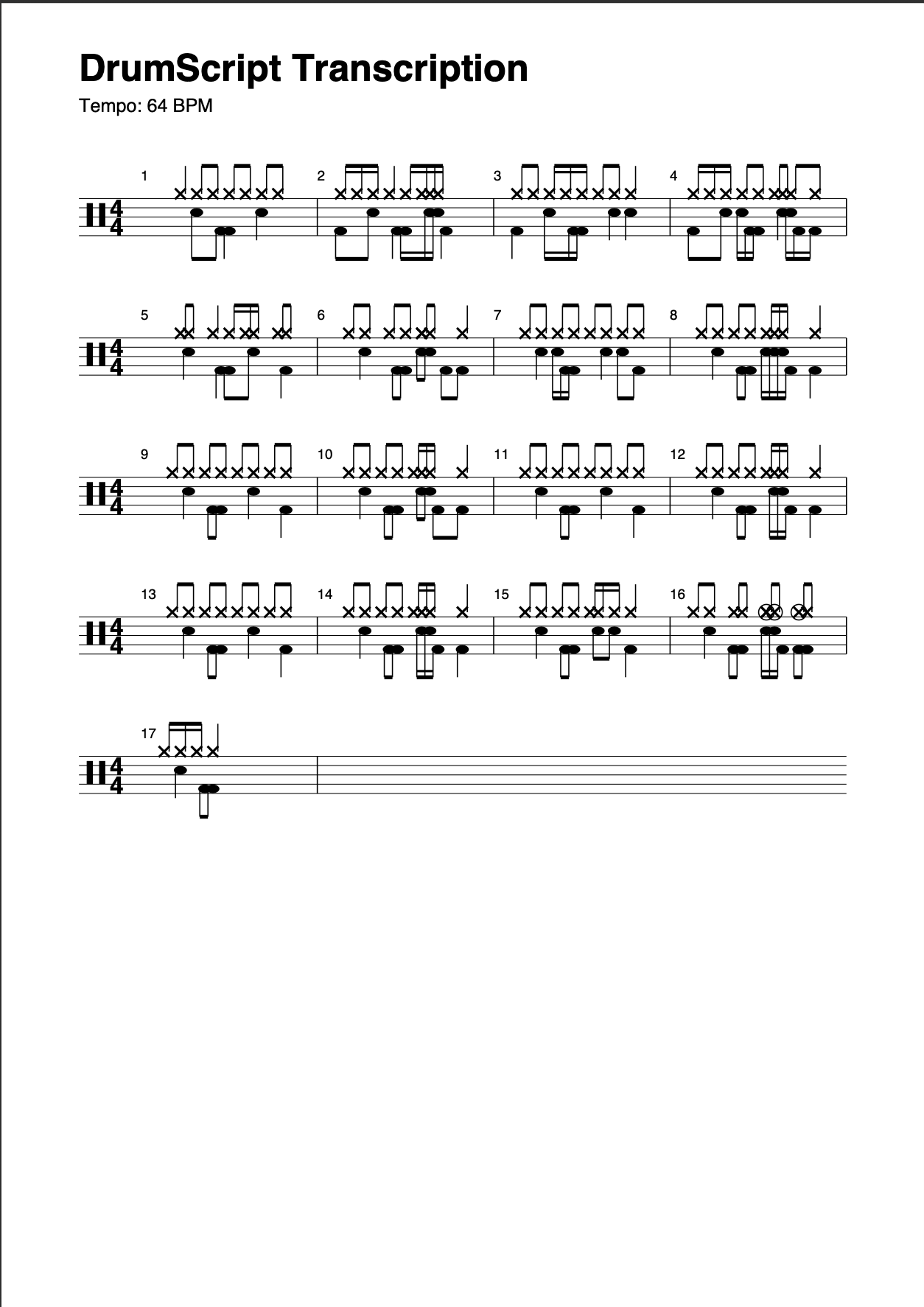
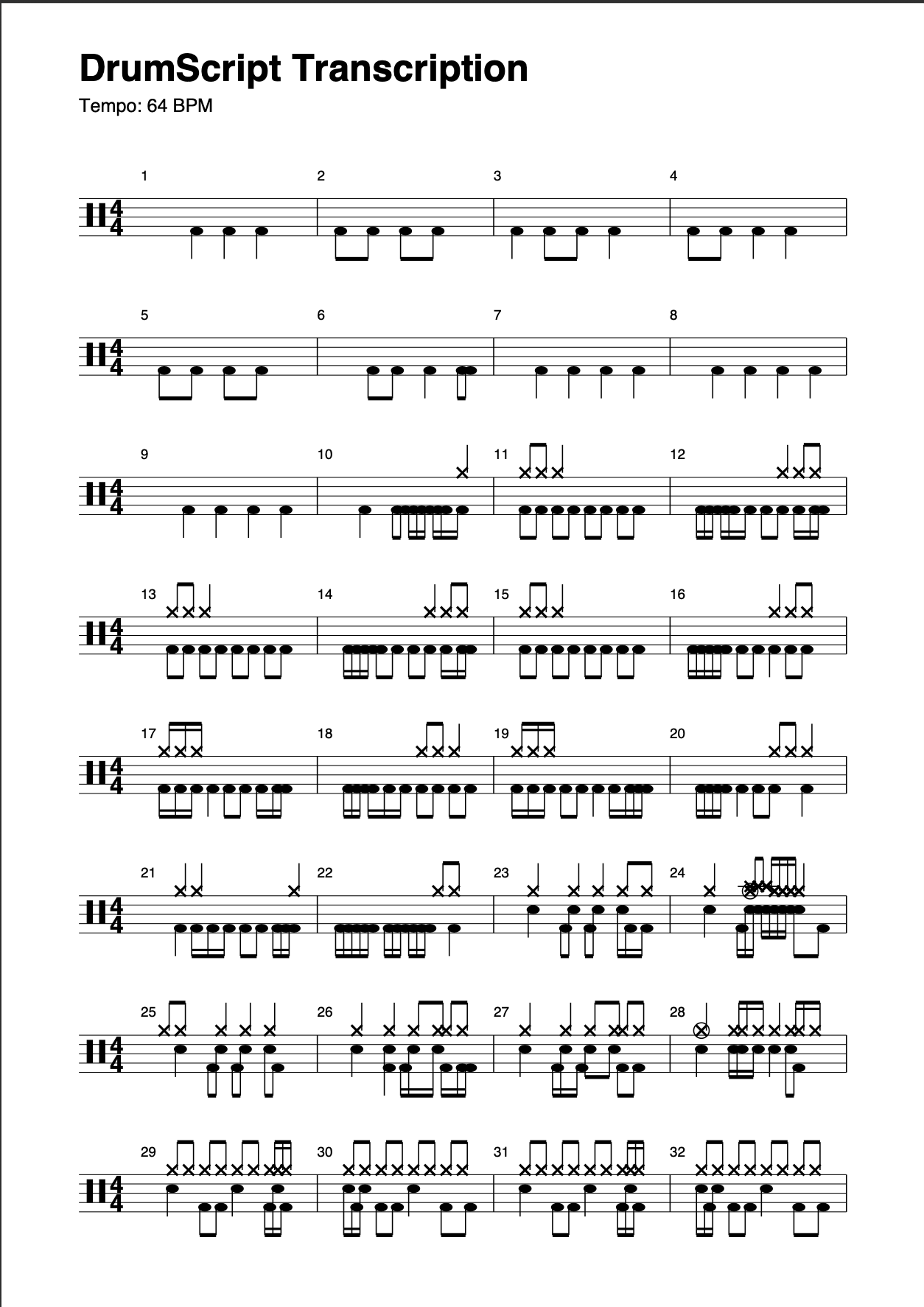
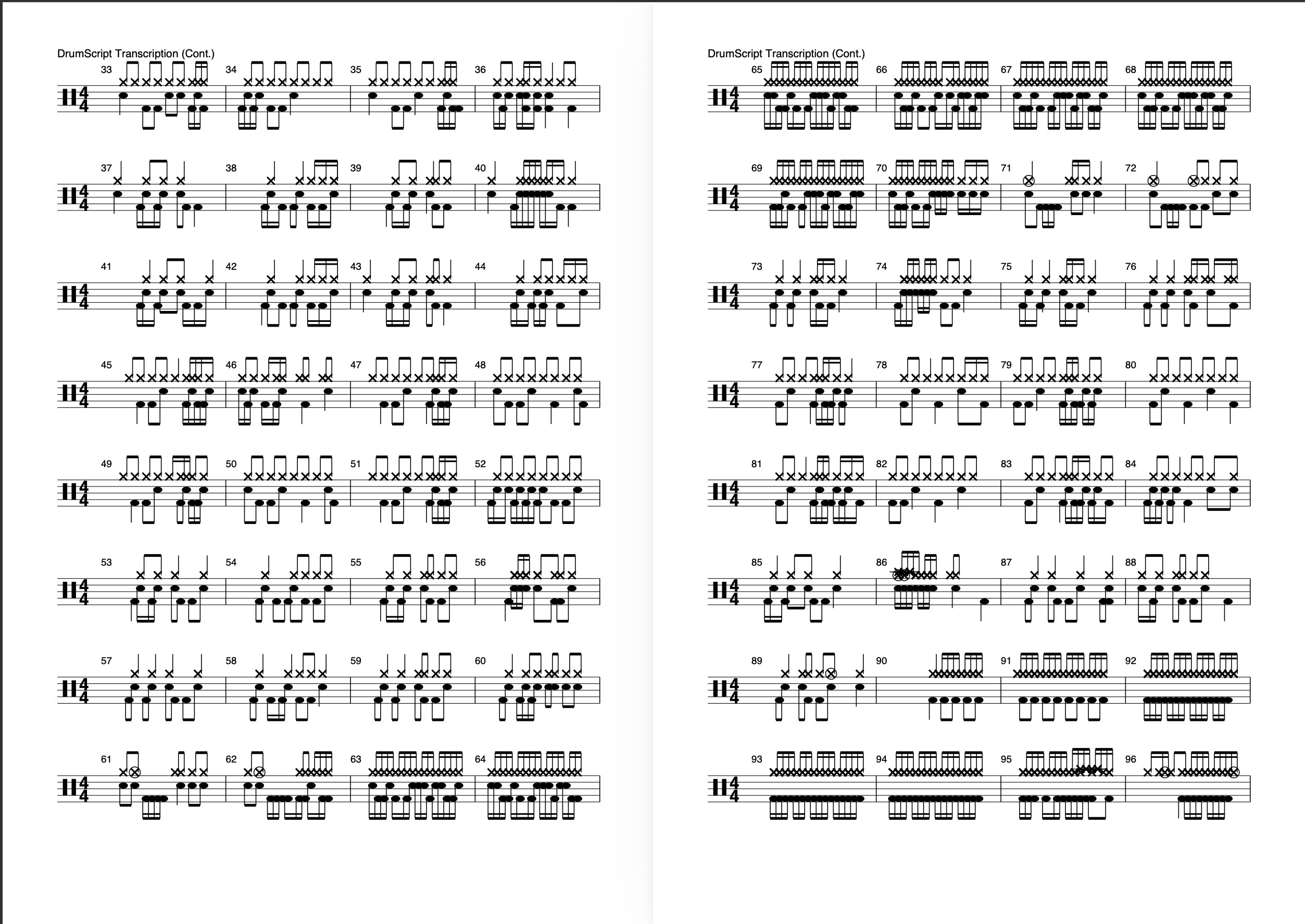
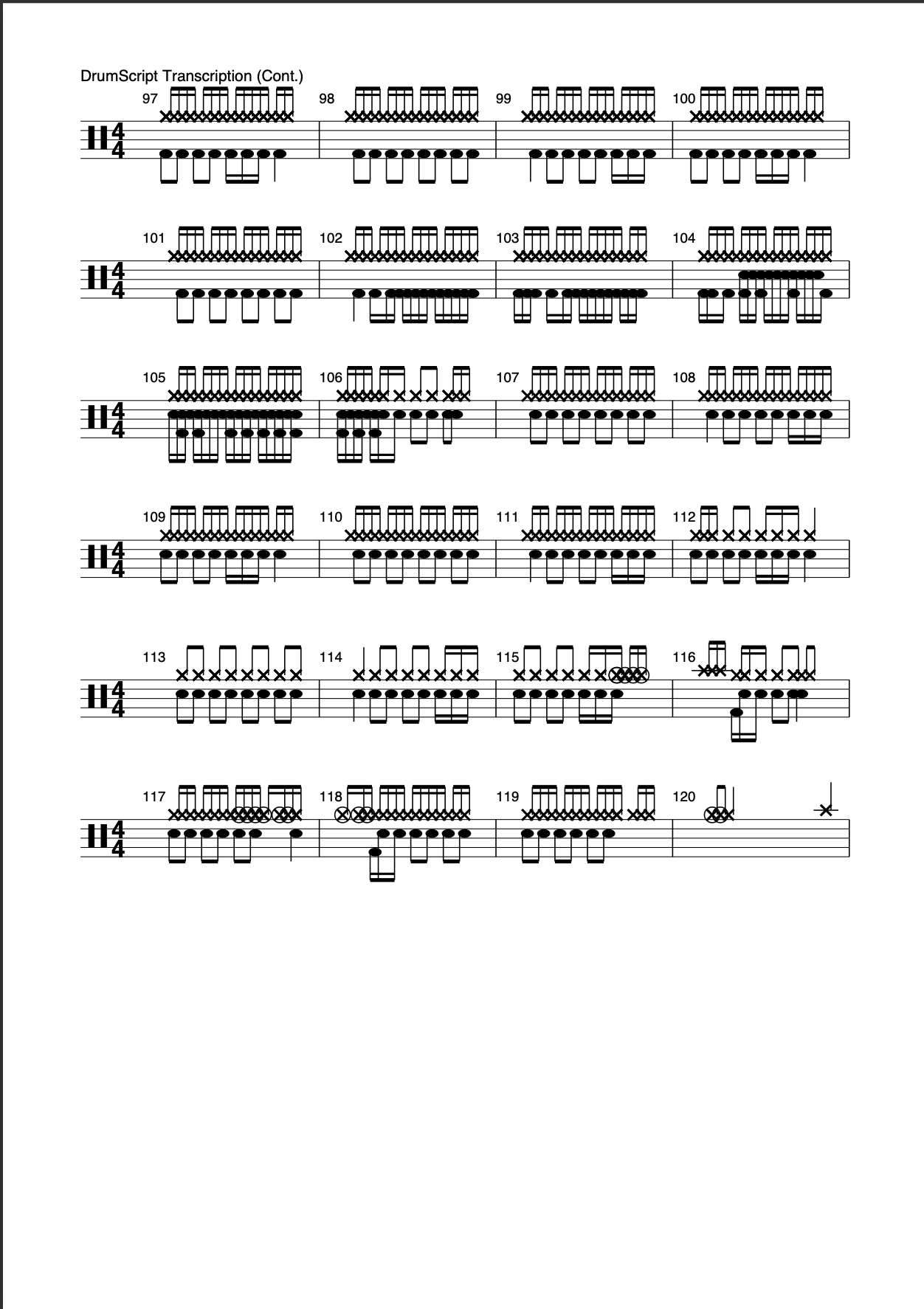
What it looks like
*Input: audio recording → Output: drum notation (PDF).
Example 1: Simple groove
Example 2: A well-known Sabbath song
Project Structure
See repository_structure.md for the full project layout.
DrumScript/
├── benchmarks/                 # mir_eval scripts for benchmarking DrumScript
├── drumscript/                 # Main source package
│   ├── __init__.py             # Public API (transcribe, load_audio, etc.)
│   ├── main.py                 # CLI entry point
│   ├── audio_processor/        # Audio loading, DSP, stem splitting
│   ├── drum_classifier/        # Rule-based classification engine
│   ├── notation_generator/     # Score building, PDF/MIDI/XML export
│   ├── datasets/               # Benchmark dataset adapters (IDMT, etc.)
│   └── utils/                  # Helpers (ffmpeg installer, research scripts)
├── benchmarks/                 # Evaluation runners (see benchmarks/README.md)
├── docs/                       # Sphinx documentation
├── tests/                      # pytest test suite (138 unit + 23 integration)
├── .github/workflows/          # CI/CD (tests, build, publish, docs)
├── pyproject.toml              # Package metadata and dependencies
└── uv.lock                     # Pinned dependency versions
Features
- Automatic Drum Transcription: Detects kicks, snares, hi-hats, toms, and cymbals using a deterministic, rule-based classification engine — no machine learning required.
- Tempo Detection: Automatically estimates BPM using a voting-system algorithm tuned for percussive audio.
- Onset Detection: Onset detection method tuned to the physics of percussion audio rather than polyphonic instruments (piano, guitar, etc.).
- Stem Separation: Uses the state-of-the-art Demucs source separation model to isolate drums, bass, vocals, and other instruments from a full mix.
- Backing Track Generator: Automatically remove the drums from any
.mp3or.wavto create a drumless play-along track. Bass-only and vocal-only extraction also supported. - Multiple Output Formats: Export transcriptions to PDF sheet music, MIDI (
.mid), and MusicXML (.xml) for import into DAWs and notation software (Logic Pro, Cubase, Ableton, MuseScore, Sibelius, etc.). - Deterministic Classification: DrumScript's core classification engine uses physics-based rules derived from acoustic analysis of real drum samples, not probabilistic AI/ML models.
Note: Some dependencies used by DrumScript (e.g. Demucs, librosa) may internally use probabilistic methods. DrumScript's own classification engine is fully deterministic.
Installation
For users:
pip install drumscript
For developers:
git clone https://github.com/DrumScript/DrumScript.git
cd DrumScript
uv sync # this will create a .venv
source .venv/bin/activate && uv sync --extra dev
pytest -m "not slow"
DrumScript manages all dependencies via pyproject.toml using uv. There is no requirements.txt.
System dependencies
-
ffmpeg is required for MP3 input/output. WAV-only workflows do not need it.
- macOS:
brew install ffmpeg - Ubuntu/Debian:
sudo apt-get install ffmpeg libsndfile1 - Windows: Download from ffmpeg.org and add to PATH.
- Or use the built-in helper:
import drumscript as ds; ds.install_ffmpeg()
- macOS:
-
PortAudio is required by
sounddevicefor audio playback.- macOS:
brew install portaudio - Ubuntu/Debian:
sudo apt-get install libportaudio2 - Windows: Usually bundled with the
sounddevicewheel.
- macOS:
-
git-lfs is only required if you want to run the documentation notebooks locally or rebuild the docs site. Some example audio files in
docs/guide/interactive/audio/are tracked via Git LFS to keep the main repo lightweight.pip install drumscriptand ordinary use of the package do not need it. If you skip this step,git clonewill still succeed — you'll just get small LFS pointer files in place of the example audio.- macOS:
brew install git-lfs - Ubuntu/Debian:
sudo apt-get install git-lfs - Windows: Download from git-lfs.com or install via
winget install GitHub.GitLFS. - After installing, run
git lfs installonce, thengit lfs pullinside the cloned repo to fetch the audio.
- macOS:
Quick Start
Please note: DrumScript assumes you are providing drum audio-only inputs by default
If you are using transcription with full song use the
full_song=Trueflag, ie
End-to-end transcription
import drumscript as ds

# Transcribe an isolated drum stem → PDF + JSON + MIDI
result = ds.transcribe("drum_audio.wav")
print(result["pdf_path"])   # PDF sheet music
print(result["json_path"])  # raw transcription data (JSON)
print(result["midi_path"])  # MIDI file for DAW import

# Transcribe a full song (separates drums automatically)
result = ds.transcribe("full_song.mp3") # drum only audio
result = ds.transcribe("full_song.mp3", full_song=True) # full song, tells DrumScript to extract the drums first and then transcribe

# Get all intermediate results (tempo, onsets, events, etc.)
result = ds.transcribe("drum_audio.wav", verbose=True)
print(f"Tempo: {result['tempo']:.1f} BPM")
print(f"Events: {len(result['events'])}")
print(f"PDF: {result['pdf_path']}")
print(f"MIDI: {result['midi_path']}")
Note (v0.2.0):
transcribe()now returns a dict withpdf_path,json_path, andmidi_pathkeys. Using the return value as a plain string (e.g.pdf = ds.transcribe(...)) still works but is deprecated and will be removed in v1.0.0. Useresult["pdf_path"]instead.
Load and explore audio
import drumscript as ds

# Load at native sample rate (for notebooks / exploration)
audio, sr = ds.load_audio("drum_audio.wav")
# print(f"Sample rate: {sr} Hz, Duration: {len(audio)/sr:.1f}s")
print(f"Sample rate: {audio_file[1]} Hz, Duration: {len(audio_file[0])/audio_file[1]:.1f}s")

# Detect tempo
bpm = ds.detect_tempo("drum_audio.wav")
print(f"Tempo: {bpm:.1f} BPM")
Extract stems
import drumscript as ds

# Extract just the drum stem from full polyphonic audio (let's call it "full_song.wav")
# Not to be confused with "full_song" flag used in transcribe(), which is for when you want to extract stems before transcribing
stem_split = ds.extract_stems("full_song.wav")
Create drumless backing track to your favourite songs
import drumscript as ds

# Remember to use mp3 flag if using mp3 audio
# default input format is .wav

remove_drums = ds.extract_stems("full_song.wav",
    drumless=True,
    verbose=True,
)
print(f"Files written to: {remove_drums['output_directory']}")
# The backing track is saved as <input>_no_drums.wav in that directory.
CLI Usage
DrumScript also provides a command-line interface.
Basic transcription (isolated drum stem)
drumscript drum_audio.wav
Full song transcription (auto-separates drums)
drumscript full_song.mp3 --full-song
Extract a drumless backing track
drumscript full_song.mp3 --drumless
All options
drumscript <audio_file> [OPTIONS]

Options:
  --full-song     Transcribe a full song (isolates drums first via Demucs)
  --drumless      Extract a drumless backing track
  --mute STEM     Mute a specific stem (e.g. --mute bass). Repeatable.
  --all-stems     Export all individual stems (drums, bass, vocals, other)
  --format FORMAT Output format for stems: wav (default) or mp3 (requires ffmpeg to be installed)
  --rudiment      Optimise classification for isolated single beats
  --ts SIG        Time signature (default: 4/4)
Examples
# Transcribe with 6/8 time signature
drumscript drum_audio.wav --ts 6/8

# Extract all stems as MP3
drumscript full_song.mp3 --all-stems --format mp3

# Classify rudiments
drumscript snare_hit.wav --rudiment
Contributing
We welcome contributions! DrumScript is intended to be a community-owned project. You can also refer to detailed contributor guidance here
- Open an Issue for bugs or feature requests.
- Submit a Pull Request for code changes.
- See CONTRIBUTING.md for the full contributor guide.
All bug reports and feature requests must be filed as GitHub Issues. All code changes must be submitted as Pull Requests. Keeping discussion public helps everyone.
Alpha Priorities (v0.0.4 < v1.0.0)
The alpha phase began June 2026. We expect it to run through late 2026 and into 2027 — beta is targeted on API stability and benchmark validation rather than a fixed calendar date.
What works today:
- End-to-end transcription pipeline: audio → onsets → classification → PDF / MIDI / MusicXML
- Tempo detection via spectral onset envelope
- Stem separation using Demucs (
htdemucs4-stem model) - Drumless backing track generation
- CLI and Python API
What we're focused on during the alpha:
- Expanding test coverage across genres, kit types, and recording conditions
- Fixing classification edge cases (deep snares vs clicky kicks, splash cymbals vs open hats)
- Improving onset detection sensitivity for ghost notes and fast passages
- Stabilising the public API ahead of the beta freeze
- Community feedback collection
Publishing a new release
We use an automated pipeline to publish new versions to PyPI. All releases must use a specific tag format: vX.Y.Z (for example, v0.2.0).
To publish a release via GitHub Actions (Recommended):
- Go to the Actions tab in this repository.
- Click on Create Release on the left menu.
- Click Run workflow on the right.
- Type in your new version number (e.g.,
0.2.0) and click Run workflow. GitHub will handle the rest!
Testing
For detailed instructions on testing and publishing via the command line, please see our Testing Guidance.
Benchmarking
DrumScript includes a benchmarking framework for evaluating the classifier against standard ADT datasets using mir_eval. Currently supports IDMT-SMT-Drums V2.
# Install dev dependencies (includes mir_eval)
uv sync --extra dev

# Run the IDMT benchmark
uv run --extra dev python benchmarks/run.py idmt \
  --root /path/to/IDMT-SMT-DRUMS-V2

# Run on a single subset with a limit
uv run --extra dev python benchmarks/run.py idmt \
  --root /path/to/IDMT-SMT-DRUMS-V2 \
  --subset RealDrum --limit 5
Results are archived to outputs/benchmarks/idmt/ with per-file metrics, summary statistics, and git commit tracking for reproducibility. See benchmarks/README.md for dataset setup and full usage.
Traffic
We collate usage over time for performance-monitoring. Live repository statistics — updated daily:
FAQs
Why doesn't DrumScript include ffmpeg as a dependency?
ffmpeg is a system-level program, not a Python library, so it cannot be declared in pyproject.toml. It must be installed on the operating system. DrumScript provides an install_ffmpeg() helper to make this easier.
What normalisation is applied to loaded audio?
load_audio() applies peak normalisation after loading. It converts the audio to mono and scales it so the loudest sample is at 1.0. This is a linear operation — no audio detail is lost.
What is hop_length?
When analysing audio, librosa slides a small analysis window across the signal. The hop_length is how many samples the window advances per step. DrumScript uses HOP_LENGTH = 128, which at 44100 Hz gives a time resolution of ~2.9 milliseconds — fast enough to capture individual drum hits.
Does DrumScript use AI/machine learning?
DrumScript's own classification engine is fully deterministic — it uses physics-based rules, not neural networks. However, the optional stem separation feature uses Demucs, which is a deep learning model by Meta/Facebook.
Acknowledgements
- Demucs — The stem splitting functionality is built upon the work of @adefossez.
- librosa — For foundational audio processing tools.
- @nanaoto — For building the
mir_evalbenchmarking infrastructure and IDMT-SMT-Drums V2 adapter (PR #273).
Similar Projects
DrumScript has no affiliation with any of the projects below. They are listed for context and reference.
- librosa — The spectral analysis library that powers DrumScript's onset detection and feature extraction.
- Demucs — The stem separation model we use for isolating drums from full mixes.
- tepreece/drumscript (Golang) — A
(Go)langMIDI drum pattern scripting language by Tom Preece. Different use case (composing drum patterns via script), different technology (MIDI output rather than audio transcription). If you're looking to write drum patterns programmatically, check it out. Maintained by @tepreece - basic-pitch — A lightweight yet powerful audio-to-MIDI converter with pitch bend detection (better for non-percussive audio). Maintained by Spotify.
- mir_eval — Standard evaluation metrics for music information retrieval tasks.
- onset_db - Provides a dataset of annotated musical onsets for tuning and evaluating audio detection algorithms. Maintained by JKU Linz.
License
Copyright 2026 DrumScript
                             Apache License
                       Version 2.0, January 2004
                    http://www.apache.org/licenses/
1 maintainer

Metadata
1 maintainer
Release files for drumscript 0.2.1
For a detailed explanation of source distributions (sdists) and built distributions (wheels), please see the package formats documentation.
Source distribution (sdist)
| File | Size | Uploaded | |
|---|---|---|---|
| drumscript-0.2.1.tar.gz | 78.0 kB | Details |
Built distribution (wheel)
| File | Interpreter | ABI | Platform | Reset |
|---|---|---|---|---|
| drumscript-0.2.1-py3-none-any.whl | Python 3 | none | any | Details |
Total release size: 157.3 kB
Release files / drumscript-0.2.1.tar.gz
| Download URL | drumscript-0.2.1.tar.gz |
|---|---|
| Size | 78.0 kB |
| Tags | Source |
|
SHA-256 checksum How to use checksums |
d46f8a9ffd7b2eec4140f23a159ef0b31db4434bfaae9a322818503af467894b
|
|
BLAKE2b-256 checksum How to use checksums |
cd7ae6d38e4868845bdea4afccb79b827632c041d311555f5246dbed4564c9aa
|
| Upload date | |
|
Uploaded using Trusted Publishing? What is trusted publishing? |
Yes |
| Uploaded via |
twine/7.0.0 CPython/3.13.14
|
Provenance
Provenance describes where a file came from. On PyPI, provenance is shared via attestations, which provide a verifiable record of the build or publishing details. View details, limitations and caveats.


PyPI Publish Attestation
PyPI verified that this artifact, at this checksum, originated from the publisher listed below.
Signed by GitHub Actions, verified by PyPI on Aug 21, 2026.
Transparency logRelease files / drumscript-0.2.1-py3-none-any.whl
| Download URL | drumscript-0.2.1-py3-none-any.whl |
|---|---|
| Size | 79.3 kB |
| Tags | Python 3 |
|
SHA-256 checksum How to use checksums |
a206a5e60ab7f9551a70aabbfa305df7a882a7455e190181cddc7242f93a81de
|
|
BLAKE2b-256 checksum How to use checksums |
0f49738f56739fd5cd731eca49791eb2ffdcc9c9fbc978247577b38153c9f199
|
| Upload date | |
|
Uploaded using Trusted Publishing? What is trusted publishing? |
Yes |
| Uploaded via |
twine/7.0.0 CPython/3.13.14
|
Provenance
Provenance describes where a file came from. On PyPI, provenance is shared via attestations, which provide a verifiable record of the build or publishing details. View details, limitations and caveats.
PyPI Publish Attestation
PyPI verified that this artifact, at this checksum, originated from the publisher listed below.
Signed by GitHub Actions, verified by PyPI on Aug 21, 2026.
Transparency log













