
dside



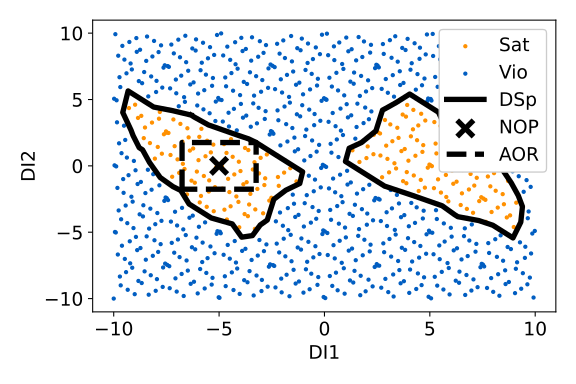
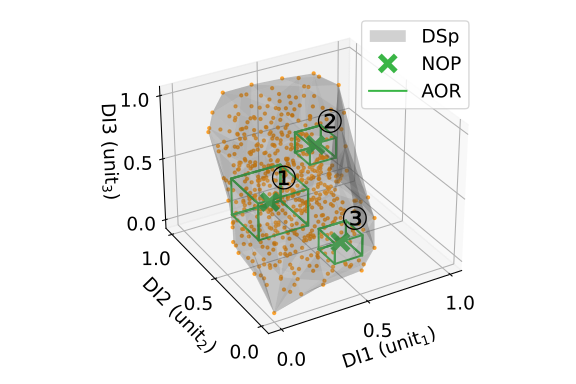
Design space identification tool for plotting and analysing design spaces (2D and 3D). Constraints with respect to key performance indicators (KPIs) are used to categorize the samples. Concave hulls (alpha shape) are used to identify design space (DSp) and quantify the size of the space. Given nominal operating point (NOP), an acceptable operating region (AOR) can be quantified to find the maximum multivariate allowable disturbance that the process can still handle while satisfying all constraints (multivariate proven acceptable range - MPAR).
Installation
Currently, dside requires pandas, numpy, and matplotlib. dside can be installed with the following commands.
pip install dside
Quick Overview
Use this tool to visualize 2D and 3D design spaces, obtain mathematical representations of the design space boundary in the form of alpha shapes, calculate the size of the design space, and investigate nominal operating points in terms of performance and flexibility (acceptable ranges). Identification of multi-region spaces is possible.
import dside
# 1. Create instance of ds with data from DataFrame df
ds = dside.DSI(df)
# 2. Screen the points using the constraints (dictionary)
ds.screen(constraints)
# 3. Find DSp boundaries based on vnames (list of variable names)
ds.find_DSp(vnames)
# 4. Plot the design space and the samples
ds.plot(vnames)
# 5. Plot the nominal point and AOR based on point x (list/numpy array)
ds.find_AOR(x)
# 6. Save the results in detailed output.txt file
ds.send_output('output')
Citation
Please cite the following publication if you are using dside for your own research.
@article{sachio2023dsp,
    title={A model-based approach towards accelerated process development: A case study on chromatography},
    author = {Steven Sachio and Cleo Kontoravdi and Maria M. Papathanasiou},
    journal = {Chemical Engineering Research and Design},
    volume = {197},
    pages = {800-820},
    year = {2023},
    issn = {0263-8762},
    doi = {https://doi.org/10.1016/j.cherd.2023.08.016},
    url = {https://www.sciencedirect.com/science/article/pii/S0263876223005166},
}
1 maintainer

Release files for dside 2.3.3
For a detailed explanation of source distributions (sdists) and built distributions (wheels), please see the package formats documentation.
Source distribution (sdist)
| File | Size | Uploaded | |
|---|---|---|---|
| dside-2.3.3.tar.gz | 22.4 kB | Details |
Release files / dside-2.3.3.tar.gz
| Download URL | dside-2.3.3.tar.gz |
|---|---|
| Size | 22.4 kB |
| Tags | Source |
|
SHA-256 checksum How to use checksums |
d63426bbe16d66acb74727e3c2dff5922952f1d371d4778e87709fb5043fc901
|
|
BLAKE2b-256 checksum How to use checksums |
29bc796911fa82a566746b0bc05d5f556d94c96e62c23d649aaddaff819de83f
|
| Upload date | |
|
Uploaded using Trusted Publishing? What is trusted publishing? |
No |
| Uploaded via |
twine/5.1.1 CPython/3.10.6
|














