







dsigma is an easy-to-use Python package for measuring gravitational galaxy-galaxy lensing. Using a lensing catalog, it estimates excess surface density around a population of lenses, such as galaxies in the Sloan Digital Sky Survey or the Baryon Oscillation Spectroscopic Survey. It has a flexible API and can utilize data from, DECADE, the Dark Energy Survey (DES), the Kilo-Degree Survey (KiDS), and the Hyper Suprime-Cam (HSC) lensing surveys, among others. With core computations written in C, dsigma is very fast. Additionally, dsigma provides out-of-the-box support for estimating covariances with jackknife resampling and calculating various summary statistics.
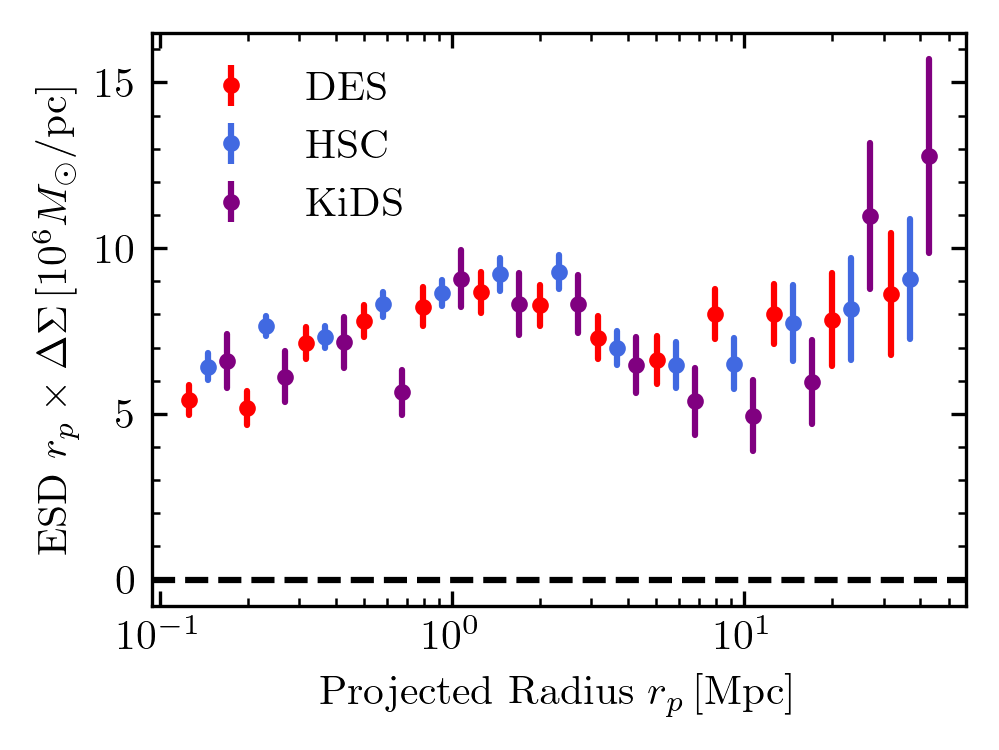
dsigma focuses specifically on computing the excess surface density $\Delta\Sigma$ around a set of lens galaxies as a function of projected physical separation. In principle, the more general TreeCorr package can also be used to compute various two-point correlation functions, including galaxy-galaxy lensing. However, for galaxy-galaxy lensing, TreeCorr computes the tangential shear $\gamma_t$, not $\Delta\Sigma$. Furthermore, TreeCorr has a steeper learning curve and requires more care in implementing survey-specific correction terms.
Authors
- Johannes U. Lange
- Song Huang
Installation
The easiest way to install dsigma is to use pip for the latest stable version from the Python Package Index (PyPI).
pip install dsigma
Alternatively, you can install the latest development version from GitHub.
pip install git+https://github.com/johannesulf/dsigma
Documentation
Documentation for dsigma with concept introductions, examples, and API documentation is available on readthedocs.
Attribution
dsigma is listed in the Astronomy Source Code Library. If you find the code useful in your research, please cite Lange & Huang (2022).
License
dsigma is licensed under the MIT License.
Generative AI
Generative AI was used to search for potential bugs in the code and to improve the documentation by finding typos and suggesting minor rewrites. The core developers did not use AI to write any part of the dsigma code itself. Code contributions from other developers may use AI, as described in the respective pull requests, and are carefully vetted by the core developers.
1 maintainer

Metadata
1 maintainer
Release files for dsigma 1.2.4
For a detailed explanation of source distributions (sdists) and built distributions (wheels), please see the package formats documentation.
Source distribution (sdist)
| File | Size | Uploaded | Provenance | Actions |
|---|---|---|---|---|
| dsigma-1.2.4.tar.gz | 32.6 kB | Without provenance | Details for dsigma-1.2.4.tar.gz |
Release files / dsigma-1.2.4.tar.gz
| Download URL | dsigma-1.2.4.tar.gz |
|---|---|
| Size | 32.6 kB |
| Tags | Source |
|
SHA-256 checksum How to use checksums |
71aa1b7953f1dfde97497f898bbbe8da2d2cba2de927f9084e9feaf7e9e3d8be
|
|
BLAKE2b-256 checksum How to use checksums |
497f9b96d87b3c1cc22a053db74fc527893d5170ff7c10552c0a86b0f374ae6d
|
| Upload date | |
|
Uploaded using Trusted Publishing? What is trusted publishing? |
No |
| Uploaded via |
twine/7.0.0 CPython/3.14.10
|
Security for dsigma 1.2.4
Provenance
Provenance describes where a file came from. On PyPI, provenance is shared via attestations, which provide a verifiable record of the build or publishing details. View details, limitations and caveats.
No provenance found
None of the files in this release were uploaded with provenance metadata.
A note on package security
PyPI is a repository for distributing packages, not a service for auditing them. While third-party security researchers and our staff do their best to detect and remove malicious packages, PyPI cannot guarantee the quality, security or suitability of any given package.
To learn more about protecting yourself from malicious actors, visit our package security documentation.














