

DTA-GNN: Target-Specific Binding Affinity Dataset Builder and GNN Trainer
Build leakage-free Drug-Target Affinity datasets from ChEMBL and train Graph Neural Networks for your targets of interest.



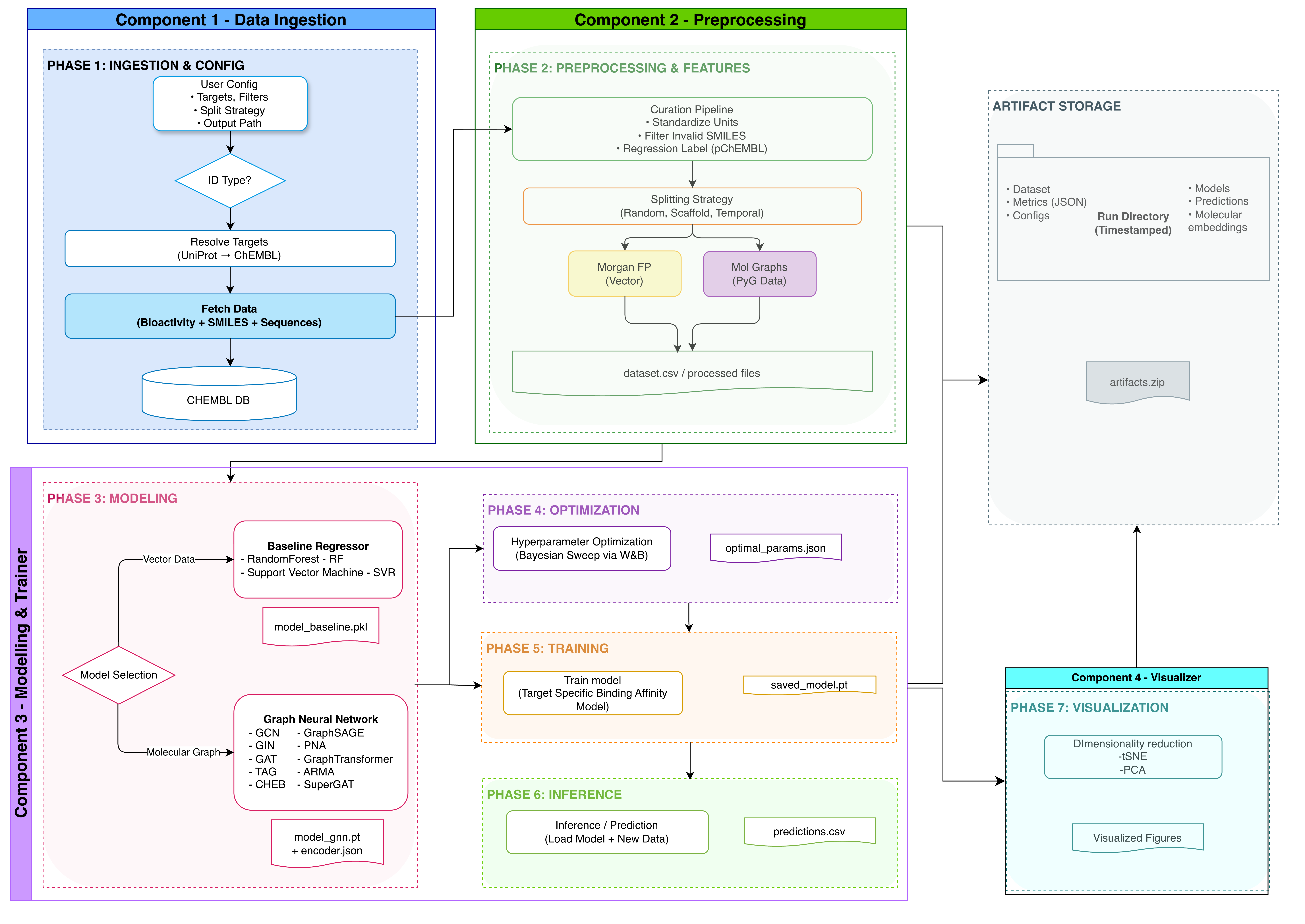
🧬 From ChEMBL target → Clean dataset → Trained GNN for your target of interest
🎯 Overview
DTA-GNN is an end-to-end toolkit for Drug-Target Affinity prediction that:
- Curates clean, leakage-free datasets from ChEMBL
- Converts molecules to 2D molecular graphs or Morgan fingerprints
- Trains baseline models (Random Forest, SVR) and Graph Neural Networks (GIN, GCN, GAT, GraphSAGE, PNA, Transformer, TAG, ARMA, Cheb, SuperGAT)
- Evaluates with proper scaffold-aware splitting
📦 Installation
pip
# from source (development)
pip install -e .

# With development tools (for contributors)
pip install -e ".[dev]"
# from PyPI (coming soon!)
pip install dta-gnn
Docker
# Pull from GitHub Container Registry
docker pull ghcr.io/gozsari/dta-gnn:latest

# Run Web UI (Web API mode - no local database needed)
docker run --rm -p 7860:7860 ghcr.io/gozsari/dta-gnn:latest \
    dta_gnn ui --host 0.0.0.0

# Run Web UI with local ChEMBL database
docker run --rm -p 7860:7860 \
  -v $(pwd)/chembl_dbs:/home/dtagnn/app/chembl_dbs \
  -v $(pwd)/runs:/home/dtagnn/app/runs \
  ghcr.io/gozsari/dta-gnn:latest dta_gnn ui --host 0.0.0.0
# In the UI, use path: chembl_dbs/chembl_36.db

# Run CLI commands
docker run --rm -v $(pwd)/runs:/home/dtagnn/app/runs \
  ghcr.io/gozsari/dta-gnn:latest \
  dta_gnn setup --version 36 --dir ./chembl_dbs

# Or use Docker Compose
docker-compose up ui        # Web UI
docker-compose up jupyter   # Jupyter Lab
🚀 Quick Start
CLI
# Download ChEMBL database (optional, for faster data access)
dta_gnn setup --version 36 --dir ./chembl_dbs

# Launch the Web UI
dta_gnn ui

# Run the full end-to-end pipeline from a UniProt ID
dta_gnn train-gnn P00533 --architecture gin --wandb-project my_project --n-trials 20 --epochs 30
Python API
# One-call end-to-end pipeline: UniProt → dataset → HPO → trained GNN → test metrics
from dta_gnn.training import run_gnn_end_to_end, EndToEndConfig

result = run_gnn_end_to_end(EndToEndConfig(
    uniprot_ids="P00533",        # EGFR — any UniProt accession
    architecture="gin",
    wandb_project="my_project",
    n_trials=20,
    epochs=30,
))
print(result.test_metrics)   # {"rmse": ..., "r2": ..., "mae": ...}
print(result.timings)        # per-step wall-clock times
Or use the lower-level API to build datasets and train models step by step:
from dta_gnn.pipeline import Pipeline
from dta_gnn.models import train_random_forest_on_run, train_svr_on_run, train_gnn_on_run, GnnTrainConfig

# 1. Build dataset for your target of interest
pipeline = Pipeline(source_type="web")
dataset = pipeline.build_dta(
    target_ids=["CHEMBL1862"],  # Your kinase, GPCR, or other target
    split_method="scaffold",    # Proper leakage-free splitting
)

# 2. Train a baseline model (Random Forest or SVR)
rf_result = train_random_forest_on_run("runs/current", n_estimators=500)
print(f"RF Test RMSE: {rf_result.metrics['splits']['test']['rmse']:.3f}")

# Or train SVR
svr_result = train_svr_on_run("runs/current", C=10.0, epsilon=0.1, kernel="rbf")
print(f"SVR Test RMSE: {svr_result.metrics['splits']['test']['rmse']:.3f}")

# 3. Train a Graph Neural Network
config = GnnTrainConfig(
    architecture="gin",    # GIN, GCN, GAT, GraphSAGE, PNA, Transformer, TAG, ARMA, Cheb, SuperGAT
    hidden_dim=256,
    num_layers=5,
    epochs=100,
)
gnn_result = train_gnn_on_run("runs/current", config=config)
print(f"GNN Test RMSE: {gnn_result.metrics['splits']['test']['rmse']:.3f}")
🖥️ Web UI
DTA-GNN includes an interactive Gradio-based web interface for building datasets without writing code.
Launch the UI
# Using pip
dta_gnn ui

# Using Docker
docker run --rm -p 7860:7860 ghcr.io/gozsari/dta-gnn:latest \
    dta_gnn ui --host 0.0.0.0

# Using Docker Compose
docker-compose up ui
The UI will be available at http://localhost:7860 (or the specified host/port).
🔑 Key Features
🤖 Model Training
- Baseline models: Random Forest and SVR using Morgan fingerprints (ECFP4)
- 10 GNN architectures: GIN, GCN, GAT, GraphSAGE, PNA, Transformer, TAG, ARMA, Cheb, SuperGAT
- Configurable: Layers, pooling, residual connections, hyperparameters
- Embeddings: Extract learned molecular representations from GNNs
🔒 Leakage Prevention
- Scaffold-aware train/test splits
- Temporal splits for prospective prediction
- Automatic leakage auditing
📦 End-to-End Pipeline
- One-call end-to-end pipeline: UniProt ID → ChEMBL dataset → W&B HPO → trained GNN → test evaluation
- ChEMBL data fetching (Web API or SQLite)
- Standardized pChEMBL conversion
- Duplicate aggregation
- Dataset cards for reproducibility
🖥️ Multiple Interfaces
- CLI: Quick experiments from terminal
- Python API: Integration in pipelines
- Web UI: Interactive dataset building - No coding required
Supported GNN Architectures
DTA-GNN supports multiple Graph Neural Network (GNN) architectures out of the box, enabling flexibility across different graph structures, scales, and learning objectives.
| Architecture | Description | Key Characteristics |
|---|---|---|
| GIN | Graph Isomorphism Network | Highly expressive; sum aggregation with learnable ε; MLP-based updates with strong theoretical discriminative power |
| GCN | Graph Convolutional Network | Symmetric normalized adjacency; efficient and stable spectral convolution; strong baseline for semi-supervised learning |
| GAT | Graph Attention Network | Learnable neighbor attention; multi-head attention for stability; supports edge features and residual connections |
| GraphSAGE | Sample and Aggregate | Inductive learning; neighborhood sampling for scalability; flexible aggregators (mean, max, LSTM) |
| PNA | Principal Neighbourhood Aggregation | Multiple aggregators and degree-aware scalers; adapts to varying node degree distributions; robust on heterogeneous graphs |
| Transformer | Graph Transformer with multi-head attention | Dot-product self-attention; optional edge features; gated skip connections for stable deep learning |
| TAG | Topology Adaptive Graph Convolution | Explicit K-hop message passing; adapts filters to local topology; polynomial-style convolution |
| ARMA | Auto-Regressive Moving Average | Recursive stacked filters with residual connections; stable deep propagation; efficient spectral approximation |
| Cheb | Chebyshev Spectral Graph Convolution | K-hop localized spectral filtering; Chebyshev polynomial approximation; avoids eigen-decomposition |
| SuperGAT | Supervised Graph Attention Network | Self-supervised attention via link prediction; combines structural and feature-based attention; robust attention learning |
Configuration
from dta_gnn.models import GnnTrainConfig

config = GnnTrainConfig(
    architecture="gin",        # gin, gcn, gat, sage, pna, transformer, tag, arma, cheb, supergat
    embedding_dim=128,         # Atom embedding dimension
    hidden_dim=256,            # Hidden layer dimension
    num_layers=5,              # Number of message passing layers
    dropout=0.1,               # Dropout rate
    pooling="attention",       # add, mean, max, attention
    residual=True,             # Residual connections
    # Architecture-specific parameters (optional)
    gin_conv_mlp_layers=2,     # GIN: MLP depth in convolution
    gin_train_eps=False,       # GIN: Whether to learn epsilon
    gin_eps=0.0,               # GIN: Initial epsilon value
    gat_heads=4,               # GAT: Number of attention heads
    sage_aggr="mean",          # GraphSAGE: Aggregation (mean, max, lstm, pool)
    transformer_heads=4,       # Transformer: Number of attention heads
    tag_k=2,                   # TAG: K-hop message passing
    arma_num_stacks=1,         # ARMA: Number of stacks
    arma_num_layers=1,         # ARMA: Number of layers per stack
    cheb_k=2,                  # Cheb: K-hop spectral filtering
    supergat_heads=4,          # SuperGAT: Number of attention heads
    supergat_attention_type="MX",  # SuperGAT: Attention type (MX, SD)
    lr=1e-3,                   # Learning rate
    batch_size=64,
    epochs=100,
)
🔬 Molecular Graph Representation
DTA-GNN converts SMILES to rich 2D molecular graphs:
Molecule (SMILES) → Atoms (Nodes) + Bonds (Edges) → GNN → Prediction
Node Features (6D):
- Atomic number
- Total degree
- Formal charge
- Total H count
- Aromaticity
- Atomic mass
Edge Features (6D):
- Single/Double/Triple bond
- Aromaticity
- Conjugation
- Ring membership
from dta_gnn.features.molecule_graphs import smiles_to_graph_2d

# Convert any molecule to a graph
graph = smiles_to_graph_2d(
    molecule_chembl_id="aspirin",
    smiles="CC(=O)OC1=CC=CC=C1C(=O)O"
)
print(f"Atoms: {len(graph.atom_type)}, Bonds: {graph.edge_index.shape[1]//2}")
📊 Examples
Complete Workflow
from dta_gnn.pipeline import Pipeline
from dta_gnn.models import train_gnn_on_run, GnnTrainConfig
from dta_gnn.audits import audit_scaffold_leakage

# Step 1: Build dataset for kinase targets
pipeline = Pipeline(source_type="sqlite", sqlite_path="chembl_36.db")
df = pipeline.build_dta(
    target_ids=["CHEMBL1862", "CHEMBL2111", "CHEMBL3778"],
    split_method="scaffold",
)
print(f"Dataset: {len(df)} drug-target pairs")

# Step 2: Verify no data leakage
train = df[df["split"] == "train"]
test = df[df["split"] == "test"]
audit = audit_scaffold_leakage(train, test)
print(f"Scaffold leakage: {audit['leakage_ratio']:.1%}")  # Should be 0%

# Step 3: Train GNN model
config = GnnTrainConfig(
    architecture="gin",
    hidden_dim=256,
    num_layers=5,
    pooling="attention",
    epochs=100,
)
result = train_gnn_on_run("runs/current", config=config)

# Step 4: Evaluate
print(f"Train RMSE: {result.metrics['splits']['train']['rmse']:.3f}")
print(f"Val RMSE:   {result.metrics['splits']['val']['rmse']:.3f}")
print(f"Test RMSE:  {result.metrics['splits']['test']['rmse']:.3f}")

# Step 5: Extract molecular embeddings for downstream tasks
from dta_gnn.models import extract_gnn_embeddings_on_run
embeddings = extract_gnn_embeddings_on_run("runs/current")
print(f"Extracted {embeddings.n_molecules} embeddings of dim {embeddings.embedding_dim}")
👥 Who Is This For?
| You Are... | You Want To... | DTA-GNN Gives You... |
|---|---|---|
| Drug Discovery Researcher | Predict affinity for your target | End-to-end pipeline with baseline models and GNNs |
| ML Researcher | Benchmark new GNN architectures | Leakage-free datasets + baselines (RF, SVR, 10 GNN architectures) |
| Computational Chemist | Screen compounds virtually | Trained models + embeddings |
📖 Documentation
🧪 Testing
pytest tests/ -v
📄 License
MIT License - see LICENSE
📚 Citation
@article{ozsari2026dta,
  title={DTA-GNN: a toolkit for constructing target-specific drug--target affinity datasets and training graph neural networks},
  author={Özsari, Gökhan and Rifaioğlu, Ahmet Süreyya and Acar, Aybar Can and Doğan, Tunca and Atalay, M Volkan},
  journal={SoftwareX},
  volume={34},
  pages={102671},
  year={2026},
  publisher={Elsevier}
}
1 maintainer

Metadata
1 maintainer
Release files for dta-gnn 0.2.1
For a detailed explanation of source distributions (sdists) and built distributions (wheels), please see the package formats documentation.
Source distribution (sdist)
| File | Size | Uploaded | |
|---|---|---|---|
| dta_gnn-0.2.1.tar.gz | 112.9 kB | Details |
Built distribution (wheel)
| File | Interpreter | ABI | Platform | Reset |
|---|---|---|---|---|
| dta_gnn-0.2.1-py3-none-any.whl | Python 3 | none | any | Details |
Total release size: 212.4 kB
Release files / dta_gnn-0.2.1.tar.gz
| Download URL | dta_gnn-0.2.1.tar.gz |
|---|---|
| Size | 112.9 kB |
| Tags | Source |
|
SHA-256 checksum How to use checksums |
cb32ee2282d444479259f32a163ea72d1889fbd23c4d427118af911e75fd2863
|
|
BLAKE2b-256 checksum How to use checksums |
db3d0581e3a362b5f9905c48d1ee2e28f3f5137cdb6f4a4ad78e33ba001e84e5
|
| Upload date | |
|
Uploaded using Trusted Publishing? What is trusted publishing? |
No |
| Uploaded via |
twine/6.2.0 CPython/3.10.20
|
Release files / dta_gnn-0.2.1-py3-none-any.whl
| Download URL | dta_gnn-0.2.1-py3-none-any.whl |
|---|---|
| Size | 99.6 kB |
| Tags | Python 3 |
|
SHA-256 checksum How to use checksums |
5d3aa197c5e23a86aec1707d2a1ea55e62b33bb6264e37a60e75ff9bb2d7b0ec
|
|
BLAKE2b-256 checksum How to use checksums |
2ad5ded79309fcb70a645163914c8245cc874b323ecd2fe2961e511946021733
|
| Upload date | |
|
Uploaded using Trusted Publishing? What is trusted publishing? |
No |
| Uploaded via |
twine/6.2.0 CPython/3.10.20
|














