
Codes for the paper: Unexpected clustering pattern in dwarf galaxies challenges formation models

Project description
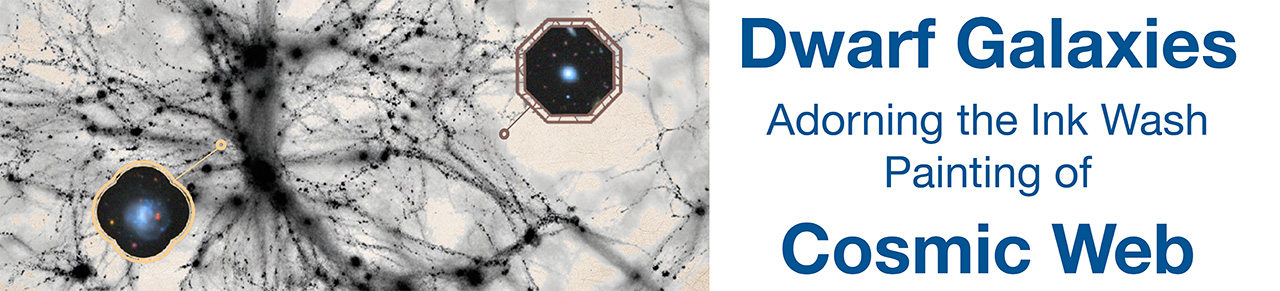



The package holds the codes for the paper Unexpected clustering pattern in dwarf galaxies challenges formation models (Ziwen Zhang et al. Nature 2025, arXiv:2504.03305).
What did we discover in this work?
A surprising pattern of spatial distribution was discovered in dwarf galaxies that diffuse ones cluster more strongly than compact ones - reversing the trends seen in massive galaxies. This challenges the structure formation models within the standard cold-dark-matter cosmology, calling for revisions for the understanding of the assembly of visible- and dark-matter structures.
Installation
To install the package, run:
pip install dwarf-assembly-bias
Alternatively, you can clone the repository and install the package locally via pip install -e /path/to/the/repo.
Resources for the paper
Code samples
Code samples are organized as individual programs, scripts or jupyter-notebooks, each for a specific procedure in producing the results in the paper. All code samples are put under docs/code_samples/:
- cal_2pccf/: program for two-point cross-correlation function (2PCCF) in observation.
- cov_fit.py, fit_bias.py: measuring the covariance matrix and fitting the relative bias.
- Mhalo.py: HI-based halo mass estimation by assuming Burkert profile.
- galaxy_web_cross.py: program for galaxy-cosmic web (knots, filaments, sheets and voids) 2PCCFs, for a sample of galaxies with given real-space locations. galaxy_web_cross_from_obs_sample.py: is similar but takes input galaxies in redshift-space and make a correction for the redshift-space distortion before calculating the 2PCCFs.
- theory.ipynb: theoretical interpretations (galaxy-galaxy 2PCCF in theory, abundance matching, model of self-interaction dark matter).
Data for the figures
Here we provide all the data sheets, and scripts to load the data sheets and generate the figures exactly as those presented in the paper. All of these are held under docs/figures/. Specifically,
- data/: Excel data sheets, one for each Figure or Extended Data Figure.
- plots_observation.py: scripts to generate observational figures (Fig. 1 and Extended Data Figs. 1-7).
- plots_theory.ipynb: scripts to generate theoretical figures (Figs. 2, 3, 4 and Extended Data Fig. 8).
For developers
Contribute to the project
Pull requests are welcome. For any changes, start a pull request to the dev branch and we will review it.
For users
Citation
We ask the users to cite the paper when using the package (code or data) in their research.
Users using specific module/code sample should also follow the copyright header in the source files.
Details of this work
Sample construction
The samples and subsamples of observed dwarf galaxies are described in the main text (Methods: "The sample of dwarf galaxies").
To measure the 2PCCF from observation, two additional sets of samples are constructed:
- The reference sample, used as field tracers, is a magnitude-limited sample constructed from the NYU-VAGC sample following the following selection criteria described in Sec. 2.1 of Lixin Wang et al. 2019: the $r$-band Petrosian apparent magnitude $r<17.6$; the $r$-band Petrosian absolute magnitude in $[-24, -16]$; the redshift $0.01 < z < 0.2$.
- The random samples, used to account for the observational selection effects, is obtained according to the method described in Sec. 3.1 of Cheng Li et al. 2006 as follows. We generated ten duplicates for each galaxy in the reference sample and randomly place them in the SDSS survey area. All other properties, including stellar mass and redshift of the duplicates, are the same as those of the parent galaxy. The random sample thus has the same survey geometry, the same distributions of galaxy properties and redshift, as the reference sample.
Acknowledgements
We thank Fangzhou Jiang for his open source project of self-interaction dark matter (Fangzhou Jiang et al. 2023; ads; github). A copy the source code can be found under src/dwarf_assembly_bias/sidm/.
We thank Hui-Jie Hu for his subroutines of HI-based halo mass estimator. A copy of the source code can be found at docs/code_samples/Mhalo.py.
Release history Release notifications | RSS feed


Download files
Download the file for your platform. If you're not sure which to choose, learn more about installing packages.
Source Distribution
Built Distribution
Filter files by name, interpreter, ABI, and platform.
If you're not sure about the file name format, learn more about wheel file names.
Copy a direct link to the current filters
File details
Details for the file dwarf_assembly_bias-0.0.2.tar.gz.
File metadata
- Download URL: dwarf_assembly_bias-0.0.2.tar.gz
- Upload date:
- Size: 75.5 kB
- Tags: Source
- Uploaded using Trusted Publishing? No
- Uploaded via: twine/6.1.0 CPython/3.11.11
File hashes
| Algorithm | Hash digest | |
|---|---|---|
| SHA256 |
a6233f997749197092446786ad21a75f85df4e1cb91dd06ea695d9597a52fc07
|
|
| MD5 |
29b10f8e83f0f0e047c1053596484b11
|
|
| BLAKE2b-256 |
7d66e3a01205682da50df34b147afbd16a6481914d92eda726d152f71f771126
|
File details
Details for the file dwarf_assembly_bias-0.0.2-py3-none-any.whl.
File metadata
- Download URL: dwarf_assembly_bias-0.0.2-py3-none-any.whl
- Upload date:
- Size: 86.8 kB
- Tags: Python 3
- Uploaded using Trusted Publishing? No
- Uploaded via: twine/6.1.0 CPython/3.11.11
File hashes
| Algorithm | Hash digest | |
|---|---|---|
| SHA256 |
fb442dc6a52f2e8c43b45b3cc886e181263b4fe3bcd4282cc44452888ff48a7b
|
|
| MD5 |
e2791906f0ad49315a854b5ead015591
|
|
| BLAKE2b-256 |
e34a8cf4a13aca25110ccbab3652e648505ee416e580b0cb9ef858f3ebfa6719
|






