



Ocean SDK is D-Wave’s suite of tools for solving hard problems with quantum computers.
Installation
Installation from PyPI:
pip install dwave-ocean-sdkFor more information, see the Ocean documentation’s installation page.
Getting Started
Sign up for the Leap quantum cloud service here: Leap signup.
Start learning with the following D-Wave resources:
D-Wave Documentation to learn about quantum computers and how to use them.
Get Started with Ocean Software to install and start coding with Ocean software.
dwave-examples for code examples and Jupyter Notebooks.
Resource Library on D-Wave website for whitepapers and additional resources.
Example Quantum Program
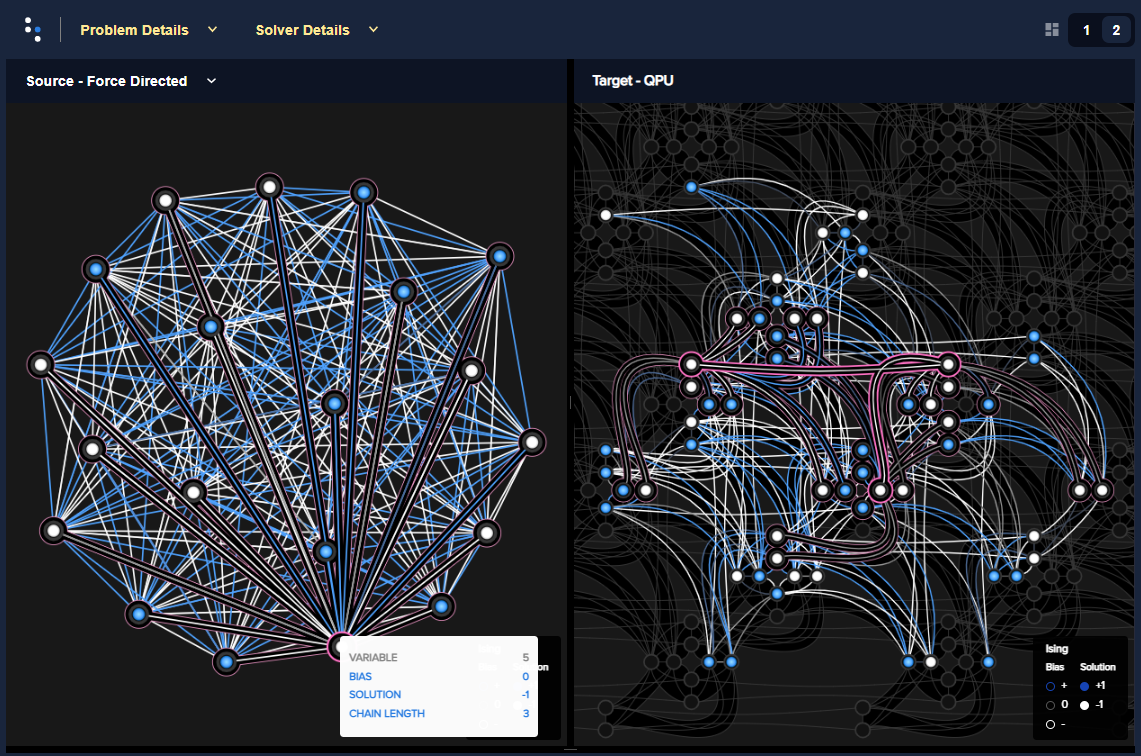
The following lines of code solve and visualize a random problem on a quantum computer.
import dimod
import dwave.inspector
import dwave.system

bqm = dimod.generators.ran_r(1, 20)
sampler = dwave.system.EmbeddingComposite(dwave.system.DWaveSampler())
sampleset = sampler.sample(bqm, num_reads=100)
dwave.inspector.show(sampleset)
The left side of the visualized solution represents the problem’s variables as circles, with white dots for variables assigned values of -1 and blue dots for values of +1; the colors of the connecting lines represent values of the quadratic coefficients for each pair of variables. The right side shows the qubits representing these variables on a quantum processing unit.
You can find introductory examples in the documentation and dwave-examples GitHub repository, and many customer prototype applications on the D-Wave website.
Support
Find support here:
Leap user community to converse with a large community of D-Wave users.
Leap help center to search the Leap knowledge base.
SDK GitHub repo to open issues or request features on the Ocean SDK or on any one of its packages.
Contributing
Your contributions are welcome!
Ocean’s contributing guide has guidelines for contributing to Ocean packages.
License
Released under the Apache License 2.0. See LICENSE file.
2 maintainers


Metadata
2 maintainers
Release files for dwave-ocean-sdk 9.5.0
For a detailed explanation of source distributions (sdists) and built distributions (wheels), please see the package formats documentation.
Source distribution (sdist)
| File | Size | Uploaded | Provenance | Actions |
|---|---|---|---|---|
| dwave_ocean_sdk-9.5.0.tar.gz | 8.8 kB | Without provenance | Details for dwave_ocean_sdk-9.5.0.tar.gz |
Built distribution (wheel)
| File | Interpreter | ABI | Platform | Actions Reset |
|---|---|---|---|---|
| dwave_ocean_sdk-9.5.0-py3-none-any.whl | Python 3 | none | any | Details for dwave_ocean_sdk-9.5.0-py3-none-any.whl |
Total release size: 17.3 kB
Release files / dwave_ocean_sdk-9.5.0.tar.gz
| Download URL | dwave_ocean_sdk-9.5.0.tar.gz |
|---|---|
| Size | 8.8 kB |
| Tags | Source |
|
SHA-256 checksum How to use checksums |
e78f34d94d4cd5b35a8b3cd6a92c0ba50ea5830b5acfdec5ce4354657afb9074
|
|
BLAKE2b-256 checksum How to use checksums |
50ea0f44828eb15a60166e5512dac3194276124eb700f0d6b27f83254e611f63
|
| Upload date | |
|
Uploaded using Trusted Publishing? What is trusted publishing? |
No |
| Uploaded via |
twine/7.0.0 CPython/3.12.14
|
Release files / dwave_ocean_sdk-9.5.0-py3-none-any.whl
| Download URL | dwave_ocean_sdk-9.5.0-py3-none-any.whl |
|---|---|
| Size | 8.5 kB |
| Tags | Python 3 |
|
SHA-256 checksum How to use checksums |
20a330e4654c160ad938759ff9789d95784cbf0b7d2b19a9e5f6ca73875786b3
|
|
BLAKE2b-256 checksum How to use checksums |
33cec69380c84dacb695931427c8e630e0cef7cc5a20594aa8261c2c07620bd8
|
| Upload date | |
|
Uploaded using Trusted Publishing? What is trusted publishing? |
No |
| Uploaded via |
twine/7.0.0 CPython/3.12.14
|
Security for dwave-ocean-sdk 9.5.0
Provenance
Provenance describes where a file came from. On PyPI, provenance is shared via attestations, which provide a verifiable record of the build or publishing details. View details, limitations and caveats.
No provenance found
None of the files in this release were uploaded with provenance metadata.
A note on package security
PyPI is a repository for distributing packages, not a service for auditing them. While third-party security researchers and our staff do their best to detect and remove malicious packages, PyPI cannot guarantee the quality, security or suitability of any given package.
To learn more about protecting yourself from malicious actors, visit our package security documentation.














