
OData filter and projection helpers for AWS DynamoDB
Verified details
These details have been verified by PyPIProject links
GitHub Statistics
Maintainers

Project description
dynamo-odata
DynamoDB-focused OData toolkit: build filters, projections, and query DynamoDB tables using OData expressions — with full async support and no eval().
Features:
- OData
$filterexpressions → boto3ConditionBase(no string eval, fully type-safe) - OData
$select→ProjectionExpressionwith reserved keyword handling - OData
$expand→ batch FK resolution with dotted$selectsupport - FastAPI integration:
ODataQueryParams+ODataServicewires all OData params in one call - DynamoDB CRUD operations with sync and async (
aioboto3) parity - Single-table design helpers (
1#/0#active prefix, soft/hard delete, restore) - Atomic multi-item writes via
transact_write - GSI queries with OData filter support
- Pydantic-friendly: call
model.model_dump(exclude_none=True)before writes — see Pydantic integration - 197 tests, lark-based parser, Python 3.10+
What this is: A focused DynamoDB library. Not an ORM, not a general SQL tool, not a full OData server.
What's NOT included (by design): SQL backends, table creation, schema migrations, Athena, SQLite.
Why dynamo-odata?
Unreadable filter expressions
# boto3 raw
Attr('status').eq('active') & Attr('age').gt(18)

# dynamo-odata — pass the OData string straight from the query param
filter="status eq 'active' and age gt 18"
FK resolution N+1 boilerplate
# boto3 raw — ~50 lines: collect, deduplicate, chunk into 100-key batches,
# retry UnprocessedKeys, join results back onto base items

# dynamo-odata — one call, concurrent batches, automatic retry
await expand_items_async(items, {"owner": owner_cfg}, db)
FastAPI query-param wiring
# boto3 raw — ~30 lines of Query() params + manual threading to DynamoDB

# dynamo-odata
@app.get("/items")
async def list_items(params: ODataQueryParams = Depends(ODataQueryParams)):
    return await item_service.query_items(db, pk, params)
| Task | Raw boto3 | dynamo-odata |
|---|---|---|
| OData filter from query string | ~15 lines (parse, validate, build ConditionBase) |
filter="status eq 'active'" |
| Resolve FKs for 25 items | ~50 lines (collect, deduplicate, chunk, retry, join) | expand_items_async(items, specs, db) |
| Wire filter/select/expand/pagination in FastAPI | ~30 lines of Query params + manual threading |
Depends(ODataQueryParams) + query_items |
Installation
# Core library (sync only)
pip install dynamo-odata

# With async support (aioboto3)
pip install dynamo-odata[async]

# With FastAPI integration (ODataQueryParams, ODataService)
pip install dynamo-odata[fastapi]

# Development
pip install dynamo-odata[dev]
Setup
AWS Credentials
dynamo-odatausesboto3, so configure AWS credentials as you normally would:
# Option 1: Environment variables
export AWS_ACCESS_KEY_ID=...
export AWS_SECRET_ACCESS_KEY=...
export AWS_DEFAULT_REGION=us-west-2

# Option 2: AWS credentials file
~/.aws/credentials
~/.aws/config

# Option 3: IAM role (on EC2, Lambda, etc.)
# Automatic if running in AWS
Quick Test
Verify the installation works:
from dynamo_odata import build_filter

# Parse an OData filter expression
condition = build_filter("status eq 'active'")
print(condition)  # Attr('status').eq('active')
Quickstart
Sync Operations
from dynamo_odata import DynamoDb, build_filter, build_projection

# Initialize the client
db = DynamoDb(table_name="users-table", region="us-west-2")

# Get a single item by partition and sort key
item = db.get(pk="user::tenant1", sk="1#user123", item_only=True)

# Query all items for a tenant, with OData filter
items = db.get_all(
    pk="user::tenant1",
    filter="status eq 'active' and age gt 18",
    item_only=True
)

# Batch get multiple items
items = db.batch_get(pk="user::tenant1", sks=["user1", "user2", "user3"], item_only=True)

# Create or update an item
db.put(pk="user::tenant1", sk="1#user123", data={"name": "Ada", "status": "active"})

# Soft delete (moves to inactive prefix `0#`)
db.soft_delete(pk="user::tenant1", sk="1#user123")

# Hard delete (permanent)
db.hard_delete(pk="user::tenant1", sk="1#user123")

# Paginate through results
for page in db.scan_all_paginated(pk="user::tenant1", page_size=50):
    print(f"Got {len(page)} items")
Async Operations
All methods have async equivalents. Use with asyncio or async frameworks like FastAPI:
from dynamo_odata import DynamoDb

db = DynamoDb(table_name="users-table", region="us-west-2")

# Async reads (with native aioboto3)
item = await db.get_async(pk="user::tenant1", sk="1#user123", item_only=True)
items = await db.get_all_async(pk="user::tenant1", filter="status eq 'active'")
items = await db.batch_get_async(pk="user::tenant1", sks=["user1", "user2"])

# Async writes
await db.put_async(pk="user::tenant1", sk="1#user123", data={"name": "Ada"})
await db.soft_delete_async(pk="user::tenant1", sk="1#user123")

# Async pagination
async for page in db.scan_all_paginated_async(pk="user::tenant1", page_size=50):
    print(f"Got {len(page)} items")
Key Schema Configuration
The default key attribute names are lowercase pk and sk. For projects that use uppercase
attributes such as PK and SK, pass a schema preset when constructing the client:
from dynamo_odata import DynamoDb, UPPERCASE_KEY_SCHEMA

db = DynamoDb(
    table_name="main-table",
    region="us-east-1",
    key_schema=UPPERCASE_KEY_SCHEMA,
)

item = db.get(pk="TENANT#tenant1", sk="1#USER#123", item_only=True)
You can also define a custom schema if your table uses different key names or separators:
from dynamo_odata import DynamoDb, KeySchema

custom_schema = KeySchema(
    pk_name="PK",
    sk_name="SK",
    pk_separator="::",
    sk_separator="#",
)

db = DynamoDb(table_name="custom-table", key_schema=custom_schema)
Guardrails For API Usage
For API-facing workloads, you can opt into partition-key validation and filter-policy validation so callers cannot query unexpected partitions or use unrestricted filters.
from dynamo_odata import DynamoDb, FilterPolicy, PartitionKeyGuard, UPPERCASE_KEY_SCHEMA

db = DynamoDb(
    table_name="main-table",
    key_schema=UPPERCASE_KEY_SCHEMA,
    partition_key_guard=PartitionKeyGuard(("TENANT#",)),
    filter_policy=FilterPolicy(
        allowed_fields=frozenset({"status", "specialty", "lsis3"}),
        allowed_comparators=frozenset({"eq", "ne", "gt", "ge", "lt", "le"}),
        allowed_functions=frozenset({"contains", "startswith", "tolower"}),
        max_predicates=4,
        max_depth=6,
    ),
)

# Allowed
items = db.get_all("TENANT#tenant1", filter="status eq 'active'", item_only=True)

# Rejected before query execution
# db.get_all("DISEASE#123", filter="contains(notes, 'x')", item_only=True)
Regulated Environment Profile Helpers
For API layers that need repeatable controls, use the optional regulated profile helpers:
These helpers provide policy primitives only. PHI/PII identification and enforcement rules remain the responsibility of the consuming application.
from dynamo_odata import (
    apply_response_allowlist,
    apply_response_field_policy,
    build_regulated_profile,
    validate_regulated_query,
)

profile = build_regulated_profile(
    partition_prefixes=("TENANT#",),
    allowed_filter_fields=frozenset({"status", "name"}),
    max_page_size=50,
)

normalized_limit = validate_regulated_query(
    profile,
    partition_key="TENANT#tenant1",
    filter_text="status eq 'active'",
    limit=25,
)

items = [
    {"PK": "TENANT#tenant1", "SK": "1#USER#1", "name": "Ada", "status": "active"},
]
safe_items = apply_response_field_policy(items, profile.forbidden_response_fields)
public_items = apply_response_allowlist(safe_items, frozenset({"name", "status"}))
Building Filters and Projections
Use build_filter() and build_projection() as standalone utilities (no database connection needed):
from dynamo_odata import build_filter, build_projection

# Parse OData filter into boto3 ConditionBase
condition = build_filter("status eq 'active' and age gt 18")
# Returns: Attr('status').eq('active') & Attr('age').gt(18)

# Build projection expression (field list)
# All fields are aliased because many common names are DynamoDB reserved keywords
projection_expr, attr_names = build_projection(["id", "name", "status"])
# Returns: ("#id,#name,#status", {"#id": "id", "#name": "name", "#status": "status"})
$expand
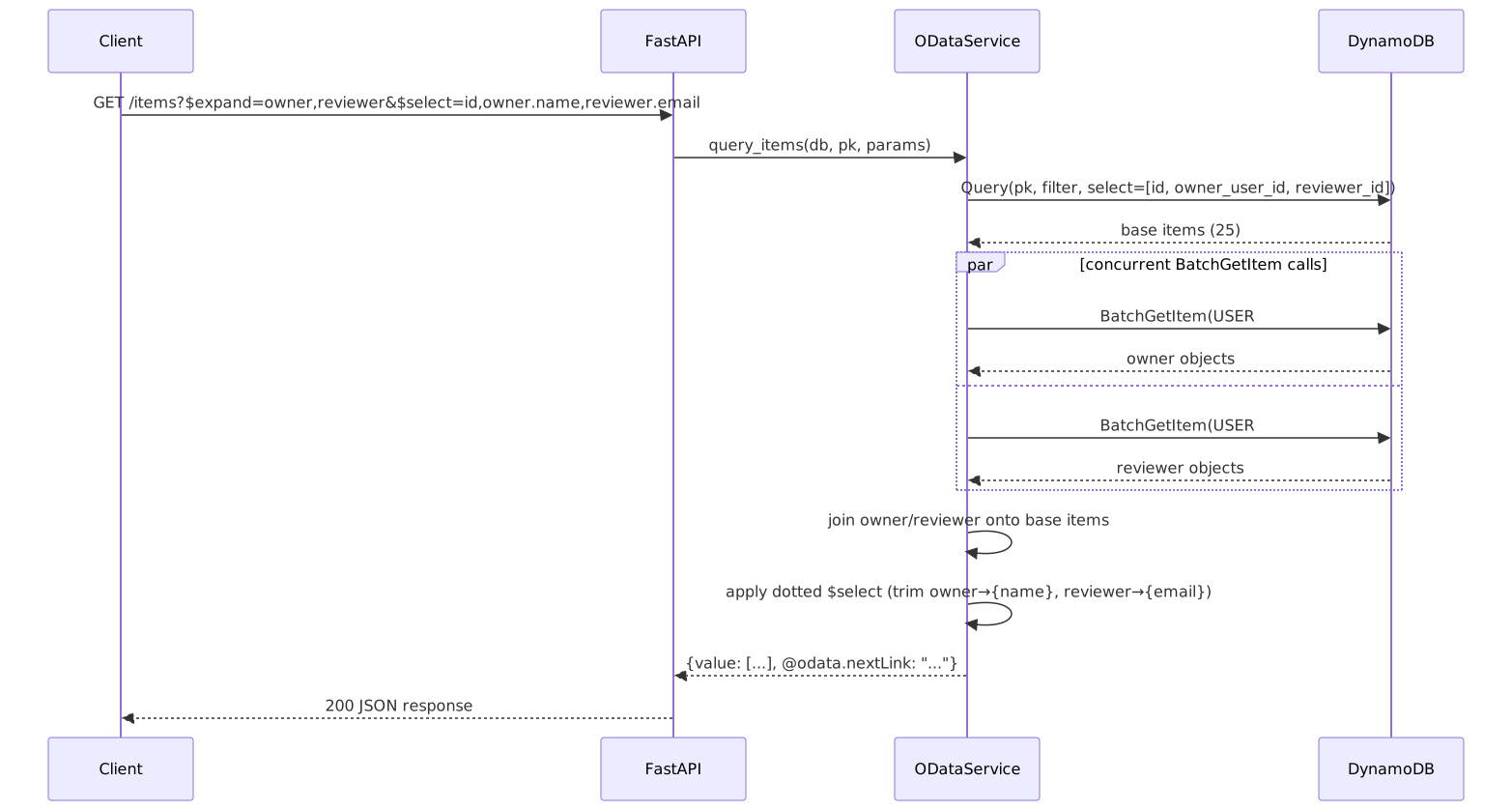
Resolve foreign-key fields to full objects using a single BatchGetItem call per alias —
no N+1 queries, automatic deduplication, concurrent fetches.
from dynamo_odata import DynamoDb
from dynamo_odata.expand import ExpandConfig, expand_items_async, apply_dotted_select

db = DynamoDb(table_name="main-table", region="us-west-2")

# Declare the FK relationship once
owner_cfg = ExpandConfig(
    local_key="owner_user_id",   # FK field on each base item
    target_pk="USER#tenant1",    # DynamoDB PK for the target entity
    remote_key="user_id",        # Field on expanded item that matches the FK
    target_sk_prefix="USER#",    # Prepended to FK value to form the SK body
    fields=("name", "email"),    # Optional: limit returned fields (None = all)
)

# Fetch base items
items, _ = await db.get_all_async(pk="ITEM#tenant1", select="id,status,owner_user_id")

# Resolve FKs — concurrent BatchGetItem per alias, auto-retry on UnprocessedKeys
items = await expand_items_async(items, {"owner": owner_cfg}, db)
# items[0] == {"id": "...", "status": "active", "owner_user_id": "alice",
#               "owner": {"user_id": "alice", "name": "Alice", "email": "alice@ex.com"}}

# Trim expanded objects to only the requested dotted sub-fields
items = apply_dotted_select(items, "id,status,owner.name,owner.email")
# items[0]["owner"] == {"name": "Alice", "email": "alice@ex.com"}
Known limitation: Expanded lookups are active-items only. DynamoDb._normalize_sks
prepends the active prefix (1#) to every sort key, so FK values pointing to soft-deleted
items silently resolve to None.
FastAPI integration
pip install dynamo-odata[fastapi]
ODataQueryParams binds all five OData query params as a Depends argument.
ODataService.query_items wires filter, select, expand, and pagination in one call.
from fastapi import Depends, FastAPI
from dynamo_odata import DynamoDb
from dynamo_odata.expand import ExpandConfig
from dynamo_odata.fastapi import ODataQueryParams, ODataService

app = FastAPI()
db = DynamoDb(table_name="main-table", region="us-west-2")

item_service = ODataService(
    expand_config={
        "owner": ExpandConfig(
            local_key="owner_user_id",
            target_pk="USER#tenant1",
            remote_key="user_id",
            target_sk_prefix="USER#",
        ),
    }
)

@app.get("/items")
async def list_items(params: ODataQueryParams = Depends(ODataQueryParams)):
    return await item_service.query_items(db, "ITEM#tenant1", params)
Supported query params on any route wired this way:
| Param | Example | Effect |
|---|---|---|
$filter |
status eq 'active' |
OData filter expression |
$select |
id,name,owner.email |
Field projection; dotted paths trim expanded objects |
$expand |
owner |
Resolve FK alias(es) via BatchGetItem |
$top |
25 |
Page size (default 25) |
$skipToken |
(opaque cursor) | Pagination token from @odata.nextLink |
Dotted $select fields (e.g. owner.email) automatically add the implied expand — no
explicit $expand=owner needed.
See examples/fastapi_expand.py for a complete runnable app with Swagger UI.
$expand flow:
Filter Expressions (OData)
Supported Operators
Comparison:
build_filter("name eq 'John'")       # equals
build_filter("age ne 30")             # not equals
build_filter("price lt 100")          # less than
build_filter("price le 100")          # less than or equal
build_filter("score gt 50")           # greater than
build_filter("score ge 50")           # greater than or equal
Logical:
build_filter("status eq 'active' and age gt 18")      # AND
build_filter("role eq 'admin' or role eq 'mod'")      # OR
build_filter("not deleted eq true")                    # NOT
Membership:
build_filter("status in ('active', 'pending', 'review')")  # IN list
build_filter("age between 18 and 65")                      # BETWEEN
String Functions:
build_filter("email contains '@example.com'")    # substring match
build_filter("email startswith 'admin'")         # prefix match
Special:
build_filter("last_seen exists")         # attribute exists
build_filter("deleted not_exists")       # attribute missing
build_filter("status eq null")           # null checks (special handling in DynamoDB)
Grouping with Parentheses
Parentheses control evaluation order and are essential when mixing and / or.
Without them, and binds more tightly than or — the same precedence rules as
Python and SQL.
# Without parentheses: `and` binds tighter than `or`
# Equivalent to: status eq 'active' and (role eq 'admin' or role eq 'mod')? NO —
# actually: (status eq 'active' and role eq 'admin') or role eq 'mod'
build_filter("status eq 'active' and role eq 'admin' or role eq 'mod'")

# With parentheses: intent is explicit and correct
build_filter("status eq 'active' and (role eq 'admin' or role eq 'mod')")

# Multiple groups
build_filter("(status eq 'active' or status eq 'trial') and (age gt 18 or override eq true)")

# Negating a group
build_filter("not (status eq 'deleted' or status eq 'banned')")

# Deeply nested
build_filter("(a eq 1 and (b eq 2 or c eq 3)) or (d eq 4 and e eq 5)")
Rule of thumb: any time you combine and with or in the same expression,
use parentheses to make the grouping explicit.
Unsupported (by design)
These are not supported in DynamoDB OData queries:
endswith,concat,indexof,length,substring,toupper,trim- datetime helpers:
year,month,day,hour,minute,date,now - math helpers:
round,floor,ceiling
Attempting to use unsupported functions raises UnsupportedFunctionException.
Common Patterns
Multi-tenant queries (single-table design):
# Query all active users in a tenant
db.get_all(
    pk="user::tenant123",
    filter="status eq 'active'",
    item_only=True
)
Combining filters:
# Complex filter expression
db.get_all(
    pk="user::tenant1",
    filter="(status eq 'active' or status eq 'trial') and age gt 18 and premium eq true",
    item_only=True
)
Projecting specific fields:
# Return only certain fields
projection_expr, attr_names = build_projection(["id", "email", "name", "created_at"])

items = db.get_all(
    pk="user::tenant1",
    projection_expression=projection_expr,
    expression_attribute_names=attr_names,
    item_only=True
)
Single-Table Pattern
dynamo-odata supports the common single-table DynamoDB design with prefixed sort keys for managing record status.
Active/Inactive Records
By convention, records use a 1# prefix for active records and 0# for inactive (soft-deleted):
# Create/put an item (automatically gets 1# prefix)
db.put(pk="user::tenant1", sk="user123", data={"email": "alice@example.com"})
# Stored as: pk="user::tenant1", sk="1#user123"

# Query only active records (default behavior)
items = db.get_all(pk="user::tenant1", item_only=True)
# Only returns records with sk starting with "1#"

# Soft delete (moves record to inactive)
db.soft_delete(pk="user::tenant1", sk="1#user123")
# Record now: pk="user::tenant1", sk="0#user123"

# Query both active and inactive
items = db.get_all(pk="user::tenant1", include_inactive=True, item_only=True)
Hard Delete vs Soft Delete
| Operation | Effect | Query Impact | Recovery |
|---|---|---|---|
soft_delete() |
Moves 1# → 0# prefix |
Item still in table, excluded from default queries | Can restore by moving back to 1# |
hard_delete() |
Removes item entirely | Item permanently gone | Not recoverable |
When to use each:
- Soft delete: User deletions, content removal, audit trails
- Hard delete: GDPR compliance, purging test data, final cleanup
Querying Soft-Deleted Items
# By default, get_all excludes soft-deleted items
items = db.get_all(pk="user::tenant1")  # Only `1#` records

# Include soft-deleted items explicitly
all_items = db.get_all(pk="user::tenant1", include_inactive=True)

# Query only soft-deleted items
deleted_items = db.get_all(
    pk="user::tenant1",
    filter="sk_begins_with('0#')"  # Low-level filter if needed
)
API Reference
DynamoDb Client
Initialization:
db = DynamoDb(
    table_name="users",           # Required
    region="us-west-2",           # Optional, defaults to us-west-2
    pk_separator="::",            # Optional, default partition key separator
    sk_separator="#",             # Optional, default sort key status separator
)
Methods (Sync/Async pairs):
| Method | Args | Returns | Notes |
|---|---|---|---|
get / get_async |
pk, sk, [item_only] |
dict or Item | Single item lookup |
get_all / get_all_async |
pk, [filter, select, item_only, include_inactive] |
list[dict] | Query with filter |
batch_get / batch_get_async |
pk, sks, [item_only] |
list[dict] | Multiple items, auto-chunked |
put / put_async |
pk, sk, data |
None | Unconditional full-item replace (PUT semantics) |
put_item / put_item_async |
pk, sk, item |
None | Unconditional write; does not strip key attrs |
create_item / create_item_async |
pk, sk, item |
None | Conditional write — raises if item already exists |
update_item / update_item_async |
pk, sk, updates |
dict | Partial update (PATCH); returns full item after write |
query_gsi / query_gsi_async |
index_name, pk_attr, pk_value, [sk_*, filter, limit, cursor] |
(list[dict], cursor) | GSI query with optional SK conditions and pagination |
transact_write / transact_write_async |
operations |
None | Atomic multi-item write (up to 25 ops); TableName injected automatically |
restore / restore_async |
pk, sk_body, [restore_data] |
None | Swap SK from 0# → 1#, clear deleted_* attrs |
delete / delete_async |
pk, sk |
None | Hard delete |
soft_delete / soft_delete_async |
pk, sk |
None | Soft delete (prefix move) |
hard_delete / hard_delete_async |
pk, sk |
None | Permanent delete |
scan_all_paginated / scan_all_paginated_async |
[pk, filter, page_size] |
Iterator[list[dict]] | Paginated scan |
Utility Functions:
| Function | Args | Returns | Notes |
|---|---|---|---|
build_filter(expr) |
OData filter string | ConditionBase | Parse filter expression |
build_projection(fields) |
list[str] | (expr, attr_names_dict) | Build projection + name map |
Key Helpers (DynamoDb methods):
| Method | Args | Returns | Notes |
|---|---|---|---|
build_pk |
*parts |
str | Joins key parts with pk_separator |
build_active_sk |
value |
str | Ensures active SK prefix (1# by default) |
build_inactive_sk |
value |
str | Ensures inactive SK prefix (0# by default) |
is_active_sk |
value |
bool | Checks active prefix |
is_inactive_sk |
value |
bool | Checks inactive prefix |
Pydantic Integration
dynamo-odata is Pydantic-agnostic — it works with plain dicts. The recommended
pattern when using Pydantic models is to serialise to dict before writing and
deserialise after reading:
from dynamo_odata import DynamoDb, UPPERCASE_KEY_SCHEMA
from pydantic import BaseModel

db = DynamoDb(table_name="main", key_schema=UPPERCASE_KEY_SCHEMA)

# Write — exclude_none=True prevents boto3 rejecting null attribute values
item = my_model.model_dump(exclude_none=True)
db.put_item(pk, sk, item)

# Read
raw = db.get(pk, sk, item_only=True)
model = MyModel(**raw)
For models with optional fields, always pass exclude_none=True (or
exclude_unset=True for partial updates). DynamoDB's resource interface
rejects None attribute values with a TypeError.
Error Handling
Common exceptions you may encounter:
from dynamo_odata import DynamoDb
from botocore.exceptions import ClientError

db = DynamoDb(table_name="users")

try:
    item = db.get(pk="user::t1", sk="1#user1")
except ClientError as e:
    if e.response['Error']['Code'] == 'ResourceNotFoundException':
        print("Table does not exist")
    else:
        print(f"DynamoDB error: {e}")
For filter parsing errors:
from dynamo_odata import build_filter
from dynamo_odata.odata_query.exceptions import InvalidQueryException

try:
    condition = build_filter("invalid filter syntax @@")
except InvalidQueryException as e:
    print(f"Filter syntax error: {e}")
Sync vs Async: When to Use Each
Use sync if:
- Running in a synchronous context (Flask, Django, scripts)
- You need simpler code and don't mind blocking I/O
- Testing or scripting
Use async if:
- Running in an async framework (FastAPI, asyncio)
- You need to handle many concurrent requests
- Integrating with other async libraries
Performance note: Async has minimal overhead but shines when combined with other async operations. For single isolated queries, sync and async have similar latency.
Repository layout
plan/— implementation plans and roadmapdocs/— diagrams and supplementary docsexamples/— runnable example appssrc/dynamo_odata/— library source codedb.py— DynamoDb client classdynamo_filter.py— OData filter buildingprojection.py— projection expression buildingexpand.py—$expandFK resolution (ExpandConfig,expand_items_async,apply_dotted_select,parse_expand)fastapi/— FastAPI integration (ODataQueryParams,ODataService)odata_query/— vendored OData parser and AST
tests/— automated test suite
Development
Running Tests
# Install dev dependencies
pip install -e ".[dev]"

# Run all tests
pytest tests/

# Run with coverage
pytest tests/ --cov=src/dynamo_odata

# Run specific test file
pytest tests/test_filter.py -v
Project Status
| Phase | Status | Version |
|---|---|---|
| Core library | ✅ Complete | 0.1.0 |
| Parser (lark) | ✅ Complete | 0.1.0 |
| Async support | ✅ Complete | 0.5.0 |
$expand + FastAPI layer |
✅ Complete | 0.7.0 |
| PyPI publish | 📅 Pending | — |
License
MIT. See LICENSE for details.
Attribution
This package includes a vendored and modified version of the OData AST, visitor, and grammar from odata-query by Gorillini NV, used under the MIT License. The DynamoDB backend is original work.
What's Next?
- Contribute DynamoDB visitor back to upstream
odata-queryproject - PyPI publish (
pip install dynamo-odata) — see Phase 3 of the expand plan
Contributing
Contributions welcome! Please:
- Fork the repository
- Create a feature branch
- Write tests for new functionality
- Run
pytestand ensure all tests pass - Open a pull request with a clear description
See CONTRIBUTING.md for more details.
Project details
Verified details
These details have been verified by PyPIProject links
GitHub Statistics
Maintainers


Download files
Download the file for your platform. If you're not sure which to choose, learn more about installing packages.
Source Distribution
Built Distribution
Filter files by name, interpreter, ABI, and platform.
If you're not sure about the file name format, learn more about wheel file names.
Copy a direct link to the current filters
File details
Details for the file dynamo_odata-0.7.0.tar.gz.
File metadata
- Download URL: dynamo_odata-0.7.0.tar.gz
- Upload date:
- Size: 64.0 kB
- Tags: Source
- Uploaded using Trusted Publishing? Yes
- Uploaded via: twine/6.1.0 CPython/3.13.12
File hashes
| Algorithm | Hash digest | |
|---|---|---|
| SHA256 |
814de5d712cf75b284a8d20b2a3d442ed21d65205d38b628aadf15c4352b960f
|
|
| MD5 |
de0c8aa062f2ef9b74b8f90513f3bbe9
|
|
| BLAKE2b-256 |
a45c22a2fe5f646ae95b007c6c297419d801f8c6736b8db88d48ca774a75b731
|
Provenance
The following attestation bundles were made for dynamo_odata-0.7.0.tar.gz:
Publisher:
publish.yml on one-table-labs/dynamo-odata
-
Statement:
-
Statement type:
https://in-toto.io/Statement/v1 -
Predicate type:
https://docs.pypi.org/attestations/publish/v1 -
Subject name:
dynamo_odata-0.7.0.tar.gz -
Subject digest:
814de5d712cf75b284a8d20b2a3d442ed21d65205d38b628aadf15c4352b960f - Sigstore transparency entry: 1410649485
- Sigstore integration time:
-
Permalink:
one-table-labs/dynamo-odata@4c59768e4a0c418d551227944db1e7d80f0dfcc4 -
Branch / Tag:
refs/tags/v0.7.0 - Owner: https://github.com/one-table-labs
-
Access:
public
-
Token Issuer:
https://token.actions.githubusercontent.com -
Runner Environment:
github-hosted -
Publication workflow:
publish.yml@4c59768e4a0c418d551227944db1e7d80f0dfcc4 -
Trigger Event:
push
-
Statement type:
File details
Details for the file dynamo_odata-0.7.0-py3-none-any.whl.
File metadata
- Download URL: dynamo_odata-0.7.0-py3-none-any.whl
- Upload date:
- Size: 45.2 kB
- Tags: Python 3
- Uploaded using Trusted Publishing? Yes
- Uploaded via: twine/6.1.0 CPython/3.13.12
File hashes
| Algorithm | Hash digest | |
|---|---|---|
| SHA256 |
fbcac202eb69fce7ec495a6b2c4293d59ef012958ac0af561e3d01c7210a6e2f
|
|
| MD5 |
af1e8f4c16bae9c1c14042d493313388
|
|
| BLAKE2b-256 |
796987ee7f330ce44ec4cbb748f28bf84d393a7e1e758912647e02368631a791
|
Provenance
The following attestation bundles were made for dynamo_odata-0.7.0-py3-none-any.whl:
Publisher:
publish.yml on one-table-labs/dynamo-odata
-
Statement:
-
Statement type:
https://in-toto.io/Statement/v1 -
Predicate type:
https://docs.pypi.org/attestations/publish/v1 -
Subject name:
dynamo_odata-0.7.0-py3-none-any.whl -
Subject digest:
fbcac202eb69fce7ec495a6b2c4293d59ef012958ac0af561e3d01c7210a6e2f - Sigstore transparency entry: 1410650520
- Sigstore integration time:
-
Permalink:
one-table-labs/dynamo-odata@4c59768e4a0c418d551227944db1e7d80f0dfcc4 -
Branch / Tag:
refs/tags/v0.7.0 - Owner: https://github.com/one-table-labs
-
Access:
public
-
Token Issuer:
https://token.actions.githubusercontent.com -
Runner Environment:
github-hosted -
Publication workflow:
publish.yml@4c59768e4a0c418d551227944db1e7d80f0dfcc4 -
Trigger Event:
push
-
Statement type:






