
dynavec




Serverless, in-your-own-account hybrid vector database on AWS.
dynavec fuses Amazon DynamoDB (single-digit-millisecond metadata + document store) with Amazon S3 Vectors (billion-scale, AWS-managed approximate-nearest-neighbor search) into one Python client — a drop-in alternative to Pinecone, Qdrant, Milvus, Weaviate, and OpenSearch that runs entirely inside your AWS account and bills only when you use it.
# with pip
pip install dynavec                            # base: boto3 + numpy only
pip install "dynavec[openai]"                  # + OpenAI embedder
pip install "dynavec[sentence-transformers]"   # + local/offline embedder
pip install "dynavec[all]"                     # every embedder + framework adapters

# with uv (installs from the same PyPI index)
uv add dynavec
uv add "dynavec[all]"
Type hints are included for type checkers such as mypy and pyright.
Why dynavec
| Goal | How dynavec delivers it |
|---|---|
| Cost-effective | No always-on servers, no managed-service premium. You pay S3 Vectors storage/query + DynamoDB on-demand. Idle cost ≈ storage only. |
| Lowest latency | ANN keys come from S3 Vectors; the actual documents are hydrated from DynamoDB via BatchGetItem in single-digit ms. Warm S3 Vectors queries land ~100 ms. |
| Scale | S3 Vectors is designed to search across billions of vectors with 90%+ recall. |
| Data compliance | Every byte stays in your account, your region, your AZs. dynavec only ever calls AWS with your credentials. No third-party data plane. |
| Secure / elastic | Serverless primitives scale to zero and back automatically; IAM is the only access boundary. |
What dynavec is not pretending to be
S3 Vectors is the ANN engine — AWS manages the index internally, so you don't (and can't) choose HNSW vs SPANN vs SPFresh there. dynavec's algorithmic value is the layers around it that you do control: the two-store hybrid design, metadata pre-filtering, RRF hybrid fusion, MMR diversity reranking, namespace/partition routing, and (on the roadmap) an optional in-process hnswlib hot tier for sub-10-ms hot-partition queries. See ARCHITECTURE.md.
Architecture at a glance
             ┌──────────────────────── your AWS account ────────────────────────┐
  upsert ───▶│  Embedder (BYO key: OpenAI / Gemini / Cohere / Bedrock / local)   │
             │        │                                                          │
             │        ▼                                                          │
             │  ┌─────────────┐   vector + small filterable metadata            │
             │  │ S3 Vectors  │◀──────────────────────────────────┐            │
             │  │ (ANN index) │                                    │            │
             │  └─────────────┘   full text + rich metadata        │            │
             │  ┌─────────────┐◀──────────────────────────────────┘            │
             │  │  DynamoDB   │                                                  │
             │  │ (documents) │                                                  │
             │  └─────────────┘                                                  │
             │                                                                   │
  search  ──▶│  1) query_vectors → keys+distance   2) BatchGetItem → documents   │
             │  3) MMR rerank / RRF hybrid fusion → ranked SearchResults         │
             └───────────────────────────────────────────────────────────────────┘
Quick start
Three steps to your first semantic search — everything runs inside your own AWS account.
1. Install
pip install dynavec            # or: uv add dynavec
pip install "dynavec[openai]"  # add an embedder extra so dynavec can embed for you
2. Grant AWS access
dynavec needs an IAM identity with permission for Amazon S3 Vectors + Amazon DynamoDB. Create an IAM user, attach the policy below, and export its keys (or use an IAM role / profile — see Provisioning & IAM).
export AWS_ACCESS_KEY_ID=...
export AWS_SECRET_ACCESS_KEY=...
export AWS_DEFAULT_REGION=us-east-1
Minimum IAM policy (click to expand)
Replace REGION and ACCOUNT_ID. dynamodb:Scan is only needed for the GraphRAG feature; the Create*/Delete* actions are only needed for auto_provision=True.
{
  "Version": "2012-10-17",
  "Statement": [
    {
      "Sid": "DynavecS3Vectors",
      "Effect": "Allow",
      "Action": [
        "s3vectors:CreateVectorBucket", "s3vectors:GetVectorBucket",
        "s3vectors:ListVectorBuckets", "s3vectors:DeleteVectorBucket",
        "s3vectors:CreateIndex", "s3vectors:GetIndex",
        "s3vectors:ListIndexes", "s3vectors:DeleteIndex",
        "s3vectors:PutVectors", "s3vectors:GetVectors",
        "s3vectors:ListVectors", "s3vectors:QueryVectors", "s3vectors:DeleteVectors"
      ],
      "Resource": "*"
    },
    {
      "Sid": "DynavecDynamoDB",
      "Effect": "Allow",
      "Action": [
        "dynamodb:CreateTable", "dynamodb:DescribeTable", "dynamodb:DeleteTable",
        "dynamodb:BatchWriteItem", "dynamodb:BatchGetItem",
        "dynamodb:PutItem", "dynamodb:GetItem", "dynamodb:UpdateItem",
        "dynamodb:DeleteItem", "dynamodb:Query", "dynamodb:Scan"
      ],
      "Resource": [
        "arn:aws:dynamodb:REGION:ACCOUNT_ID:table/dynavec_*",
        "arn:aws:dynamodb:REGION:ACCOUNT_ID:table/dynavec_*/index/*"
      ]
    }
  ]
}
3. Run your first query
from dynavec import Dynavec, DynavecConfig, Document
from dynavec.embeddings import OpenAIEmbedder   # or Gemini / Bedrock / SentenceTransformer

cfg = DynavecConfig(
    vector_bucket="my-vectors",     # S3 vector bucket
    index="docs",                   # vector index
    table="dynavec_docs",           # DynamoDB table
    dimension=1536,
    distance_metric="cosine",
    region="us-east-1",
    auto_provision=True,            # create bucket + index + table if missing
)

db = Dynavec(cfg, embedder=OpenAIEmbedder(model="text-embedding-3-small"))

db.upsert(
    [
        Document(id="a", text="The mitochondria is the powerhouse of the cell.",
                 metadata={"topic": "biology", "year": 2021}),
        Document(id="b", text="Rockets reach orbit at roughly 28,000 km/h.",
                 metadata={"topic": "space", "year": 2023}),
    ],
    auto_metadata=True,             # also attach hash/timestamp/word counts
)

hits = db.search(
    "how do cells make energy?",
    top_k=3,
    filter={"topic": "biology"},    # S3 Vectors metadata pre-filter
    rerank="mmr",                   # diversity-aware reranking
)
for h in hits:
    print(h.score, h.id, h.text)
Bring your own vectors (no embedder needed)
db = Dynavec(cfg)  # no embedder
db.upsert([Document(id="x", vector=my_1536_dim_vector, metadata={"lang": "en"})])
hits = db.search(vector=my_query_vector, top_k=5)
The metadata switch
- You provide metadata → stored verbatim (full copy in DynamoDB, filterable subset in S3 Vectors).
auto_metadata=True→ dynavec also derivescreated_at,content_hash,word_count,char_count. Your keys always win on conflict.
Control the split with DynavecConfig.filterable_keys (allowlist of keys pushed to S3 Vectors for filtering) — keep it small; S3 Vectors caps filterable metadata size per vector.
Framework integrations
LangChain
from dynavec.integrations.langchain import DynavecVectorStore

store = DynavecVectorStore(db, namespace="kb")
retriever = store.as_retriever(search_kwargs={"k": 4})
FastMCP Server (Claude Desktop, Cursor, AI agents)
Expose dynavec_search and dynavec_graph_search tools to any MCP client over stdio:
# Launch MCP server from environment variables
dynavec mcp
{
  "mcpServers": {
    "dynavec": {
      "command": "uvx",
      "args": ["--with", "dynavec[all]", "dynavec", "mcp"],
      "env": {
        "AWS_ACCESS_KEY_ID": "AKIA...",
        "AWS_SECRET_ACCESS_KEY": "...",
        "AWS_REGION": "us-east-1",
        "OPENAI_API_KEY": "sk-...",
        "DYNAVEC_VECTOR_BUCKET": "my-vectors",
        "DYNAVEC_INDEX": "docs",
        "DYNAVEC_TABLE": "dynavec_docs"
      }
    }
  }
}
LlamaIndex, CrewAI, and Strands adapters are on the roadmap; the core client works in any of them today.
Choosing an embedding dimension
Embedding dimension trades off recall against storage cost and latency. A larger dimension usually gives higher recall, but the right choice is the smallest dimension that meets your recall target — not the largest. See EMBEDDING_DIMENSIONS.md for a comparison table, the S3 Vectors 4096-dim ceiling, and a step-by-step picking guide.
Namespaces & multi-tenancy
Every write/read takes a namespace. dynavec tags each vector with its namespace and scopes queries to it automatically, so a single index can host many tenants (or many embedding "collections") with clean isolation. DynamoDB keys use escaped "{namespace}#{id}" components for even partition distribution, so # in namespaces, document IDs, and graph entity IDs remains unambiguous.
Provisioning & IAM
auto_provision=True (or db.provision()) creates the S3 vector bucket, the vector index, and the DynamoDB table idempotently. The caller needs s3vectors:* on the bucket/index and dynamodb:* on the table (scope these down in production — see ARCHITECTURE.md). For supported AWS regions and regional configuration, see REGIONS.md.
Benchmarks
benchmarks/ measures recall@k, latency (p50/p95/p99), and estimated $/month, with a cost model comparing dynavec to Pinecone / Qdrant / Milvus / Weaviate / OpenSearch. See benchmarks/README.md.
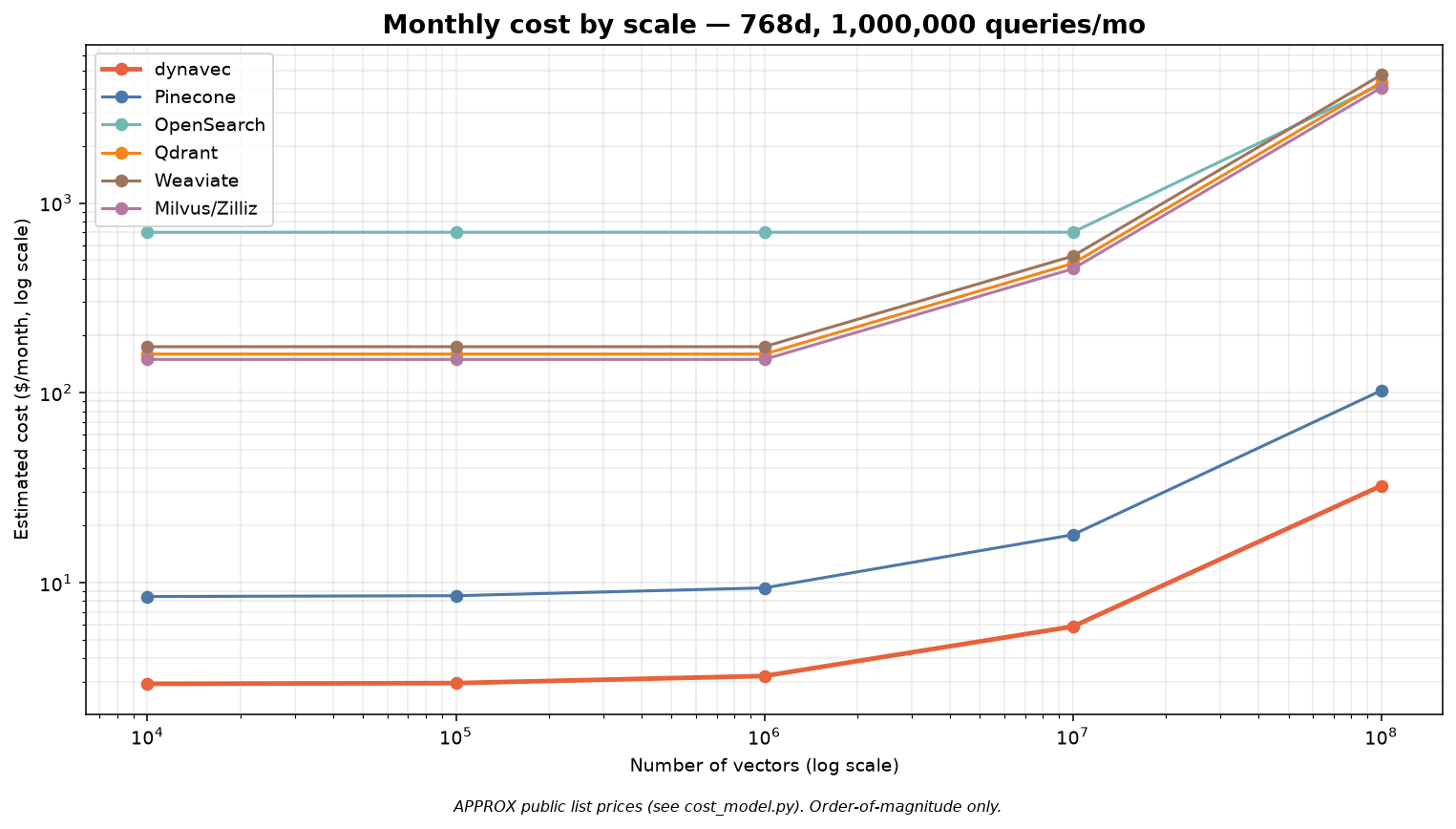
Cost by scale
dynavec has no idle floor — you pay storage + per-request, so it stays far below cluster- and OCU-based systems, and tracks serverless Pinecone while keeping your data in-account.
Quality & latency
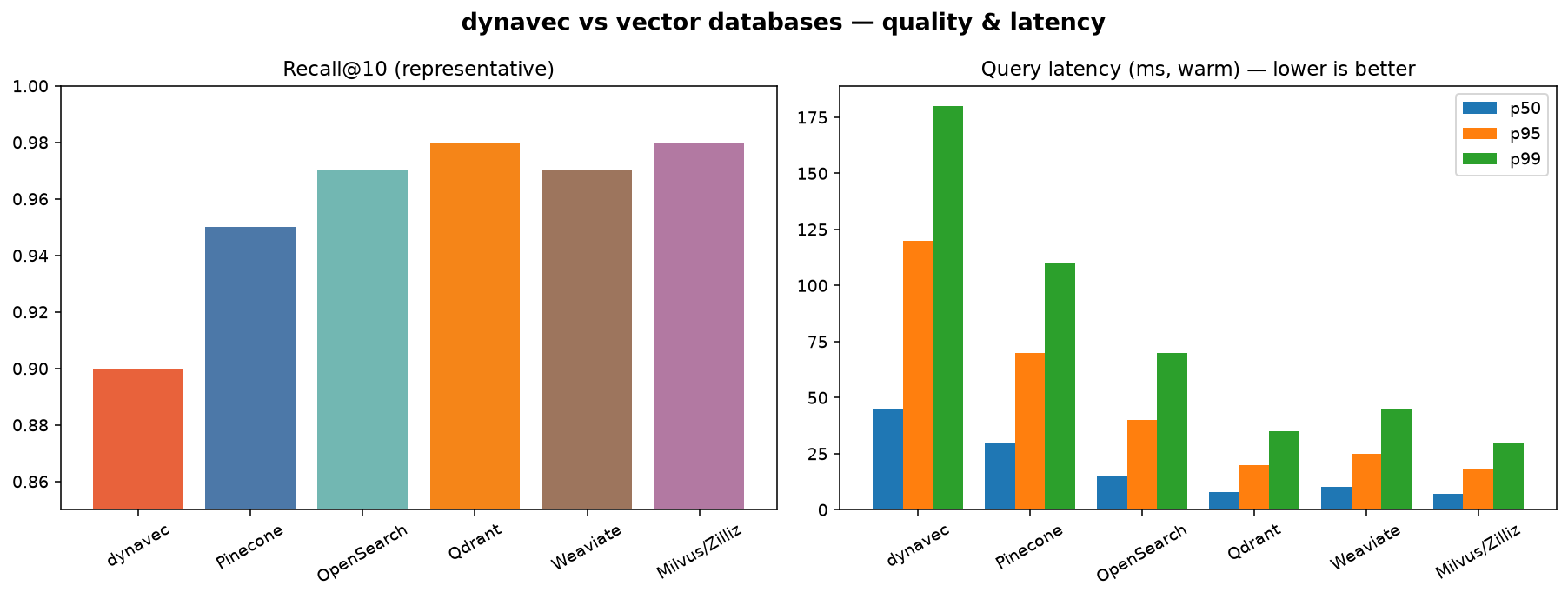
Comparison (1M × 768d, 1M queries/mo)
| Metric | dynavec | Pinecone | OpenSearch | Qdrant | Weaviate | Milvus/Zilliz |
|---|---|---|---|---|---|---|
| Recall@10 | 0.90 | 0.95 | 0.97 | 0.98 | 0.97 | 0.98 |
| Latency p50 (ms) | 45 | 30 | 15 | 8 | 10 | 7 |
| Latency p95 (ms) | 120 | 70 | 40 | 20 | 25 | 18 |
| Cost ($/mo) | $3 | $9 | $701 | $160 | $175 | $150 |
| Serverless (scale-to-zero) | Yes | Yes | No (OCU floor) | No (nodes) | No (nodes) | No (CU) |
| Data in your AWS account | Yes | No | Yes | Self-host only | Self-host only | Self-host only |
Honesty note: the cost row is computed by the repo's cost model from public list prices (order-of-magnitude; verify before quoting). Recall/latency are representative figures pending a live AWS run — regenerate real numbers with the commands below.
Scaling: every embedding dimension, 100K → 1 billion vectors
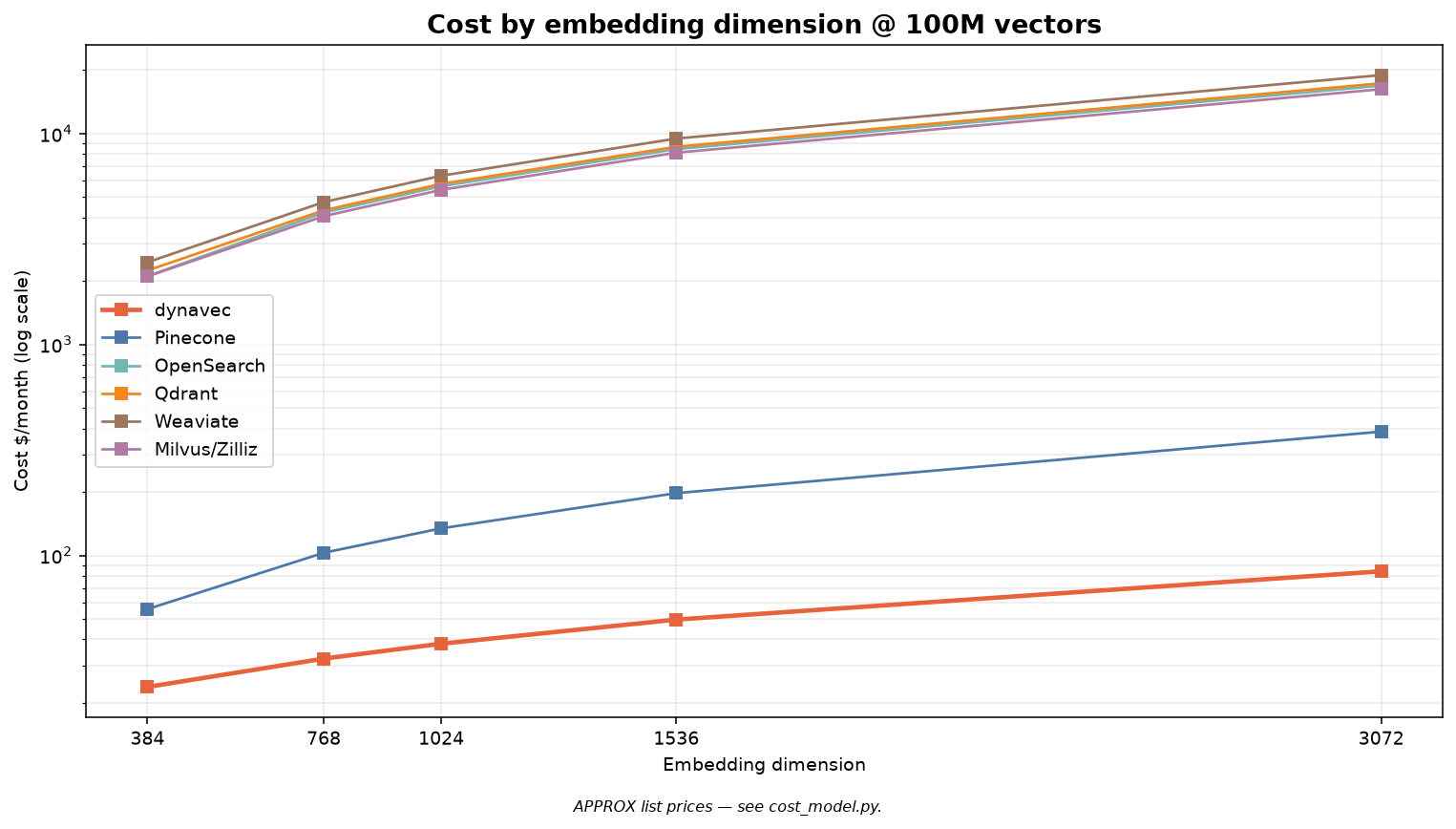
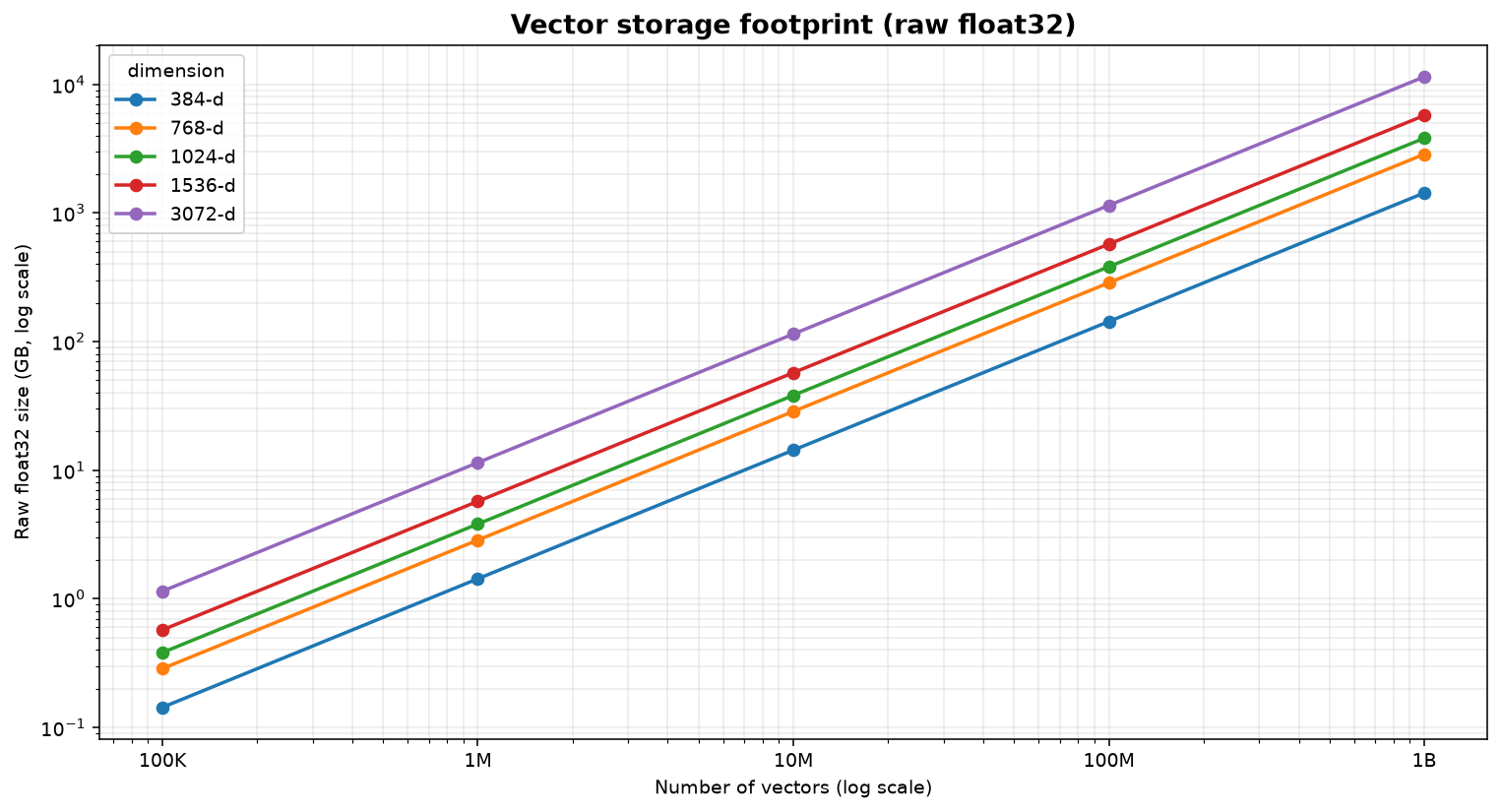
Cost across the common embedding dimensions (384 / 768 / 1024 / 1536 / 3072) and the full scale ladder. dynavec stays lowest at every point because its storage is priced like S3, not RAM — while cluster/OCU systems grow linearly with data held in memory.
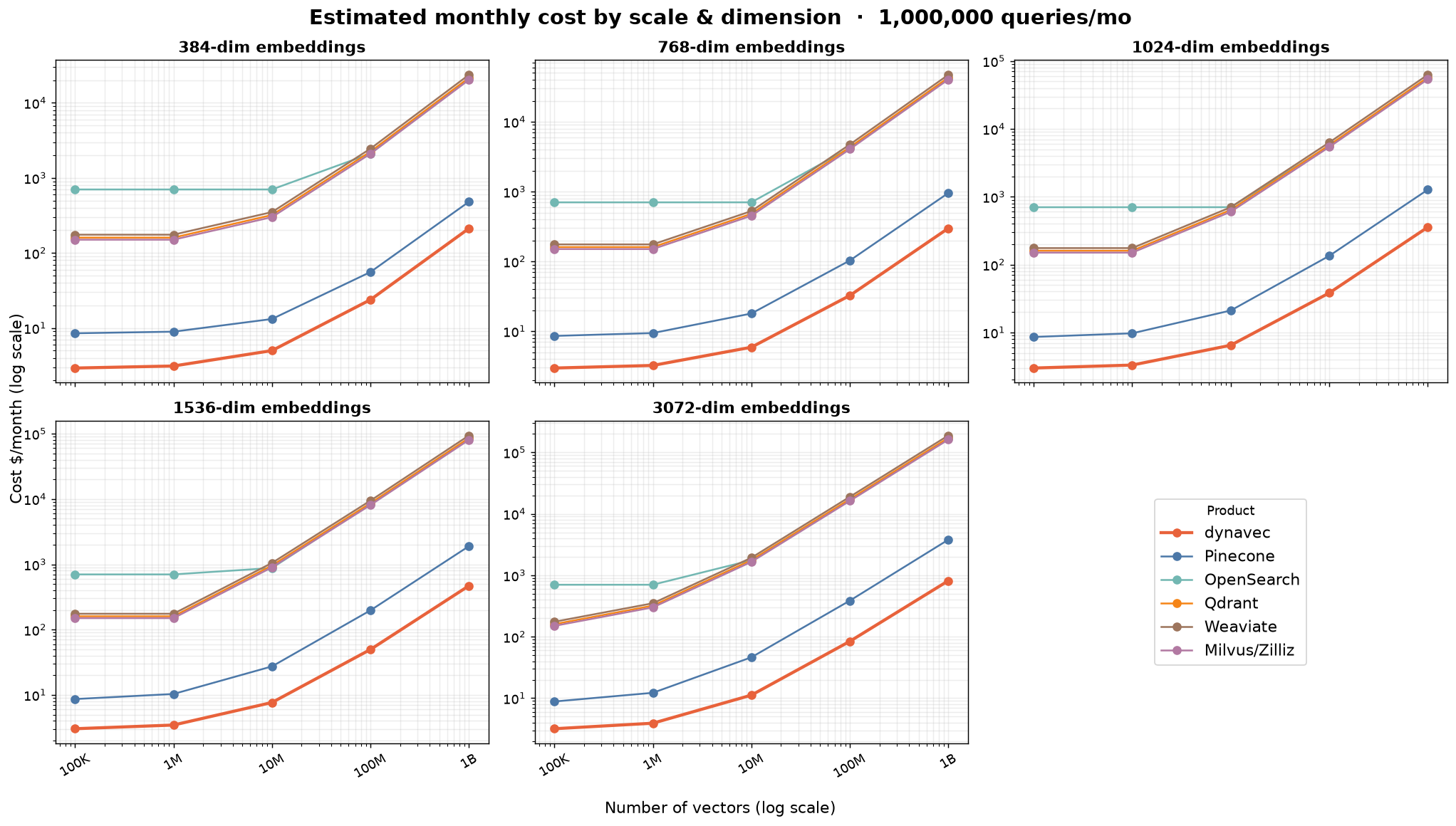
| Cost by dimension @ 100M vectors | Raw storage footprint | |
|---|---|---|
 |
 |
1536-dim (e.g. OpenAI text-embedding-3-small) — $/month @ 1M queries/mo:
| Product | 100K | 1M | 10M | 100M | 1B |
|---|---|---|---|---|---|
| dynavec | $3 | $3 | $8 | $50 | $469 |
| Pinecone | $9 | $10 | $27 | $197 | $1,897 |
| OpenSearch | $701 | $701 | $877 | $8,423 | $83,708 |
| Qdrant | $160 | $160 | $960 | $8,640 | $85,920 |
| Weaviate | $175 | $175 | $1,050 | $9,450 | $93,975 |
| Milvus/Zilliz | $150 | $150 | $900 | $8,100 | $80,550 |
| raw float32 size | 1 GB | 6 GB | 57 GB | 572 GB | 5,722 GB |
Full tables for all five dimensions: scaling.md. At 1B × 1536-d that's ~5.7 TB of raw vectors — where dynavec's product quantization and the S3-priced tier matter most.
pip install "dynavec[benchmark]"          # or: uv add "dynavec[benchmark]"

# reproduce the charts + table above
python -m benchmarks.report --vectors 1_000_000 --dim 768 --qpm 1_000_000

# measure real recall + latency against your own AWS account
python -m benchmarks.run_benchmark --backend dynavec \
    --bucket my-vectors --index bench --table dynavec_bench --n 100000 --dim 768
Observability dashboard
A native, in-your-brand observability dashboard — a Langfuse-style view of real query telemetry (no simulated data). Attach a recorder and every search is captured with latency, cache outcome, result count, and score stats.
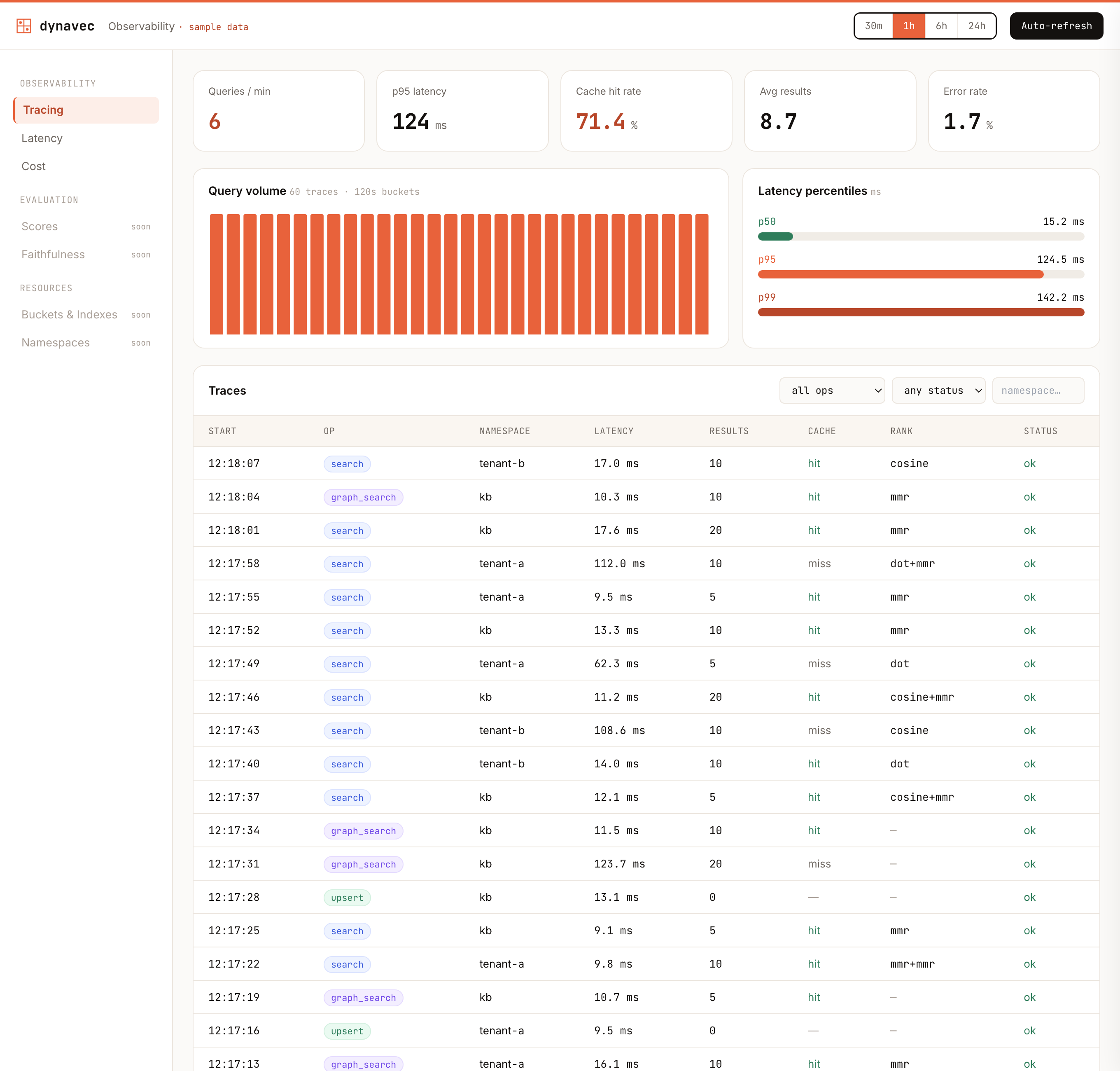
▶ Live interactive preview — in the landing-page theme.
The dashboard is a Next.js + TypeScript + Tailwind + Recharts app in dashboard/; the data comes from a tiny Python telemetry API. Two steps:
1. Expose real telemetry — attach a recorder to your client and serve the API:
from dynavec import Dynavec, DynavecConfig, SemanticCache
from dynavec.telemetry import TelemetryRecorder
from dynavec.dashboard import serve

rec = TelemetryRecorder()
db = Dynavec(cfg, embedder=emb, cache=SemanticCache(), telemetry=rec)
# ... your app runs searches; the recorder fills automatically ...
serve(rec, port=8779)          # JSON API at http://127.0.0.1:8779
2. Run the dashboard (points at that API; falls back to sample data if unset):
cd dashboard
npm install
NEXT_PUBLIC_DYNAVEC_API=http://127.0.0.1:8779 npm run dev   # http://localhost:3000
No AWS? python examples/dashboard_demo.py runs real searches against in-memory
stand-ins and serves the API on :8779 for the dashboard to read.
It shows a query-volume histogram, latency percentiles (p50/p95/p99), cache hit-rate, and a filterable traces table with per-trace drill-down. Contributors welcome: the Evaluation (recall@k, faithfulness), Resource (buckets/indexes/namespaces), and Cost panels are open under the dashboard epic (#122).
Capabilities
| Area | What you get | API |
|---|---|---|
| Distance metrics | Index on cosine/euclidean (S3 Vectors native); client-side rescore in cosine / dot / euclidean / manhattan or a weighted combination, with optional result-set normalization | search(..., rescore="dot", normalize_scores=True) |
| Concurrency | GIL-aware thread pool — real parallelism for I/O-bound AWS calls; parallel batched writes + search_many; tunable botocore connection pool (default 10, raise for high concurrency) |
DynavecConfig(max_workers=8, max_pool_connections=50), db.search_many([...]) |
| Streaming | Results yielded page-by-page as S3 Vectors paginates, so agents start consuming early | for hit in db.search_stream(q): ... |
| Namespace RAG | Per-tenant/collection handles; isolation + even partitioning | kb = db.namespace("kb"); kb.search(...) |
| Product quantization | Compress cached/hot-tier vectors up to 32× (ADC distance) | ProductQuantizer(m=96).fit(X) |
| Knowledge graph / ER | Entities + relations in DynamoDB linked to embeddings; traverse to scope/guide vector search (GraphRAG) | db.graph_add_edge(...), db.graph_search(q, seed_entities=[...]) |
| Query cache | DynamoDB-TTL exact cache, in-process semantic cache (serves near-duplicate queries), or Redis/ElastiCache | Dynavec(..., cache=SemanticCache()) |
| Ingestion / MCP | Pull + chunk + embed from any source; any MCP server's resources (Notion, Confluence, Drive, …) become a corpus | ingest(db, MCPResourceSource(session)) |
| Updates + Lambda | Update text/vector/metadata (merge or replace); transform pipeline incl. in-account AWS Lambda | db.update(id, ...), Dynavec(..., transform=LambdaTransform(...)) |
| IAM / credentials | Access keys, session tokens, named profiles, cross-account assume-role | Dynavec(..., credentials=AWSCredentials(...)) |
| Frameworks | LangChain + LlamaIndex vector stores; a framework-agnostic tool for LangGraph/CrewAI/Strands | dynavec.integrations.* |
| Benchmark report | Comparison table + recall/latency + cost-by-scale (log) charts | python -m benchmarks.report |
SemanticCache can be bounded by both entry count and approximate in-memory
size. Pass max_bytes to account for each cached float32 query vector and its
result object graph, and inspect size_bytes for the current accounted size:
cache = SemanticCache(max_size=2_048, max_bytes=64 * 1024 * 1024)
Status
v0.5.0 (current) — adds office-document ingestion (Docx/Pptx/Xlsx), a Hugging Face Inference embedder, a DSPy retrieval integration, opt-in structured JSON logging (with secret redaction), ProductQuantizer save/load, dashboard dark mode, and vectorized MMR reranking — on top of the v0.4 in-memory hot tier and the v0.1 hybrid core.
See the full history in CHANGELOG.md, the browsable Release notes page, or the GitHub Releases tab.
Roadmap (v0.6): optional hnswlib/faiss hot-tier backend for very large hot sets, sparse/BM25 hybrid computed from DynamoDB, and OPQ (rotated product quantization).
Publishing (maintainers)
dynavec publishes to PyPI; both pip and uv install from there (there is no separate "uv registry").
Automated (recommended) — a GitHub Release triggers .github/workflows/publish.yml, which builds and uploads via PyPI Trusted Publishing (OIDC) — no API token stored anywhere. One-time setup: on PyPI, add a pending publisher for project dynavec, repo codeforstartups/dynavec, workflow publish.yml, environment pypi. Then:
git tag v0.3.0 && git push origin v0.3.0 # then publish a GitHub Release for the tag
Manual — if you'd rather push from your machine with a token:
uv build                                      # -> dist/*.whl, dist/*.tar.gz
uv publish                                    # uses UV_PUBLISH_TOKEN / prompts
# or: python -m twine upload dist/*
Bump the version in both pyproject.toml and src/dynavec/__init__.py before releasing.
🫂 Community
If you want to get more involved with dynavec, join our WhatsApp community. It's a friendly space to talk about vector search, RAG, AWS costs, production issues, and everything in between — ask questions, share what you're building, or help others out.
Contributors
+----------------------------------------------------------------------------+
|     +----------------------------------------------------------------+     |
|     | Developers: Those who built with `dynavec`.                    |     |
|     | (You have `import dynavec` somewhere in your project)          |     |
|     |     +----------------------------------------------------+     |     |
|     |     | Contributors: Those who make `dynavec` better.     |     |     |
|     |     | (You make a PR to this repo)                       |     |     |
|     |     +----------------------------------------------------+     |     |
|     +----------------------------------------------------------------+     |
+----------------------------------------------------------------------------+
We welcome contributions from the community! Whether it's bug fixes, feature additions, or documentation improvements, your input is valuable. See CONTRIBUTING.md for the full guide, and browse good first issues to get started.
- Fork the repository
- Create your feature branch (
git checkout -b feature/AmazingFeature) - Commit your changes (
git commit -m 'Add some AmazingFeature') - Push to the branch (
git push origin feature/AmazingFeature) - Open a Pull Request
License
Apache-2.0
1 maintainer

Release files for dynavec 0.5.0
For a detailed explanation of source distributions (sdists) and built distributions (wheels), please see the package formats documentation.
Source distribution (sdist)
| File | Size | Uploaded | |
|---|---|---|---|
| dynavec-0.5.0.tar.gz | 3.1 MB | Details |
Built distribution (wheel)
| File | Interpreter | ABI | Platform | Reset |
|---|---|---|---|---|
| dynavec-0.5.0-py3-none-any.whl | Python 3 | none | any | Details |
Total release size: 3.3 MB
Release files / dynavec-0.5.0.tar.gz
| Download URL | dynavec-0.5.0.tar.gz |
|---|---|
| Size | 3.1 MB |
| Tags | Source |
|
SHA-256 checksum How to use checksums |
49b71e77568db7a19ed0c3666e8afdef9862f7fbdb422f1ae1ee7d66c856a54e
|
|
BLAKE2b-256 checksum How to use checksums |
38e5ca7fb9dc94863996d86e44fe842bc940de1ad4d4bd2e843fdeb70ed465f2
|
| Upload date | |
|
Uploaded using Trusted Publishing? What is trusted publishing? |
Yes |
| Uploaded via |
twine/7.0.0 CPython/3.13.14
|
Provenance
Provenance describes where a file came from. On PyPI, provenance is shared via attestations, which provide a verifiable record of the build or publishing details. View details, limitations and caveats.


PyPI Publish Attestation
PyPI verified that this artifact, at this checksum, originated from the publisher listed below.
Signed by GitHub Actions, verified by PyPI on Sep 16, 2026.
Transparency logRelease files / dynavec-0.5.0-py3-none-any.whl
| Download URL | dynavec-0.5.0-py3-none-any.whl |
|---|---|
| Size | 118.9 kB |
| Tags | Python 3 |
|
SHA-256 checksum How to use checksums |
73640cc1b367c9f8faee6ec2aae2657ca6c5a76e4f66062ac5dd70b035e07845
|
|
BLAKE2b-256 checksum How to use checksums |
6a25abd208dc652d616f545514202da5f95bfa9a8dc9a95f44a67b690a53da9d
|
| Upload date | |
|
Uploaded using Trusted Publishing? What is trusted publishing? |
Yes |
| Uploaded via |
twine/7.0.0 CPython/3.13.14
|
Provenance
Provenance describes where a file came from. On PyPI, provenance is shared via attestations, which provide a verifiable record of the build or publishing details. View details, limitations and caveats.
PyPI Publish Attestation
PyPI verified that this artifact, at this checksum, originated from the publisher listed below.
Signed by GitHub Actions, verified by PyPI on Sep 16, 2026.
Transparency log













