


🪐 ✨ Earthdata MCP Server


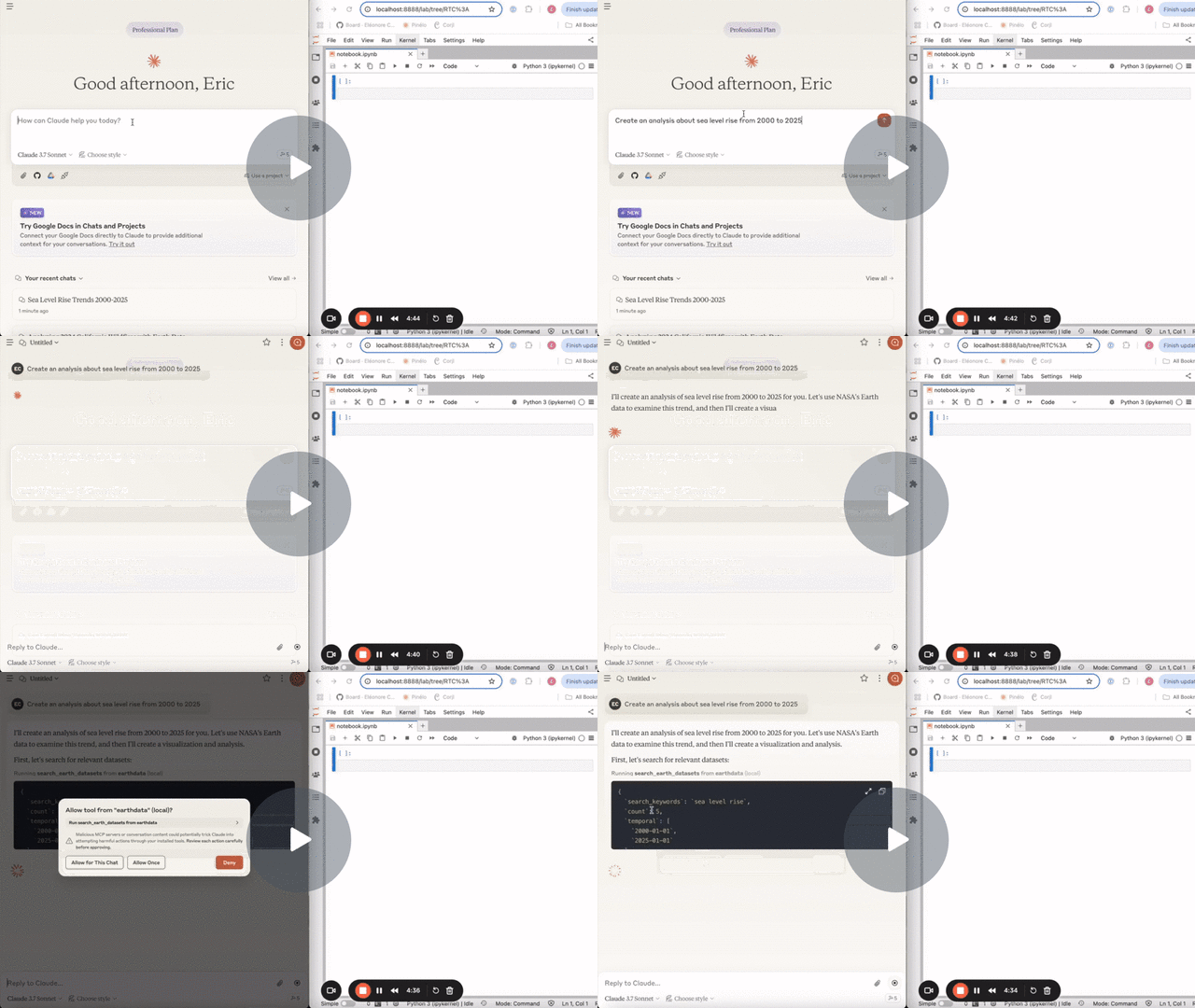
Earthdata MCP Server is a Model Context Protocol (MCP) server implementation that provides tools to interact with NASA Earth Data.
It is built as a reactor_mcp_server extension, so it runs two ways:
- On its own:
earthdata-mcp-server startserves the Earthdata tools and nothing else, over stdio or streamable HTTP. - As a toolset: installed beside any
reactor_mcp_serverhost, it is discovered and served as the opt-inearthdatatoolset to a client that asks for it:/mcp?earthdata. The Datalayer MCP Server serves it this way, next to notebooks and sandboxes.
The server is intentionally Earthdata-only. For notebook and runtime tools, serve it beside them on one host, or compose it with jupyter-mcp-server using mcp-compose.
Key Features
- Dataset discovery on NASA Earthdata
- Granule search with temporal and bounding box filters
- Flexible download workflow with explicit execution modes
Getting Started
Local install
pip install earthdata-mcp-server

# stdio, for a client that launches the server
earthdata-mcp-server start

# streamable HTTP, at http://localhost:4040/mcp
earthdata-mcp-server start --transport streamable-http --port 4040
| Option | Environment | Default |
|---|---|---|
--transport |
TRANSPORT |
stdio (or streamable-http) |
--host |
HOST |
0.0.0.0 |
--port |
PORT |
4040 |
As a toolset on a reactor MCP host
pip install earthdata-mcp-server "reactor_mcp_server[server]"
reactor-mcp-server --port 4040
A client connecting to http://localhost:4040/mcp?earthdata gets the Earthdata tools
beside whatever else is installed; /toolsets lists what the host offers. In code:
from reactor_mcp_server import build_host, create_mcp_app
from earthdata_mcp_server import EarthdataExtension

app = create_mcp_app(build_host([EarthdataExtension()]), path="/mcp")
EarthdataExtension(default=True) serves the toolset to a client that names none.
Docker with Claude Desktop
{
  "mcpServers": {
    "earthdata": {
      "command": "docker",
      "args": [
        "run",
        "-i",
        "--rm",
        "-e", "EARTHDATA_USERNAME",
        "-e", "EARTHDATA_PASSWORD",
        "datalayer/earthdata-mcp-server:latest"
      ],
      "env": {
        "EARTHDATA_USERNAME": "your_username",
        "EARTHDATA_PASSWORD": "your_password"
      }
    }
  }
}
Linux host networking
{
  "mcpServers": {
    "earthdata": {
      "command": "docker",
      "args": [
        "run",
        "-i",
        "--rm",
        "--network=host",
        "-e", "EARTHDATA_USERNAME",
        "-e", "EARTHDATA_PASSWORD",
        "datalayer/earthdata-mcp-server:latest"
      ],
      "env": {
        "EARTHDATA_USERNAME": "your_username",
        "EARTHDATA_PASSWORD": "your_password"
      }
    }
  }
}
Tools
The earthdata toolset offers 3 tools. None of them needs credentials, except
download_earth_data_granules in mode="download", which needs a NASA Earthdata Login.
Its default manifest mode and its script mode work anonymously.
search_earth_datasets
- Search for datasets on NASA Earthdata.
- Input:
- search_keywords (str): Keywords to search for in the dataset titles.
- count (int): Number of datasets to return.
- temporal (tuple): (Optional) Temporal range in the format (date_from, date_to).
- bounding_box (tuple): (Optional) Bounding box in the format (lower_left_lon, lower_left_lat, upper_right_lon, upper_right_lat).
- Returns: List of dataset abstracts.
search_earth_datagranules
- Search for data granules on NASA Earthdata.
- Input:
- short_name (str): Short name of the dataset.
- count (int): Number of data granules to return.
- temporal (tuple): (Optional) Temporal range in the format (date_from, date_to).
- bounding_box (tuple): (Optional) Bounding box in the format (lower_left_lon, lower_left_lat, upper_right_lon, upper_right_lat).
- Returns: List of data granules.
download_earth_data_granules
- Search and optionally download granules with explicit modes.
- Authentication: Only
mode="download"needs NASA Earthdata Login credentials (see authentication guide);manifestandscriptmodes work anonymously. - Input:
- folder_name (str): Local folder name to save the data.
- short_name (str): Short name of the Earth dataset to download.
- count (int): Number of data granules to download.
- temporal (tuple): (Optional) Temporal range in the format (date_from, date_to).
- bounding_box (tuple): (Optional) Bounding box in the format (lower_left_lon, lower_left_lat, upper_right_lon, upper_right_lat).
- mode (str): One of:
manifest: Returns granule metadata only.download: Downloads files directly on server side.script: Returns Python code to execute elsewhere.
- max_manifest_items (int): Max items returned in
manifestmode.
How download works
download_earth_data_granules always starts by searching for granules with your filters, then behaves based on mode:
manifest- Returns a structured preview (
items) with IDs, titles, and links. - Does not write files.
- Best first step for validating query scope.
- Returns a structured preview (
download- Authenticates with Earthdata using environment credentials.
- Downloads matching granules directly to
folder_nameon the server runtime. - Returns downloaded file paths.
script- Returns executable Python code that performs the same search + download.
- Best option when execution should happen in a notebook/runtime controlled by another MCP server.
Recommended download strategy
- Use
mode="manifest"first to inspect results safely. - Use
mode="script"when you want notebook-driven execution viamcp-compose+jupyter-mcp-server. - Use
mode="download"only when server-side file writes are intended.
For a full composition example with mcp-compose, see download workflow docs.
Prompts
-
download_analyze_global_sea_level- Generates a workflow that starts with
download_earth_data_granulesinscriptmode. - Intended to be executed in a composed notebook/runtime stack (via
mcp-compose).
- Generates a workflow that starts with
-
sealevel_rise_dataset- Search for datasets related to sea level rise worldwide.
- Input:
start_year(int): Start year to consider.end_year(int): End year to consider.
- Returns: Prompt correctly formatted.
-
ask_datasets_format- To ask about the format of the datasets.
- Returns: Prompt correctly formatted.
Development
make dev    # editable install with the test, lint and typing extras
make test
make lint
Releases are cut by pushing a tag; see RELEASE.md.
Building
# or run `docker build -t datalayer/earthdata-mcp-server .`
make build-docker
If you prefer, you can pull the prebuilt images.
make pull-docker
1 maintainer

Metadata
1 maintainer
Release files for earthdata-mcp-server 0.6.0
For a detailed explanation of source distributions (sdists) and built distributions (wheels), please see the package formats documentation.
Source distribution (sdist)
| File | Size | Uploaded | |
|---|---|---|---|
| earthdata_mcp_server-0.6.0.tar.gz | 22.5 kB | Details |
Built distribution (wheel)
| File | Interpreter | ABI | Platform | Reset |
|---|---|---|---|---|
| earthdata_mcp_server-0.6.0-py3-none-any.whl | Python 3 | none | any | Details |
Total release size: 44.2 kB
Release files / earthdata_mcp_server-0.6.0.tar.gz
| Download URL | earthdata_mcp_server-0.6.0.tar.gz |
|---|---|
| Size | 22.5 kB |
| Tags | Source |
|
SHA-256 checksum How to use checksums |
ffcd8d0d3a05f84dc8d380304c73c9531cb183a44ba273a5152792ad1168eb57
|
|
BLAKE2b-256 checksum How to use checksums |
fa32cb57ac3e88e3b0ecf0b7a55c24adb15e33da61b2d1e11c0e7abfe2f91eb3
|
| Upload date | |
|
Uploaded using Trusted Publishing? What is trusted publishing? |
Yes |
| Uploaded via |
twine/7.0.0 CPython/3.13.14
|
Provenance
Provenance describes where a file came from. On PyPI, provenance is shared via attestations, which provide a verifiable record of the build or publishing details. View details, limitations and caveats.


PyPI Publish Attestation
PyPI verified that this artifact, at this checksum, originated from the publisher listed below.
Signed by GitHub Actions, verified by PyPI on Oct 10, 2026.
Transparency logRelease files / earthdata_mcp_server-0.6.0-py3-none-any.whl
| Download URL | earthdata_mcp_server-0.6.0-py3-none-any.whl |
|---|---|
| Size | 21.7 kB |
| Tags | Python 3 |
|
SHA-256 checksum How to use checksums |
c774ce8ec10370caad9b97a68a719e96055318d2f20f71fd27756edd344a6a10
|
|
BLAKE2b-256 checksum How to use checksums |
d38fb57aa370ab752d9046e9eb910df646c6d91507a156d7c2f98fd26ccc0982
|
| Upload date | |
|
Uploaded using Trusted Publishing? What is trusted publishing? |
Yes |
| Uploaded via |
twine/7.0.0 CPython/3.13.14
|
Provenance
Provenance describes where a file came from. On PyPI, provenance is shared via attestations, which provide a verifiable record of the build or publishing details. View details, limitations and caveats.
PyPI Publish Attestation
PyPI verified that this artifact, at this checksum, originated from the publisher listed below.
Signed by GitHub Actions, verified by PyPI on Oct 10, 2026.
Transparency log













