
Echocorn
Echocorn is a fast, lightweight ASGI server: a hand written HTTP/1.1
implementation plus first class HTTP/2 built on
h2. It runs modern async applications
(FastAPI, Starlette, Quart, Django, ...) with a small dependency footprint and
the protocol details that matter in production: RFC compliant framing, correct
HTTP/2 flow control, backpressure, timeouts, TLS with ALPN and graceful
shutdown.
Features
- HTTP/1.1: keep-alive and pipelining, chunked request
and response bodies,
Expect: 100-continue, trailers, informational (1xx) responses, close-delimited HTTP/1.0 bodies. - HTTP/2: ALPN over TLS and h2c with prior knowledge, concurrent
streams, inbound and outbound flow control, stream resets, GOAWAY, PING,
trailers and
SETTINGSadvertised to clients. - WebSockets over
ws://andwss://: the ASGIwebsocketprotocol with subprotocol negotiation, ping/pong, fragmentation, strict frame validation (masking, reserved bits, UTF-8, size limits), backpressure and a proper close handshake. WebSocket over HTTP/2 is deliberately not advertised, so browsers upgrade over HTTP/1.1 as they do with other servers. - Transparent compression:
gzip/deflatenegotiated withAccept-Encodingquality values on HTTP/1.1 and HTTP/2 alike, applied only to compressible, non-partial responses, with a streaming compressor (no threads). Negotiated answers carryVary: Accept-Encodinganddeflateuses the zlib wrapper. - Security by default: strict request framing that rejects request smuggling
(
Transfer-Encoding+Content-Length, conflicting lengths, obs-fold, illegal names/values), header injection protection in both directions, connection-specific header stripping for HTTP/2, optional hardened response headers and domain binding. - Abuse resistance and rate limiting: one absolute request deadline per
request (TLS handshake included), TCP reset for stalled peers,
connection/head/body limits, socket options, and
[ratelimit]- per client address, over a sliding window, with one burst per window and a lockout, counted for all workers together in one shared table (no file, no disk on the request path); over-limit requests get429+Retry-Afterand never reach the application. - Backpressure everywhere: bounded request queues, socket read pausing, write buffer watermarks and HTTP/2 flow-control windows, so a slow client never becomes unbounded memory growth.
- Optional HTTP to HTTPS redirect (
[redirect] enabled = true), served by a worker of its own, keeping the path and query string. - Reverse proxy mode:
app = "127.0.0.1:5000"puts the whole server in front of a program that is already listening locally; TLS, HTTP/2, compression, the limits and the redirect keep working, the upstream connection is pooled, both bodies are streamed, WebSockets are tunnelled andX-Forwarded-*is rewritten. - One configuration file (
echocorn.toml, read with the standard librarytomllib), validated at startup, withuvlooppicked up automatically, a multi-process model over one shared listening socket and an embeddableASGIServerAPI.
Installation
Python 3.11 or newer (the configuration file is read with tomllib):
pip install echocorn

pip install "echocorn[uvloop]"  # libuv event loop (not available on Windows)
pip install "echocorn[test]"    # test dependencies
Quick start
Everything the server needs is in one TOML file, next to your application:
# echocorn.toml
app = "app:app"  # "module:attribute", or "127.0.0.1:5000" / "10.0.0.16:8080"

[server]
host = "0.0.0.0"
port = 8000
workers = 4
compression = true
safe_headers = true

[tls]
certfile = "cert.pem"
keyfile = "key.pem"
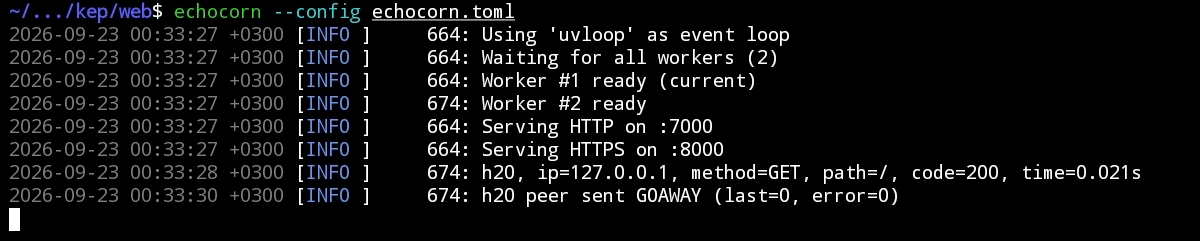
echocorn --config echocorn.toml

echocorn --help  # help menu
echocorn --version
--config is the only option the command line takes (no environment variable,
no server flag). A fully commented example ships with the project
(echocorn.toml); copy it and edit what you care about.
Embedding
import asyncio
from echocorn import ASGIServer, ServerConfig

config = ServerConfig(host="127.0.0.1", port=8080, compression=True)
server = ASGIServer(app, config)

asyncio.run(server.serve())  # or server.run() to block
An existing configuration file can be reused with the same validation the command line applies:
from echocorn import ASGIServer, load_settings, resolve_app

settings = load_settings("echocorn.toml")  # the path is always explicit
ASGIServer(resolve_app(settings.app, settings.config), settings.config).run()
resolve_app imports a module:attribute setting and turns a host:port one
into a proxy (import_app is the module-only form). server.request_stop() asks
the server to shut down cleanly and is thread-safe.
Frameworks
Native ASGI applications (Starlette, FastAPI, Quart, Django, Litestar, ...) run
directly: app = "myapp:asgi_app". Flask is WSGI, so it needs an adapter - the
standard one is asgiref, a single extra line:
# app.py
from asgiref.wsgi import WsgiToAsgi
from flask import Flask

app = Flask(__name__)

@app.route("/")
def index():
    return {"hello": "world"}

app = WsgiToAsgi(app)
A WSGI adapter that rejects the ASGI lifespan scope is detected immediately:
the server logs it and serves instead of waiting for the handshake to time out.
Reverse proxy
When the program to serve already listens on a local address, name it by address instead of by module:
app = "127.0.0.1:5000"

[server]
port = 443
compression = true

[tls]
certfile = "cert.pem"
keyfile = "key.pem"

[redirect]
enabled = true
port = 80
A request is forwarded as plain HTTP/1.1 and the answer is streamed back: neither
body is buffered whole, a chunked upload stays chunked, and the upstream
connection is pooled and reused. The Host field is replaced by the upstream
address, while X-Forwarded-For, X-Real-IP, X-Forwarded-Proto,
X-Forwarded-Host and X-Forwarded-Port describe the real client - replaced,
never extended: whatever the client sent (including Forwarded) is thrown away
first, so an application, its logs or its own rate limiter cannot be lied to.
The older spellings of the same two claims - X-Forwarded-Ssl,
X-Forwarded-Scheme, X-Url-Scheme, X-Https, Front-End-Https - are rebuilt
from the connection as well: a framework that still reads one of them to decide
about a secure cookie, or about whether to trust its own authentication, must
not be told by the client that a plaintext request was encrypted.
Hop-by-hop fields are dropped in both directions and the framing is re-derived,
so an HTTP/2 client gets a close-delimited or chunked upstream answer just as
well, and an announced trailer section is relayed. Every proxy connection is an
asyncio.Protocol, like the rest of the server: one coroutine per exchange,
with write-watermark backpressure.
Two failure modes that would otherwise be a mysterious 502 are handled: a
pooled connection the upstream closed meanwhile is detected on the first write
and the request is sent once more on a fresh connection (idempotent methods
without a body only, since a body already read cannot be replayed), and an
answer that dies mid-body is cut, never framed as whole - on HTTP/1.1 the
connection closes with the body unterminated, on HTTP/2 the stream is reset.
max_response_size caps what the proxy relays (a too-large answer is a 502
before it starts, a streamed one that grows past the limit is cut off), and
request_timeout bounds the whole exchange. An upstream head that is cut short,
or one that arrives in pieces and is never finished, is a 502 too - and one
that grows past max_header_size is refused whether it arrived in one piece or
in ten, since the reader waits for the bytes it has not seen yet instead of
walking the ones it has. A WebSocket upgrade is proxied too:
the handshake is repeated against the upstream, frames are forwarded both ways
(a ping is answered on the side it arrives on), a refused handshake is relayed
as it is so a client sees the application's 401, and a tunnel never returns to
the pool. An unreachable upstream answers 502 Bad Gateway with the reason in
the body.
A host:port target must be local - loopback (127.0.0.0/8, ::1, localhost),
a private network (10.0.0.0/8, 172.16.0.0/12, 192.168.0.0/16, fc00::/7) or
link-local (169.254.0.0/16, fe80::/10) - so 10.0.0.16:8080 is valid while
example.com:80 is refused: a configuration file can never turn the server into
an open proxy. The hop to the upstream is always HTTP/1.1 (h2c to the upstream is
not used), and the same switch is available from Python:
from echocorn import ASGIServer, ServerConfig, resolve_app

config = ServerConfig(port=443, certfile="cert.pem", keyfile="key.pem")
ASGIServer(resolve_app("127.0.0.1:5000", config), config).run()
Command line
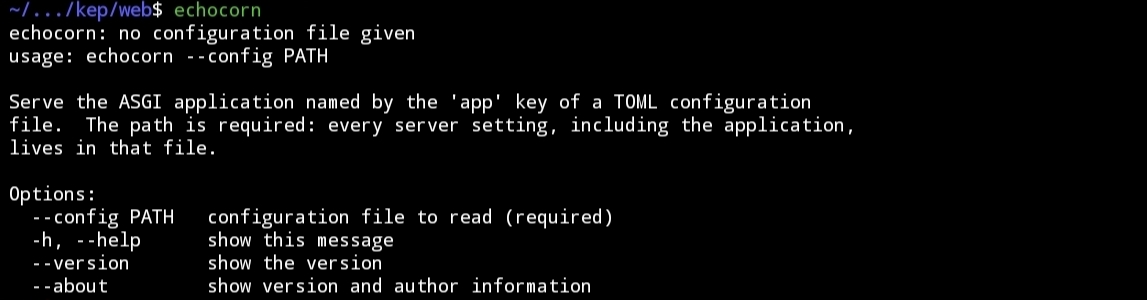
usage: echocorn --config PATH

Options:
  --config PATH   configuration file to read (required)
  -h, --help      show this message
  --version       show the version
  --about         show version and author information
TLS connections negotiate h2 through ALPN and fall back to http/1.1.
Cleartext connections speak HTTP/2 when the client sends the HTTP/2 connection
preface (h2c with prior knowledge); anything else is HTTP/1.1.
Upgrade-based h2c is intentionally not implemented.
Security
- Strict request framing removes the classic request smuggling vectors; field
names and values are validated in both directions, so response splitting
(
CRLFinjection) is impossible, and access log fields are escaped so a hostile path cannot forge log entries. - Every request the server refuses itself - a misdirected
421, a refused method, a head that was too large, a rate limited client, an illegal upgrade - is logged as aWARNline shaped like the access log (address, method, target, status, reason). Those answers never reach the application, so the log is the only place they can be seen. - A single absolute deadline, per-stream deadlines and an idle timeout (HTTP/2) stop slow-loris attacks during the TLS handshake, the head and the body.
- WebSocket frames are validated strictly (masking, reserved bits, non-minimal
lengths, control frame rules, UTF-8) and messages are capped by
websocket.max_message_size. - Heads, header counts, bodies and simultaneous connections are all bounded, and a protocol that is switched off cannot be reached at all.
safe_headersadds HSTS,X-Content-Type-Options,X-Frame-Options,Referrer-Policy,Permissions-Policyand the cross-origin policies.
For production, pair Echocorn with the usual hardening: a TLS 1.2+ cipher policy,
OS tuning (file descriptor limits, somaxconn), a reverse proxy or load balancer
where appropriate, and monitoring.
Screenshots
Examples of running Echocorn and request logs:
Donate
If you find Echocorn useful and want to support development, you can donate here:

1 maintainer

Metadata
1 maintainer
Release files for echocorn 1.0.3
For a detailed explanation of source distributions (sdists) and built distributions (wheels), please see the package formats documentation.
Source distribution (sdist)
| File | Size | Uploaded | |
|---|---|---|---|
| echocorn-1.0.3.tar.gz | 101.7 kB | Details |
Built distribution (wheel)
| File | Interpreter | ABI | Platform | Reset |
|---|---|---|---|---|
| echocorn-1.0.3-py3-none-any.whl | Python 3 | none | any | Details |
Total release size: 202.0 kB
Release files / echocorn-1.0.3.tar.gz
| Download URL | echocorn-1.0.3.tar.gz |
|---|---|
| Size | 101.7 kB |
| Tags | Source |
|
SHA-256 checksum How to use checksums |
aa9bc578c2b05f1fd018ec5d7c1b03a61f2d23b77eb087877852a8300f14c2e2
|
|
BLAKE2b-256 checksum How to use checksums |
3551eff239d4a59dbb450ee391a29fc5160f76c6548e6bbee9df308a60bc42c3
|
| Upload date | |
|
Uploaded using Trusted Publishing? What is trusted publishing? |
No |
| Uploaded via |
twine/7.0.0 CPython/3.14.6
|
Release files / echocorn-1.0.3-py3-none-any.whl
| Download URL | echocorn-1.0.3-py3-none-any.whl |
|---|---|
| Size | 100.3 kB |
| Tags | Python 3 |
|
SHA-256 checksum How to use checksums |
d47ce1d09b25a3e7467445f565908173386808ab3af23b0d22b0062d84331a1b
|
|
BLAKE2b-256 checksum How to use checksums |
858b935149000eee69df37a44e14ec9c26b77b5ce3b658bce7efdf2705c075f7
|
| Upload date | |
|
Uploaded using Trusted Publishing? What is trusted publishing? |
No |
| Uploaded via |
twine/7.0.0 CPython/3.14.6
|














