

EC-KitY is a Python tool kit for doing evolutionary computation, and it is scikit-learn compatible.
Currently we have implemented Genetic Algorithm (GA) and tree-based Genetic Programming (GP), but EC-KitY will grow!
EC-KitY is:
- A comprehensive toolkit for running evolutionary algorithms
- Written in Python
- Can work with or without scikit-learn, i.e., supports both sklearn (ML) and non-sklearn (basic) modes
- Designed with modern software engineering in mind
- Designed to support all popular EC paradigms (GA, GP, ES, coevolution, multi-objective, etc').
Dependencies
The minimal Python Version for EC-KitY is Python 3.8
The dependencies of our base package are described in requirements.txt
In addition, the dependencies of the ML mode are described in requirements-ml.txt
User installation
pip install eckity
Documentation
API is available here
(Work in progress - some modules and functions are not documented yet.)
Tutorials
The tutorials are available here, walking you through running EC-KitY both in sklearn mode and in non-sklearn mode.
Examples
More examples are in the examples folder.
All you need to do is define a fitness-evaluation method, through a SimpleIndividualEvaluator sub-class.
You can run the examples with ease by opening this colab notebook.
Basic example (no sklearn)
You can run an EA with just 3 lines of code. The problem being solved herein is simple symbolic regression.
Additional information on this problem can be found in the Symbolic Regression Tutorial.
from eckity.subpopulation import Subpopulation
from eckity.algorithms import SimpleEvolution
from eckity.base.untyped_functions import f_add, f_sub, f_mul, f_div
from eckity.creators import FullCreator
from eckity.genetic_operators import SubtreeCrossover, SubtreeMutation
from examples.treegp.basic_mode.symbolic_regression import SymbolicRegressionEvaluator

algo = SimpleEvolution(
    Subpopulation(
        SymbolicRegressionEvaluator(),
        creators=FullCreator(
            terminal_set=['x', 'y', 'z'],
            function_set=[f_add, f_sub, f_mul, f_div]
        ),
        operators_sequence=[SubtreeCrossover(), SubtreeMutation()]
    )
)
algo.evolve()
print(f'algo.execute(x=2,y=3,z=4): {algo.execute(x=2, y=3, z=4)}')
Example with sklearn
The problem being solved herein is the same problem, but in this case we also involve sklearn compatability - a core feature of EC-KitY. Additional information for this example can be found in the Sklearn Symbolic Regression Tutorial.
A simple sklearn-compatible EA run:
from sklearn.datasets import make_regression
from sklearn.metrics import mean_absolute_error
from sklearn.model_selection import train_test_split

from eckity.algorithms.simple_evolution import SimpleEvolution
from eckity.base.untyped_functions import f_add, f_div, f_mul, f_sub
from eckity.creators.gp_creators.full import FullCreator
from eckity.genetic_encodings.gp.tree.utils import create_terminal_set
from eckity.genetic_operators import SubtreeCrossover, SubtreeMutation
from eckity.sklearn_compatible.regression_evaluator import RegressionEvaluator
from eckity.sklearn_compatible.sk_regressor import SKRegressor
from eckity.subpopulation import Subpopulation

X, y = make_regression(n_samples=100, n_features=3)
terminal_set = create_terminal_set(X)
function_set = [f_add, f_sub, f_mul, f_div]

algo = SimpleEvolution(
    Subpopulation(
        RegressionEvaluator(),
        creators=FullCreator(
            terminal_set=terminal_set,
            function_set=function_set
        ),
        operators_sequence=[SubtreeCrossover(), SubtreeMutation()]
    )
)
regressor = SKRegressor(algo)

X_train, X_test, y_train, y_test = train_test_split(X, y, test_size=0.2)
regressor.fit(X_train, y_train)
print('MAE on test set:', mean_absolute_error(y_test, regressor.predict(X_test)))
Feature comparison
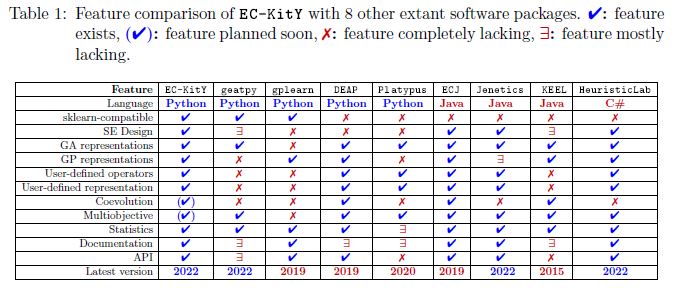
Here's a comparison table. The full paper is available here.
Authors
Moshe Sipper, Achiya Elyasaf, Itai Tzruia, Tomer Halperin
Citation
Citations are always appreciated 😊:
@article{eckity2023,
author = {Moshe Sipper and Tomer Halperin and Itai Tzruia and Achiya Elyasaf},
title = {{EC-KitY}: Evolutionary computation tool kit in {Python} with seamless machine learning integration},
journal = {SoftwareX},
volume = {22},
pages = {101381},
year = {2023},
url = {https://www.sciencedirect.com/science/article/pii/S2352711023000778},
}

@misc{eckity2022git,
    author = {Sipper, Moshe and Halperin, Tomer and Tzruia, Itai and  Elyasaf, Achiya},
    title = {{EC-KitY}: Evolutionary Computation Tool Kit in {Python}},
    year = {2022},
    publisher = {GitHub},
    journal = {GitHub repository},
    howpublished = {\url{https://www.eckity.org/} }
}
Sample repos using EC-KitY
1 maintainer

Metadata
1 maintainer
Release files for eckity 0.4.2
For a detailed explanation of source distributions (sdists) and built distributions (wheels), please see the package formats documentation.
Source distribution (sdist)
| File | Size | Uploaded | |
|---|---|---|---|
| eckity-0.4.2.tar.gz | 74.2 kB | Details |
Built distribution (wheel)
| File | Interpreter | ABI | Platform | Reset |
|---|---|---|---|---|
| eckity-0.4.2-py3-none-any.whl | Python 3 | none | any | Details |
Total release size: 208.3 kB
Release files / eckity-0.4.2.tar.gz
| Download URL | eckity-0.4.2.tar.gz |
|---|---|
| Size | 74.2 kB |
| Tags | Source |
|
SHA-256 checksum How to use checksums |
63e8757d9a17b89531d8f700fa6b5d315fb1bcba6dcb656b3db4fc3dfcca2863
|
|
BLAKE2b-256 checksum How to use checksums |
4db856d249e01e523039daac38bbf5991bdcb393cdb14bee39926ff04d3dcbee
|
| Upload date | |
|
Uploaded using Trusted Publishing? What is trusted publishing? |
No |
| Uploaded via |
twine/6.2.0 CPython/3.9.25
|
Release files / eckity-0.4.2-py3-none-any.whl
| Download URL | eckity-0.4.2-py3-none-any.whl |
|---|---|
| Size | 134.1 kB |
| Tags | Python 3 |
|
SHA-256 checksum How to use checksums |
f53bbb0b1316837f83c394170195fac8bc2dcb44861f320487727055de9c68b4
|
|
BLAKE2b-256 checksum How to use checksums |
4f7b87c7da269ceb9fede2c0fc0f2dc0471799d621da0b805cd7a81007be6129
|
| Upload date | |
|
Uploaded using Trusted Publishing? What is trusted publishing? |
No |
| Uploaded via |
twine/6.2.0 CPython/3.9.25
|














