
signrules


signrules proves Lotka–Volterra sign patterns impossible. Every proof comes with a machine certificate,
and an independent checker replays it.
A Lotka–Volterra community ẋ = diag(x)(a − Bx) is described qualitatively by its sign pattern: the signs
of the growth rates a and of the interaction matrix B. The pattern is possible if some magnitudes with
these signs have a positive equilibrium that is locally asymptotically stable, and impossible otherwise.
Install
uv tool install ecological_sign_rules # the signrules command; Python 3.10 or later
The package is ecological_sign_rules on PyPI and imports
as signrules. Without installing: uvx --from ecological_sign_rules signrules. In a project:
uv add ecological_sign_rules. uv itself installs with
curl -LsSf https://astral.sh/uv/install.sh | sh or brew install uv.
First run
signrules
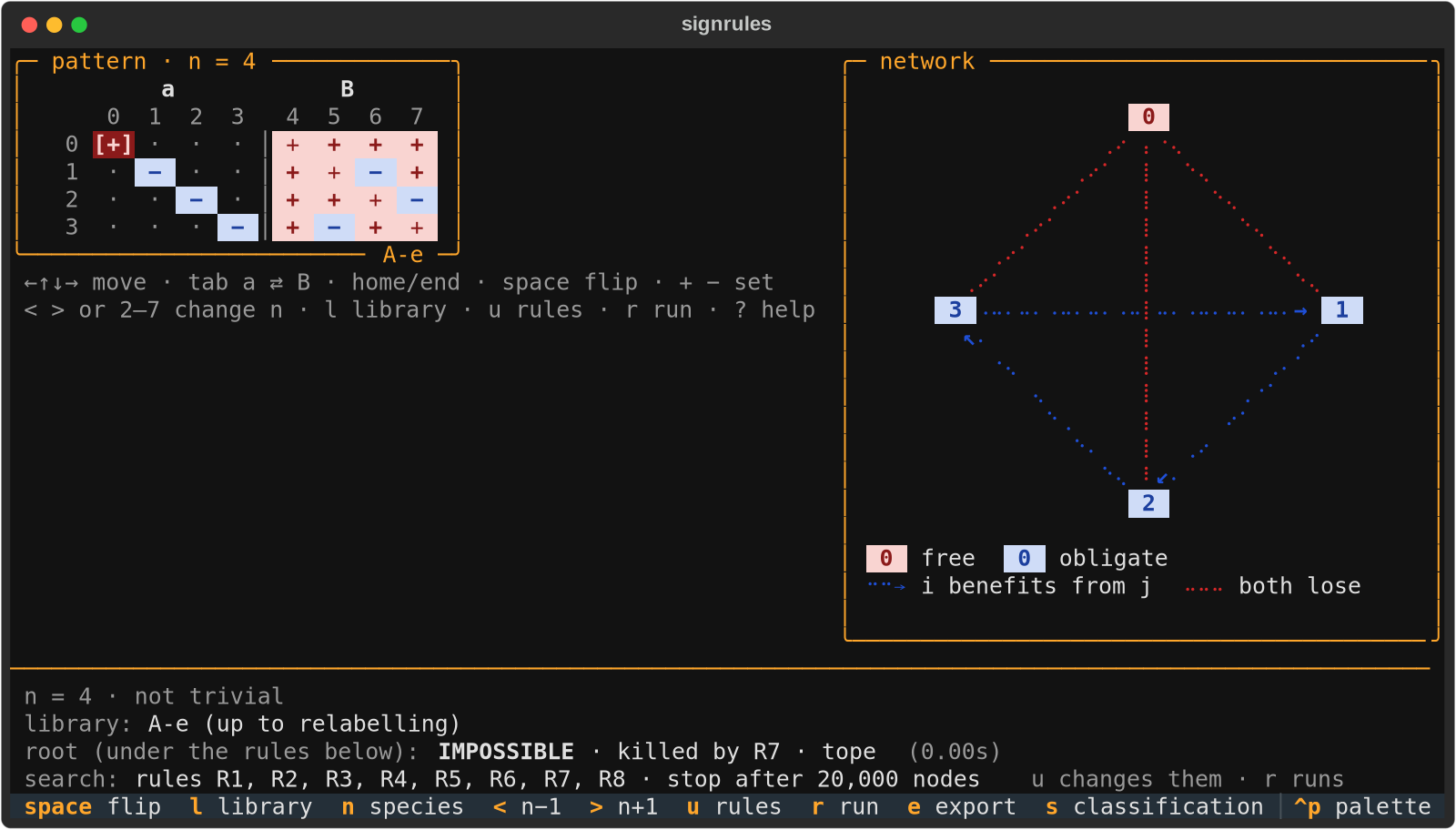
This opens an app in the terminal:
- Pick a pattern in the library (↑ ↓, enter), or start from an empty matrix.
- Edit it: the arrow keys move over the sign matrix
[diag(a) | B], space flips a sign,<and>remove or add a species. - Press
rto search. A dashboard shows the search live; the verdict comes at the end, with the certificate under it for an impossible pattern.
? lists every key; Esc goes back, q quits.
The same from the command line:
signrules run --preset A-e                         # a four-species pattern proved impossible: verdict and certificate
signrules run --a +--- --B "+-++/-+++/+++-/++-+"   # your own pattern: the signs of a, then the rows of B
signrules verify                                   # check the classification on four, five and six species
Verdicts and terms
A search ends in one of three verdicts:
- Impossible: no magnitudes with these signs have a stable positive equilibrium. The certificate printed with the verdict is the proof, and the independent checker has replayed it.
- Not decided by the rules: some sign tables survive every rule. The pattern may be possible; the rules cannot tell.
- Undecided: the search stopped at its node limit (20,000 by default;
--max-nodes 0lifts it).
The words used below:
- sign table: a sign for every minor of
B(equivalently, every Plücker coordinate of[diag(a) | B]). - killed: every sign table is ruled out, so the pattern is impossible. Killed at the root: ruled out by propagation alone, before any branching; the certificate is then a short list of steps.
- completion: a full sign table that no rule rules out.
- certificate: the steps from the pattern to a contradiction, each naming the identity or inequality that forces it.
- trivial: some obligate species has only harmful interactions, so no positive equilibrium exists at all.
- deletion lemma: deleting a species from an impossible pattern leaves an impossible or trivial one. So every impossible pattern on n species extends one on n − 1 species, and the extension screen lists the candidates.
- minimal impossible: impossible, with every one-species deletion impossible or trivial.
Commands
| command | what it does |
|---|---|
run |
complete one pattern with a live dashboard; prints the verdict and, for a kill, the certificate |
tree |
complete one pattern and write an interactive HTML viewer of the search tree |
replay |
kill one pattern at the root and check its certificate with the independent replayer |
edit |
the full-screen app (also plain signrules): library, matrix editor, network, rules, search, verdict |
presets |
list the named patterns (the eleven n = 4 patterns, the n = 5, 6 presets) with short ids |
screen |
list the candidates for impossible n-species patterns (deletion lemma) and run the rules on each |
verify |
check the classification on four, five and six species: every pattern killed or certified possible |
signrules <command> --help gives the options and examples. Signs are written +-..., +,-,... or
1,-1,...; the rows of B are separated by /, and its diagonal is +. A preset is named by its short id
(signrules presets) or any unambiguous prefix of its name. --rules takes all (the default), annals
(the rules of the first paper below) or a list such as R1,R2,R7. --plain, or output to a file, prints the
verdict only. --cert DIR draws the certificate (needs Graphviz). python -m signrules is the same command.
What it proves
- Four species: each of the 3044 patterns up to relabelling is decided. 715 are killed at the root (11 of them non-trivial: the eleven candidates of Meng et al.); each of the other 2329 has a certificate of possibility, a rational matrix whose equilibrium is checked stable in exact arithmetic.
- Five and six species: the deletion lemma, applied to the impossible patterns on one species fewer, leaves 83 candidates at n = 5 and 143 at n = 6, and every one is decided: 24 and 41 are killed at the root, the other 59 and 102 have certificates of possibility. So exactly 24 five-species and 41 six-species patterns are impossible, the minimal impossible patterns.
signrules verify checks all of this from the data shipped with the package, in about 15 seconds: it
rebuilds the candidate lists, redoes and replays every kill, and checks every certificate.
- Any number of species: two benefactor-permutation families are impossible (
scripts/families.py).
Use from Python
from signrules import Ecology, complete

eco = Ecology.parse("+---", "+-++/-+++/+++-/++-+")   # the strings of the command line; lists of ±1 work too
print(eco)                                           # the sign matrix [diag(a) | B]
result = complete(eco)
print(result.verdict, result.summary())              # impossible  impossible at the root (R8 real eigenvalue ...)
- For a kill,
replay_kill(eco, result)re-derives every step with the independent checker, andwrite_certificate(eco, result, "cert")draws the certificate (needs Graphviz). - For an open pattern,
result.completionsholds the surviving sign tables, andeco.minor_signs(table)names one as{minor: sign}. signrules.patternshas the named patterns:ELEVEN(four species),PATTERNS(five and six),parity_pattern,random_pattern.signrules.datahas the classification:census(4), andscreen_records(n),root_kills(n)andpossible(n)for n = 5, 6.signrules.possible.check_witnesschecks a certificate of possibility.
The docstring of complete lists its options.
How it works
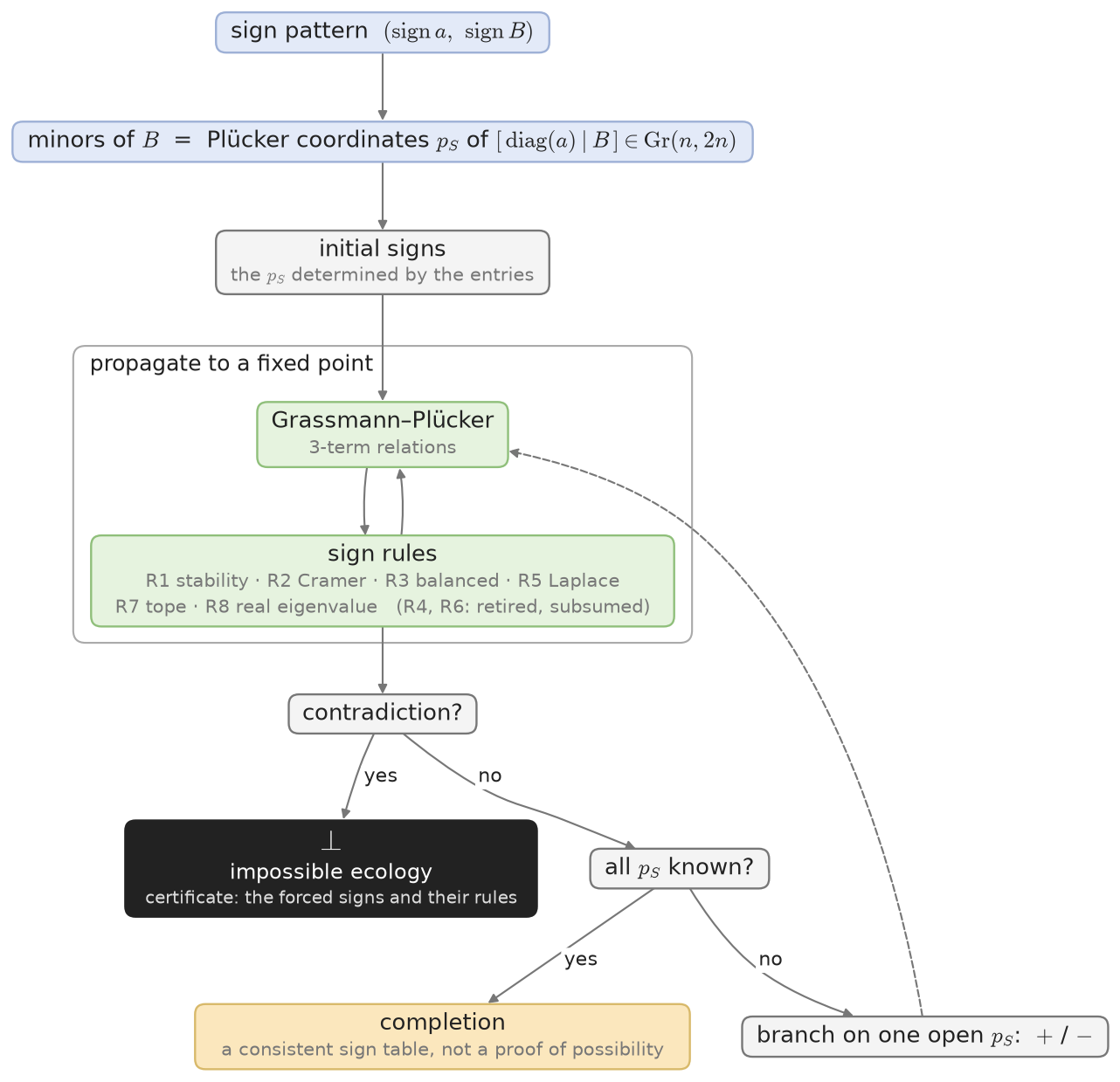
The matrix [diag(a) | B] is a point of the Grassmannian Gr(n, 2n), and every Plücker coordinate is a minor
of B up to a known sign. Feasibility and stability become constraints on one set of sign variables. The
search propagates the 3-term Grassmann–Plücker relations and the rules below to a fixed point, then branches
on an open sign. A contradiction kills the branch, and the steps that led to it form the certificate. The
tests check that the rules never reject a genuine feasible, stable system.
| rule | what it says | source |
|---|---|---|
R1 |
stability: det B > 0 and positive coefficients of the characteristic polynomial |
[1] |
R2n |
Cramer's rule on the full system | [1] |
R2 |
Cramer's rule on every subsystem | [2] |
R3 |
balanced patterns: the principal-minor signs of an M-matrix | [2], Theorems 3.1–3.2 |
R5 |
Laplace expansion of every minor along a row or a column | [2] |
R7 |
tope rule, the oriented-matroid Farkas lemma; it contains R2 |
new |
R8 |
a real positive eigenvalue for benefactor-permutation patterns | new |
The two new rules will appear in a paper in preparation. Two rules from [2], R4 and R6, are subsumed by
these and not run. docs/SIGNRULES.md
gives the full account: the dictionary between minors and Plücker coordinates, each rule with its proof,
certificates and replay, the search, and the screens.
Conventions
Species are numbered from 0 here and from 1 in the papers. b_ii > 0. B[i, j] < 0: species j benefits
species i (food, a mutualist); B[i, j] > 0: i loses to j (competition, predation). a_i > 0: species
i grows alone (free); a_i < 0: it does not (obligate). In [diag(a) | B] the columns 0..n-1 carry
diag(a) and n..2n-1 carry B, so p_0367 is the Plücker coordinate on columns 0, 3, 6, 7. In the
network drawings, a dashed arrow i → j means that i benefits from j, a red line joins two species that each
lose to the other, and free species are pink, obligate ones blue.
Reproducing the papers
The package does not need the scripts/ folder; the scripts reproduce the numbers of the papers from a clone
of the repository. Their records are in data/.
| result | command |
|---|---|
the eleven four-species kills; with --rules R1,R2n, the completion counts of [1] (S-d, S-e, A-a, A-c: 64, 64, 1996, 1528) |
uv run python scripts/impossible_eleven.py |
| the extension screens: 83 candidates at n = 5, 143 at n = 6 | signrules screen 5 --out n5.jsonl, signrules screen 6 --out n6.jsonl |
| every root kill replays, and flipping any single step makes the replay fail | uv run python scripts/replay_certificates.py 6 --tamper (and 4, 5) |
| the exhaustive five-species screen of all 248,436 non-trivial patterns up to relabelling: 21 kills under R1–R6, three more by R8 | uv run python scripts/screen_all.py --rules R1,R2,R3,R4,R5,R6 (100 CPU-minutes) |
| the benefactor-permutation families | uv run python scripts/families.py |
| what each rule adds on the minimal impossible patterns | uv run python scripts/rule_ladder.py 4 5 6 --out ladder.jsonl |
| R4 and R6 are subsumed by the other rules | uv run python scripts/rule_ablation.py 3 4 --census, uv run python scripts/r4_subsumption.py 3 4 --rules R1,R7 --others |
Development
git clone https://github.com/gescholt/signrules.git && cd signrules
uv sync --all-extras             # the environment from uv.lock, with the extras and pytest
uv run pytest -q                 # about a minute
The extras are live (questionary: menus for signrules run without a pattern) and html (plotly, for
save_search_tree_html). Graphviz (apt install graphviz, brew install graphviz) is needed only to draw
certificates and trees.
Papers
The package extends the sign-completion algorithm of [1] with the arguments of [2], read as propagation rules:
- [1] T. Ö. Çelik, P. A. Haas, G. Scholten, K. Wang, G. Zucal, Strata of ecological coexistence via Grassmannians, Ann. Comb. (2026), doi:10.1007/s00026-026-00837-7, arXiv:2509.00165.
- [2] T. Ö. Çelik, V. A. Isoldi, I. Portakal, G. Zucal, Stable coexistence in ecologies and games (2026), arXiv:2609.09286.
The four-species patterns come from Y. Meng, S. Horvát, C. D. Modes, P. A. Haas, Impossible ecologies: interaction networks and stability of coexistence in ecological communities, Cell Systems 16 (2025) 101297, doi:10.1016/j.cels.2025.101297.
Citation and licence
Every release is archived on Zenodo: doi:10.5281/zenodo.24214426 (all versions). To cite, see CITATION.cff. Changes are listed in CHANGELOG.md. MIT licence. Questions and bug reports: open an issue.
1 maintainer

Metadata
1 maintainer
Release files for ecological_sign_rules 0.5.3
For a detailed explanation of source distributions (sdists) and built distributions (wheels), please see the package formats documentation.
Source distribution (sdist)
| File | Size | Uploaded | Provenance | Actions |
|---|---|---|---|---|
| ecological_sign_rules-0.5.3.tar.gz | 177.3 kB | Without provenance | Details for ecological_sign_rules-0.5.3.tar.gz |
Built distribution (wheel)
| File | Interpreter | ABI | Platform | Actions Reset |
|---|---|---|---|---|
| ecological_sign_rules-0.5.3-py3-none-any.whl | Python 3 | none | any | Details for ecological_sign_rules-0.5.3-py3-none-any.whl |
Total release size: 367.7 kB
Release files / ecological_sign_rules-0.5.3.tar.gz
| Download URL | ecological_sign_rules-0.5.3.tar.gz |
|---|---|
| Size | 177.3 kB |
| Tags | Source |
|
SHA-256 checksum How to use checksums |
4ca86012d05bd8587491f1d1e248ddb4f57fc3cb36193bcca10eae82a04b081c
|
|
BLAKE2b-256 checksum How to use checksums |
672258cf620ab04b9aec2caac0cfd1f0e28085911e6658378be089a30cec2211
|
| Upload date | |
|
Uploaded using Trusted Publishing? What is trusted publishing? |
Yes |
| Uploaded via |
uv/0.13.9 {"installer":{"name":"uv","version":"0.13.9","subcommand":["publish"]},"python":null,"implementation":{"name":null,"version":null},"distro":{"name":"Ubuntu","version":"26.04","id":"resolute","libc":null},"system":{"name":null,"release":null},"cpu":null,"openssl_version":null,"setuptools_version":null,"rustc_version":null,"ci":true}
|
Release files / ecological_sign_rules-0.5.3-py3-none-any.whl
| Download URL | ecological_sign_rules-0.5.3-py3-none-any.whl |
|---|---|
| Size | 190.4 kB |
| Tags | Python 3 |
|
SHA-256 checksum How to use checksums |
46a0374010ea914c86ad8dc58ca9ab7ca008ff6aac967a5d0e640e066b32e731
|
|
BLAKE2b-256 checksum How to use checksums |
7bf8ef9b8985259c270bad2810130f2cd5329275477c1627ee8527f69351b9c6
|
| Upload date | |
|
Uploaded using Trusted Publishing? What is trusted publishing? |
Yes |
| Uploaded via |
uv/0.13.9 {"installer":{"name":"uv","version":"0.13.9","subcommand":["publish"]},"python":null,"implementation":{"name":null,"version":null},"distro":{"name":"Ubuntu","version":"26.04","id":"resolute","libc":null},"system":{"name":null,"release":null},"cpu":null,"openssl_version":null,"setuptools_version":null,"rustc_version":null,"ci":true}
|
Security for ecological_sign_rules 0.5.3
Provenance
Provenance describes where a file came from. On PyPI, provenance is shared via attestations, which provide a verifiable record of the build or publishing details. View details, limitations and caveats.
No provenance found
None of the files in this release were uploaded with provenance metadata.
A note on package security
PyPI is a repository for distributing packages, not a service for auditing them. While third-party security researchers and our staff do their best to detect and remove malicious packages, PyPI cannot guarantee the quality, security or suitability of any given package.
To learn more about protecting yourself from malicious actors, visit our package security documentation.













