

Lightweight Framework for Edge AI





✨ If you like our project, please give us a star ⭐️ for the latest update.
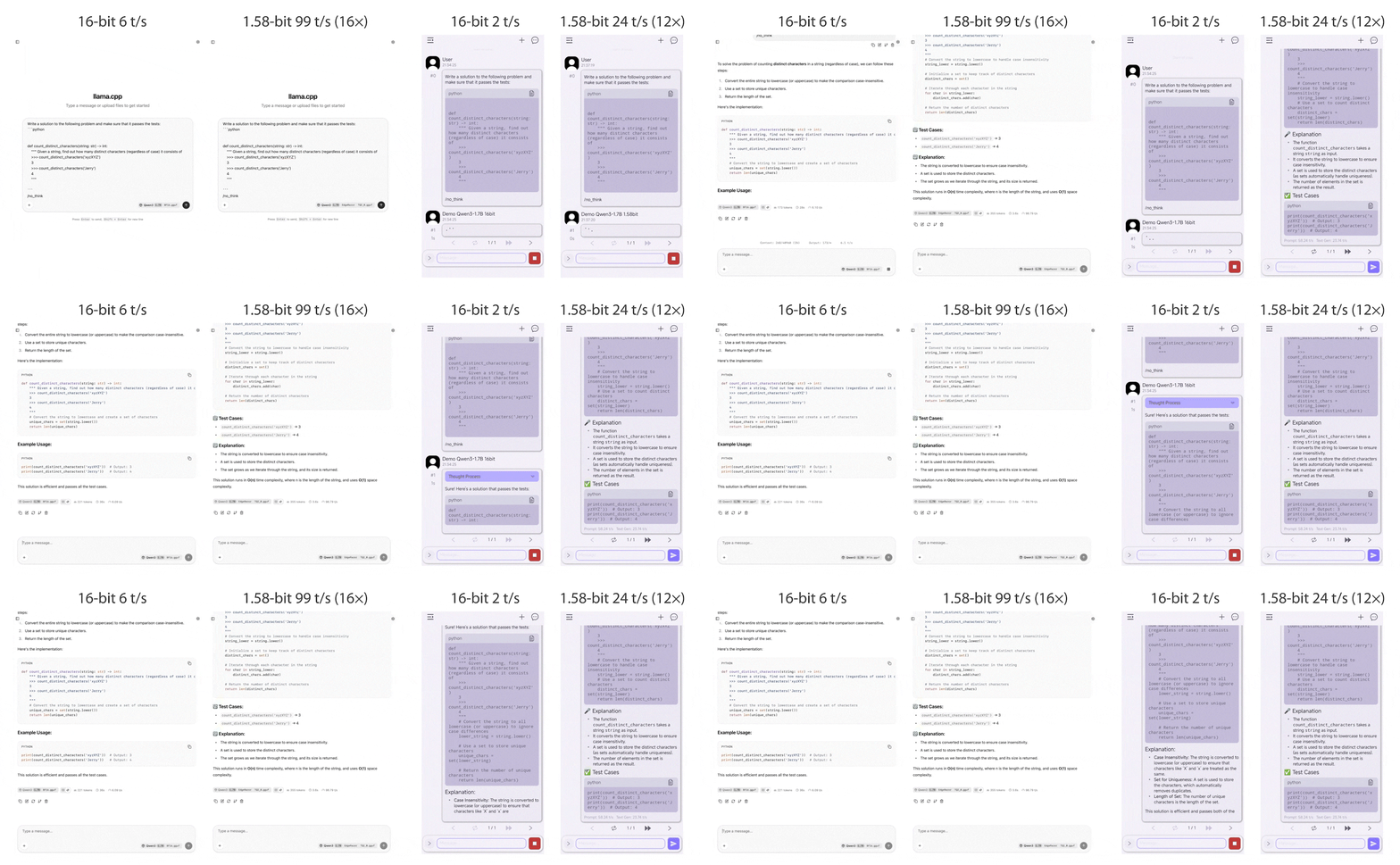
EdgeRazor is a lightweight framework for edge AI, designed to train models that are smaller, faster, and deployable across diverse hardware, ranging from mobile and edge endpoints to latency-sensitive clouds. The EdgeRazor framework seamlessly integrates model compression techniques into existing full-precision training pipelines with minimal code modification, preserving promising task performance and enabling low-cost and high-efficiency computations.
EdgeRazor currently focuses on low-bit LLM compression via configurable quantization-aware distillation. In terms of quantization, EdgeRazor supports quantizing weights (including embedding and lm_head layers), activations, and KV cache. Quantized bit-widths include the uniform 1.58-bit and 4-bit, as well as matrix-wise mixed-precision, such as 2.79-bit (50% 4-bit + 50% 1.58-bit) and 1.88-bit (12.5% 4-bit + 87.5% 1.58-bit). In terms of distillation, EdgeRazor offers the logits, features, and attention distillation, all of which can be flexibly combined within a unified configuration interface.
EdgeRazor achieves the state-of-the-art performance across a range of models, including base LLMs, instruction-tuned LLMs, and multimodal LLMs. For W-A8-KV8 quantization, Qwen3-0.6B-EdgeRazor attains average scores of 47.80 / 44.10 / 41.76 / 39.81 at 4-bit / 2.79-bit / 1.88-bit / 1.58-bit, corresponding to compression ratios of 3.94× / 5.05× / 6.40× / 7.03×, respectively. In comparison, the best prior methods achieve 45.74 / 37.38 / 30.49 at 4-bit / 3-bit / 2-bit with compression ratios of 2.21× / 2.47× / 2.78×.
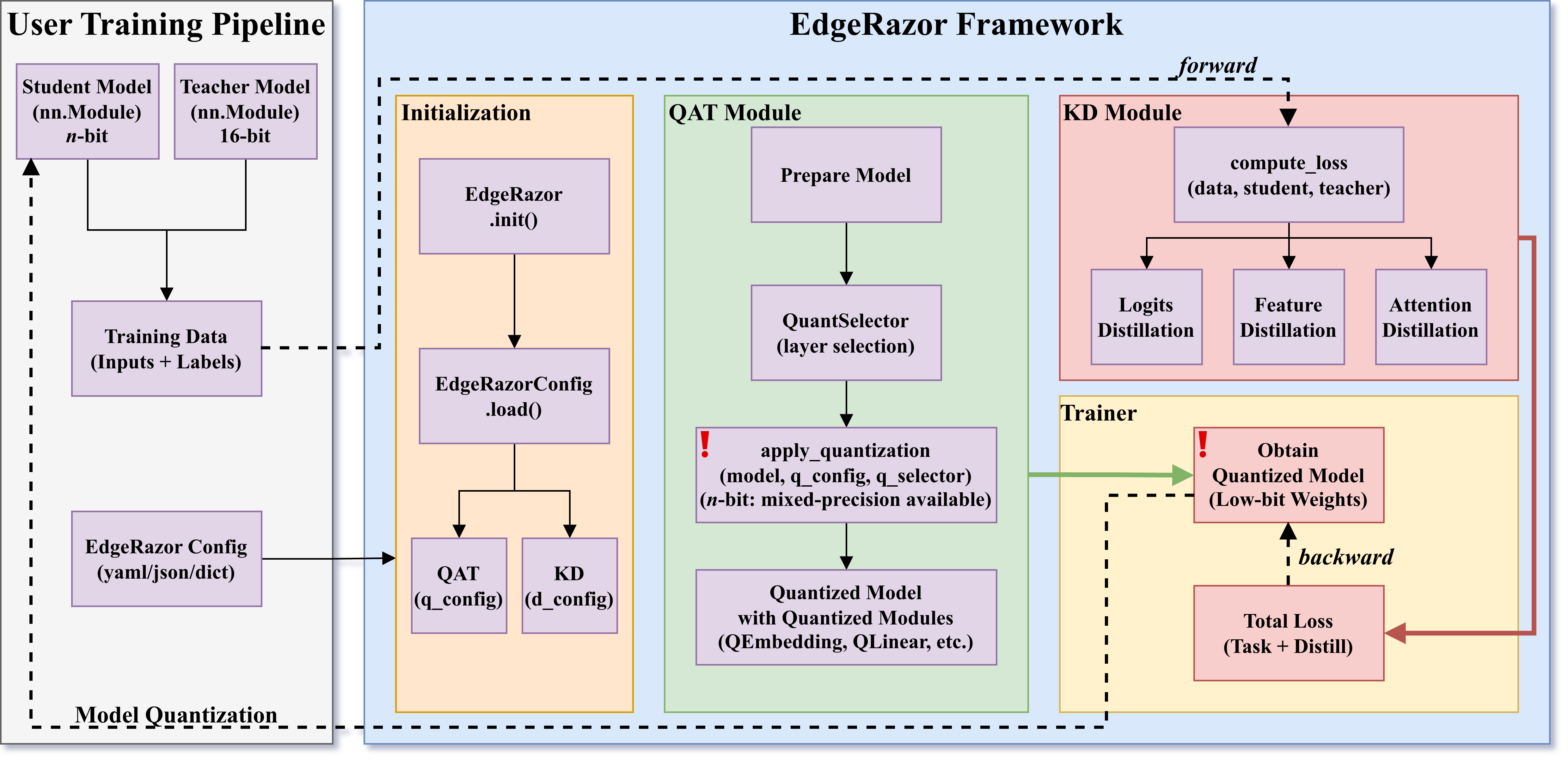
Figure: The EdgeRazor framework with lightweight model training pipeline.
News
- 🔥 [2026-04]: 📄 Paper-EdgeRazor is available on arXiv:2605.04062 and Hugging Face Paper!
- 🔥 [2026-04]: 🚀 EdgeRazor Playground is launched and open-sourced! CPU-friendly! Have a try!
- 🔥 [2026-04]: 🏅 CACC 2025 Final (China Algorithm Capability Competition) apply EdgeRazor as a solution in the AI subject!
- 🔥 [2026-04]: 🏆 Low-bit LLMs by EdgeRazor is released! Check our Hugging Face collection: zhangsq-nju/edgerazor-nbit.
- 🔥 [2026-04]: 🛠️ Open-sourced EdgeRazor-V1 is released! Now configurable on diverse models for seamless integration and customization!
- 🔥 [2025-10]: 📄 Paper-TernaryCLIP is available on arXiv:2510.21879!
Contents
- News
- Contents
- Quick Start
- Main Techniques
- Applications
- Model Zoo
- Todo List
- Acknowledgements
- Citation
- Contributor List
Quick Start
Installation
- Download from PyPi
pip install edgerazor
- Download from GitHub (latest version)
git clone https://github.com/zhangsq-nju/EdgeRazor.git && cd EdgeRazor
conda create -n edgerazor python=3.10.20 -y
conda activate edgerazor
pip install -e .
Usage
After installation, you can integrate EdgeRazor into your existing training pipeline to build lightweight models.
-
Seamlessly integrate EdgeRazor into your FULL-PRECISION model training pipeline!
-
Below are LLM examples of both the high-level and low-level API usage
# High-level API Usage
trainer = EdgeRazorCausalLMTrainer(
  model=student,
  args=TrainingArguments(...),
  train_dataset=train_dataset,
  data_collator=data_collator,
  processing_class=tokenizer,
  teacher_model=teacher,
  edgerazor_config="/path/to/w1.58-a8-kv8.yaml",
)
trainer.train()
# Low-level API Usage
edgerazor = EdgeRazor(config="/path/to/w1.58-a8-kv8.yaml")
student = edgerazor.quantize(student)
kv_cache_quant = edgerazor.create_kv_cache(model_config=student.config)
# Training loop:
student_outputs = student(**inputs, kv_cache_quant)
teacher_outputs = teacher(**inputs)
loss, loss_dict = edgerazor.compute_loss(student_outputs, teacher_outputs, labels)
Docker
Lightweight models are available from checkpoints trained with EdgeRazor. For example, you can convert Qwen3-EdgeRazor-4bit checkpoints to Q4_0 GGUF models. We also provide ready-to-use quantized models in our collection, including Qwen3-0.6B-EdgeRazor-GGUF and Qwen3-1.7B-EdgeRazor-GGUF.
# Serve quantized LLMs under CPU-only environments:
docker pull ghcr.io/ggml-org/llama.cpp:server
hf download zhangsq-nju/Qwen3-1.7B-EdgeRazor-GGUF Qwen3-1.7B-EdgeRazor-TQ2_0.gguf --local-dir /path/to/Qwen3-1.7B-EdgeRazor-GGUF
cd ./docker && bash local_server_tq2_0.sh
Playground
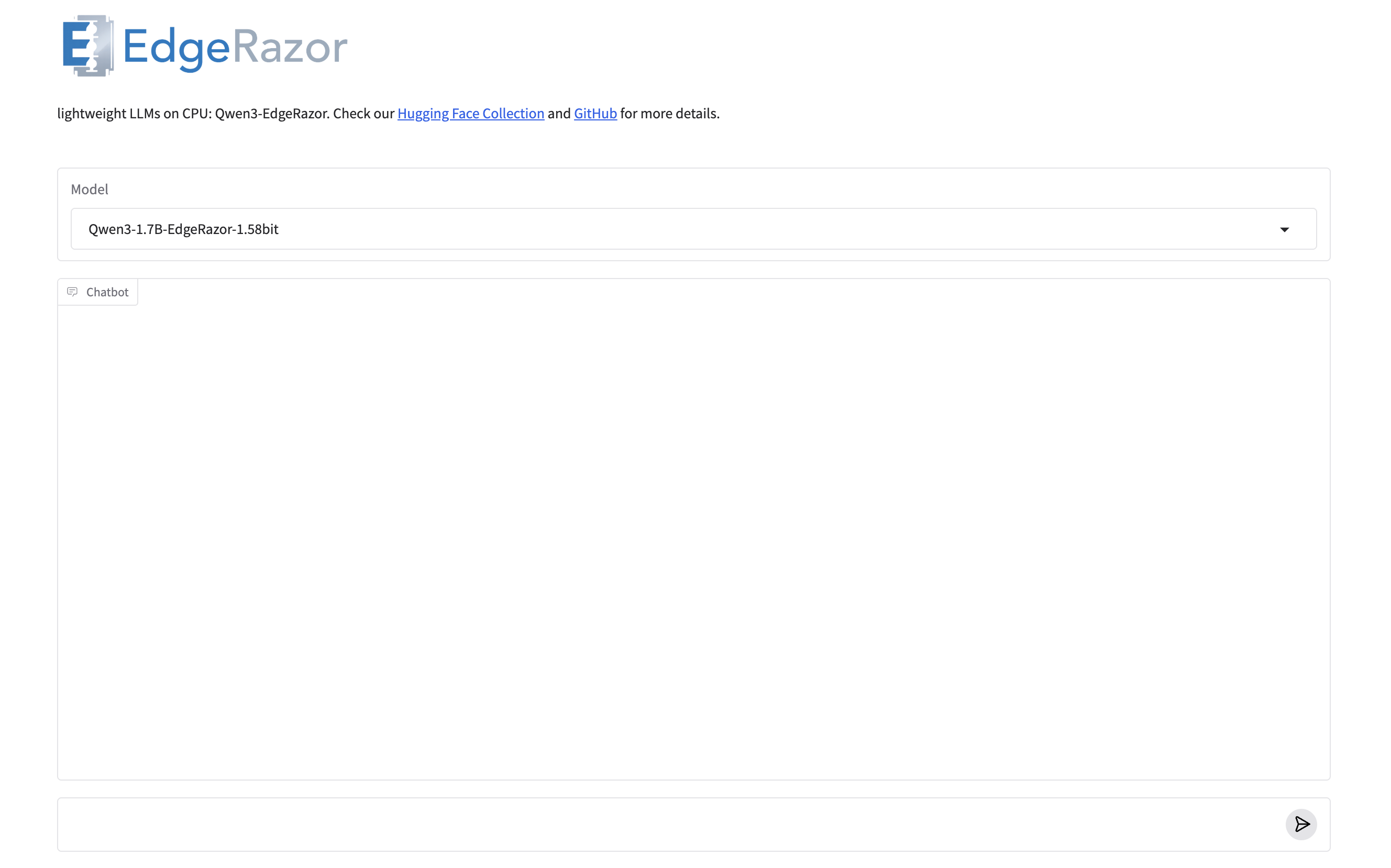
EdgeRazor Playgound is CPU-friendly! Enjoy low-bit LLMs from EdgeRazor on your edge devices!
cd EdgeRazor/playground
pip install -r requirements.txt
python app.py
Main Techniques
Mixed-Precision Quantization-Aware Distillation (MPQAD):
- Configurable training pipelines between 16-bit and $n$-bit models
- Configurable quantization for weights: Structural Quantization with Mixed Precision (SQMP)
- Configurable distillation methods: Layer-Adaptive Feature Distillation (LAFD), Entropy-Aware KL Divergence (EAKLD)
Figure: Workflow of the EdgeRazor framework.
Applications
- Lightweight ViT-S/16 for MNIST, check here.
- Lightweight ViT-S/16 for RetinaMNIST, check here.
- Lightweight ResNet-18, check here.
- Lightweight Qwen3-0.6B/1.7B, check here.
- Lightweight MobileLLM-ParetoQ-350M-BF16, check here.
- Lightweight Qwen2.5-Omni-7B, check here.
Model Zoo
LLMs
-
Average Performance (Avg.): average of performance scores in multiple tasks using lm-eval v0.4.9.1 with tasks.
- Tasks for instruct LLMs: arc_easy, arc_challenge, hellaswag, boolq, social_iqa, openbookqa, piqa, winogrande, hendrycks_ethics, truthfulqa_mc2, mmlu, gsm8k, humaneval_instruct, ifeval.
- Tasks for base LLMs: arc_easy, arc_challenge, hellaswag, boolq, social_iqa, openbookqa, piqa, winogrande, hendrycks_ethics, truthfulqa_mc2, mmlu, gsm8k, humaneval.
- Except for 5-shot gsm8k, all other tasks are 0-shot.
-
Hub Link: We provide the original quantized checkpoints. We also transfer the checkpoints into GGUF (llama.cpp) and GPTQ (GPTQModel, working in progress) formats if compatible.
| Model | W-A-KV | Group Size | Avg. | Hub Link |
|---|---|---|---|---|
| Qwen3-0.6B | W16-A16-KV16 | - | 47.35 | Base |
| Qwen3-0.6B | W4-A8-KV8 | 256 | 47.80 | EdgeRazor, Q4_0 |
| Qwen3-0.6B | W2.79-A8-KV8 | 256 | 44.10 | EdgeRazor |
| Qwen3-0.6B | W1.88-A8-KV8 | 256 | 41.76 | EdgeRazor |
| Qwen3-0.6B | W1.58-A8-KV8 | 256 | 39.81 | EdgeRazor, TQ1_0, TQ2_0 |
| Qwen3-1.7B | W16-A16-KV16 | - | 58.65 | Base |
| Qwen3-1.7B | W4-A8-KV8 | 256 | 58.57 | EdgeRazor, Q4_0 |
| Qwen3-1.7B | W2.79-A8-KV8 | 256 | 53.00 | EdgeRazor |
| Qwen3-1.7B | W1.88-A8-KV8 | 256 | 47.14 | EdgeRazor |
| Qwen3-1.7B | W1.58-A8-KV8 | 256 | 43.91 | EdgeRazor, TQ1_0, TQ2_0 |
| MobileLLM-350M | W16-A16-KV16 | - | 41.18 | Base |
| MobileLLM-350M | W4-A8-KV8 | 64 | 41.86 | EdgeRazor |
| MobileLLM-350M | W2.79-A8-KV8 | 64 | 40.62 | EdgeRazor |
| MobileLLM-350M | W1.88-A8-KV8 | 64 | 39.32 | EdgeRazor |
| MobileLLM-350M | W1.58-A8-KV8 | 64 | 38.12 | EdgeRazor |
MLLMs
- Video-MME and MLVU are video understanding tasks using lmms-eval v0.5.0 with tasks.
| Model | W-A-KV | Group Size | Video-MME | MLVU | Hub Link |
|---|---|---|---|---|---|
| Qwen2.5-Omni-7B | W16-A16-KV16 | - | 62.81 | 48.01 | Base |
| Qwen2.5-Omni-7B | W4-A16-KV16 | 32 | 62.22 | 48.82 | EdgeRazor |
Todo List
EdgeRazor is continuously evolving! Here's what's coming:
- Lightweight MobileLLM, Qwen3, and Qwen2.5-Omni: training code
- New API: EdgeRazorCausalLMTrainer for compressing text LLMs
- Upgrade to support the newest dependencies
Have ideas or suggestions? We welcome and appreciate any contributions and collaborations! Please feel free to submit issues or pull requests! 🚀
Acknowledgements
The deployment demos utilize llama.cpp and ChatterUI.
Citation
If you find our papar and code useful in your research, please consider kindly citing our papers ✏️:
@article{zhangsh-edgerazor,
  title={{EdgeRazor}: A Lightweight Framework for Large Language Models via Mixed-Precision Quantization-Aware Distillation},
  author={Shu-Hao Zhang and Le-Tong Huang and Xiang-Sheng Deng and Xin-Yi Zou and Chen Wu and Nan Li and Shao-Qun Zhang},
  year={2026},
  journal={arXiv preprint arXiv:2605.04062}
}

@article{zhangsh-ternaryclip,
  title={{TernaryCLIP}: Efficiently Compressing Vision-Language Models with Ternary Weights and Distilled Knowledge},
  author={Shu-Hao Zhang and Wei-Cheng Tang and Chen Wu and Peng Hu and Nan Li and Liang-Jie Zhang and Qi Zhang and Shao-Qun Zhang},
  year={2025},
  journal={arXiv preprint arXiv:2510.21879}
}
Contributor List
This project was supported by LAMDA and Assistant Professor Shao-Qun Zhang. Shu-Hao Zhang is the core developer and maintainer of EdgeRazor-V1. Xiang-Sheng Deng and Le-Tong Huang jointly participated in the development of this project.
1 maintainer

Metadata
1 maintainer
Release files for edgerazor 1.3.5
For a detailed explanation of source distributions (sdists) and built distributions (wheels), please see the package formats documentation.
Source distribution (sdist)
| File | Size | Uploaded | Provenance | |
|---|---|---|---|---|
| edgerazor-1.3.5.tar.gz | 96.8 kB | Without provenance | Details |
Built distribution (wheel)
| File | Interpreter | ABI | Platform | Reset |
|---|---|---|---|---|
| edgerazor-1.3.5-py3-none-any.whl | Python 3 | none | any | Details |
Total release size: 207.2 kB
Release files / edgerazor-1.3.5.tar.gz
| Download URL | edgerazor-1.3.5.tar.gz |
|---|---|
| Size | 96.8 kB |
| Tags | Source |
|
SHA-256 checksum How to use checksums |
029dd728deda7e648bdc3c6df729bcdc5df6d9808178a53803336f16fc9a55bb
|
|
BLAKE2b-256 checksum How to use checksums |
9d5d455ad7849b5945eaac94b5e03fb6f0ba0c265c3d50dc9b132733afde279b
|
| Upload date | |
|
Uploaded using Trusted Publishing? What is trusted publishing? |
No |
| Uploaded via |
twine/6.2.0 CPython/3.10.20
|
Release files / edgerazor-1.3.5-py3-none-any.whl
| Download URL | edgerazor-1.3.5-py3-none-any.whl |
|---|---|
| Size | 110.4 kB |
| Tags | Python 3 |
|
SHA-256 checksum How to use checksums |
4c02efd44f2ed3d254395b59b1328dfd2713195d061f9519024669adfe296648
|
|
BLAKE2b-256 checksum How to use checksums |
2b3bdfd8172702cbb229d944777241c67ba030843f851e627d07dbeaacd2f149
|
| Upload date | |
|
Uploaded using Trusted Publishing? What is trusted publishing? |
No |
| Uploaded via |
twine/6.2.0 CPython/3.10.20
|
Security for edgerazor 1.3.5
Provenance
Provenance describes where a file came from. On PyPI, provenance is shared via attestations, which provide a verifiable record of the build or publishing details. View details, limitations and caveats.
No provenance found
None of the files in this release were uploaded with provenance metadata.
A note on package security
PyPI is a repository for distributing packages, not a service for auditing them. While third-party security researchers and our staff do their best to detect and remove malicious packages, PyPI cannot guarantee the quality, security or suitability of any given package.
To learn more about protecting yourself from malicious actors, visit our package security documentation.














