
Edison
An EDIFACT parser with a real syntax tree.



Edison is a Python library for parsing EDIFACT messages. Instead of treating a message as a flat stream of segments, it models valid messages as a tree. You define the schema once, then parse, validate, or pretty-print messages against that structure.
Highlights
- Define EDIFACT syntax trees directly in Python.
- Segments can define groups of child segments, which can be conditional, mandatory, or repeatable.
- Attach parsing callbacks to the segments you care about.
- Select schemas by message version.
- Handle escaped EDIFACT separators and EBCDIC control characters.
- Properly tokenize segments with specified lengths like
BLB - Export transition graphs with
pydot.
Installation
Edison requires Python 3.12 or newer.
pip install edison-parser
Quick start
Subclass BaseParser, define one or more schemas, and attach callback method
names to the schema nodes you want to process.
from edison import BaseParser


class PIZZAQParser(BaseParser):
    schemas = {
        (0, 0): [
            ["UNH"],
            ["CVR"],
            ["REF"],
            [
                "PIZ",
                [
                    ["TYP", [], "parse_typ"],
                    ["REF", [], "parse_ref"],
                ],
            ],
            ["UNT"],
        ],
    }

    def __init__(self):
        self.summary = {}
        self.pizza = None

    def parse_typ(self, segment: str):
        self.pizza = segment[4:]

    def parse_ref(self, segment: str):
        refs = segment[4:].split("*")
        self.summary[self.pizza] = len(refs)


edi = """
UNH+1+PIZZAQ:1:1:1A+00012480825035'
CVR+USD'
REF+LUIS'
PIZ+1'
TYP+MARGARITA'
REF+1*2'
PIZ+2'
TYP+PESTO'
REF+3'
UNT+19+1'
"""

# Create the parser and parse this EDIFACT message.
# The `summary` attribute is populated by the callbacks.
parser = PIZZAQParser()
parser.parse(edi)
parser.summary  # {"MARGARITA": 2, "PESTO": 1}

# Validate and pretty-print the message.
PIZZAQParser.validate(edi)  # True/False
PIZZAQParser.show(edi)  # to print
Here is the output of PIZZAQParser.show(edi).
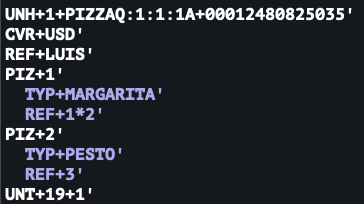
Tree-based structure.
Schema format
A schema is a dictionary keyed by the minimum supported version:
schemas = {
    (0, 0): [
        ["UNH"],
        ["BGM"],
        ["UNT"],
    ],
}
Each segment node accepts these positional fields:
["TAG", children, action, repetition, flag]
| Field | Default | Meaning |
|---|---|---|
TAG |
required | Three-character EDIFACT segment tag. |
children |
[] |
Nested segment group. |
action |
None |
Parser method name called with the raw segment. |
repetition |
99999 |
1 means single-use; any higher value means repeatable. |
flag |
"C" |
"C" for conditional, "M" for mandatory. |
Main API
| API | Use |
|---|---|
parser.parse(edi, version=None) |
Walk an EDI message and call matching segment actions. |
Parser.validate(edi, version=None) |
Return True when all segments follow the schema transitions. |
Parser.show(edi, version=None, colorize=True) |
Return a formatted, indented representation of an EDI message. |
Parser.build_dot_object(version=None, include_up_links=True) |
Build a pydot.Dot transition graph. |
extract_envelope_headers(edi) |
Quickly return the UNB and UNH envelope segments. |
extract_envelope_footers(edi) |
Quickly return the UNT and UNZ envelope segments. |
escape(data) / unescape(data) |
Escape or unescape EDIFACT separators: +, :, *, '. |
normalize_ebcdic_separators(edi) |
Convert EBCDIC EDIFACT separators to ASCII safely. |
Advanced usage
Versioned syntax trees
Define multiple syntax trees when the same message evolves across versions. The
parser selects the highest schema version less than or equal to the version
argument, while parsing callbacks can stay the same.
from edison import BaseParser


class RouteParser(BaseParser):
    schemas = {
        (0, 0): [
            ["UNH"],
            ["ORG", [], "parse_origin"],
            ["DST", [], "parse_destination"],
            ["UNT"],
        ],
        (2, 0): [
            ["UNH"],
            [
                "LEG",
                [
                    ["ORG", [], "parse_origin"],
                    ["DST", [], "parse_destination"],
                ],
            ],
            ["UNT"],
        ],
    }

    def __init__(self):
        self.route = {}

    def parse_origin(self, segment: str):
        self.route["origin"] = segment[4:]

    def parse_destination(self, segment: str):
        self.route["destination"] = segment[4:]


legacy = RouteParser()
legacy.parse("UNH'ORG+PAR'DST+NCE'UNT'", version=(1, 0))

modern = RouteParser()
modern.parse("UNH'LEG+1'ORG+PAR'DST+NCE'UNT'", version=(2, 0))

assert legacy.route == modern.route == {
    "origin": "PAR",
    "destination": "NCE",
}
assert RouteParser.validate("UNH'ORG+PAR'DST+NCE'UNT'", version=(1, 0))
assert RouteParser.validate("UNH'LEG+1'ORG+PAR'DST+NCE'UNT'", version=(2, 0))
When version is omitted, incomplete, or newer than all known schemas, Edison
uses the latest schema. If a requested version is older than the first schema,
find_transitions() raises ValueError.
Mandatory and repeatable segments
repetition controls whether the transition graph can come back to the same
node:
1means the node can be used once in a given sequence.- Any value greater than
1means the node is repeatable. The transition graph only distinguishes1from "repeatable"; it does not count exact occurrence limits such as2versus99999.
Mandatory nodes constrain valid paths through the tree. Once a mandatory node is
next in a sequence, the parser cannot skip over it to reach a later sibling, a
parent, or a child that would bypass it. A mandatory child does not make its
parent mandatory by itself: if the whole group is required, mark the group node
as "M" too.
from edison import BaseParser


class OrderParser(BaseParser):
    schemas = {
        (0, 0): [
            ["UNH"],
            [
                "ITM",
                [
                    ["DSC"],
                    ["QTY", [], "parse_quantity", 1, "M"],
                    ["PRI"],
                ],
                None,
                99999,
                "M",
            ],
            ["UNT"],
        ],
    }

    def __init__(self):
        self.quantities = []

    def parse_quantity(self, segment: str):
        self.quantities.append(segment[4:])


assert OrderParser.validate("UNH'ITM'DSC'QTY+2'PRI'ITM'QTY+1'UNT'")
assert not OrderParser.validate("UNH'UNT'")  # ITM is mandatory.
assert not OrderParser.validate("UNH'ITM'PRI'UNT'")  # QTY is mandatory.
assert not OrderParser.validate("UNH'ITM'QTY+2'QTY+3'UNT'")  # QTY repeats once.
Shared headers, footers, and parser hooks
Use header and footer when several schemas share envelope segments. They are
automatically prepended and appended to every schema at class compilation time.
from edison import BaseParser


class EnvelopeParser(BaseParser):
    header = [["UNH", [], "on_segment"]]
    footer = [["UNT", [], "on_segment"]]
    schemas = {(0, 0): [["BGM", [], "on_segment"]]}

    def __init__(self):
        self.segments = []

    def set_up(self):
        self.segments.clear()

    def on_segment(self, segment: str):
        self.segments.append(segment)

    def tear_down(self):
        self.count = len(self.segments)
set_up() runs before parsing starts, and tear_down() runs after parsing
finishes.
Transition graphs
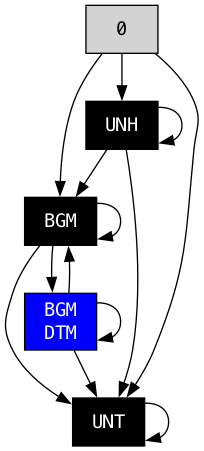
Internally, Edison builds a directed graph of transitions between segments, when the parser class is created.
Each node is a specific segment, and each edge is a valid transition to the next segment.
With this, parsing is just a walk through the graph, and validation is checking if the path exists.
You can visualize the transition graph with build_dot_object(), which returns a pydot.Dot object.
pydot is installed with Edison. To write PNG files, make sure Graphviz is available on your system.
from edison import BaseParser


class Parser(BaseParser):
    schemas = {
        (0, 0): [
            ["UNH"],
            [
                "BGM",
                [
                    ["DTM"],
                ],
            ],
            ["UNT"],
        ],
    }


dot = Parser.build_dot_object()
dot.write_png("transitions.png")
Here is the resulting graph for the above schema.
You can pass the same version selector used by parsing, and hide upward links for a simpler tree-like graph:
dot = Parser.build_dot_object(version=(13, 2), include_up_links=False)
dot.write_png("transitions-v13.png")
Because build_dot_object() returns the underlying pydot.Dot object, you can
customize it before writing.
Escaping and EBCDIC EDIFACT separators
Edison understands escaped EDIFACT separators and can normalize EBCDIC separator characters often found in binary payloads.
from edison import normalize_ebcdic_separators, escape, unescape


assert escape("REC+") == r"REC\+"
assert unescape(r"REC\+") == "REC+"
assert normalize_ebcdic_separators("UNB\x1dSENDER\x1fREC") == "UNB+SENDER:REC"
The segment tokenizer also handles escaped quotes, so content such as
IFT+1+AIRLINE\'SERVER' stays in a single EDIFACT segment.
EDIFACT envelope extraction
For the common case of reading EDIFACT envelope boundaries, use
extract_envelope_headers() to lazily return the first UNB/UNH segments or
extract_envelope_footers() to lazily return the last UNT/UNZ segments:
from edison import extract_envelope_footers, extract_envelope_headers

edi = "UNB+SENDER+RECEIVER'UNH+1+PIZZAQ:1:1:1A'BGM+1'UNT+3+1'UNZ+1+1'"
headers = extract_envelope_headers(edi)
footers = extract_envelope_footers(edi)

assert headers.unb == "UNB+SENDER+RECEIVER"
assert headers.unh == "UNH+1+PIZZAQ:1:1:1A"
assert footers.unt == "UNT+3+1"
assert footers.unz == "UNZ+1+1"
Development
Local commands
This repository uses uv, tox, pytest, ruff, black, ty, and
pre-commit hooks.
uv tool install tox --with tox-uv
tox -e py
Build distributions with:
uv build --sdist --wheel -o dist/
Run the full pre-commit suite with:
uv tool install prek==0.4.10
prek run --all-files
CI runs tests through tox on CPython 3.12 and 3.14 across Linux, Windows, and macOS, then builds source and wheel distributions.
1 maintainer

Metadata
1 maintainer
Release files for edison-parser 0.4
For a detailed explanation of source distributions (sdists) and built distributions (wheels), please see the package formats documentation.
Source distribution (sdist)
| File | Size | Uploaded | Provenance | |
|---|---|---|---|---|
| edison_parser-0.4.tar.gz | 21.6 kB | With provenance | Details |
Built distribution (wheel)
| File | Interpreter | ABI | Platform | Reset |
|---|---|---|---|---|
| edison_parser-0.4-py3-none-any.whl | Python 3 | none | any | Details |
Total release size: 38.4 kB
Release files / edison_parser-0.4.tar.gz
| Download URL | edison_parser-0.4.tar.gz |
|---|---|
| Size | 21.6 kB |
| Tags | Source |
|
SHA-256 checksum How to use checksums |
56c1ce3e481f0378ba91a9ec3f7d294ca4d931de925d76e527f12571f5b9c9fe
|
|
BLAKE2b-256 checksum How to use checksums |
0ac01957017b18ae0464d009aea818d60a22e4b054ae3ce17b34b47a97cdc9c8
|
| Upload date | |
|
Uploaded using Trusted Publishing? What is trusted publishing? |
Yes |
| Uploaded via |
twine/7.0.0 CPython/3.13.16
|
Provenance
Provenance describes where a file came from. On PyPI, provenance is shared via attestations, which provide a verifiable record of the build or publishing details. View details, limitations and caveats.


PyPI Publish Attestation
PyPI verified that this artifact, at this checksum, originated from the publisher listed below.
Signed by GitHub Actions, verified by PyPI on Oct 21, 2026.
Transparency logRelease files / edison_parser-0.4-py3-none-any.whl
| Download URL | edison_parser-0.4-py3-none-any.whl |
|---|---|
| Size | 16.9 kB |
| Tags | Python 3 |
|
SHA-256 checksum How to use checksums |
c25c64fbf647a887100ac0355139282e3da646841bbf3b50cdb2e0d0fdf622e8
|
|
BLAKE2b-256 checksum How to use checksums |
d7528bd1d55ad1ebcd16e7fd749ba3f67e21b1bc46cf577d34b500aa3c3a5aef
|
| Upload date | |
|
Uploaded using Trusted Publishing? What is trusted publishing? |
Yes |
| Uploaded via |
twine/7.0.0 CPython/3.13.16
|
Provenance
Provenance describes where a file came from. On PyPI, provenance is shared via attestations, which provide a verifiable record of the build or publishing details. View details, limitations and caveats.
PyPI Publish Attestation
PyPI verified that this artifact, at this checksum, originated from the publisher listed below.
Signed by GitHub Actions, verified by PyPI on Oct 21, 2026.
Transparency logSecurity for edison-parser 0.4
Provenance
Provenance describes where a file came from. On PyPI, provenance is shared via attestations, which provide a verifiable record of the build or publishing details. View details, limitations and caveats.
Full provenance
All 2 files in this release have been uploaded with provenance metadata.
Attestation for edison_parser-0.4.tar.gz
PyPI Publish Attestation
PyPI verified that this artifact, at this checksum, originated from the publisher listed below.
Signed by GitHub Actions, verified by PyPI on Oct 21, 2026.
Transparency logA note on package security
PyPI is a repository for distributing packages, not a service for auditing them. While third-party security researchers and our staff do their best to detect and remove malicious packages, PyPI cannot guarantee the quality, security or suitability of any given package.














