
Intracranial hemorrhage detection on CT — built for the small ones.






Install · Quickstart · API · Models · Results · How it works · Limitations · Research
ednhemo segments intracranial hemorrhages (ICH) on non-contrast head CT and reports them lesion by lesion: volume in mL, size class, slice, and model confidence. It ships two trained 2D U-Nets inside the wheel — pip install ednhemo works offline, no checkpoint download, no Kaggle account.
It was built for a problem that pixel-wise Dice hides: small hemorrhages. A 30-voxel bleed can disappear completely while the Dice score barely moves. So the second checkpoint (variante) guarantees that 4 of every 8 training slices contain a hemorrhage under 5 mL. On the official 96-scan test set it recovers 19 more lesions than the reference model, 52 of the 58 recovered lesions are under 1 mL.
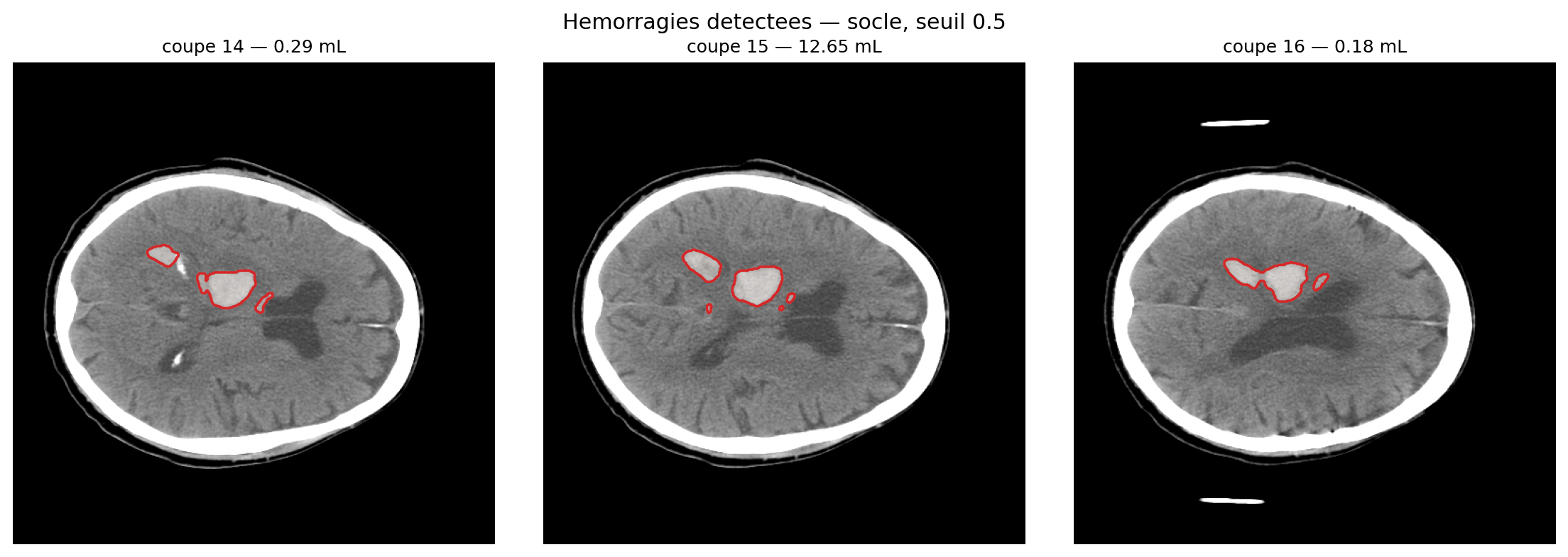
One test scan → 5 hemorrhages (0.02, 0.04, 0.18, 0.29 and 12.6 mL), 4 of them under 5 mL.
Install
pip install ednhemo
- Python 3.9+, PyTorch 2.0+ (installed automatically, CPU build by default).
- Both checkpoints are bundled (~60 MB), so the first run needs no network access.
- CPU works; a CUDA GPU is roughly 20× faster (about 1–2 s per slice on CPU, tens of ms on GPU).
From source:
git clone https://github.com/aimenachraff-jpg/ednhemo.git
cd ednhemo
pip install -e ".[dev]"
Quickstart
Command line
ednhemo scan.nii.gz
ednhemo 0.1.1
Input      : scan.nii.gz
Model      : variante - Lot G model (small-lesion oversampling)
             Dice 0.540 | sensitivity 44.1% | false alarms/scan 3.78
Volume     : 28 slice(s), 0.488 x 0.488 x 5.3 mm
Mask       : 10,407 positive voxel(s) (threshold 0.50)
Detected   : 5 hemorrhage(s), 4 under 5 mL, 13.121 mL total

  #  slice  volume_ml  size class    voxels  confidence
---  -----  ---------  -----------  ------  ----------
  1     14      0.286  0.1-1 mL        227       0.924
  2     15     12.591  > 5 mL          9987       0.985
  3     15      0.042  < 0.1 mL         33       0.901
  4     15      0.018  < 0.1 mL         14       0.687
  5     16      0.184  0.1-1 mL        146       0.927

Outputs written to .../ednhemo_output/scan_variante
  - mask.nii.gz
  - lesions.csv
  - summary.json
  - overlay.png
Useful flags:
ednhemo scan.nii.gz --model socle          # reference checkpoint
ednhemo scan.nii.gz -o results/ --json     # custom output dir, JSON on stdout
ednhemo slice.png                          # 2D image already windowed to [-40, 120] HU
ednhemo --list-models                      # checkpoint metrics
ednhemo scan.nii.gz --device cuda --batch-size 16
Python API
from ednhemo import analyze

result = analyze("scan.nii.gz", model="variante")

print(result.n_lesions, result.n_small_lesions)   # 5 4
for lesion in result.lesions:
    print(lesion.slice, round(lesion.volume_ml, 3), lesion.size_class, round(lesion.confidence, 3))

result.save("out/")        # mask.nii.gz, lesions.csv, summary.json, overlay.png
result.mask                # boolean (X, Y, Z) at the input resolution
result.summary()           # JSON-serializable dict
Low-level access, if you want to reuse the network or the probabilities:
import numpy as np
from ednhemo import load_model, load_volume, predict_probabilities, find_lesions

volume = load_volume("scan.nii.gz")          # windowed + normalized to [-1, 1]
model = load_model("socle", device="cpu")    # UNet2D, eval mode

probabilities = predict_probabilities(volume, model=model)
mask = probabilities > 0.5
lesions = find_lesions(mask, probabilities, volume.spacing)
analyze also accepts a raw HU array:
result = analyze(volume_hu, model="variante") # (X, Y) or (X, Y, Z), raw HU
What you get
| File | Content |
|---|---|
mask.nii.gz |
Binary mask, same affine and spacing as the input NIfTI |
mask.png |
Binary mask for 2D inputs |
lesions.csv |
One row per lesion: slice, volume (mL), size class, voxels, confidence, centroid |
summary.json |
Model, threshold, spacing, counts, total volume, full lesion list |
overlay.png |
Up to four slices with the predicted contour and per-slice volume |
Models
| Name | What it is | Validation Dice | Test Dice | Sensitivity | False alarms / scan |
|---|---|---|---|---|---|
socle |
Reference model, common protocol | 0.5845 (epoch 26) | 0.510 | 41.9 % | 3.43 |
variante |
Lot G: 4 small-lesion slices per batch of 8 | 0.5544 (epoch 35) | 0.540 | 44.1 % | 3.78 |
variante is the default. Use socle if you want the checkpoint trained with the strict common protocol, or variante if sensitivity on small bleeds matters more than a small increase in false alarms.
Aliases: base → socle, small → variante.
Both models are the same architecture: 2D U-Net, four levels (32-64-128-256), 7,765,409 parameters, one input channel, one logit map per pixel.
Results
Official evaluation on the 96 held-out test scans (864 lesions), using the imposed evaluation_commune.py without modification (SHA-256 verified). A lesion counts as detected when at least one predicted voxel overlaps it.
| Metric | socle |
variante |
Δ |
|---|---|---|---|
| Dice (mean) | 0.510 | 0.540 | +0.030 |
| Sensitivity, all lesions | 41.9 % (362/864) | 44.1 % (381/864) | +2.2 pts |
| Mean per-scan sensitivity | 54.4 % | 57.7 % | +3.3 pts |
| False alarms per scan | 3.43 | 3.78 | +0.35 |
By size class:
| Class | socle |
variante |
Δ |
|---|---|---|---|
| < 0.1 mL | 16.0 % (39/244) | 18.4 % (45/244) | +2.5 pts |
| 0.1 – 1 mL | 33.3 % (139/417) | 36.7 % (153/417) | +3.4 pts |
| 1 – 5 mL | 86.4 % | 83.9 % | −2.5 pts |
| > 5 mL | 96.5 % | 98.8 % | +2.3 pts |
Lesion by lesion: 58 lesions missed by socle are recovered by variante, 39 are lost (net +19); 52 of the 58 recovered lesions are under 1 mL.
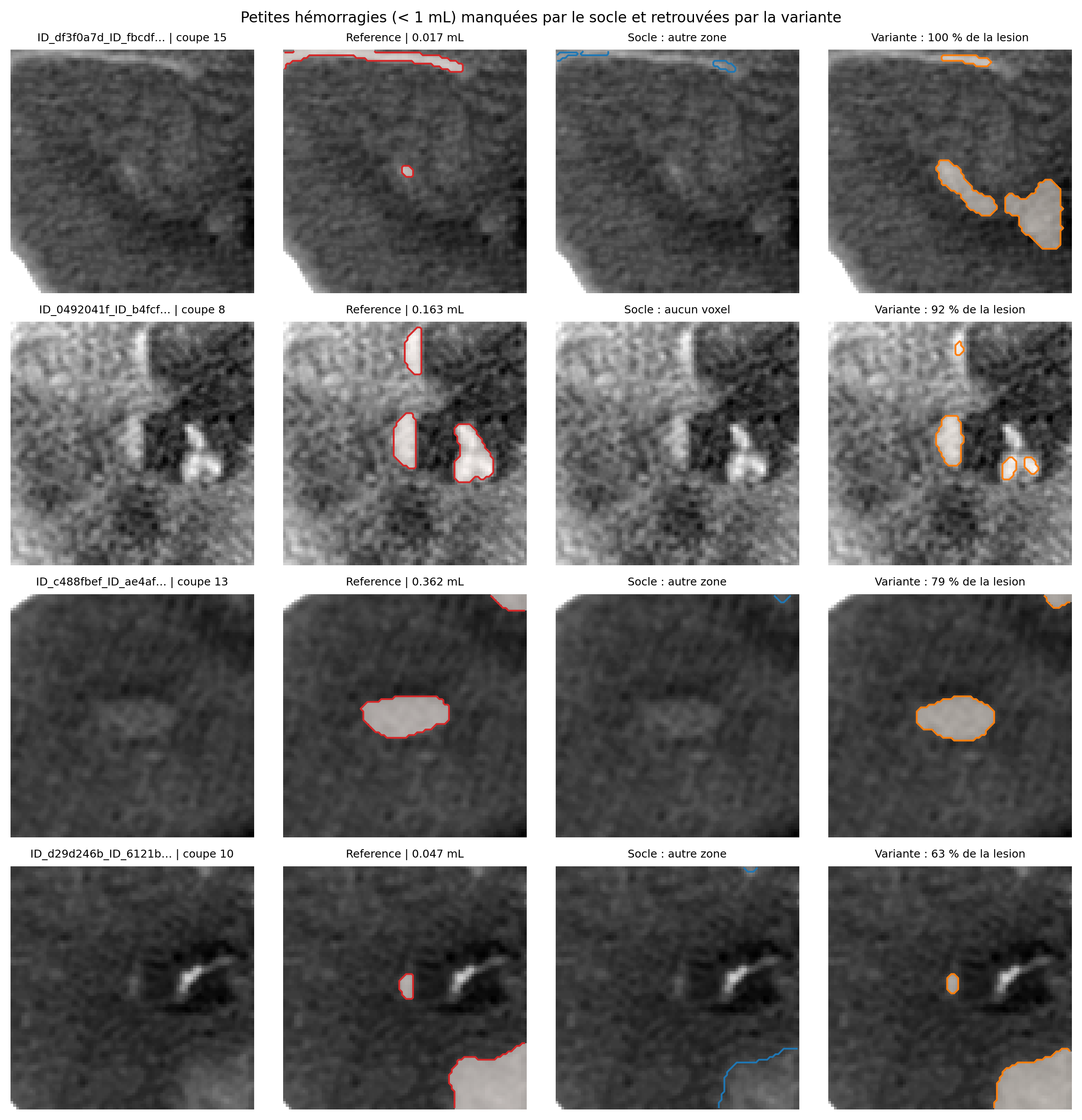
Red: reference · Orange: lot G prediction. These lesions are entirely missed by socle — invisible to the Dice score.
How it works
flowchart LR
    A["NIfTI scan<br/>or 2D image"] --> B["Brain window<br/>[-40, 120] HU"]
    B --> C["Normalize<br/>(v - 40) / 80"]
    C --> D["Resize<br/>512 x 512"]
    D --> E["2D U-Net<br/>7.77 M params"]
    E --> F["sigmoid > 0.5"]
    F --> G["26-connected<br/>components"]
    G --> H["Volume (mL)<br/>size class<br/>confidence"]
The inference pipeline is the training pipeline, byte for byte:
- Window: clip to
[-40, 120]HU, normalize with(v − 40) / 80→[-1, +1]. - Resize: bilinear to 512 × 512; the mask is resampled back to the input resolution (nearest neighbour).
- Threshold: 0.5, as imposed by the protocol.
- Volumes: computed with the NIfTI voxel spacing; for 2D images the BHSD spacing (0.488 × 0.488 × 6 mm) is used and volumes are indicative.
- Lesions: 26-connected components; components under 0.01 mL are ignored, as everywhere in the project.
- Confidence: mean sigmoid probability over the lesion voxels.
For a 2D PNG/JPEG, the image is assumed to be already windowed to [-40, 120] HU: 8-bit values are mapped with 2·(v/255) − 1, the exact equivalent of the HU normalization.
Limitations
- Not a medical device. Research and educational use only.
- One seed, one split. Trained with seed 36 on the official BHSD split (80 train / 16 validation / 96 test); no cross-validation, so the confidence intervals are wide.
- 2D model. Slices are processed independently; there is no 3D context. The protocol allowed only horizontal flip and ±10° rotation.
- Small lesions remain hard. Sensitivity is 18.4 % below 0.1 mL and 36.7 % between 0.1 and 1 mL. The model is a small-lesion improvement, not a small-lesion solution.
- Fixed threshold. 0.5 was imposed for the comparison; the CLI exposes
--thresholdbut the published metrics are at 0.5. - Domain shift. BHSD is a public Chinese dataset; scanner protocols, slice thickness and population differ from other hospitals.
- Subarachnoid hemorrhage is the hardest subtype (sensitivity ≈ 0.29): thin, diffuse lesions with few voxels.
Reproducibility
Everything is reproducible end to end:
- Seed 36, official split 80/16/96, best validation Dice checkpoint.
- Training notebooks 01–07 and
utils.pyare inresearch/notebooks. - Official results (per-lesion, per-scan, per-class CSVs) are in
research/results. - Reports (one-page and final) are in
research/reports. - Kaggle: kernels
aymencharafedn/01…07and datasetsbhsd-label-192,m2-modeles-equipe-36,m2-predictions-{socle,variante}-equipe-36.
The imposed evaluation script was never modified — its SHA-256 is checked in the final report.
Citation
If you use this code or these weights, please cite the project:
@software{ednhemo2026,
  title  = {ednhemo: small-hemorrhage-aware intracranial hemorrhage detection on CT},
  author = {Chekalil, Aimene Charef Eddine and Ouadah, Mustapha},
  year   = {2026},
  url    = {https://github.com/aimenachraff-jpg/ednhemo},
  note   = {M2 mini-project, team 36 — U-Net 2D on BHSD}
}
See CITATION.cff for the machine-readable version.
License
MIT © 2026 Chekalil Aimene Charef Eddine and Ouadah Mustapha.
The BHSD dataset is not redistributed here; see the BHSD paper for its terms. The model weights are released for research use.
Acknowledgements
- BHSD — the 192-scan annotated CT dataset used for training and evaluation.
- The M2 teaching team for the protocol, the official split and
evaluation_commune.py. - The open-source stack that made this possible: PyTorch, MONAI, NiBabel, SciPy, Matplotlib.
1 maintainer

Metadata
1 maintainer
Release files for ednhemo 0.1.1
For a detailed explanation of source distributions (sdists) and built distributions (wheels), please see the package formats documentation.
Source distribution (sdist)
| File | Size | Uploaded | Provenance | Actions |
|---|---|---|---|---|
| ednhemo-0.1.1.tar.gz | 57.6 MB | Without provenance | Details for ednhemo-0.1.1.tar.gz |
Built distribution (wheel)
| File | Interpreter | ABI | Platform | Actions Reset |
|---|---|---|---|---|
| ednhemo-0.1.1-py3-none-any.whl | Python 3 | none | any | Details for ednhemo-0.1.1-py3-none-any.whl |
Total release size: 115.1 MB
Release files / ednhemo-0.1.1.tar.gz
| Download URL | ednhemo-0.1.1.tar.gz |
|---|---|
| Size | 57.6 MB |
| Tags | Source |
|
SHA-256 checksum How to use checksums |
a50a33774ab5549004db3b2d469f14a71897cd8bb3fc99dd1c35bbaed8b8820f
|
|
BLAKE2b-256 checksum How to use checksums |
b5cb03643181f044cfec9bdadbc4e54cd90a93943580b06cb2f474a088e8c75a
|
| Upload date | |
|
Uploaded using Trusted Publishing? What is trusted publishing? |
No |
| Uploaded via |
twine/7.0.0 CPython/3.13.16
|
Release files / ednhemo-0.1.1-py3-none-any.whl
| Download URL | ednhemo-0.1.1-py3-none-any.whl |
|---|---|
| Size | 57.6 MB |
| Tags | Python 3 |
|
SHA-256 checksum How to use checksums |
770bd599f19ad8dede886912ca44f26660aba6067f7def80abbf90cc58b430ac
|
|
BLAKE2b-256 checksum How to use checksums |
342daf1cbf142c4eae97fe0c5ce6c9e50522a9ef4329a78fbf1b14f3298c2dba
|
| Upload date | |
|
Uploaded using Trusted Publishing? What is trusted publishing? |
No |
| Uploaded via |
twine/7.0.0 CPython/3.13.16
|
Security for ednhemo 0.1.1
Provenance
Provenance describes where a file came from. On PyPI, provenance is shared via attestations, which provide a verifiable record of the build or publishing details. View details, limitations and caveats.
No provenance found
None of the files in this release were uploaded with provenance metadata.
A note on package security
PyPI is a repository for distributing packages, not a service for auditing them. While third-party security researchers and our staff do their best to detect and remove malicious packages, PyPI cannot guarantee the quality, security or suitability of any given package.
To learn more about protecting yourself from malicious actors, visit our package security documentation.














