
effconnpy



Overview

Effconnpy is a Python library for advanced causal inference and connectivity analysis in time series data, offering both bivariate and multivariate approaches.
The toolbox assumes that neuroimging data (e.g. from Nifti files) have been already pre-processed e.g. with fMRI-prep, and parcellated, therefore the time series have been saved in text files as .tsv
and can easily be loaded into a dataframe.
Bivariate Causality Analysis
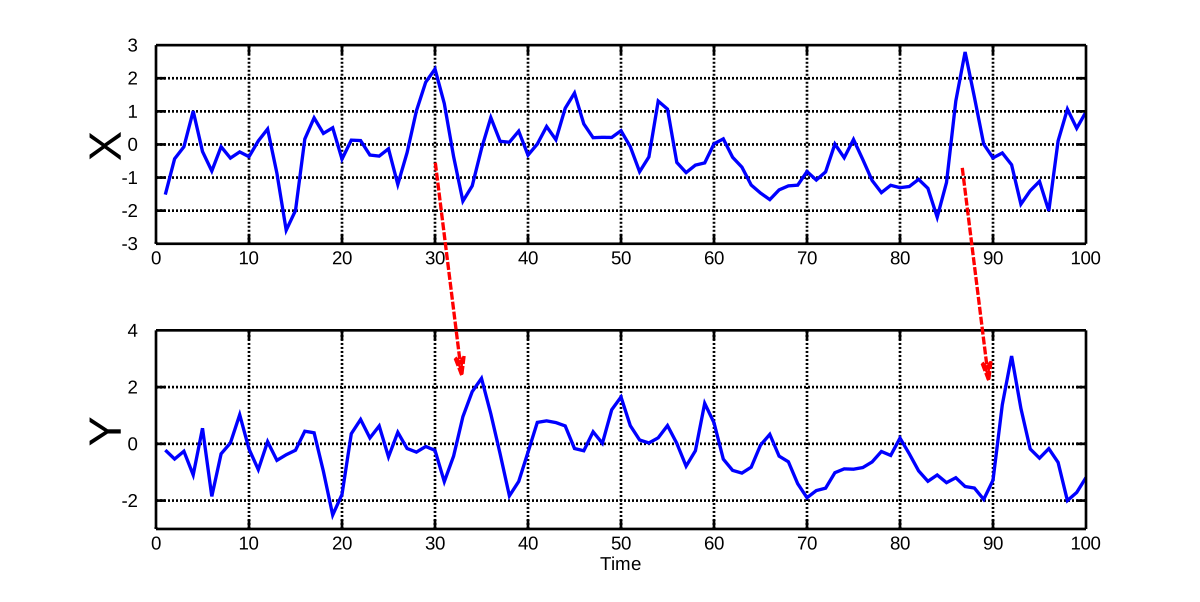
Two core classes provide bivariate causal inference methods:
1. CausalityAnalyzer
Basic methods include:
- Bivariate Granger Causality (traditional linear, and non-linear implemented by reservoir computing networks)
- Bivariate Transfer Entropy
- Bivariate Convergent Cross Mapping
2. ExtendedCausalityAnalyzer
Extended methods include:
- Dynamic Bayesian Network
- Structural Equation Modeling
- DoWhy Causal Discovery
- Dynamic Causal Modeling
Multivariate Causality Analysis
Three specialized multivariate approaches:
1. Multivariate Granger Causality
- Based on methodology by Barnett & Seth, Journal of Neuroscience Methods 2014
- VAR model-based causality inference
- Log-likelihood ratio testing
2. Multivariate Convergent Cross-Mapping (CCM)
- Inspired by Nithya & Tangirala, ICC 2019
- Nonlinear causality detection
- Network-based causal relationship visualization
3. Multivariate Transfer Entropy
- Methodology from Duan et al. 2022
- Information-theoretic causality measure
- Supports conditional transfer entropy
N.B. The multivariate implementations are not considered state-of-the-art and are not fully tested, please report any error or bug.
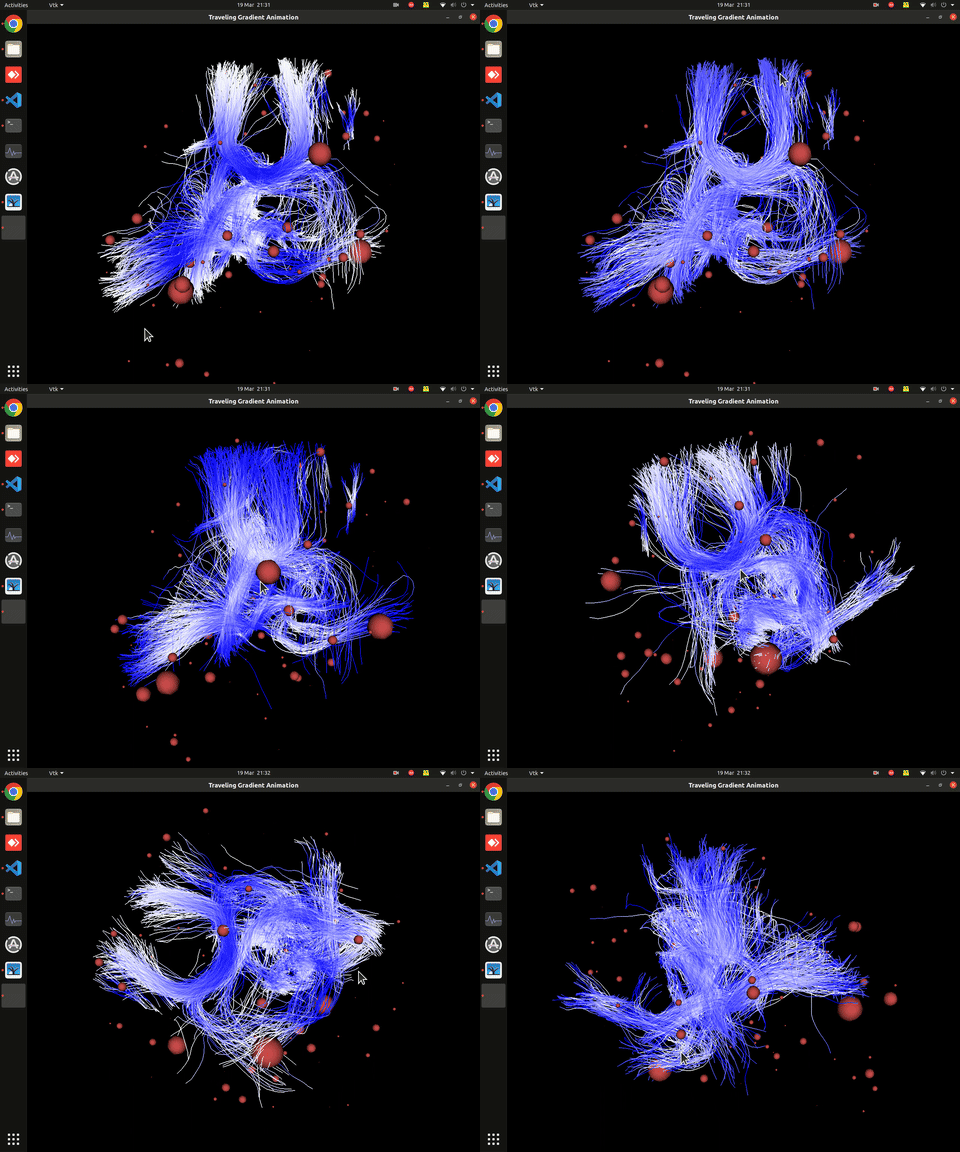
Visualization of effective connectivity
-
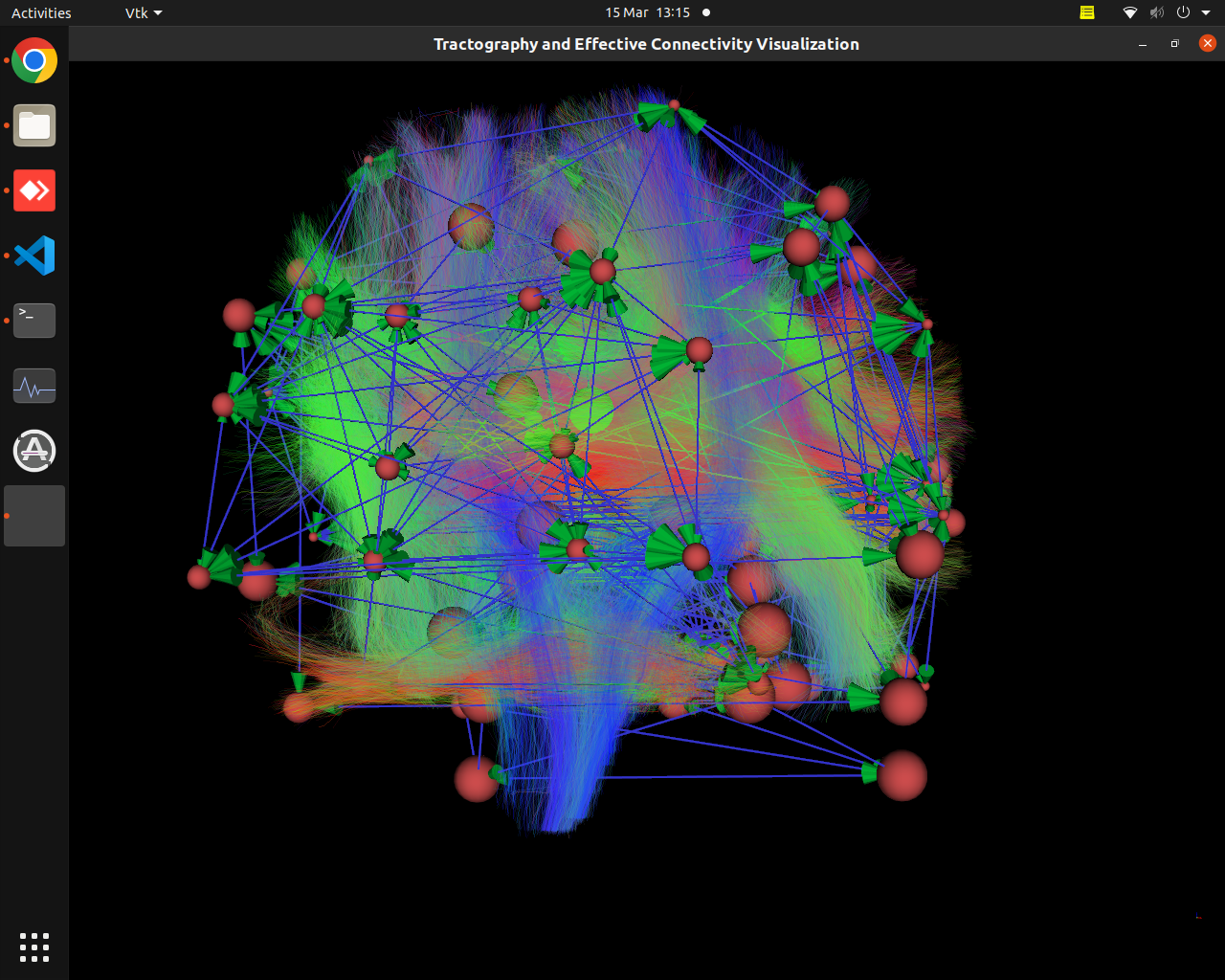
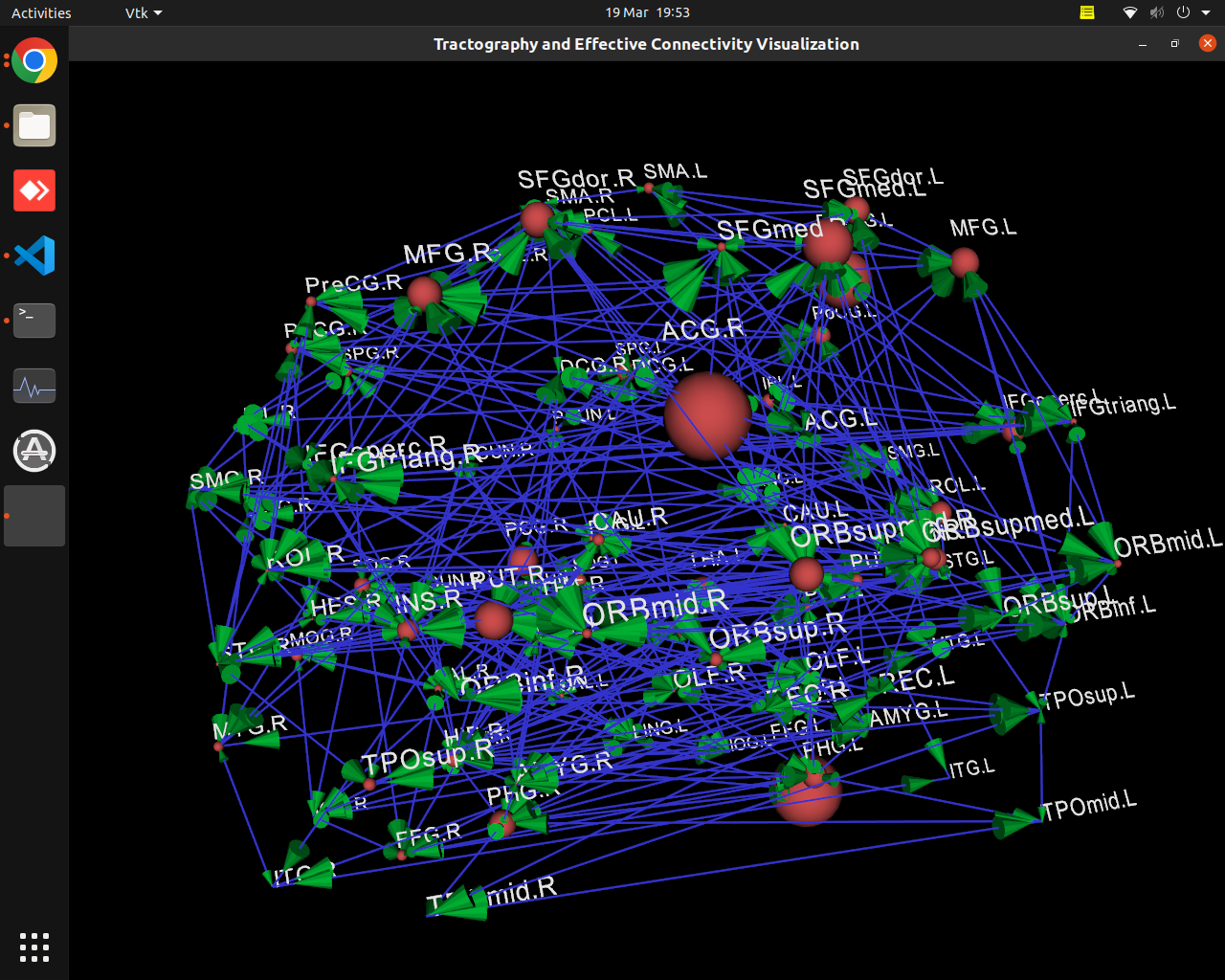
Plotting of directed graphs, also overlapping with tractography and node labels
-
Directionality of the connections as color gradients
-
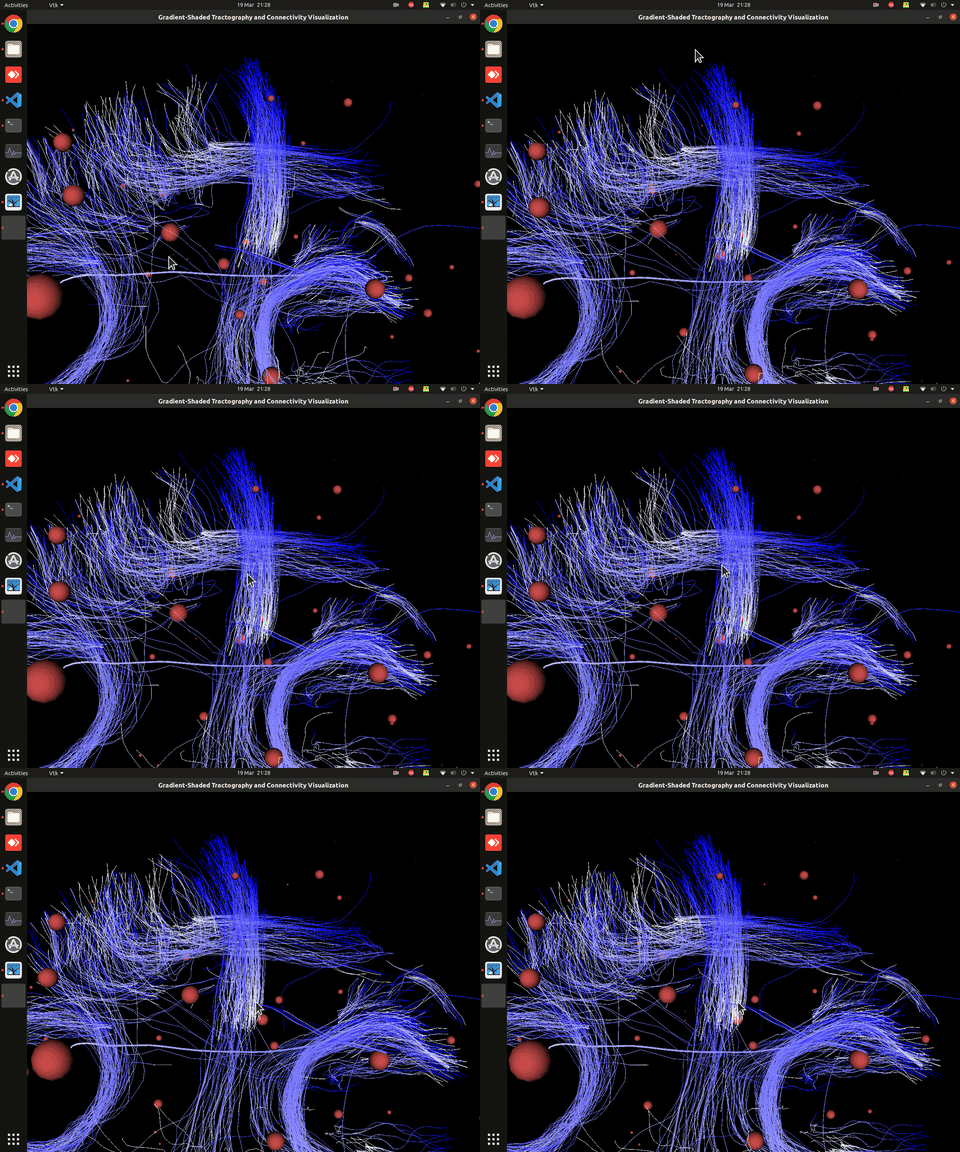
Visualization of time series over structural connections (currently not working properly[https://github.com/alecrimi/effconnpy/issues/8])
Installation
pip install effconnpy
Quick Example
from effconnpy import CausalityAnalyzer  , create_connectivity_matrix
import numpy as np
# Generate sample time series
data = np.random.rand(100, 3)
analyzer = CausalityAnalyzer(data)
results = analyzer.causality_test(method='granger')
print(results)

binary_matrix =  create_connectivity_matrix(results, method = 'granger')
print(binary_matrix)
Multivariate GC Example using causal logistic maps
from effconnpy.multivariateGC import MultivariateGrangerCausality
from effconnpy import create_connectivity_matrix
import numpy as np

# Generate sample time series
#The first 2 time series are related by a logistic causal mapping,
#while the third is random and has no causal relationship with the others
# Parameters
T = 100  # Number of time steps
x = np.zeros(T)
y = np.zeros(T)
# Initial conditions
x[0] = 0.5
y[0] = 0.5
# Iterate the system
for t in range(T - 1):
    x[t + 1] = x[t] * (3.8 - 3.8 * x[t])
    y[t + 1] = y[t] * (3.1 - 3.1 * y[t] - 0.8 * x[t])
z = np.random.rand(100)
data = np.vstack((x, y,z)).T

analyzer = MultivariateGrangerCausality(data)
results = analyzer.multivariate_granger_causality()
print(results)
Indeed, there is also a causal time series generator script to generate ground-truth time series which can be complemented by random or other time series:
    from effconnpy import timeseriesgenerator
    # Create an instance of the generator
    generator = TimeSeriesGenerator()
    # Generate some example data
    n_points = 1000

    # Lorenz system
    t, x, y, z = generator.lorenz_system(n_points)

    # Coupled logistic map
    logistic_x, logistic_y = generator.coupled_logistic_map(n_points)

    # Kuramoto oscillators
    kura1, kura2 = generator.kuramoto_oscillators(n_points)

    # AR process
    ar_x, ar_y = generator.ar_process(n_points)

    # Nonlinear coupled system
    nl_x, nl_y = generator.nonlinear_coupled_system(n_points)
Visualization of effective connectivity example
from effconnpy import  vis_effconn

node_file = "Node_AAL90.node"
edge_file = "my_effconn.csv"

vis_effconn(node_file, edge_file, show_tractography=True)
This will show the overlay of a tractography from the HCP dataset over a connectome according to an atlas with given nodes coordinates, and the effective connectivity computed and saved in a csv file. If a structural connectivity matrix (non-effective) is passed, the function will show arrows on both directions for all edges.
Citation
If you use the tool please refer to those papers
"Structurally constrained Granger causality" A. Crimi et al. Neuroimage 2021
Contributing
Contributions welcome! Please read our contributing guidelines before submitting pull requests. Currently disabled, just open issues and I will follow up
License
MIT License
1 maintainer

Release files for effconnpy 0.1.25
For a detailed explanation of source distributions (sdists) and built distributions (wheels), please see the package formats documentation.
Source distribution (sdist)
| File | Size | Uploaded | |
|---|---|---|---|
| effconnpy-0.1.25.tar.gz | 27.7 kB | Details |
Built distribution (wheel)
| File | Interpreter | ABI | Platform | Reset |
|---|---|---|---|---|
| effconnpy-0.1.25-py3-none-any.whl | Python 3 | none | any | Details |
Total release size: 61.1 kB
Release files / effconnpy-0.1.25.tar.gz
| Download URL | effconnpy-0.1.25.tar.gz |
|---|---|
| Size | 27.7 kB |
| Tags | Source |
|
SHA-256 checksum How to use checksums |
9203c2873512bb5a5d96f61eed5d332d2c1861ff8bb35965e66a1bfae7b7f034
|
|
BLAKE2b-256 checksum How to use checksums |
362f6e24d529ebb04fcac7028b9eca435d41f31dc76ea5fd9293db68598990a5
|
| Upload date | |
|
Uploaded using Trusted Publishing? What is trusted publishing? |
No |
| Uploaded via |
twine/6.1.0 CPython/3.12.4
|
Release files / effconnpy-0.1.25-py3-none-any.whl
| Download URL | effconnpy-0.1.25-py3-none-any.whl |
|---|---|
| Size | 33.4 kB |
| Tags | Python 3 |
|
SHA-256 checksum How to use checksums |
2fd01ebbceafc47a7736e503b574b5421911fb79b2d54a817b587c65261530d5
|
|
BLAKE2b-256 checksum How to use checksums |
0c778bf0947d05f2f88753da3a898f06b53921817234309c79bdabc2bb63bbc0
|
| Upload date | |
|
Uploaded using Trusted Publishing? What is trusted publishing? |
No |
| Uploaded via |
twine/6.1.0 CPython/3.12.4
|














