
Eigen-Component Analysis
A Python package for Eigen-Component Analysis (ECA) and Unsupervised Eigen-Component Analysis (uECA) for classification and clustering tasks without data centralization or standadization. ECA is a quantum theory-inspired linear model that provides interpretable feature-to-class mappings through eigencomponents.
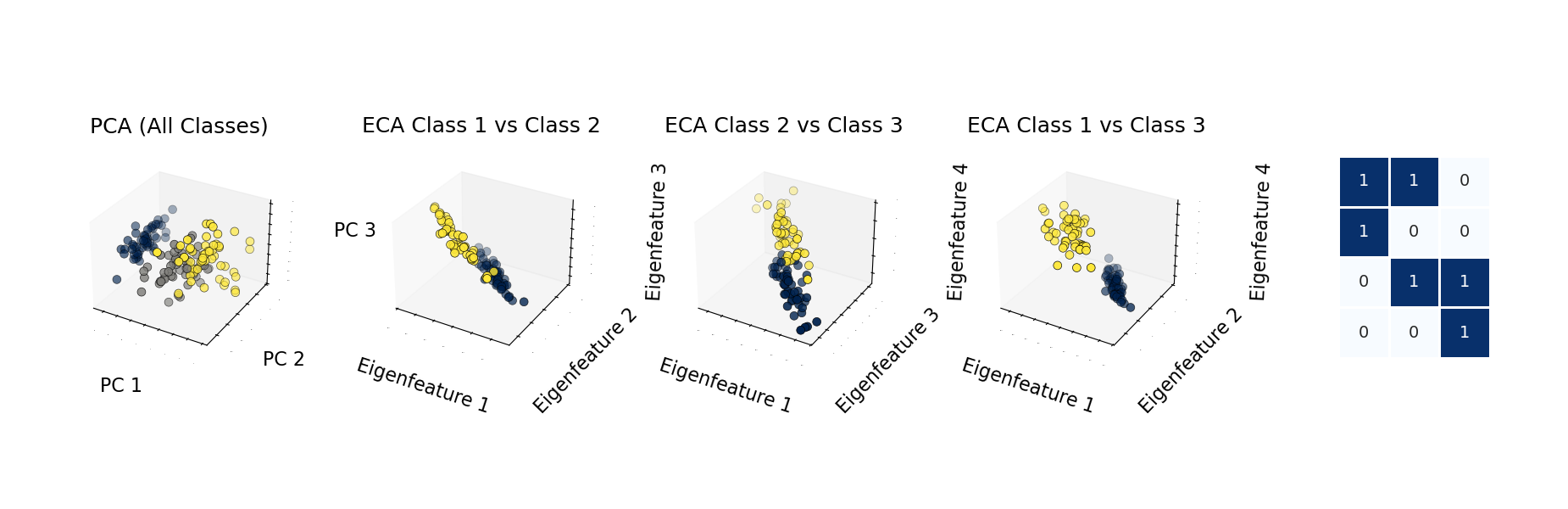
Features
- Scikit-learn Compatible: Implements the scikit-learn Estimator API with
fit,transform, andpredictmethods - Supervised & Unsupervised Learning: Supports both classification (ECA) and clustering (uECA) modes
- GPU Acceleration: PyTorch backend enables GPU acceleration when available
- Visualization Tools: Built-in methods to visualize eigenfeatures, mappings, and results
- Mathematical Foundation: Based on quantum theory principles with antisymmetric transformation matrices
Installation
From PyPI
pip install eigen-analysis
From Source
# Clone the repository
git clone https://github.com/lachlanchen/eigen_analysis.git
cd eigen_analysis
pip install .

# Install in development mode
pip install -e .
Requirements
- numpy >= 1.18.0
- torch >= 1.7.0
- matplotlib >= 3.3.0
- seaborn >= 0.11.0
- scikit-learn >= 0.24.0
- scipy >= 1.6.0
Usage
Unified API
The package provides a unified API that automatically selects between supervised and unsupervised modes:
from eigen_analysis import eigencomponent_analysis

# For classification (supervised)
model = eigencomponent_analysis(X, y, num_clusters=3)

# For clustering (unsupervised)
model = eigencomponent_analysis(X, num_clusters=3)
Classification Example
import numpy as np
from sklearn import datasets
from sklearn.model_selection import train_test_split
from eigen_analysis import ECA

# Load Iris dataset
iris = datasets.load_iris()
X = iris.data
y = iris.target

# Split data
X_train, X_test, y_train, y_test = train_test_split(X, y, test_size=0.3)

# Create and train ECA model
eca = ECA(num_clusters=3, num_epochs=10000, learning_rate=0.01)
eca.fit(X_train, y_train)

# Make predictions
y_pred = eca.predict(X_test)

# Evaluate accuracy
from sklearn.metrics import accuracy_score
accuracy = accuracy_score(y_test, y_pred)
print(f"Test accuracy: {accuracy:.4f}")

# Get transformed data
X_transformed = eca.transform(X_test)

# Access model components
P_matrix = eca.P_numpy_  # Eigenfeatures
L_matrix = eca.L_numpy_  # Feature-to-class mapping

# Visualize results
from eigen_analysis.visualization import visualize_clustering_results
visualize_clustering_results(
    X_test, y_test, y_pred,
    eca.loss_history_,
    eca.transform(X_test),
    eca.num_epochs,
    eca.model_,
    (eca.L_numpy_ > 0.5).astype(float),
    eca.L_numpy_,
    eca.P_numpy_,
    "Iris",
    output_dir="eca_classification_results"
)
Clustering Example
import numpy as np
from sklearn.datasets import make_blobs
from eigen_analysis import UECA
from sklearn.metrics import adjusted_rand_score

# Generate synthetic data
X, y_true = make_blobs(n_samples=300, centers=3, random_state=42)

# Train UECA model
ueca = UECA(num_clusters=3, learning_rate=0.01, num_epochs=3000)
ueca.fit(X, y_true)  # y_true used only for evaluation

# Access clustering results
clusters = ueca.labels_
remapped_clusters = ueca.remapped_labels_  # Optimal mapping to ground truth

# Evaluate clustering quality
ari_score = adjusted_rand_score(y_true, clusters)
print(f"Adjusted Rand Index: {ari_score:.4f}")

# Visualize clustering results
from eigen_analysis.visualization import visualize_clustering_results
visualize_clustering_results(
    X,
    y_true,
    ueca.remapped_labels_,
    ueca.loss_history_,
    ueca.transform(X),
    ueca.num_epochs,
    ueca.model_,
    ueca.L_hard_numpy_,
    ueca.L_numpy_,
    ueca.P_numpy_,
    "Custom Dataset",
    output_dir="eca_clustering_results"
)
Advanced Usage
Customizing Visualizations
# Customize visualization with feature and class names
visualize_clustering_results(
    X, y, predictions,
    loss_history, projections, num_epochs,
    model, L_hard, L_soft, P_matrix,
    dataset_name="Iris",
    feature_names=["Sepal Length", "Sepal Width", "Petal Length", "Petal Width"],
    class_names=["Setosa", "Versicolor", "Virginica"],
    output_dir="custom_visualization"
)
Working with MNIST
For MNIST visualization, there's a specialized function:
from torchvision import datasets, transforms
from eigen_analysis import ECA
from eigen_analysis.visualization import visualize_mnist_eigenfeatures

# Load MNIST
mnist_train = datasets.MNIST('data', train=True, download=True)
X_train = mnist_train.data.reshape(-1, 784).float() / 255.0
y_train = mnist_train.targets

# Train ECA model
eca = ECA(num_clusters=10, num_epochs=1000)
eca.fit(X_train, y_train)

# Visualize MNIST eigenfeatures
visualize_mnist_eigenfeatures(eca.model_, output_dir='mnist_results')
Model Parameters
ECA Model (Supervised)
num_clusters: Number of classeslearning_rate: Learning rate for optimizer (default: 0.01)num_epochs: Number of training epochs (default: 1000)temp: Temperature parameter for sigmoid (default: 10.0)random_state: Random seed for reproducibilitydevice: Device to use ('cpu' or 'cuda')
UECA Model (Unsupervised)
num_clusters: Number of clusterslearning_rate: Learning rate for optimizer (default: 0.01)num_epochs: Number of training epochs (default: 3000)random_state: Random seed for reproducibilitydevice: Device to use ('cpu' or 'cuda')
Citation
If you use this package in your research, please cite:
@inproceedings{chen2025eigen,
  title={Eigen-Component Analysis: {A} Quantum Theory-Inspired Linear Model},
  author={Chen, Rongzhou and Zhao, Yaping and Liu, Hanghang and Xu, Haohan and Ma, Shaohua and Lam, Edmund Y.},
  booktitle={2025 IEEE International Symposium on Circuits and Systems (ISCAS)},
  pages={},
  year={2025},
  publisher={IEEE},
  doi={},
}
License
MIT
1 maintainer

Download files
Download the file for your platform. If you're not sure which to choose, learn more about installing packages.
Source Distribution
Built Distribution
Filter files by name, interpreter, ABI, and platform.
If you're not sure about the file name format, learn more about wheel file names.
Copy a direct link to the current filters
File details
Details for the file eigen_analysis-0.1.6.tar.gz.
File metadata
- Download URL: eigen_analysis-0.1.6.tar.gz
- Upload date:
- Size: 18.2 kB
- Tags: Source
- Uploaded using Trusted Publishing? Yes
- Uploaded via:
twine/6.1.0 CPython/3.12.9
File hashes
| Algorithm | Hash digest | |
|---|---|---|
| SHA256 |
e99602bed8f436670bb87a50e7c6e21c41539f3526baed24f7b4823aa96c5241
|
|
| MD5 |
075c27b77287dfa7b8ad6d39a4b51a6f
|
|
| BLAKE2b-256 |
cc5950cefd4b70ea1d34c9b6c30b0aaad6b350243281f83e44eaf08d9822b377
|
Provenance
The following attestation bundles were made for eigen_analysis-0.1.6.tar.gz:
Publisher:
publish.yml on lachlanchen/eca
-
Statement:
-
Statement type:
https://in-toto.io/Statement/v1 -
Predicate type:
https://docs.pypi.org/attestations/publish/v1 -
Subject name:
eigen_analysis-0.1.6.tar.gz -
Subject digest:
e99602bed8f436670bb87a50e7c6e21c41539f3526baed24f7b4823aa96c5241 - Sigstore transparency entry: 189753526
- Sigstore integration time:
-
Permalink:
lachlanchen/eca@a00bff7fa8261a622cf3bf4832f214077743e67a -
Branch / Tag:
refs/tags/v0.1.6 - Owner: https://github.com/lachlanchen
-
Access:
public
-
Token Issuer:
https://token.actions.githubusercontent.com -
Runner Environment:
github-hosted -
Publication workflow:
publish.yml@a00bff7fa8261a622cf3bf4832f214077743e67a -
Trigger Event:
release
-
Statement type:
File details
Details for the file eigen_analysis-0.1.6-py3-none-any.whl.
File metadata
- Download URL: eigen_analysis-0.1.6-py3-none-any.whl
- Upload date:
- Size: 20.0 kB
- Tags: Python 3
- Uploaded using Trusted Publishing? Yes
- Uploaded via:
twine/6.1.0 CPython/3.12.9
File hashes
| Algorithm | Hash digest | |
|---|---|---|
| SHA256 |
f56c08f3a5b77727203e3f233a3e28cabec125bf4d79c0dfe854cc958f14cb3c
|
|
| MD5 |
cc94700f52f7921d2772d4e00b474f07
|
|
| BLAKE2b-256 |
0553a4d08adb3c0f975efef61d5cfc2a32858bb9570b6b99f7562ce3c01d5b5a
|
Provenance
The following attestation bundles were made for eigen_analysis-0.1.6-py3-none-any.whl:
Publisher:
publish.yml on lachlanchen/eca
-
Statement:
-
Statement type:
https://in-toto.io/Statement/v1 -
Predicate type:
https://docs.pypi.org/attestations/publish/v1 -
Subject name:
eigen_analysis-0.1.6-py3-none-any.whl -
Subject digest:
f56c08f3a5b77727203e3f233a3e28cabec125bf4d79c0dfe854cc958f14cb3c - Sigstore transparency entry: 189753528
- Sigstore integration time:
-
Permalink:
lachlanchen/eca@a00bff7fa8261a622cf3bf4832f214077743e67a -
Branch / Tag:
refs/tags/v0.1.6 - Owner: https://github.com/lachlanchen
-
Access:
public
-
Token Issuer:
https://token.actions.githubusercontent.com -
Runner Environment:
github-hosted -
Publication workflow:
publish.yml@a00bff7fa8261a622cf3bf4832f214077743e67a -
Trigger Event:
release
-
Statement type:














